

CCSD code G5100: Bypass of duodenum billing guide
CCSD code G5100 bills a bypass that leaves the duodenum in place CCSD code G5100...

Last Updated: Oct 16, 2026
82550 is the CPT code for creatine kinase (CK), (CPK); total. It reports a single assay of total CK activity in serum or plasma, without separating the MM, MB, or BB isoenzymes.
Coders most often confuse it with CPT 82552, which covers CK isoenzymes, and bill the fractionated code when only a total was ordered. Most 82550 denials trace back to the diagnosis on the claim, where a missing or non-specific ICD-10 code fails to establish medical necessity.
Let Pabau's smart automation suggest the right codes, reduce claim denials, and keep your practice compliant—effortlessly.
Automate repetitive tasks and focus on what matters most—your patients.
Reduce coding errors and ensure compliance with the latest regulations.
Clean claims, fewer denials, and faster reimbursements.
Powerful insights and reporting to help your practice thrive.
HIPAA compliant SOC 2 certified GDPR-compliant Trusted by 4,000+ clinics worldwide

CPT Code 82550 covers total creatine kinase (CK) only, and isoenzyme fractionation is billed separately under 82552.
Most 82550 denials trace back to a non-specific or unsupported ICD-10 code on the claim.
Medicare reimburses 82550 under the Clinical Laboratory Fee Schedule (CLFS), not the Physician Fee Schedule.
Claims management software such as Pabau keeps lab order documentation with the claim, so practices and labs can submit clean CK claims.
CPT Code 82550 is defined by the American Medical Association (AMA) with the official descriptor: Creatine kinase (CK), (CPK); total. It sits in the Chemistry section of the CPT codebook (codes 82009-84999), specifically the enzyme subsection covering muscle and cardiac markers.
Two specimen types are accepted: serum and plasma. The test measures total CK activity in units per liter (U/L), without separating the MB, MM, or BB isoenzyme fractions. That distinction matters for code selection.
Creatine kinase (CK) is an enzyme found in cardiac muscle, skeletal muscle, and brain tissue. When muscle cells are damaged or stressed, CK leaks into the bloodstream, raising serum levels. A total CK result does not identify which muscle source is responsible.
Ordering a total CK (82550) is appropriate when the clinical question is whether significant muscle damage is present. Isoenzyme fractionation (82552) is ordered only when the clinical question requires identifying which muscle type is the source.
Primary clinical indications for ordering CPT Code 82550:
CPT 82552 covers creatine kinase isoenzyme fractionation, which splits the total into its MM, MB, and BB fractions. Billing 82552 when a total CK (82550) was ordered is upcoding. Billing 82550 when isoenzymes were fractionated is undercoding. Both create audit exposure.
When to bill both codes on one date: after a total CK, a lab may reflex to isoenzyme fractionation on the same specimen that day. In that case, both 82550 and 82552 may be billed.
The medical record must show a clinical reason for the reflex. If both tests ran but the claim carries only 82552, the payer sees a fractionation with no total behind it and may request records.
Troponin tests have largely replaced CK-MB as the preferred cardiac biomarker for acute myocardial infarction, consistent with current ACC/AHA guidelines. CPT 84484 reports a quantitative troponin with a numeric result, and CPT 84512 reports a qualitative troponin that reads positive or negative.
Neither code is specific to troponin I or troponin T. Total CK (82550) remains clinically useful in parallel but serves a different diagnostic question.
Both 82550 and troponin codes can be billed on the same date of service when the patient presents with an indication that clinically justifies each. The medical record must document why each test was ordered, beyond listing the results. Payers flag claims that group both tests under a single chest pain ICD-10 code with no separate rationale for each.
The ICD-10-CM diagnosis code on the claim establishes medical necessity. A non-specific or unsupported diagnosis is the leading cause of 82550 denials. Use the most specific code available, confirmed by the ordering provider’s documentation. Verify against your applicable Medicare Administrative Contractor (MAC) Local Coverage Determination (LCD) before billing.
High-risk unsupported pairings: Z00.00 (encounter for general adult medical exam) and Z13.6 (encounter for screening for cardiovascular disorders) are two examples. Under most LCD policies, neither supports medical necessity for 82550 without additional documented clinical indicators. When ordering is purely preventive and not medically indicated, issue an Advance Beneficiary Notice (ABN) before testing.
CPT Code 82550 is paid under the Medicare Clinical Laboratory Fee Schedule (CLFS), published annually by the Centers for Medicare and Medicaid Services (CMS). Lab codes in the 82009-84999 Chemistry section are paid at the CLFS rate, not the Physician Fee Schedule (PFS).
The performing lab bills Medicare directly under the CLFS. A physician who orders the test but does not perform it receives no separate PFS payment for the lab work.
For the 2026 CLFS rate for CPT 82550, consult the official CMS CLFS downloadable file directly, as rates are updated each calendar year. Rates published on third-party sites should always be cross-checked against the CMS Clinical Laboratory Fee Schedule files.
Key Medicare billing rules for CPT Code 82550:
A clean claim for CPT Code 82550 requires the following elements to be present in the medical record before submission. Missing any one triggers a denial or a records request.
Review your ABN workflow before ordering any CK test on a Medicare patient whose diagnosis is uncertain. If the ICD-10 code is speculative at order entry, document the clinical indicator clearly. Practices using structured lab order templates with mandatory indication fields see fewer post-claim ABN issues than those relying on free-text ordering.
The place of service (POS) code controls how Medicare and commercial payers process a CPT Code 82550 claim. Billing rules and responsibility shift depending on who performs the test. A POS code that does not match where the specimen was processed draws a CO-5 denial.
Most CPT Code 82550 denials are preventable at the pre-billing stage. The table below covers the most common denial triggers and the fix for each. It also lists the associated claim adjustment reason codes (CARCs) and remittance advice remark codes (RARCs) where applicable.
For a full overview of denial patterns across lab codes, see denial management workflows and the Claim.MD clearinghouse guide.
Medicare redetermination is the first level of appeal. The deadline is 120 days from receipt of the initial determination notice, shown on the Medicare Summary Notice (MSN) or the remittance advice. Submit to the MAC that issued the denial.
Documentation to attach when appealing a medical necessity denial on CPT Code 82550:
If redetermination is upheld, the next level is reconsideration by a Qualified Independent Contractor (QIC). The QIC deadline is 180 days from receipt of the redetermination decision. Escalate to QIC when the denial is based on a policy interpretation disagreement rather than a missing document. The timeline below sets the two clocks side by side.
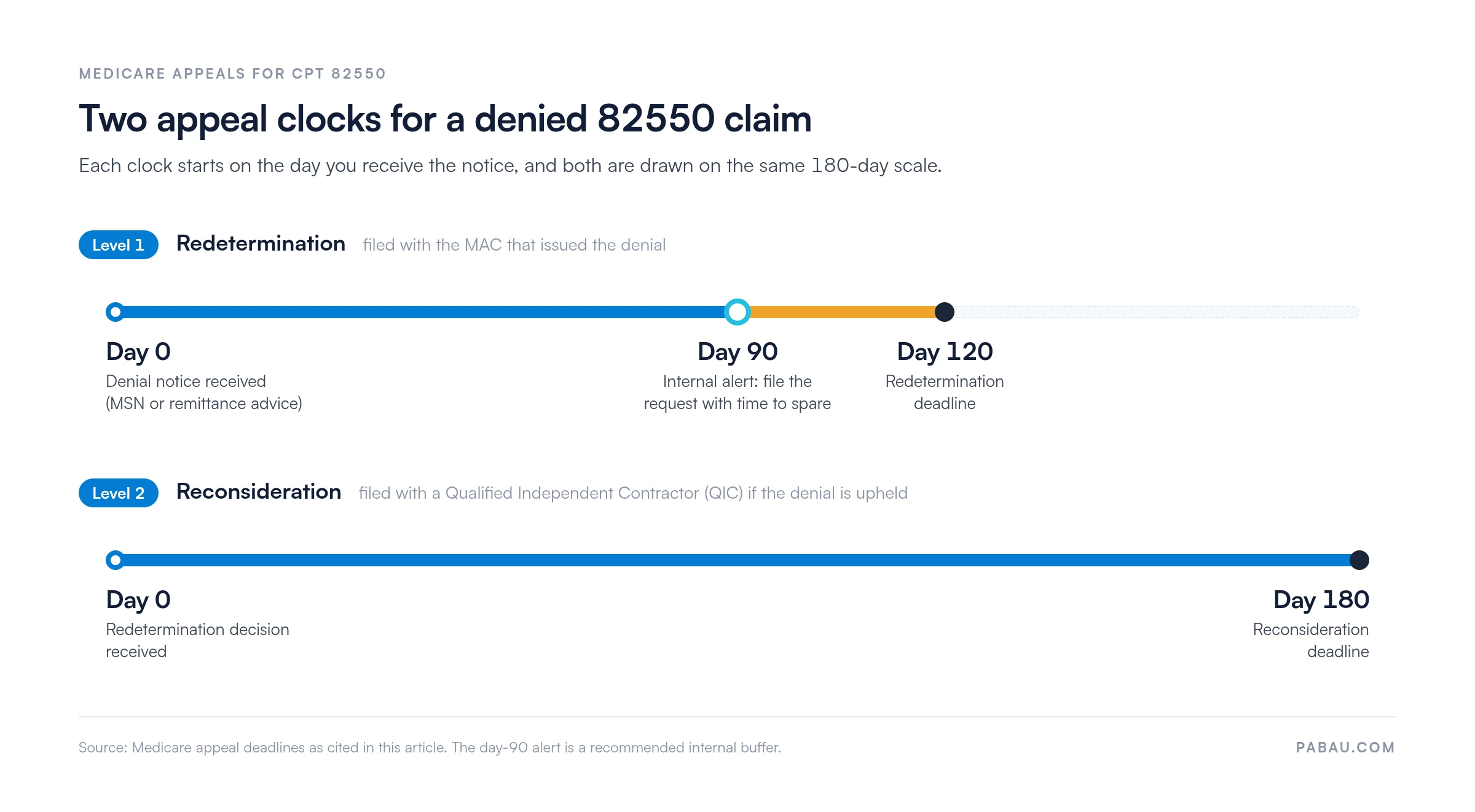
Track all open appeals, response deadlines, and attached documentation in one place. Claims management software that logs denial codes, attaches appeal notes, and tracks timelines reduces missed deadlines. Missed deadlines are the most common reason valid appeals fail. Review electronic remittance advice files as soon as they post to catch denial patterns early.
Set a 90-day calendar alert from every denial date to ensure redetermination requests are submitted with buffer before the 120-day Medicare deadline. Several 82550 denials in one month for the same ICD-10 reason point to a pattern. Pull all similar claims for that ordering provider and audit the documentation before submitting any appeals.
In many practices, the lab order lives in one system, the CK result in another, and the claim in a third. The biller then rebuilds the clinical indication from free-text notes, and that is where a vague ICD-10 code slips onto an 82550 claim.
In Pabau, clinical notes, forms, and invoices sit on one patient record, so the biller codes from the documented indication. The Claim.MD integration sends lab claims electronically to thousands of US payers, with eligibility checked in real time before each claim goes out.
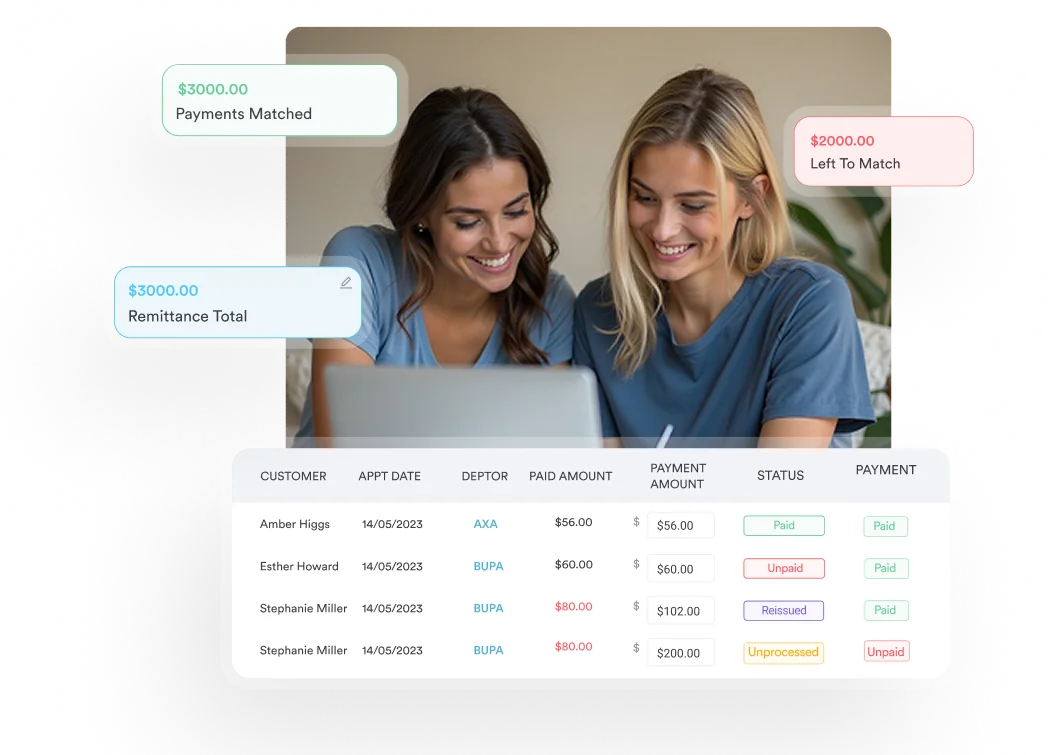
When a remittance posts, Pabau matches each payment against its claim. A CO-50 denial on a total CK claim appears next to the record you need for the appeal. You see it while the 120-day window is still open.

Pabau helps labs and physician office practices track lab orders, link documentation to claims, and submit clean CK claims through integrated billing workflows. See how it works.

Before the next total CK claim goes out, read the ordering note first. If it says why the test was needed, the right ICD-10 code follows from it, and most 82550 denials never happen.
The trade-off is effort at the front of the workflow. A mandatory indication field at order entry adds a step for the clinician, but it spares the biller a records request weeks later.
Treat CLIA numbers, POS codes, and appeal deadlines as part of revenue cycle management. A weekly review then catches these errors in batches, before they pile up as separate denials. Book a demo to see how Pabau ties each lab claim to the documentation behind it.

Need to understand how clearinghouses process lab claims? Medical claims clearinghouse guide explains how electronic claims move from practice to payer and where 82550 claims are most often rejected in transit.
Need to know what a superbill must carry? Superbill documentation guide covers what must appear on a superbill and how it feeds into clean lab claim submission.
Want to understand how the 837 EDI file carries your lab claim? 837 EDI file overview explains how CPT codes, ICD-10 codes, and CLIA numbers flow through the electronic claim transaction.
CPT Code 82550 covers a creatine kinase (CK) total test performed on a serum or plasma specimen. It measures total CK enzyme activity to detect muscle damage from any source, whether cardiac, skeletal, or smooth muscle. It does not include isoenzyme fractionation, which is billed separately under CPT 82552.
Confirm the 2026 Medicare CLFS rate for CPT 82550 in the CMS Clinical Laboratory Fee Schedule downloadable file, since rates are updated annually. Do not rely on third-party figures. Pull the current-year file from the CMS website. CLFS payment limits are set nationally, so no locality adjustment applies.
CPT 82550 covers total CK activity without separating isoenzymes; CPT 82552 covers isoenzyme fractionation, separating the CK-MM, CK-MB, and CK-BB fractions. Use 82550 when the clinical question is whether muscle damage is present. Use 82552, in addition or as a reflex, when the question is which muscle type is the source of an elevated total CK.
Order 82550 when the clinical question involves general muscle damage, rhabdomyolysis, statin-induced myopathy, or muscular dystrophy screening. Troponin tests (CPT 84484, 84512) are preferred for acute MI diagnosis. Both may be ordered on the same date when the clinical picture warrants both evaluations. Each test still needs its own documented clinical justification in the record.
The most common denial cause is a missing or non-specific ICD-10 diagnosis code that does not establish medical necessity under the applicable MAC LCD. Other frequent causes include duplicate same-day billing, a missing or incorrect CLIA number, and a wrong place of service code. For Medicare patients, a missing Advance Beneficiary Notice on an uncertain indication also triggers denials.
Generally, CPT 82550 is billed once per date of service per specimen. Serial collections on the same day, such as serial CK monitoring in rhabdomyolysis, may be billed more than once. Each collection needs its own documented clinical justification, a distinct collection time, and a note of the clinical event prompting the draw.
Commonly accepted ICD-10-CM codes include M62.82 (rhabdomyolysis), G72.0 (drug-induced myopathy, for statin monitoring), and G71.01 (Duchenne or Becker muscular dystrophy). M33.20 (polymyositis) and I21.x codes for acute MI workups are also common. Always verify your MAC’s LCD for the current covered diagnosis list, since coverage varies by jurisdiction.



