

HCPCS Code L0472: Hyperextension TLSO billing guide
HCPCS code L0472: Official descriptor and device definition HCPCS code L0472 des...

Last Updated: Nov 5, 2026
82523 is the CPT code for collagen cross-links, any method. It reports a lab test for bone resorption markers in serum or urine, whatever assay the laboratory uses.
The code covers C-telopeptide (CTX), N-telopeptide (NTX), deoxypyridinoline (DPD), and pyridinoline (PYD). Medicare covers it under NCD 190.19, mainly to monitor and predict response to antiresorptive therapy and to track Paget's disease.
Let Pabau's smart automation suggest the right codes, reduce claim denials, and keep your practice compliant—effortlessly.
Automate repetitive tasks and focus on what matters most—your patients.
Reduce coding errors and ensure compliance with the latest regulations.
Clean claims, fewer denials, and faster reimbursements.
Powerful insights and reporting to help your practice thrive.
HIPAA compliant SOC 2 certified GDPR-compliant Trusted by 4,000+ clinics worldwide

CPT code 82523 covers every collagen cross-link analyte (CTX, NTX, DPD, PYD) under one code, so serum and urine specimens bill the same way.
Medicare coverage comes from National Coverage Determination 190.19, which ties each covered test to a point in antiresorptive treatment.
Medicare pays for one or two baseline tests, a repeat about 3 months into therapy, and another 12 months later. After that, one test a year is the limit.
Most denials trace back to a non-covered ICD-10 pairing, a test ordered outside the frequency schedule, or no documented antiresorptive treatment plan.
Pabau’s claims management software checks eligibility in real time, builds superbills, and returns Claim.MD remittance data, so 82523 denials are easier to catch and correct.
CPT code 82523 is defined by the American Medical Association (AMA) as “Collagen cross-links, any method.” It reports a test for bone resorption markers, most often ordered to check how a patient with osteoporosis responds to antiresorptive therapy. The phrase “any method” is significant: It means the code covers ELISA, HPLC, immunoassay, and other laboratory techniques. Providers do not need a separate code for each testing platform, and serum and urine specimens bill under the same line item.
82523 sits in the Chemistry subsection (82009-84999) of CPT’s Pathology and Laboratory section. It is not a point-of-care code and is not CLIA-waived, so the performing laboratory must hold appropriate CLIA certification. The CLIA-waived modifier (QW) does not apply here.
The phrase refers to the analytical chemistry platform rather than to the analyte itself. The lab may run an electrochemiluminescence immunoassay (ECLIA) for serum CTX or a high-performance liquid chromatography (HPLC) assay for urinary DPD. Either way, the code reported is the same: 82523. Practices do not need to determine the lab’s specific method before submitting the claim.
Four primary analytes are billed under CPT code 82523. Each has a preferred specimen type and a clinical context. The table below maps each marker to its specimen, common method, and clinical use.
Serum CTX is the most frequently ordered analyte because it has a well-established reference range. Robust data also support its use as a surrogate for bisphosphonate response. Urine NTX and DPD remain clinically appropriate alternatives, particularly in patients where fasting serum collection is impractical.
Payers cover CPT code 82523 only when it is medically necessary. Ordering the test for general bone health screening, without a confirmed diagnosis or a treatment plan, is a frequent cause of denials. Understanding the medical billing workflow for lab tests matters here: The order must be placed with the diagnosis already documented.
Medicare’s National Coverage Determination (NCD) 190.19 sets the covered uses, and payers commonly accept these indications for 82523:
Screening a patient with normal bone density and no treatment planned is not a covered indication under Medicare or most commercial policies. Document the diagnosis and the treatment plan in the chart before placing the order.
Pairing CPT code 82523 with the correct ICD-10-CM diagnosis code is required for claim adjudication. Most osteoporosis monitoring claims pair 82523 with M81.0. The table below lists the codes payers commonly accept for 82523, along with codes that are often submitted but rejected.
Check the current covered code list on CMS.gov before submission, because it is updated periodically. Always use the most specific diagnosis code available.
Medicare covers CPT code 82523 under National Coverage Determination 190.19, “Collagen Crosslinks, Any Method.” The NCD sets the coverage rules for every Medicare Administrative Contractor (MAC). Local coverage determinations (LCDs) and billing articles only supply the lists of covered ICD-10-CM codes.
Key Medicare coverage parameters under the NCD:
Each covered test falls at a fixed point in treatment, which the schedule below lays out step by step.
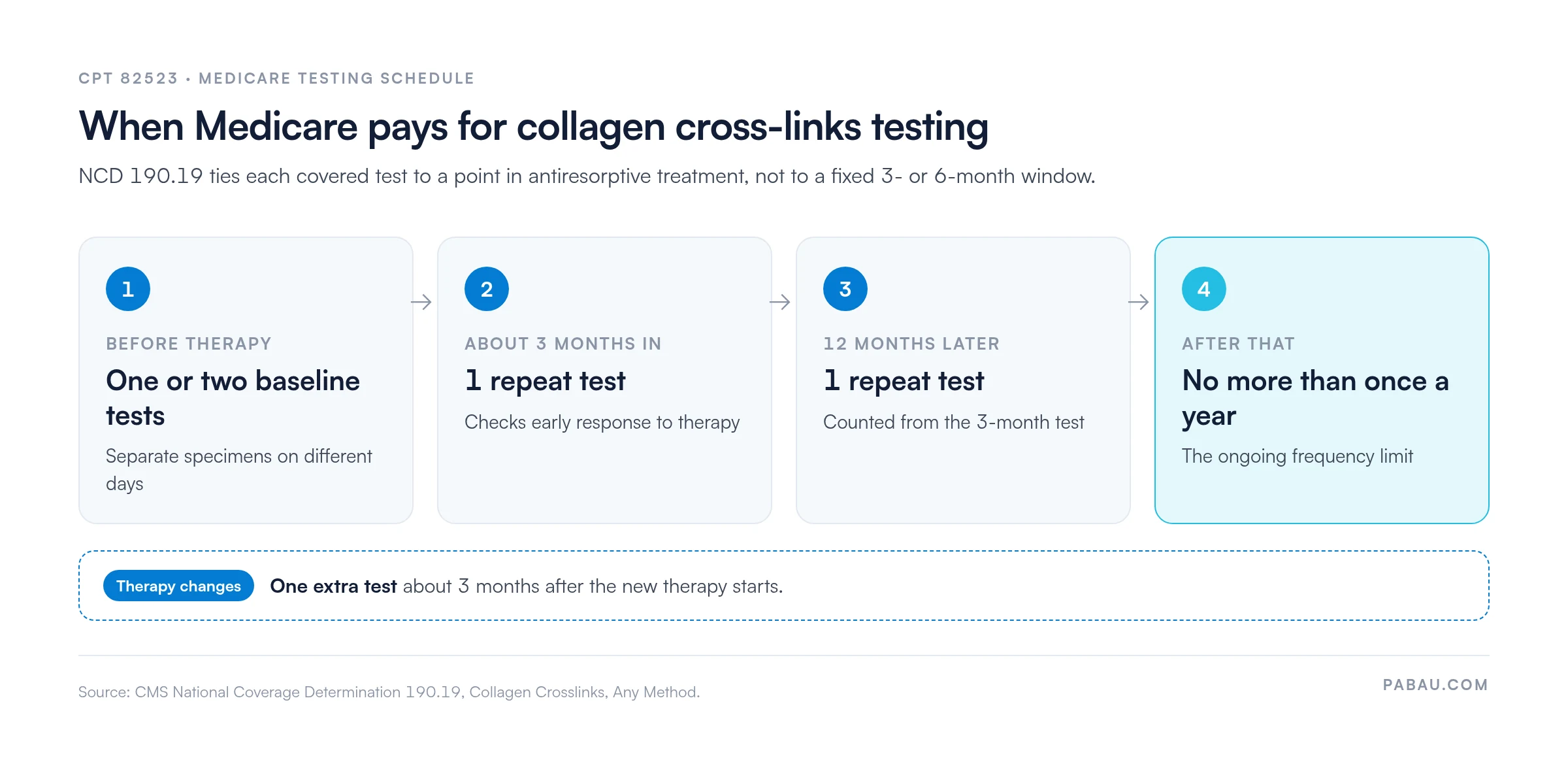
Commercial payer policies vary materially. Blue Shield of California, UnitedHealthcare (Louisiana Medicaid), and BCBS Mississippi all publish medical policies on bone turnover markers. Each sets its own frequency limits and covered indications, and some commercial policies allow one test every 3 to 6 months. The UHC Louisiana Medicaid policy applies only to that state’s Medicaid program, not to commercial UHC plans. Always pull the current policy from the payer’s provider portal before ordering.
CPT code 82523 is paid under the Medicare Clinical Laboratory Fee Schedule (CLFS), not the Physician Fee Schedule (PFS). The Centers for Medicare and Medicaid Services (CMS) pays CLFS codes at national limitation amounts, set under the Protecting Access to Medicare Act (PAMA). The schedule applies to independent and hospital outpatient laboratories and is updated every year.
Do not rely on rates published in third-party articles, including this one, for billing purposes. CLFS rates change annually and are the controlling payment amount. Always verify against the current year’s published schedule.
Medicare does not require prior authorization for most clinical laboratory tests, including 82523. That holds when an eligible provider places the order and the ICD-10 code is on the covered list. Commercial payers are a different story. Conduct insurance eligibility verification before ordering to confirm whether the patient’s plan requires prior authorization for this code.
When prior authorization is required, the documentation package typically includes:
Some commercial payers require the PA request to come from the ordering physician rather than the laboratory. Confirm the submission pathway in the payer’s provider portal before the appointment. Submitting without required authorization is a denial that cannot be appealed on medical necessity grounds alone.
Run an eligibility check on the patient’s plan before the lab order is placed. Check specifically whether bone turnover marker testing (CPT 82523) is listed as a prior-authorization-required service for that plan year. Payer PA requirements change annually, so a plan that did not require authorization last year may require it now.
Missing or incomplete documentation is a leading cause of 82523 denials, alongside incorrect ICD-10 coding and frequency violations. Maintaining strong medical billing compliance requires the chart to contain all of the following before a claim is submitted.
Payers increasingly conduct retrospective record reviews for bone turnover marker claims. A chart that cannot show the treatment context at the time of the order invites a recoupment demand. That holds even if the initial claim was paid.
Three modifiers are relevant to CPT code 82523 claims. Using the wrong modifier, or omitting a required one, produces a claim-level edit that delays payment or triggers a denial.
Several adjacent CPT codes cover bone metabolism markers and are frequently ordered alongside or instead of CPT code 82523. Understanding the distinction prevents bundling errors and claim-level edits. Use the AAPC Codify CPT lookup to verify descriptors before submitting any multi-code lab claim.
Osteocalcin (83937) and collagen cross-links (82523) measure opposite sides of bone turnover: Formation versus resorption. Some payer policies address both markers, but payers do not automatically cover both on the same date. Check the applicable LCD or payer policy for multi-marker coverage rules before ordering.
Structured denial management workflows reduce the rework cost of 82523 rejections. Each denial reason below maps to a corrective action that can be applied during the pre-submission review or at the point of appeal. Track your denial codes to identify which category accounts for the most rework in your practice.
The CMS National Correct Coding Initiative (NCCI) edits define which code pairs cannot be billed together without a modifier indicating a distinct service. NCCI edit files are updated quarterly. Verify any bundling relationship described here against the current CMS NCCI tool before submission.
CPT 82523 does not carry a widely published column-one/column-two edit pairing with osteocalcin (83937) or bone-specific alkaline phosphatase at the time of writing. Medically Unlikely Edits (MUEs) still cap the units of 82523 that can be reported per patient per date of service. Before reporting more than one unit, verify the MUE value in the CMS MUE table and the payer’s policy.
Key bundling considerations:
Bone turnover marker claims tend to fail for the same few reasons: A non-covered pairing, a test outside the schedule, or a plan nobody checked. Pabau, the practice management platform we build, includes claims management software that handles the billing side of these claims.
Before the specimen is drawn, your team can confirm the patient’s coverage with a real-time eligibility check. After the claim goes out, remittance data comes back into the same system.
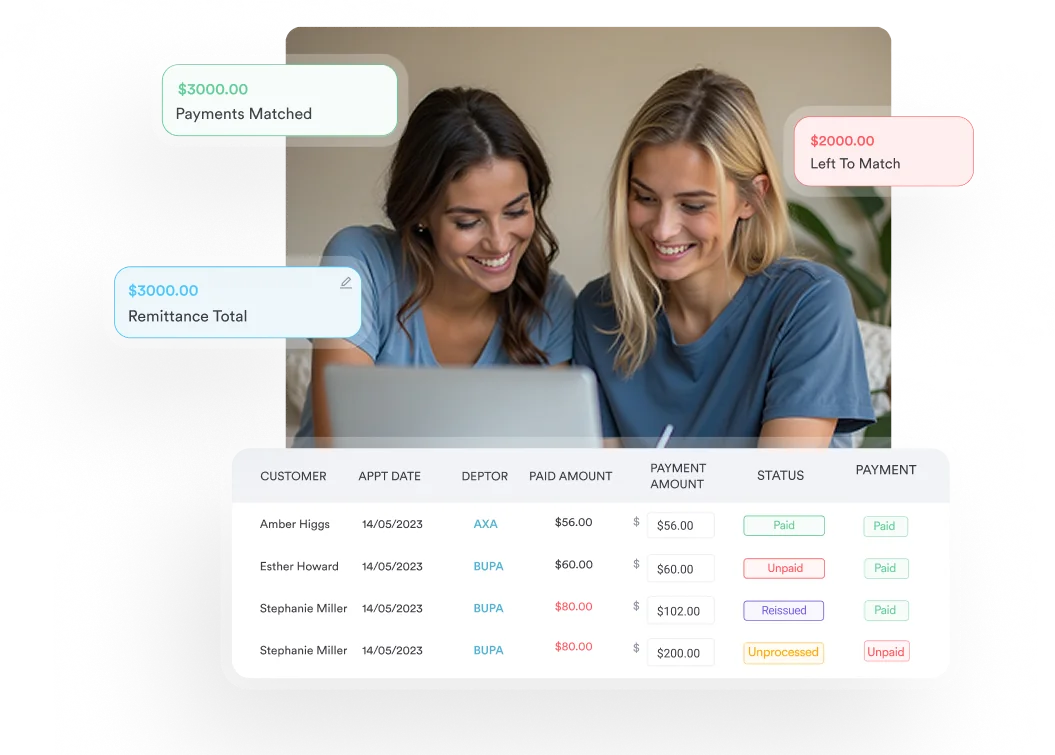
The result is fewer surprises at remittance. Coverage questions are settled before the draw, and denials arrive with a reason code your team can act on.

Pabau checks eligibility in real time, builds superbills, and brings Claim.MD remittance data back to the patient record. Your team spends less time reworking 82523 denials.

An 82523 claim is won or lost on the day the test is ordered. By the time the remittance comes back, the diagnosis, the treatment plan, and the test date are already fixed.
So time each order against NCD 190.19 for Medicare patients, and against the payer’s own policy for everyone else. A test that fits the schedule and names the antiresorptive plan is far easier to defend on audit.
The trade-off is a few minutes of checking before the specimen is drawn, which costs far less than reworking a denial. Book a demo to see how Pabau keeps eligibility checks, lab claims, and remittance data in one place.

Need to understand the clean-claim requirements before submitting? What makes a clean claim explains the seven elements every lab claim must satisfy to pass payer edits on the first pass.
Want to reduce overall claim rejection rates across your practice? How electronic remittance advice works shows how ERA data helps billing teams identify denial patterns and act on them faster.
Unsure how the 837P transaction connects your lab order to the payer? The 837 file explained covers the structure of the electronic claim transaction and where 82523 data appears in the file.
CPT code 82523 covers collagen cross-links testing using any analytical method, and qualifies four analytes: C-telopeptide (CTX), N-telopeptide (NTX), deoxypyridinoline (DPD), and pyridinoline (PYD). All four are measured as markers of bone resorption from either serum or urine specimens. The phrase “any method” in the descriptor means ELISA, HPLC, and immunoassay platforms all bill under the same code.
Yes. Medicare covers CPT code 82523 for osteoporosis monitoring under National Coverage Determination 190.19, when the claim carries a covered ICD-10 code. The NCD allows one or two baseline tests, a repeat about 3 months after therapy starts, and another 12 months later. After that, testing is limited to once a year unless therapy changes. Screening without a confirmed diagnosis is not covered.
The most commonly accepted codes are M81.0 (age-related osteoporosis without fracture), M80.x (osteoporosis with pathological fracture), and M88.x (Paget’s disease). E21.x (hyperparathyroidism) and C79.51 (secondary malignant neoplasm of bone) are payer-dependent, so check the LCD or policy. Family history or history codes such as Z82.61 or Z87.310 are typically denied as the sole diagnosis.
Modifier 91 (repeat clinical diagnostic laboratory test) applies when the same test is repeated on the same day for a new, independent clinical reason. Use it only if the payer confirms it applies. Modifier 59 applies when an NCCI edit bundles 82523 with another code and a distinct service exists. Modifier QW does not apply because 82523 is not a CLIA-waived test.
Five reasons cause most denials. They are a non-covered ICD-10 pairing, a test outside the frequency schedule, missing prior authorization, no documented antiresorptive treatment, and a screening-only indication. Each has a specific corrective action at the pre-submission stage.
Medicare generally does not require prior authorization for clinical laboratory tests, including 82523. Commercial plans vary by payer and plan year. Some require PA for bone turnover marker testing, while others do not. Check the patient’s plan benefits and verify PA requirements through the payer’s provider portal before placing the order.



