



HCPCS code E0198: Water pressure pad billing guide
HCPCS code E0198 is a water pad for a standard mattress HCPCS code E0198 is the ...

Last Updated: Oct 13, 2026
CPT code 81240 bills F2 gene analysis for the 20210G>A variant, the inherited change behind prothrombin-linked clotting risk. Under MolDX LCD L36089, Medicare treats the test as non-covered for almost every patient it sees. One narrow pregnancy indication survives, and it pays a flat national rate of $65.69.
So the payer question gets settled before the specimen leaves the room. An order placed on clinical logic alone comes back denied, whatever the chart note says.
The sections below cover the descriptor, that one covered indication, the diagnosis codes clinicians attach, the flat fee schedule, and the denials worth heading off.

CPT code 81240 covers F2 gene analysis for one variant, 20210G>A, and no CPT code exists for a multi-gene thrombophilia panel
MolDX LCD L36089 is a non-coverage policy, so Medicare pays 81240 only for pregnant patients who meet one narrow exception
The Clinical Laboratory Fee Schedule sets a flat national rate of $65.69, with no locality adjustment and no facility differential
Missing MolDX lab registration, an excluded indication, and an unsigned ABN are the denials that show up most often
Practice management software like Pabau keeps the code, its diagnoses, the ABN and the authorization on one record, so claims leave complete
The American Medical Association defines the code as: F2 (prothrombin, coagulation factor II) (eg, hereditary hypercoagulability) gene analysis, 20210G>A variant. The test looks for the prothrombin G20210A mutation in the F2 gene. Carriers produce elevated prothrombin levels, which raises the risk of deep vein thrombosis and pulmonary embolism.
The code sits in the Tier 1 molecular pathology section of the CPT code set, and it describes one variant in one gene. There is no CPT code for a multi-gene hereditary thrombophilia panel. When a lab runs several thrombophilia markers together, each marker is reported on its own code.
A marker with no Tier 1 code is checked against the Tier 2 levels, such as 81401, before 81479 is used.
Medicare does not cover CPT code 81240 for most patients. MolDX Local Coverage Determination L36089 and its companion billing article A56899 set out a non-coverage policy. Palmetto GBA, Noridian and the other MolDX contractors administer it.
The LCD says so in its own words: This is a non-coverage policy. It then rules out testing for all risk factors, signs, symptoms, diseases, or conditions, including cardiovascular risk assessment, except for pregnant patients.
That exception is narrow. Testing is indicated for a pregnant patient with a personal history of VTE tied to a non-recurrent, transient risk factor. She must also not already be receiving anticoagulant prophylaxis. The decision below is the whole policy in one view, and a claim is sorted by it before medical necessity is ever read.
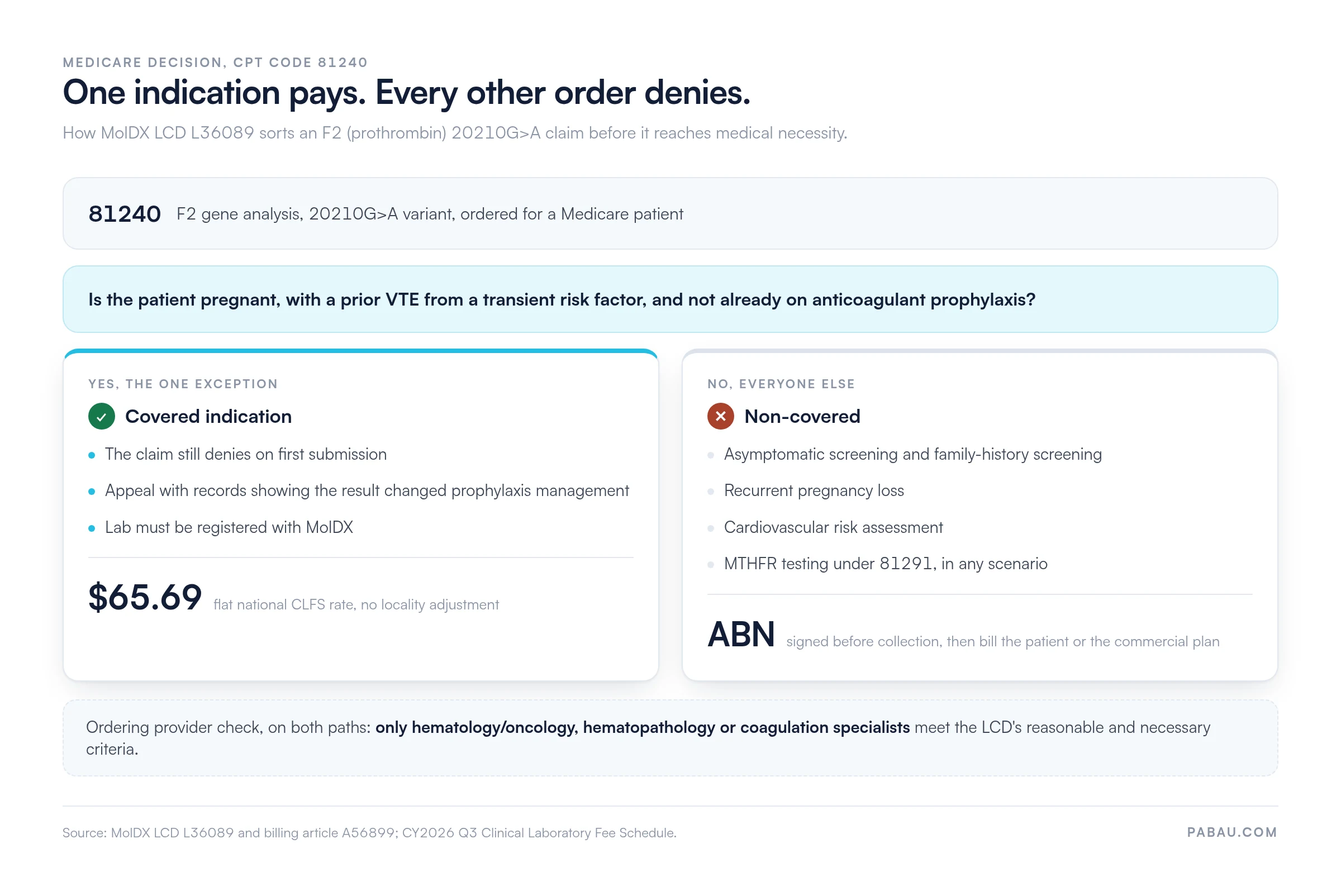
Even a claim that meets the exception denies initially. The LCD says these claims will deny per the policy, and that they should then be appealed with medical records supporting the necessity for testing. The appeal has to show how the result changed anticoagulant prophylaxis management for that patient.
Here is how that runs in practice. A pregnant patient has a prior DVT that followed surgery, and she is not on prophylaxis. Her hematologist orders the test, and a MolDX-registered lab submits the claim with Z86.718. The remittance returns CARC 96, non-covered charge, exactly as the policy predicts.
The appeal then goes out with three documents:
A practice that expects the first denial has those three ready on day one, instead of losing a cycle assembling them.
Four scenarios are excluded outright, and each one is a common reason practices order this test:
The LCD also limits who can order. Only providers with board eligibility or certification in hematology/oncology, hematopathology, or coagulation disorders satisfy the reasonable and necessary criteria. An order from a general practitioner fails that test before the diagnosis code is even read.
Labs performing tests billed under MolDX LCDs must register those tests with the MolDX program before Medicare will reimburse them.
Registration is a one-time compliance step per lab, per test. An unregistered lab billing CPT code 81240 in a MolDX jurisdiction receives a systematic denial, so confirm the status with Palmetto GBA or Noridian first.
Because the rule runs per test, a lab also billing 81270 for JAK2 analysis registers that assay separately.
Registration on its own creates no coverage. A registered lab still receives a non-coverage denial outside the pregnancy exception.
Every claim still needs at least one ICD-10-CM diagnosis code, yet none of them buys coverage here. Billing article A56899 publishes its ICD-10-CM medical necessity section as N/A, so no Medicare-approved diagnosis list exists for this code at all.
The codes below are the ones clinicians commonly attach to a thrombophilia order. They still carry weight on commercial claims and in the appeal record, and full definitions for each sit in our ICD-10-CM code library.
Z82.49 carries more weight on other lab claims. It sits on the supporting-diagnosis list for the lipoprotein(a) assay, CPT code 83695, which Medicare addresses through article A57055.
MolDX revises its policies, so check the current version of article A56899 before billing. For a Medicare patient, though, the more useful question is whether the pregnancy exception applies at all.
Medicare prices CPT code 81240 on the Clinical Laboratory Fee Schedule (CLFS), not the Physician Fee Schedule. Clinical diagnostic laboratory tests sit on the CLFS, and 81240 is one of them. The CY2026 Q3 CLFS public use file lists a single national rate of $65.69.
That rate does not move by locality. CLFS payment amounts are exempt from geographic adjustment under 42 U.S.C. 1395m-1(b)(4)(B), so no GPCI multiplier applies.
No facility versus non-facility split applies either, because CLFS pricing carries no practice expense RVUs. In the CMS relative value file, 81240 carries status indicator X, a statutory exclusion from the Physician Fee Schedule.
Treat the published amount as a ceiling rather than a quote. Medicare pays the lower of the billed charge or the fee schedule amount, so a charge set below the schedule is paid at the charge. Check the current quarterly file on the CMS Clinical Laboratory Fee Schedule files page before you set yours.
Practices running practice management software like Pabau submit 81240 through Claim.MD, our US clearinghouse partner. It reaches thousands of US payers and returns an electronic remittance advice automatically.
Compare that remittance against the published CLFS amount after adjudication. Because the rate is flat nationally, a difference points to a coverage or coding problem rather than a locality adjustment.
CLFS rates do not vary by locality, so skip the locality lookup for CPT code 81240 and check the quarterly CLFS public use file instead. Amounts change on January 1 under PAMA, and CMS republishes the file each quarter. A single annual audit against the file catches an underpayment pattern before it runs all year.
Thrombophilia workups rarely test one variant in isolation. Clinicians commonly order Factor II analysis alongside Factor V Leiden and MTHFR testing in the same encounter. Each of those has its own code, and knowing how they interact with CPT code 81240 heads off duplicate-billing denials.
CPT 81240 and CPT 81241 are commonly ordered together as a two-marker screen. Current Correct Coding Initiative (CCI) guidance does not bundle them against each other. Report both on the same date of service, with medical necessity documented for each. For Medicare, both sit under the same non-coverage rule.
Adding CPT 81291 is a separate problem. The LCD states that MTHFR genotyping has no clinical utility in any clinical scenario. That line will not be paid, and it invites a closer look at the rest of the claim.
Documentation is the one variable a practice fully controls here. A claim denied for missing documentation cannot be argued on clinical grounds afterwards, because the record either supports medical necessity or it does not.
Run this list before the order is placed, not after the denial lands:
Commercial requirements overlap with Medicare’s and then add plan-specific items. Many insurers require prior authorization for molecular genetic tests ordered in an outpatient setting. Confirm eligibility and authorization status before the specimen is collected, because the lab cannot unrun a test that the payer later refuses.
The same checkpoint applies to other Tier 1 molecular codes. Prior authorization rules for CPT code 81162, the BRCA1 and BRCA2 analysis, vary by payer, and a pre-test genetic counseling note belongs on file.
This code denies more often than most molecular pathology codes, because Medicare starts from non-coverage instead of from medical necessity. Billing teams that recognize the patterns stop most of them at submission.
The triggers below come from applying denial management practice to molecular code billing:
The remittance names the category for you. Expect CARC 96, non-covered charge, on this code. CARC 50 marks a service the payer does not deem medically necessary, and CARC 29 means the filing deadline passed. Each one leads to a different appeal, and only one of them is worth appealing quickly.
Claims tracking software earns its place by routing each denial to the right correction workflow. Teams that track denial categories by CPT code spot a systemic problem faster than teams working denials one at a time.
Most of the revenue on this test comes from commercial plans. Many major insurers cover it once their own clinical criteria are met, and those criteria run broader than Medicare’s. Thresholds, required documentation and authorization steps then differ from one plan to the next.
Blue Cross Blue Shield of Mississippi, for example, covers genetic testing for inherited thrombophilia, including the prothrombin G20210A mutation. Its criteria include a personal or family history of thromboembolism. Other BCBS affiliates operate independently and may apply different criteria.
Each commercial plan publishes its own medical policy, and those policies are not synchronized across parent brands. A claim approved by BCBS Illinois may be denied by BCBS Texas on the same code and indication. So verify coverage at plan level, never at carrier brand level. Four checks before ordering:
Build a payer-specific policy matrix for CPT code 81240 covering your top 10 commercial payers. Track each plan’s covered indications, prior authorization threshold, and the policy revision date. Review it quarterly. Denial patterns shift when insurers update their medical policies mid-year, and a matrix makes it easy to catch the change before it hits your AR.
A test that Medicare denies by default puts the weight on the front end of the billing process. Handled manually, that means checking the payer policy, chasing the prior authorization, collecting an ABN signature, then rekeying the same details into a claim form.
Practice management software like Pabau keeps that work on one record. The CPT code, its paired ICD-10 diagnoses, the ABN and the authorization reference sit on the same patient file the clinician documented in. That data then carries through to the claim without a second entry.
Denials come back categorized, so a billing team can see when L36089 non-coverage is driving a run of rejections on one code. That pattern is the cue to move those orders onto an ABN or a commercial authorization before the next specimen is collected. Staff then spend their time on the claims that can still be rescued.

Pabau’s claims management module supports CPT code entry, payer rule configuration, and claim status tracking. Your billing team spends less time chasing denials and more time on patient care.

CPT code 81240 is a simple code with a hard rule behind it, and the rule is settled before the claim is built. Decide the payer path at the point of order. A Medicare patient outside the pregnancy exception needs a signed ABN, and a commercial patient needs an authorization number on file.
Get those two steps right and the flat $65.69 rate stops mattering much. The claim either pays, or it converts cleanly to patient or plan responsibility. Skip them and the test still runs, with no one left to bill. That is the trade worth remembering on every genetic order.
Pabau keeps the ABN, the authorization and the coded order on one patient record. The decision you made at the point of order is still attached when the claim goes out. Book a demo to see how your team would bill a non-covered genetic test in Pabau.

Need the full picture of how a claim moves? Medical billing fundamentals walks the lifecycle from code entry through remittance reconciliation.
Working a run of rejections on one code? Denial management in healthcare covers how to categorize, appeal and prevent the denial types molecular codes attract.
Billing a genetic test with no specific CPT code? 81479 explains how unlisted molecular pathology claims are priced and documented.
Confusing the gene test with the clotting test? 85610 covers prothrombin time billing, which is a different service on a different fee schedule line.
Chasing authorizations before collection? Insurance eligibility verification sets out the checks that keep a molecular test from being run against a plan that will not pay.
No. CPT code 81240 is a DNA test for the inherited F2 20210G>A variant. A prothrombin time measures how quickly plasma clots, and it bills under CPT 85610. One reports a lifetime genotype, the other a result from today’s sample.
Use GA when the patient signed an ABN before collection. That tells the MAC a waiver is on file, so the balance moves to the patient once the denial posts. Use GZ when no ABN was obtained. A GZ line is denied, and the patient cannot be billed for it.
The laboratory that performs the analysis bills 81240. A practice that only draws the specimen bills the collection instead, usually CPT 36415 for venipuncture. Reporting the test from the ordering practice when a reference lab ran it creates a duplicate claim.
Rarely. The F2 genotype does not change, so a second analysis adds no clinical value and payers normally deny the repeat as a duplicate. Keep the original lab report in the chart, so the result can be quoted later without retesting.



