CCSD Code E0412: Reduction of nasal turbinates
CCSD Code E0412: definition and clinical scope CCSD Code E0412 is the UK private...

Last Updated: Oct 15, 2026
83695 is the CPT code for lipoprotein (a), a quantitative assay of Lp(a) in serum or plasma. It reports the measurement only, not the physician's interpretation.
A standard lipid panel measures LDL and HDL but leaves Lp(a) unmeasured, so the assay is coded separately rather than bundled into CPT 80061. Coverage turns on the ICD-10 diagnosis that supports medical necessity, and that pairing is where most 83695 denials start.
Let Pabau's smart automation suggest the right codes, reduce claim denials, and keep your practice compliant—effortlessly.
Automate repetitive tasks and focus on what matters most—your patients.
Reduce coding errors and ensure compliance with the latest regulations.
Clean claims, fewer denials, and faster reimbursements.
Powerful insights and reporting to help your practice thrive.
HIPAA compliant SOC 2 certified GDPR-compliant Trusted by 4,000+ clinics worldwide

CPT code 83695 reports a quantitative Lp(a) assay, a genetically determined risk marker that a lipid panel does not measure.
Medicare covers CPT 83695 under CMS Article A57055 when a supporting ICD-10 diagnosis documents cardiovascular risk, though MAC policies vary.
The most common denial reasons are missing medical necessity documentation, ICD-10 code mismatches, and frequency limit violations, each correctable with the right appeal documentation.
Practice management software like Pabau submits CPT 83695 claims through Claim.MD and checks each one for missing fields before it goes out.
CPT code 83695 is the procedure code for a quantitative assay of Lipoprotein(a), or Lp(a). Lp(a) is a lipid particle carrying an atherogenic apolipoprotein, and it raises cardiovascular disease risk independently of LDL cholesterol.
The American Medical Association (AMA), which maintains the CPT code set, files 83695 under Chemistry Procedures in the Pathology and Laboratory section. The code covers the measurement service only, not the physician’s interpretation or report.
Other single-analyte tests in that same Chemistry range follow the same claim logic. The luteinizing hormone assay billed under CPT code 83002 is one example, down to the covered-diagnosis requirement.
Lp(a) levels are genetically determined. Roughly 20-25% of the population carries an elevated level, and neither diet nor statins reliably lower it. That drives ordering volume, and it is why payers look closely at medical necessity.
The table below carries the classification data for 83695 as published by the AMA and referenced by the American Academy of Professional Coders (AAPC). Use it when checking the code against your billing system or superbill template.
To establish medical necessity, the ordering provider documents four elements before the claim reaches the clearinghouse. Incomplete documentation is the single largest source of avoidable denials on this code, so check these against your pre-authorization workflow.
For practices ordering Lp(a) routinely, a standing order template that pre-populates these four fields cuts per-claim rework.
Payers check medical necessity by matching the ICD-10 code on the claim against their coverage policy. The codes below are commonly accepted, which is not the same as guaranteed coverage, since policies vary by plan and jurisdiction. Verify against the specific MAC LCD or commercial payer policy before submission.
E78.01 (familial hypercholesterolemia) and I25.10 (atherosclerotic heart disease) give the strongest medical necessity footing. In both conditions, an elevated Lp(a) result changes what the clinician does next.
Medicare covers CPT 83695 under CMS Article A57055, which addresses biomarkers used in cardiovascular risk assessment. Coverage is conditional. The claim has to carry an accepted diagnosis code, and the MAC’s LCD for that jurisdiction must not exclude the service.
Check your MAC’s current LCD before billing, because coverage articles change between annual fee schedule cycles.
No payer covers Lp(a) testing on demand or as part of a routine wellness panel. Every policy reviewed here requires a clinical indication in the medical record before the claim is processed. Plan-level variation runs wide enough that a blanket assumption about any national brand will cost you claims.
Medicare generally does not require prior authorization for clinical laboratory tests, 83695 included. MACs can impose LCD restrictions that work like coverage criteria, but no pre-authorization submission is normally needed for Medicare lab claims.
Commercial payers behave differently. Aetna, UHC and some BCBS plans require authorization for cardiovascular biomarker panels, depending on the plan and the market. Running insurance eligibility verification before the order is the practical first step, since the response often flags whether PA applies to lab services.
When authorization is required, the payer typically wants three things. Expect the cardiovascular history or risk factor documentation, the relevant ICD-10 codes, and the ordering provider’s rationale. Turnaround at commercial payers runs 1 to 5 business days.
CPT 83695 is paid under the Medicare Clinical Laboratory Fee Schedule (CLFS), which CMS updates annually and sets at nationally uniform rates. Unlike the Physician Fee Schedule, CLFS rates do not vary by geography. Look up the current rate for 83695 in the CMS clinical laboratory fee schedule files before you quote a figure to a patient.
Reference labs bill most 83695 volume directly, so the CLFS rate is often the practice’s benchmark rather than its receipt. Check which entity holds the payer contract before you forecast revenue on this code.
Lp(a) charges get misfiled under adjacent lipoprotein codes or folded into a lipid panel. The table below sets out the distinctions and flags same-day billing eligibility.
Run a monthly audit of all claims where CPT 83695 was billed alongside 83700 or 83704. Payers that treat these as duplicate testing deny the second code with CO-97, and the pattern shows up only in denial reports. A five-minute filter in your claims management software catches this before it compounds.
CPT 83695 is a standalone laboratory code with no column-one/column-two NCCI edit pair bundling it into a lipid panel. Because Lp(a) is not a component of CPT 80061, billing both on the same date of service follows the clinical logic and is generally permitted.
The same reasoning applies to other chemistry assays that panel definitions leave out. Lactate dehydrogenase, billed under CPT code 83615, sits outside the AMA definitions of the comprehensive and basic metabolic panels.
Each service still needs its own medical necessity documentation, since one ICD-10 code supporting the lipid panel does not justify the Lp(a) assay. Place of service matters too.
CPT 83695 is usually performed at a reference laboratory such as Quest Diagnostics or Labcorp, and billed by the performing lab under POS 81. Where the ordering physician’s office runs its own chemistry, POS 11 may apply instead.
The wrong POS can trigger a claim edit even when the code and diagnosis are right. A practice that bills its own lab work can set the POS rule at order entry inside claims software for labs.
Frequency caps and POS rules are payer-level settings rather than code-level ones. A rule built into the order workflow catches both before the claim is generated.
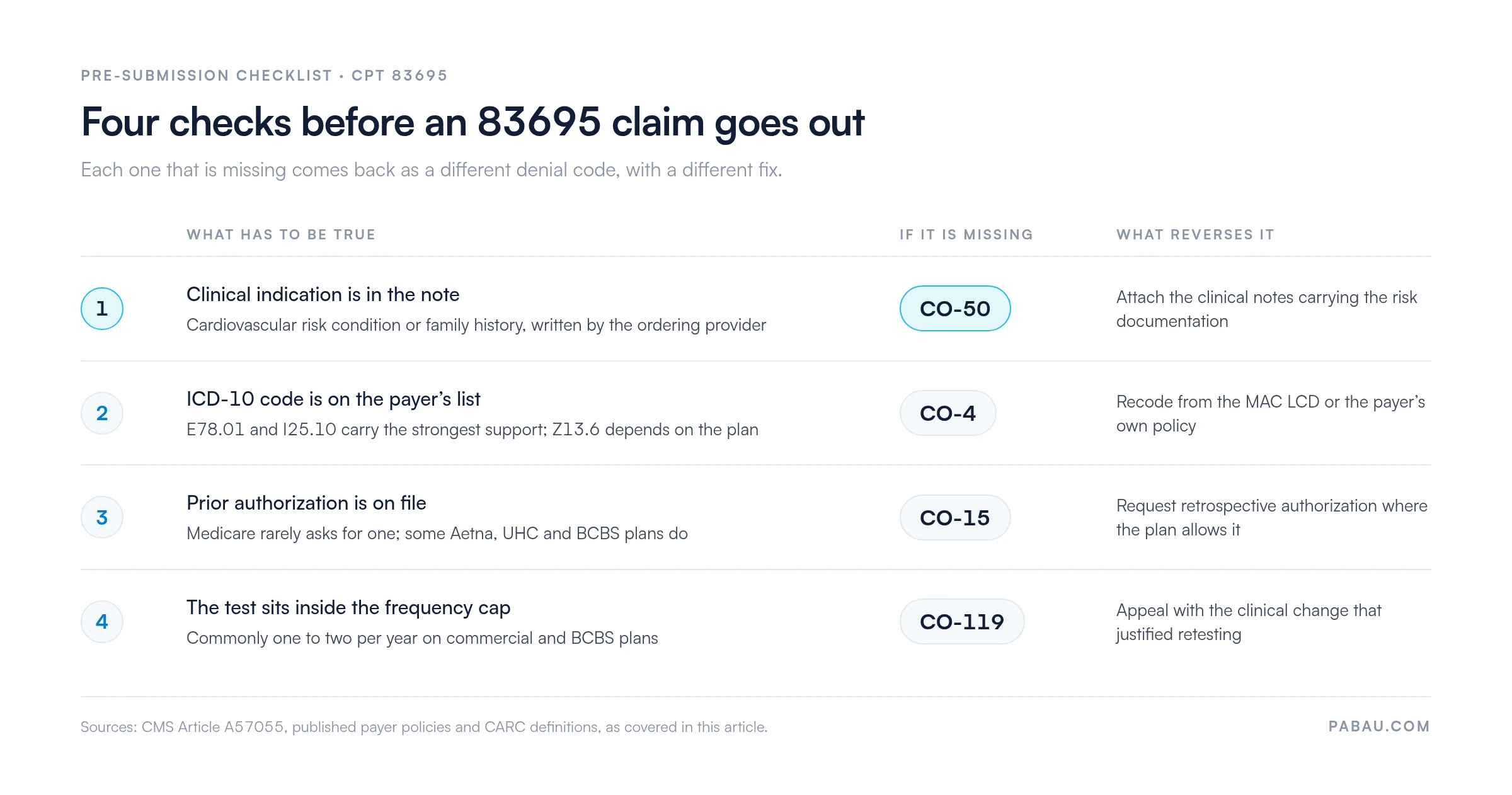
Most 83695 denials fall into four categories, each with its own CARC code and corrective action. Tracking them by denial codes stops the same pattern repeating across patient accounts.
Read the four backwards and they become a pre-submission checklist. Each check below is set before the claim is built, and each one that slips returns its own code.
Appeals succeed when the clinical record does the arguing. An appeal letter with no supporting documentation rarely reverses a CO-50 or CO-4 denial.
Flag every CO-50 denial on CPT 83695 in your denial tracker and review the corresponding clinical notes the same week. If the medical necessity language is consistently weak, the fix is upstream in the order workflow, not in the appeal process.
An 83695 problem usually surfaces after the remittance arrives, weeks after the specimen went out, with a CARC code attached. By then the ordering note is fixed and the appeal window is running.
Pabau keeps the order, the diagnosis code and the claim on one patient record. The ordering provider’s note, the ICD-10 pairing and the charge are entered once, so the claim carries what the payer asked for.
Claims then go out through our Claim.MD integration, which routes them to thousands of US insurance payers and flags incomplete fields before submission. Denials that do come back land against the same record, so building the appeal packet means filtering a list rather than hunting through files.

Pabau submits CPT 83695 claims through Claim.MD to thousands of US insurance payers. Each claim is checked for missing fields before it leaves the practice.

Code selection is rarely what sinks an 83695 claim. The order note and the diagnosis code decide it, and both are set before the specimen ever reaches the lab.
So the work that pays off sits upstream. Fix the ordering template once, review your MAC’s LCD each quarter, and the denial rate on this code looks after itself.
Pabau connects to Claim.MD to send 83695 claims to thousands of US insurance payers, checking each one for missing fields first. Book a demo to see how it handles cardiovascular lab billing.

Need a framework for handling claim rejections systematically? Denial management in healthcare covers a structured workflow for categorizing, tracking, and resolving denied claims across all payer types.
Want to understand how the clearinghouse fits into your revenue cycle? Medical claims clearinghouse guide explains how electronic claim routing and payer edits work between practice and payer.
Looking for guidance on superbill setup for lab codes? Superbill best practices covers how to structure charge capture documents for CPT and ICD-10 pairings that pass payer review.
CPT code 83695 is the procedure code for a quantitative Lipoprotein(a) assay. The test measures Lp(a) concentration in serum or plasma to assess cardiovascular disease risk independently of LDL. It falls under Chemistry Procedures in the Pathology and Laboratory section of the AMA CPT code set.
Yes, Medicare covers CPT 83695 under CMS Article A57055 when the claim is supported by an accepted ICD-10 diagnosis demonstrating cardiovascular risk. Coverage is subject to the MAC’s local coverage determination for the relevant jurisdiction, so verify with your specific MAC before billing.
Four reasons account for most of them. Missing medical necessity documentation returns CO-50, and an ICD-10 code off the payer’s covered list returns CO-4. Frequency limit violations return CO-119, and a missing commercial prior authorization returns CO-15. Each has its own corrective action and appeal approach.
Yes, CPT 83695 and CPT 80061 (lipid panel) can generally be billed on the same date of service. Lp(a) is not a component of the lipid panel. Each service must carry its own medical necessity documentation, since the lipid panel’s diagnosis code alone does not justify the Lp(a) assay.
Medicare does not typically require prior authorization for CPT 83695. Many commercial payers, including some Aetna and UHC plans, do require authorization for cardiovascular biomarker panels depending on the specific plan. Check the patient’s plan details before ordering to avoid a CO-15 denial.
Five pairings are commonly accepted. They are E78.01 (familial hypercholesterolemia), I25.10 (atherosclerotic heart disease), Z82.49 (family history of ischemic heart disease) and E78.5 (hyperlipidemia, unspecified). Z13.6 covers the screening context, where the plan accepts it. E78.01 and I25.10 give the strongest medical necessity footing.