HCPCS Code E0272: Foam rubber mattress billing guide
HCPCS Code E0272: official descriptor and code overview HCPCS Code E0272 is the ...

Last Updated: Nov 6, 2026
81015 is the CPT code for urinalysis; microscopic only. It covers examination of urine sediment under a microscope, with the provider reporting cells, casts, crystals and organisms. It includes no dipstick chemical screen and no automated analysis.
That sets it apart from 81003, which covers an automated urinalysis without microscopy. The distinction is a common source of urinalysis claim denials. CMS lists 81015 as a provider-performed microscopy procedure, so modifier QW never applies.
Let Pabau's smart automation suggest the right codes, reduce claim denials, and keep your practice compliant—effortlessly.
Automate repetitive tasks and focus on what matters most—your patients.
Reduce coding errors and ensure compliance with the latest regulations.
Clean claims, fewer denials, and faster reimbursements.
Powerful insights and reporting to help your practice thrive.
HIPAA compliant SOC 2 certified GDPR-compliant Trusted by 4,000+ clinics worldwide

CPT code 81015 covers microscopic examination of urine sediment only, with no dipstick chemical screen and no automated analysis.
CMS lists 81015 as a provider-performed microscopy (PPM) procedure, so it needs a PPM certificate or higher.
Modifier QW never applies to 81015, because the test is not CLIA-waived.
81015 and 81003 describe different procedures, so check current NCCI edits before billing them on the same date.
Pabau, the practice management platform we build, tracks urinalysis claims by CPT code so billing teams can spot repeat denial patterns.
CPT code 81015 is defined by the American Medical Association (AMA) as “Urinalysis; microscopic only.” That three-word descriptor sets a narrow scope. “Microscopic only” means the code covers examination of urine sediment under a light microscope. The provider identifies and reports formed elements: Red blood cells, white blood cells, epithelial cells, casts (granular, hyaline, cellular), crystals, bacteria, and yeast.
The word “only” rules out a dipstick chemical screen, automated cell counting and urine culture. The code captures the hands-on work: Preparing the sediment, placing it on a slide, reviewing it under magnification and writing up the findings.
The table below consolidates the key billing attributes for CPT code 81015. Reimbursement data reflects the CMS Clinical Laboratory Fee Schedule (CLFS). Rates change annually, and local Medicare Administrative Contractor (MAC) rates may differ from the national figure. Verify the current-year rate at CMS.gov before entering it into fee schedules, and review every lab code’s rate once a year.
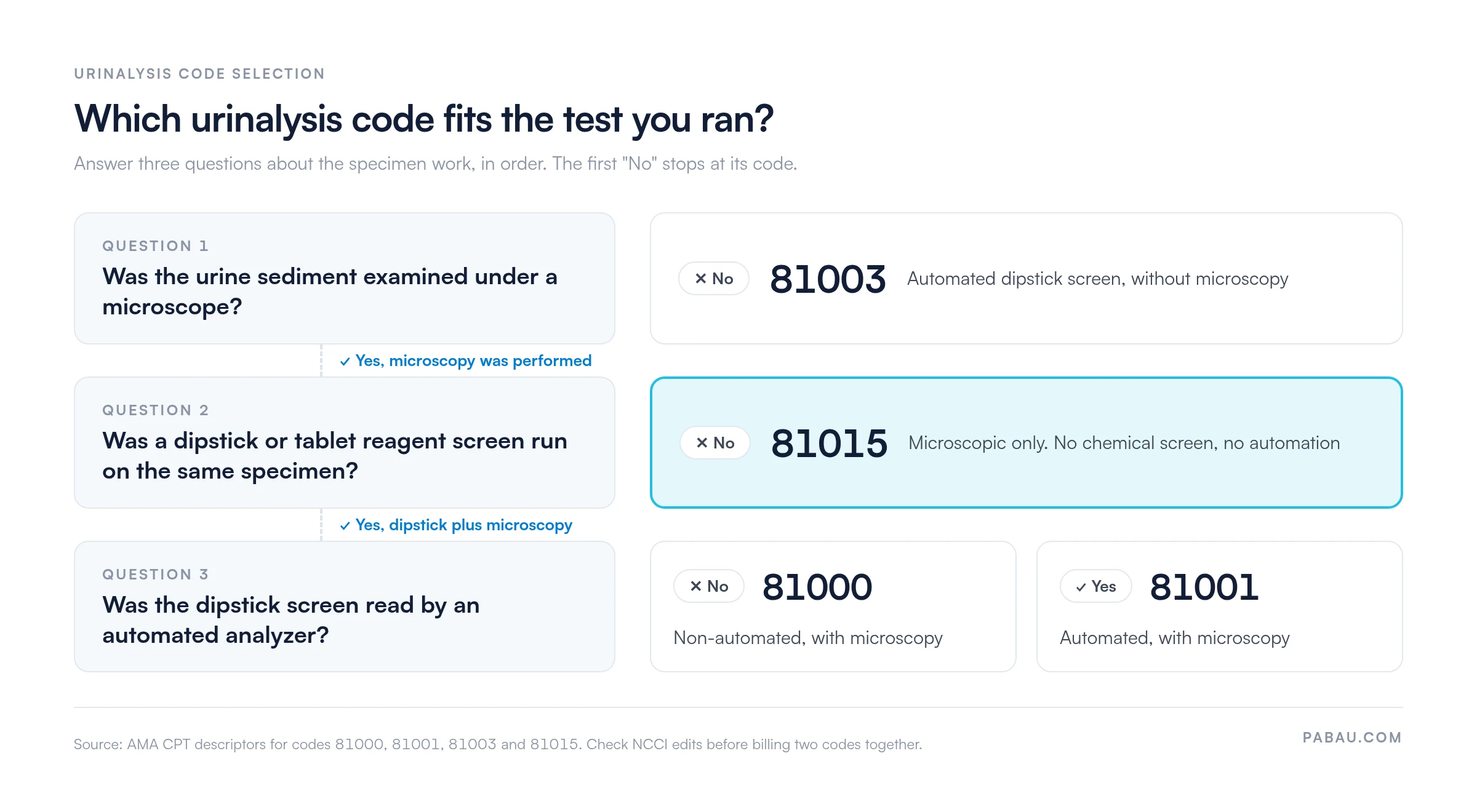
The urinalysis family contains four codes that coders regularly mix up. Selecting the wrong one is a common cause of bundling and medical necessity denials. The core distinction is whether microscopy was performed, who performed it, and whether automated analysis was involved.
When to use 81015 specifically: Bill CPT code 81015 when microscopic examination of urine sediment is ordered and performed on its own. No automated analysis or chemical dipstick screen is billed alongside it.
Picture a practice that runs every “UA with micro” order through an automated analyzer first, then performs manual microscopy on flagged specimens. That workflow typically generates two procedures: 81003 for the automated screen and potentially 81015 for the microscopy. Both remain subject to NCCI edits and payer policy.
Common mix-up with 81001: CPT code 81015, 81000 and 81001 all involve microscopy. The difference is the dipstick screen. Code 81000 pairs microscopy with a non-automated dipstick screen, and 81001 pairs it with an automated one. 81015 covers microscopy alone.
If both the dipstick and the microscopy were done manually, 81000 is correct, not 81015. Three questions about the specimen settle which of the four codes applies, as the diagram below shows.
Every CPT code 81015 claim requires a supporting diagnosis code that establishes medical necessity. MAC Local Coverage Determinations (LCDs) define which ICD-10-CM codes are accepted in each jurisdiction, so verify against your specific MAC before assuming coverage.
The codes below are frequently cited across multiple LCDs as supporting diagnoses for urinalysis microscopy. Use the CDC/NCHS ICD-10-CM web tool to verify current code validity and descriptors.
When ordering microscopy after an abnormal automated screen (81003), document in the chart note that the automated result triggered the manual review. State the specific abnormal flag (e.g., ‘automated UA positive for leukocyte esterase and nitrites; manual microscopy ordered to quantify WBC count and confirm bacteriuria’). This documentation justifies medical necessity for the second procedure and reduces the risk of a CO-50 denial.
CPT code 81015 is paid under the Medicare Clinical Laboratory Fee Schedule, not the Physician Fee Schedule. CLFS rates for urinalysis codes have historically sat in the low single digits. Published data for the code family puts the national rate for microscopic-only urinalysis at approximately $3-$4.
Confirm that figure in the current-year CLFS download at CMS.gov before using it in fee schedules or contract negotiations.
Two factors affect what a practice collects. First, local MAC rates may differ from the national cap, particularly in high-cost geographic areas.
Second, private payers negotiate separate lab fee schedules that often differ from Medicare rates. They run higher for some preferred-provider labs and lower under capitated arrangements. A real-time eligibility check before the specimen is drawn flags coverage limits before they turn into denial letters.
A claim for CPT code 81015 that lacks supporting documentation will not survive a MAC audit, even if the procedure was performed correctly. Following the guidance on medical billing compliance helps practices build chart documentation habits that reduce post-payment recoupment risk. The five elements below must be present in the medical record for every 81015 claim.
Building these elements into a standard lab-order template reduces missing-information denials. Submitting a clean claim from the first pass cuts rework time substantially for high-volume lab billing practices.
Denials for CPT code 81015 cluster around four root causes. Understanding each one points directly to the corrective action. Urinalysis codes are a high-frequency, low-complexity denial category that responds well to front-end edits.
In Pabau’s claims software for billers, teams tag denial codes against specific CPT codes and track repeat patterns across claim batches. That shows whether a urinalysis denial is a documentation problem or a code-pairing problem. Recurring denial codes often point to front-end fixes rather than individual claim appeals.
Often, yes. A urine culture can usually be billed alongside 81015. Pairing 81015 with 81003 depends on the NCCI edits in force on that date of service.
81015 and 81003 on the same date of service: 81003 is an automated chemical screen and 81015 is microscopy, so the two describe different procedures. Billing both on one claim is justifiable when both were performed.
However, NCCI edits bundle 81015 into 81003 in certain code-pair combinations. Coders must run the specific pair through the AAPC Codify CPT lookup or the CMS NCCI edits tool before submitting. If an edit exists, modifier 59 may unlock the code pair only when a distinct, separately documented procedural service occurred.
Do not use modifier 59 routinely: The OIG has historically flagged unbundling of urinalysis codes as a billing compliance risk.
81015 and urine culture on the same date: These two services are not generally subject to NCCI bundling with each other. A microscopic examination and a urine culture billed as 87086 are distinct procedures.
One examines formed elements, and the other grows organisms in culture media. Both may be billed on the same date when both were ordered and performed, with documentation supporting separate medical necessity.
Keep a separate order for each test to support billing both. Private payers may apply their own clinical editing rules, so verify payer-specific policy before submitting.
Three modifiers appear in CPT code 81015 billing, each with a specific and limited application. Misapplying any of them converts a clean claim into a denial or, worse, a compliance exposure.
Run a quarterly code-pair audit across all CPT 81015 claims. Pull claims where 81015 and 81003 both appear on the same date of service. Then check whether modifier 59 was applied and whether the chart supports a distinct service. Claims where 59 appears without supporting documentation are a compliance liability. Correct the pattern before a MAC review flags it.
Urinalysis billing errors usually surface weeks later, when a CO-97 or CO-4 remittance arrives. By then the order, the chart note and the lab report sit in different places. Rebuilding the case for an appeal costs staff time on a claim worth a few dollars.
Pabau keeps the clinical note, the diagnosis code and the CPT line on one patient record. Billers can check whether 81015 went out alone or beside 81003, and whether a modifier was attached, before the claim leaves the practice.
The outcome is fewer bundling and modifier denials, plus a denial history you can filter by code. When 81015 claims keep coming back, you can see whether the fix belongs in documentation or in code selection.

Pabau connects lab orders, CPT code tracking, and claim submission in one workflow. See how billing teams use Pabau to catch denial patterns before they repeat.

CPT code 81015 is a narrow code: Microscopy of urine sediment only, with no chemical screen, no automation and no culture bundled in.
Before you bill it, ask whether a dipstick was run on the same specimen. If a manual dipstick was run, 81000 is the right code. If an analyzer read the dipstick, it is 81001. If 81003 covered an automated screen, check the NCCI edits before adding 81015.
Treat the CLIA certificate as part of the claim, too. Billing 81015 under a certificate of waiver alone is a compliance problem that no modifier can fix.
Pabau keeps the order, the diagnosis and the CPT line together, so these checks happen before submission rather than after a denial. Book a demo to see how Pabau helps your billing team get urinalysis claims paid the first time.

Need to understand how clearinghouse claim submission works for lab codes? Claim.MD clearinghouse overview explains how electronic claims route from practice to payer and how ERA files confirm payment.
Want to understand the full denial appeal process? How 837 claim files work covers the electronic transaction standard used to submit lab claims and the data elements that trigger edits.
Looking for eligibility verification before the specimen is collected? Insurance eligibility verification guide walks through the process of confirming lab coverage before billing.
Building a process for recurring urinalysis denials? Denial management in healthcare sets out how to track, appeal and prevent denials across your claim volume.
Need a clean record of each separately ordered lab test? What a superbill is explains the itemized form that supports billing two services on one date.
CPT code 81015 covers urinalysis by microscopic examination only. A physician or mid-level provider examines urine sediment under a microscope. They report formed elements such as red and white blood cells, epithelial cells, casts and crystals. It does not include a chemical dipstick screen, automated analysis or urine culture.
CPT 81003 covers automated urinalysis without microscopy, while CPT code 81015 covers microscopy only, with no dipstick screen. 81003 runs the specimen through an automated analyzer for chemical screening. 81015 requires a provider to examine the sediment under a microscope. 81003 is CLIA-waived, while 81015 is a provider-performed microscopy (PPM) procedure that needs a PPM certificate or higher.
The Medicare Clinical Laboratory Fee Schedule (CLFS) national rate for CPT code 81015 is approximately $3-$4, though this figure changes annually. Always download the current-year CLFS file from CMS.gov and filter for code 81015 before entering rates into fee schedules. Local MAC rates may differ from the national figure.
The most commonly paired ICD-10-CM codes include N39.0 (urinary tract infection), R82.90 (abnormal urine findings), R80.9 (proteinuria) and N20.0 (kidney calculus). R31.9 (hematuria) and N18.30 (chronic kidney disease, stage 3 unspecified) are also common. Coverage depends on the applicable MAC Local Coverage Determination, so verify the diagnosis code against your MAC LCD before billing.
Four denial reasons come up most often. CO-97 means an NCCI edit bundled 81015 into another code. CO-50 means the diagnosis does not match the MAC LCD, or the chart lacks a documented clinical indication. CO-4 flags an incorrect modifier, such as QW on 81015, which is not CLIA-waived. CO-B7 means the practice or lab lacks a PPM or higher-level CLIA certificate.
Yes, in most cases. CPT 81015 (microscopy) and CPT 87086 (urine culture) describe distinct procedures with no standard NCCI bundling edit between them. Both can be billed on the same date when both were ordered and performed with separate documentation of medical necessity. Private payer clinical editing rules may differ, so verify payer-specific policy before submitting.
Bill CPT 81001 when an automated dipstick screen and microscopy were both performed on the same specimen. If the dipstick was read manually, the correct code is 81000. CPT code 81015 applies only when microscopy was performed without any chemical screen. Billing 81015 when a dipstick was also run understates the service.