

HCPCS code E0198: Water pressure pad billing guide
HCPCS code E0198 is a water pad for a standard mattress HCPCS code E0198 is the ...

Last Updated: Oct 13, 2026
81000 is the CPT code for a non-automated urinalysis by dip stick or tablet reagent, with microscopy. The reagent panel covers bilirubin, glucose, hemoglobin, ketones, leukocytes, nitrite, pH, protein, specific gravity, urobilinogen, any number of these constituents.
The code sits in the Pathology and Laboratory section of the AMA's CPT code set. Three problems drive most denials on it. Coders report 81000 when an analyzer ran the sample, the record carries no microscopy findings, or no qualifying diagnosis is linked.
Let Pabau's smart automation suggest the right codes, reduce claim denials, and keep your practice compliant—effortlessly.
Automate repetitive tasks and focus on what matters most—your patients.
Reduce coding errors and ensure compliance with the latest regulations.
Clean claims, fewer denials, and faster reimbursements.
Powerful insights and reporting to help your practice thrive.
HIPAA compliant SOC 2 certified GDPR-compliant Trusted by 4,000+ clinics worldwide

CPT Code 81000 covers a non-automated dip stick or tablet reagent urinalysis that includes microscopy.
Report 81002 when no sediment exam was done, and 81003 when an analyzer ran the sample.
Documentation must show the method, the microscopy findings, and a qualifying ICD-10 diagnosis.
Medicare pays 81000 under the Clinical Laboratory Fee Schedule, typically under $5, so confirm the current rate on the CMS CLFS page.
Pabau’s claims management software flags missing documentation and routes urinalysis claims through the Claim.MD clearinghouse before submission.
CPT Code 81000 is the billing code for a non-automated urinalysis by dip stick or tablet reagent, with microscopy. The AMA descriptor, confirmed by the AAPC Codify CPT lookup, names the constituents the reagent reads. Those are bilirubin, glucose, hemoglobin, ketones, leukocytes, nitrite, pH, protein, specific gravity, urobilinogen, any number of these constituents.
The descriptor then closes with its method clause, “non-automated, with microscopy”. The code sits in the 81000-81099 Urinalysis subsection of Pathology and Laboratory.
Two terms in that descriptor carry billing weight. “Non-automated” means a clinician or lab technician performs the test manually rather than running the sample through an analyzer. “With microscopy” means the urine sediment is examined under a microscope and documented at the same encounter. Both conditions must hold to report 81000.
CPT Code 81000 is appropriate when a clinician orders a manual dipstick urinalysis and examines the urine sediment at the same encounter. The scenarios that usually justify it are urinary tract infection workup, hematuria evaluation, proteinuria screening, and wellness visits where a comprehensive urinalysis is indicated.
Medical necessity must be supported by a linked ICD-10 diagnosis code. Payers, including Medicare, require documentation showing why the test was ordered. A claim carrying 81000 without a qualifying diagnosis is one of the most consistent denial triggers on urinalysis.
Local Coverage Determinations (LCDs) issued by Medicare Administrative Contractors (MACs) may add coverage criteria for urinalysis codes. Coverage rules vary by MAC jurisdiction, so confirming the applicable LCD for the practice’s region belongs in the billing workflow.
The four urinalysis codes in the 81000 family differ on exactly two variables: whether the test is automated, and whether microscopy is included. Getting those two flags wrong is the most common urinalysis coding error. The grid below places each code against both.
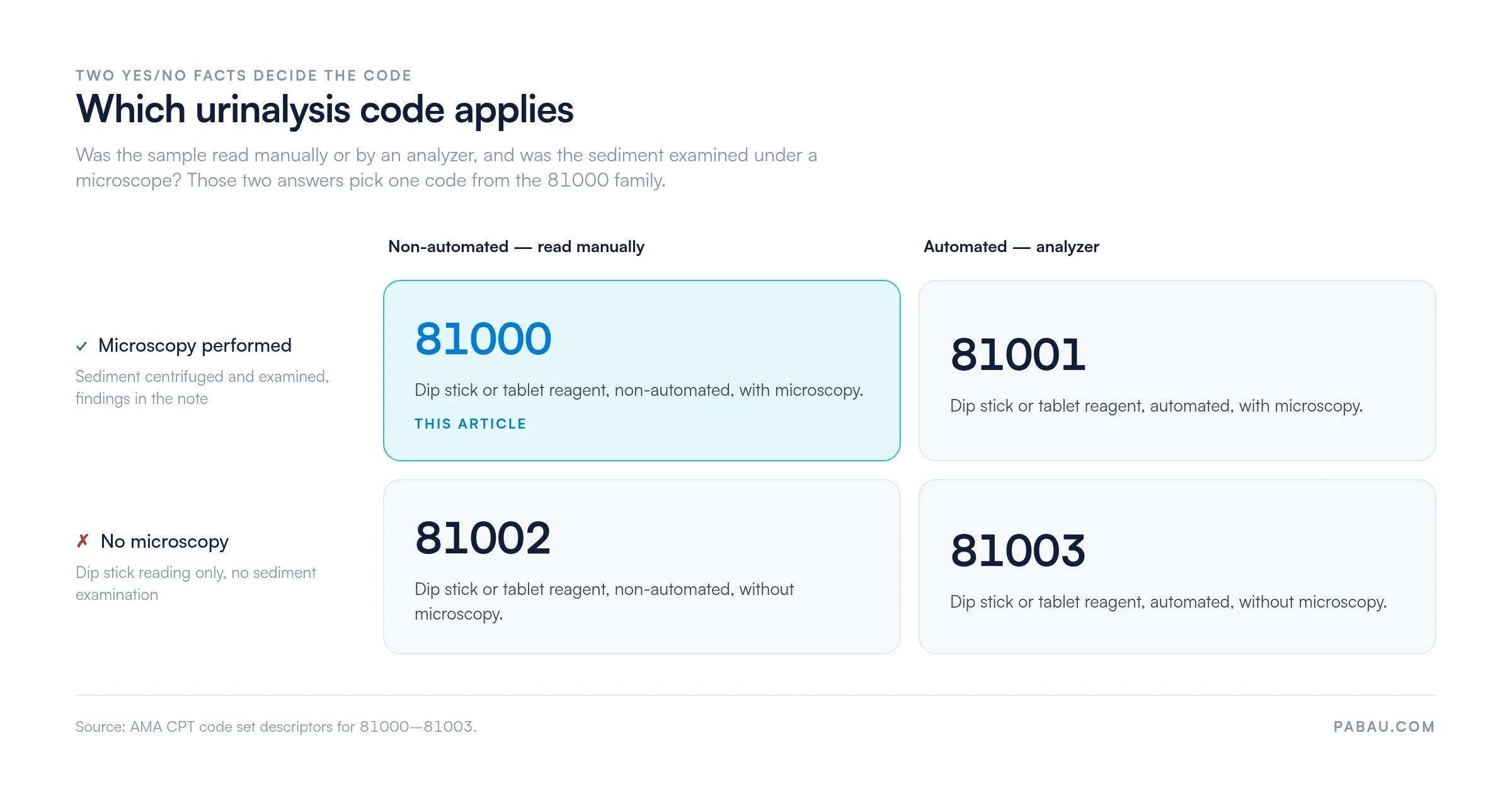
The most frequent code-selection error is billing 81000 when 81003 describes what happened. If an analyzer ran the sample and no microscopy was done, 81003 is correct. Billing 81000 there is upcoding, because 81000 claims a higher-complexity service. The record must reflect the method used.
A non-automated dipstick test means a clinician or technician dips a reagent strip into the urine sample. The color changes are then read by eye or with a handheld reader, not by a benchtop analyzer.
This manual process maps to 81000 with microscopy, or 81002 without it. Many small practices and urgent care centers use it for its low equipment cost and speed.
Every urinalysis claim on CPT Code 81000 needs a linked ICD-10 diagnosis that establishes medical necessity. The CDC/NCHS ICD-10-CM web tool is the authoritative source for confirming current code validity. The table below lists the diagnoses most often paired with urinalysis claims in primary and urgent care.
N39.0 is the pairing billing teams reach for most often, and it carries documentation demands of its own. Whichever diagnosis is used, it must reflect the reason the test was ordered, not the result it returned.
Auditors reviewing CPT Code 81000 claims look for five documentation elements. All five must be in the patient record before the claim is submitted. Missing one is grounds for denial, or for recoupment on audit.
Attaching the CPT and ICD-10 codes to the encounter note at the point of care is the safer habit. It keeps what the billing team submits aligned with what the clinician performed. Recording the diagnosis at the time of service is what stops a post-payment audit from turning into recoupment.
Run a monthly audit of all 81000 claims submitted in the prior 30 days. Pull 10 records at random and confirm each has: a written order, documented method (non-automated), microscopy findings in the note, and a linked ICD-10 diagnosis. If any element is missing from more than 20% of records, the documentation workflow needs a fix before the next MAC review cycle.
Medicare reimburses CPT Code 81000 under the Clinical Laboratory Fee Schedule (CLFS), not the Physician Fee Schedule. The national allowable generally sits under $5, so accuracy on this code matters more than volume.
The exact figure changes by year and by locality. Verify the current rate on the CMS Clinical Laboratory Fee Schedule page before quoting dollar amounts internally or in payer negotiations.
A clearinghouse makes rate reconciliation easier on low-dollar lab codes. Electronic remittance advice returns the allowed amount against each 81000 line, so a shortfall shows up in the next batch rather than at year end.
Urinalysis claims are audited regularly, because the 81000-81003 family turns on clear, testable criteria. Billing staff who know the denial patterns can head off most rejections before submission.
Reviewing denial codes after each remittance cycle shows whether rejections are documentation-related or payer-policy-related. On 81000, CO-4 and CO-50 both point at a coding or medical necessity problem rather than a payer-system error. CO-4 flags a procedure inconsistent with the modifier, and CO-50 a non-covered service.
CPT Code 81000 covers the routine dipstick-plus-microscopy urinalysis, but clinicians often order other urine tests at the same encounter. Each has its own documentation and medical necessity requirements. Knowing where the 81000 family ends prevents unbundling errors and missed billing.
These codes are not bundled with CPT Code 81000. They can be billed on the same date when each test is separately ordered, performed, and documented. NCCI edits decide whether any of them form an edit pair with 81000, so check the current tables before billing a combination.
Urinalysis billing errors are almost always preventable. A coder usually knows the rule. What they lack is a way to check it while the claim is being built.
The record arrives without a microscopy note, or the method goes undocumented. Sometimes the ICD-10 code is picked from a dropdown before the clinical rationale reaches the chart.
Practice management software like Pabau moves that check to the moment of submission, ahead of the remittance. Pabau’s claims software for practices scrubs each claim before it leaves the building, and flags an incomplete document trail on the spot.
On a low-dollar code like CPT Code 81000, an appeal can cost more than the allowed amount. Prevention is the only route that pays.
The fundamentals of urinalysis coding do not change. What changes with integrated software is whether they are checked automatically, or only after a denial lands. Practices with heavy urinalysis volume gain the most from automating that check, and primary care, urgent care and OB/GYN see it first.

Pabau’s integrated claims management routes 81000 and related lab codes through Claim.MD’s clearinghouse with pre-submission scrubbing, eligibility checks, and ERA reconciliation built in. See how it works for your practice.

Check your CLIA certificate status before billing any urinalysis code. In-office labs performing waived tests must hold a Certificate of Waiver. If your practice sends urinalysis to a reference lab, confirm which party bills the code. Duplicate billing is a common audit trigger when both entities submit claims for the same test.
CPT Code 81000 has a narrow billing window: non-automated method, microscopy performed, and a qualifying diagnosis on the claim. Every denial traces back to one of those three being unmet or undocumented.
Coding accuracy at this level holds only when the documentation workflow catches a missing element before the claim is built. Checking after the remittance arrives costs more than the code pays.
Pabau connects the clinical record, code selection, and clearinghouse submission in one platform, so lab claims stop cycling through documentation and denial. Book a demo to walk through a live claim-scrubbing scenario for your practice type.

Need to understand how claims move from submission to payment? What is revenue cycle management covers the full lifecycle from patient encounter to collected revenue, including lab code workflows.
Seeing 81000 denials with CO-50 or CO-4 codes? Denial management in healthcare walks through building a systematic appeals and correction process for recurring rejection patterns.
Performed the dipstick without a sediment exam? CPT code 81002 covers the non-automated urinalysis that stops at the reagent strip.
Running samples through an automated analyzer? CPT code 81003 explains when the automated, no-microscopy code replaces 81000.
CPT Code 81000 bills a non-automated urinalysis by dip stick or tablet reagent, including microscopic examination of the sediment. It is reported when a clinician manually performs a dipstick test and then examines the centrifuged sediment under a microscope in the same encounter. Common clinical indications include UTI workup, hematuria evaluation, proteinuria screening, and routine wellness exams with documented justification.
CPT 81000 is non-automated with microscopy. CPT 81003 is automated without microscopy. If the urinalysis was run on an automated analyzer and no sediment examination was performed, 81003 is the correct code. Reporting 81000 in that case is upcoding, and it is one of the most common audit findings on urinalysis claims.
Both 81000 and 81002 describe non-automated dipstick urinalysis, but 81000 includes microscopy and 81002 does not. If a manual dipstick was performed and no microscopic sediment examination was done, report 81002. Reporting 81000 without microscopy findings in the record will result in a documentation-based denial on audit.
The most frequently paired ICD-10 codes are N39.0 (urinary tract infection, site not specified) and R31.9 (hematuria, unspecified). R30.0 (dysuria), R80.9 (proteinuria, unspecified) and Z00.00 (general adult wellness exam) are also common. The linked diagnosis must reflect the clinical reason the test was ordered and must be documented in the encounter note before appearing on the claim.
Medicare reimburses CPT Code 81000 under the Clinical Laboratory Fee Schedule, typically under $5 nationally. The exact figure changes annually and varies by locality. Confirm the current allowable on the CMS Clinical Laboratory Fee Schedule page before quoting rates internally or in payer contracts.
Five elements are required. The chart needs a clinician order for urinalysis, the non-automated method documented, the microscopy findings, the dipstick results, and a qualifying ICD-10 diagnosis. Missing the microscopy documentation is the single most common denial driver for this code.



