

CCSD code G5100: Bypass of duodenum billing guide
CCSD code G5100 bills a bypass that leaves the duodenum in place CCSD code G5100...

Last Updated: Oct 16, 2026
77385 is the deleted CPT code for intensity modulated radiation treatment delivery (IMRT), simple, including guidance and tracking when performed. The AMA retired it on January 1, 2026, together with 77386 for complex IMRT.
Use 77385 only for sessions delivered on or before December 31, 2025. From 2026, IMRT delivery bills as 77407 (Level 2) for a single isocenter, or 77412 (Level 3) with multiple isocenters or active motion management. Physicians report the image guidance review as 77387-26.
Let Pabau's smart automation suggest the right codes, reduce claim denials, and keep your practice compliant—effortlessly.
Automate repetitive tasks and focus on what matters most—your patients.
Reduce coding errors and ensure compliance with the latest regulations.
Clean claims, fewer denials, and faster reimbursements.
Powerful insights and reporting to help your practice thrive.
HIPAA compliant SOC 2 certified GDPR-compliant Trusted by 4,000+ clinics worldwide

CPT 77385 described simple IMRT delivery per session, and it was deleted on January 1, 2026, together with 77386.
Simple meant prostate, breast, or any site treated with physical compensator-based IMRT, whatever the field count or plan complexity.
Sessions delivered on or before December 31, 2025, still bill as 77385 on original, corrected, and appealed claims.
From 2026, IMRT delivery bills as 77407 (Level 2) or 77412 (Level 3), chosen by isocenters and motion management.
Image guidance is now bundled into delivery, so physicians report only the professional component as 77387-26.
CPT code 77385 was the code for intensity modulated radiation treatment delivery (IMRT), simple, including guidance and tracking when performed. The AMA deleted it from the CPT code set on January 1, 2026, along with its complex counterpart, 77386.
The code is no longer valid for any session delivered from that date. IMRT delivery now bills under the level-based codes CPT 77407 (Level 2) and CPT 77412 (Level 3). These codes no longer distinguish IMRT from 3D conformal treatment.
From 2015 to 2025, Medicare ran two parallel code sets for radiation treatment delivery. Hospitals reported IMRT with 77385 and 77386, while freestanding centers billed Medicare with G-codes such as HCPCS G6015.
In 2023, the RUC flagged the delivery and image guidance codes as potentially misvalued, because their inputs had last been valued in 2014. The revaluation that followed rebuilt the family around delivery complexity instead of technique.
According to ASTRO’s summary of the 2026 changes, the result is one set of three levels used in both hospital and freestanding settings. IMRT stopped being a separate category, so its two delivery codes had no place left in the family.
The split between 77385 and 77386 depended on the treatment site and the IMRT technique. It did not depend on the number of fields, the number of segments, or how hard the plan was to optimize.
A head and neck IMRT plan with multileaf collimator delivery was therefore complex, however simple the plan looked. A head and neck plan delivered with physical compensators was simple. This matters when you audit or correct a pre-2026 claim, because the site and technique in the record decide the code.
There is no one-to-one replacement for 77385. Each session is now coded by its delivery level, so the same patient group can land in two different codes.
Payment figures are national amounts from ASTRO’s 2026 physician fee schedule final rule summary. Local amounts vary with geographic adjustment, and hospital claims are paid under HOPPS instead.
Most sessions that were simple IMRT under 77385 now bill as 77407. A single-isocenter prostate plan treated without intrafraction tracking is the typical example.
Some former 77385 sessions qualify for 77412 instead. A left breast treated with deep inspiration breath hold uses active motion management. A breast plan that adds a second isocenter for the nodal fields has multiple isocenters. The diagram below walks one session through both decisions, date first and setup second.
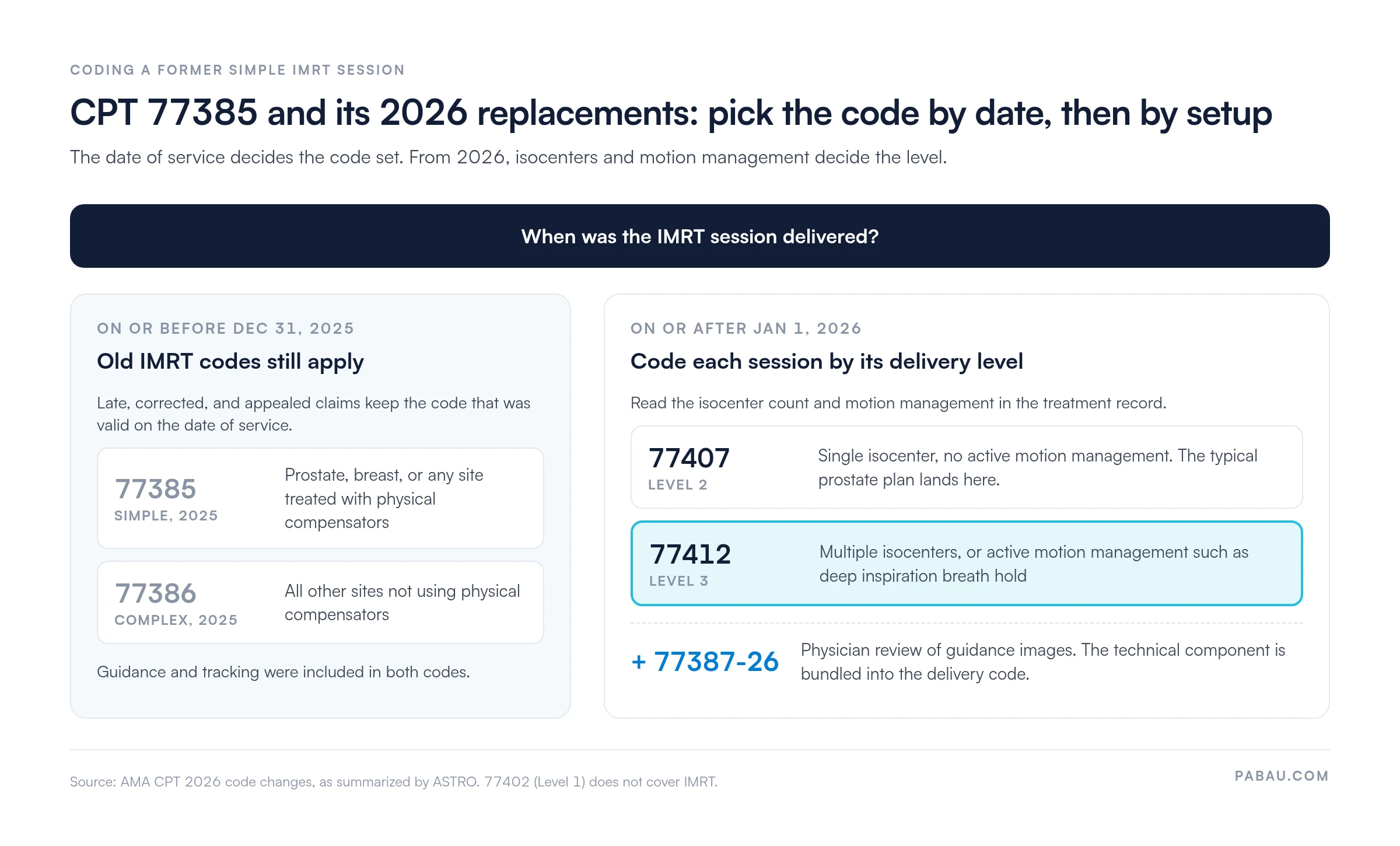
Don’t map 77385 to 77407 in your charge master and stop there. Code each session from its treatment record, because the isocenter count and motion management decide the level.
The old 77385 descriptor already bundled guidance and tracking into the delivery code. From 2026, every delivery level works the same way, and CT guidance code 77014 is deleted.
The physician still reports the professional review of guidance images as CPT 77387 with modifier 26. Medicare does not pay the technical component separately in either setting.
The date of service decides the code, whenever the claim is submitted. A simple IMRT session delivered on or before December 31, 2025, is still reported as 77385.
Legacy 77385 claims still need the records that supported simple IMRT. Keep these on file for audits and appeals, because a clean claim depends on them:

Most denials in the first year come from claims built on the old framework. Each denied line comes back with one of the standard denial codes naming the cause. Tracking which of these errors drives your rejections is a useful start for denial management.
The new levels turn on facts that the old IMRT codes never asked for. The treatment record for each session should show what the level depends on:
A record that names the technique without these details leaves the level open to challenge. That was rarely a risk under 77385, because the treatment site settled the code on its own.
A code deletion leaves two sets of rules running side by side for a year. Billing teams work 2025 corrections under 77385 while every new session goes out as 77407 or 77412.
Pabau links the treatment record to claim generation, so the delivery level, the 77387-26 line, and the date of service travel together. Its claims management software sends claims through Claim.MD and brings remittance back as ERA files.
That lets your team see which sessions paid at the new levels and which came back for a code that no longer exists.

Pabau’s claims management tools connect each treatment session to its claim line, so 2026 delivery codes go out with the right date and guidance line.

CPT code 77385 now belongs to 2025 and earlier. Keep it for late, corrected, and appealed claims on those dates, and nowhere else.
For 2026 sessions, the useful habit is to stop thinking in simple and complex IMRT. Read the isocenters and the motion management in each record, then pick 77407 or 77412.
Pabau keeps the delivery level, the guidance line, and the date of service together from record to claim. To see that on a full treatment course, book a demo.

Need to understand how claims reach a payer? Medical claims clearinghouse guide explains how electronic claims are validated, routed, and tracked before reaching Medicare or a commercial payer.
Reading denials on 2026 radiation oncology claims? Electronic remittance advice (ERA) guide covers how to read 835 files, identify CARC denial reasons, and automate payment posting.
Want to reduce rework on radiation oncology claims? Medical billing fundamentals outlines the end-to-end billing cycle and where radiation oncology practices lose the most revenue to preventable errors.
Cleaning 2026 charge lists of deleted guidance codes? CPT code 77014 covers the CT guidance code that was deleted alongside 77385 in 2026.
No. CPT code 77385 was deleted on January 1, 2026, so it is invalid for any session delivered from that date. It remains correct only for simple IMRT sessions delivered on or before December 31, 2025.
No single code replaced it. Simple IMRT delivery now bills as 77407 (Level 2) for a single isocenter without active motion management. It bills as 77412 (Level 3) when the session uses multiple isocenters or active motion management.
The split depended on treatment site and technique. 77385 covered prostate, breast, and any site treated with physical compensator-based IMRT. 77386 covered all other sites not using compensators. Both codes were deleted in 2026.
Yes. The date of service decides the code, so 2025 sessions keep 77385 on late, corrected, and appealed claims. Medicare allows 12 months from the date of service to file the original claim.
The technical component of image guidance is bundled into 77402, 77407, and 77412. The physician reports the professional review of guidance images as 77387 with modifier 26. CT guidance code 77014 was deleted.
No. Most single-isocenter prostate and breast sessions map to 77407. A session with breath hold, surface guidance, or a second isocenter qualifies as 77412 instead.



