CPT code 63081: Vertebral corpectomy, cervical spine
CPT code 63081: official descriptor and procedure overview CPT code 63081 descri...

Last Updated: Oct 6, 2026
CPT code 77387 reports the image guidance used to localize the target volume during radiation treatment delivery. Since January 1, 2026, it pays as a professional-component service only. CMS gave the technical component procedure status B, so that half is bundled into the treatment delivery code and is not separately payable. The finalized 2026 work RVU is 0.68.
That change came with a rebuild of the delivery codes themselves. The CY2026 Physician Fee Schedule final rule deleted 77014, 77385, and 77386, along with the G6001 to G6017 series. Three leveled delivery codes replaced them, numbered 77402, 77407, and 77412. Any claim or charge master still carrying the deleted codes needs remapping before the next billing cycle.

CPT code 77387 reports image guidance for target volume localization during radiation treatment delivery, billed once per treatment session.
Since January 1, 2026, 77387 pays as a professional component only, because CMS gave its technical component status B.
CMS deleted 77014, 77385, and 77386 effective January 1, 2026, replacing them with delivery codes 77402, 77407, and 77412.
IMRT and VMAT now report under 77407 at Level 2, not under a dedicated IMRT delivery code.
The finalized 2026 work RVU for 77387 is 0.68.
Billing a deleted delivery code or claiming the technical component of 77387 are the two leading 2026 denial triggers.
Pabau’s claims management software tracks modifier requirements, payer rules, and session documentation so radiation oncology billing staff can reduce claim errors before submission.
The American Medical Association (AMA) CPT code set gives the official descriptor for 77387. It reads: Guidance for localization of target volume for delivery of radiation treatment, includes intrafraction tracking, when performed. In practice that covers the imaging used to confirm patient positioning and target alignment immediately before or during a fraction. Clinicians know the workflow as image-guided radiation therapy, or IGRT.
Two things changed at once, and they interact. Image guidance for every external beam modality now funnels into the single code 77387, and its technical component stopped being separately payable. Meanwhile the delivery codes it accompanies were replaced outright. A practice that fixed only one of the two ends up with rejected claims either way.
The replacement delivery codes are graded by how complex the delivery is, not by whether the plan is 3D or IMRT. Site of service no longer changes the code either. The table below shows where each level sits.
Note what moved. Motion management and image guidance are both bundled into the delivery codes now, which is why the technical side of 77387 lost separate payment. IMRT sits at Level 2, so the old habit of treating intensity modulation as automatically complex no longer holds.
These codes were deleted effective January 1, 2026, and will reject on any later date of service:
Pull every claim with a date of service on or after January 1, 2026 that still carries 77014, 77385, or 77386. Those codes no longer exist, so each claim needs remapping to 77402, 77407, or 77412 before resubmission. Check the charge master in the same pass, because that is usually where deleted codes survive quietly.
CPT code 77387 applies whenever a radiation oncology practice uses imaging to localize the treatment target volume immediately before or during a session. The imaging modality does not change the code. Cone-beam CT, 2D kV or MV imaging, ultrasound localization, and electromagnetic tracking all report the same way. The imaging must be used for intrafraction target confirmation.
Per coding guidance from the American Society for Radiation Oncology (ASTRO), these clinical situations support reporting 77387:
CPT code 77387 is reported once per treatment session, not once per image acquired or per field treated. A patient treated with two fields in a single session generates one unit of 77387, not two.
Diagnosis coding on a radiation session claim has its own sequencing rule, and getting it backwards causes denials that look like coverage problems. The CMS ICD-10-CM code files are updated each October 1, so verify selections against the current fiscal-year tables.
Sequencing matters more than code choice here. The ICD-10-CM official guidelines put Z51.0 first when the reason for the encounter is radiation therapy, with the malignancy coded as a secondary diagnosis. Claims that lead with the tumor code and omit Z51.0 tend to come back as medical necessity denials. That label sends billing teams looking in the wrong place.
Modifier 26 is the normal way to report CPT code 77387 in 2026, because the professional component is the only payable half. There is no longer a payable professional and technical split to divide between the facility and the physician group. The table below covers what each modifier does now.
Private payer policy diverged during the transition, and it has not fully converged. UnitedHealthcare’s revised radiation therapy guideline requires modifier 26 on 77387, while some other commercial payers denied the code when the modifier was appended. Confirm each payer’s position in writing before the date of service rather than after the first denial.
Verify requirements against your MAC’s local coverage articles as well. Record each payer’s modifier rule during eligibility verification, before the first fraction is delivered.
Medicare pays the professional component of CPT code 77387 under the Physician Fee Schedule, using the Resource-Based Relative Value Scale. Dollar amounts vary by locality and change each January 1. Pull locality-adjusted figures from the CMS Physician Fee Schedule lookup tool for your MAC jurisdiction.
Note: Confirm the 2026 national payment amount through the CMS PFS tool or your MAC’s fee schedule before you submit. Do not rely on third-party estimates. RVU values change annually, so recheck them each October when the proposed rule publishes.
Catching these annual updates before January 1 is what keeps a radiation oncology course billing cleanly from the first fraction. A charge master reviewed in December costs far less than a January of rejected claims.
Inadequate documentation is the fastest path to a denied or recouped 77387 claim. CMS and MAC-level policies require evidence that image guidance was clinically indicated, performed, and interpreted by a physician. That is the practical test of medical billing compliance in radiation oncology. Build the habit into every session rather than retrofitting it after an audit.
One documentation habit carries more weight than it used to. Because delivery level now depends on features such as motion management and isocenter count, the treatment record has to state those features explicitly. A reviewer cannot infer them from the plan name.
Medicare coverage for CPT code 77387 is governed at the MAC level. Noridian Healthcare Solutions and the other MACs apply Local Coverage Determinations that define which clinical indications support image guidance. Confirm the current LCD number and status with your own MAC, since these policies are periodically revised or superseded.
Expect some LCD and payer policy text to lag the 2026 code changes. Where a policy still names 77014 or 77385, the underlying coverage intent usually survives, but the billed code does not. Ask the payer which current code satisfies the policy instead of billing the deleted one.
A session record that lists the treating diagnosis, the delivery level, and the imaging modality gives a reviewer what they need at a glance. That is also what keeps an appeal short when a claim does get pulled.
CPT code 77387 never stands alone. It describes guidance for a delivery service, so the claim needs a current delivery code to give it context. The AAPC CPT code lookup is a useful cross-check before submission.
Planning and management codes were left alone by the 2026 rebuild. Only treatment delivery and image guidance changed, so 77280 through 77295, 77301, 77336, and 77427 keep working as before.
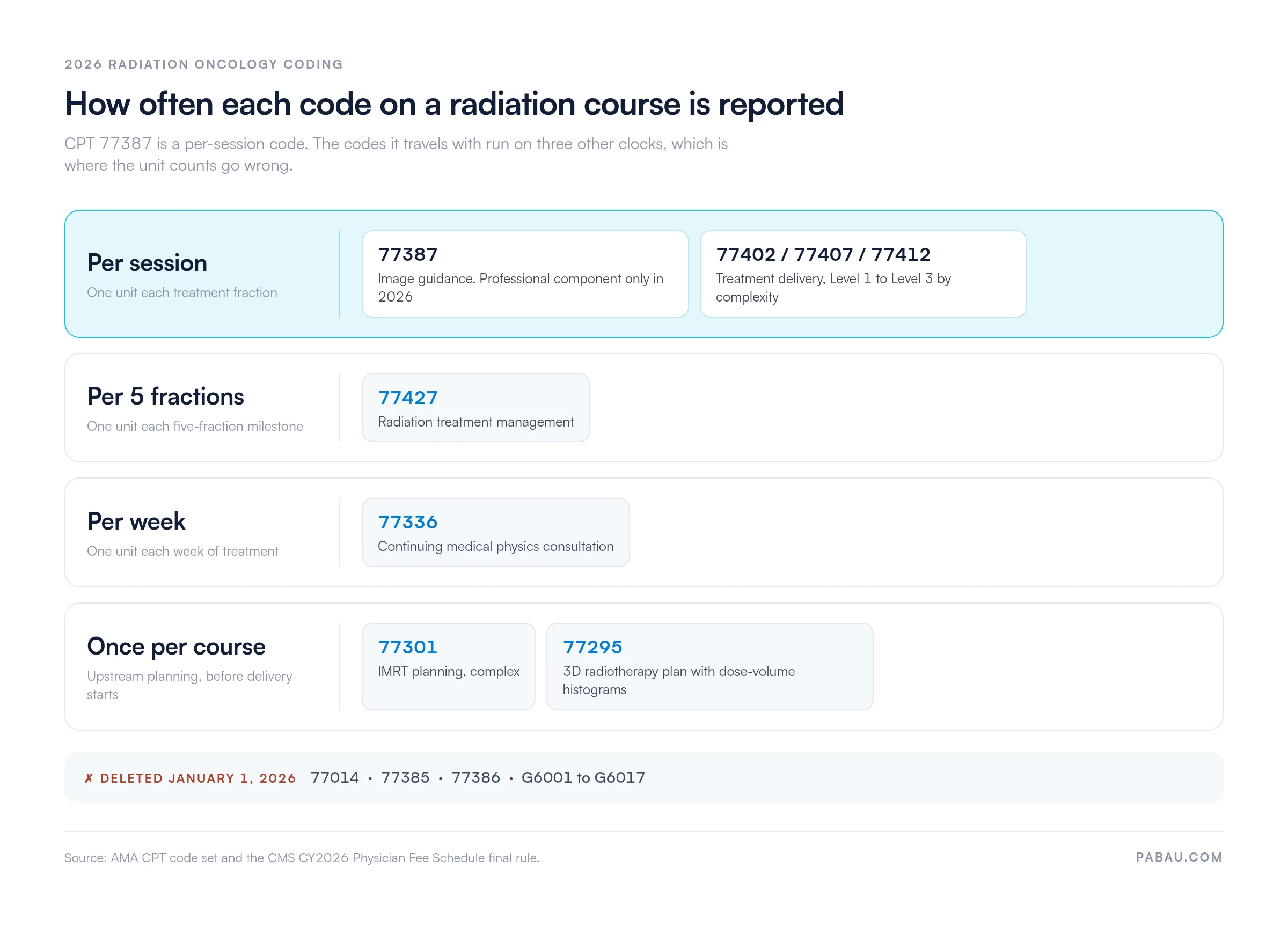
77427 and 77387 together: Radiation treatment management and image guidance cover different services and can appear on the same date. But 77427 is reported per five-fraction milestone while 77387 is reported per session. Never substitute one for the other or combine their units. The map below sets out every code’s reporting frequency across one course.
CPT 77014 was deleted effective January 1, 2026, so there is no longer a comparison to make. The two codes cannot be weighed against each other or billed on the same claim. Every image guidance service for external beam delivery now reports under 77387, whatever the modality.
The practical effect is a simpler claim with one new failure mode. Billing teams no longer manage a guidance bundling pair, but they do have to keep 77014 out of the charge master. Dates of service before January 1, 2026 still bill under the old rules. A practice working through an aging backlog needs both code sets available.
Denial patterns on 77387 changed shape in 2026, and most of the new ones are mapping errors rather than clinical ones. Catching them early prevents revenue leakage across a course that can run 25 to 40 sessions.
Denial prevention on 77387 starts with pre-submission claim scrubbing. Reviewing the claim denial codes on each remittance tells billing teams where the cause sits. It is either the documentation, the modifier, or the code mapping. That distinction is what lets them fix the root cause instead of resubmitting.
Run a monthly report filtering all 77387 claims denied in the last 30 days, then group those denials by reason code. If more than 20% share the same reason, the problem is systemic rather than case-by-case. That calls for a workflow fix, not a round of individual resubmissions.
Image guidance billing is documentation-intensive, and the 2026 changes added a mapping burden on top. Each session generates a record that has to capture the imaging modality, the physician interpretation, the delivery level billed, and the per-session unit count. Tracking that by hand across a 30-fraction course creates audit exposure.
Practice management software like Pabau gives radiation oncology billing staff a structured workflow instead. Our claims management software keeps 77387 attached to the correct delivery code. It applies the modifier rule you recorded for that payer. It also flags a missing physician attestation before the claim reaches the payer.
Claims then route through Claim.MD, which validates each one against payer rules and NCCI edits in real time. Invalid codes and modifier errors get caught at that stage rather than after a denial. Remittance advice comes back automatically, so staff see reason codes and payment amounts without downloading 835 files from each payer portal.

Pre-submission scrubbing, clearinghouse validation, and automated remittance posting work together here. For practices running high-volume radiation courses, that shortens the distance between the treatment date and the payment date.

Pabau’s claims management tools help billing staff map 77387 to the right 2026 delivery code. Staff apply the modifier each payer wants, then send clean claims through Claim.MD before denial triggers hit.

CPT code 77387 survived the 2026 rebuild, but the codes around it moved. The code now pays as a professional component only. Its delivery partners are 77402, 77407, and 77412. The old 77014, 77385, and 77386 are gone. Practices that have remapped their charge master and recorded each payer’s modifier rule are billing cleanly. Those that have not are seeing invalid-code rejections that look like coverage denials.
Pabau’s claims management tools give billing teams a structured way to handle 77387 across long treatment courses. That runs from delivery code mapping to real-time clearinghouse validation via Claim.MD. To see how that works for radiation oncology billing, book a demo with the Pabau team.

Need to see how a clearinghouse validates a claim? Claim.MD clearinghouse review walks through the electronic submission workflow from practice to payer.
Seeing the same denial reason come back on repeat? Denial management in healthcare covers root-cause analysis and the fix workflows billing teams use.
Want the session record to satisfy a reviewer first time? What is a superbill lists the fields a payer looks for on a treatment claim.
Chasing a lower rejection rate on first submission? What is a clean claim in medical billing sets out the checks that get a claim paid without rework.
Mapping the whole path from treatment to payment? What is revenue cycle management covers each stage from eligibility through to payment posting.
CPT code 77387 reports guidance for localization of the target volume during radiation treatment delivery, the workflow known as image-guided radiation therapy. It covers the acquisition, fusion, review, and interpretation of the localization imaging. It is reported once per treatment session, alongside the delivery code billed for that session.
Yes, 77387 is active and billable in 2026, but only as a professional component. CMS assigned its technical component procedure status B effective January 1, 2026. That half is now bundled into the treatment delivery code and is not separately payable.
The finalized 2026 work RVU for CPT 77387 is 0.68. Only the professional component is payable, so there is no separate technical payment to add. Dollar amounts vary by locality, so confirm the current figure in the CMS Physician Fee Schedule lookup tool for your MAC jurisdiction.
Modifier 26 is the standard way to report CPT 77387 in 2026, because the professional component is the only payable half. Under status B, modifier TC is no longer separately payable. Modifier 59 is rarely applicable now that 77014 is deleted, so check current NCCI tables first.
Three leveled radiation treatment delivery codes replaced them effective January 1, 2026. Level 1 is 77402, covering simple 2D or electron delivery. Level 2 is 77407, covering 3D conformal therapy plus IMRT and VMAT at a single isocenter. Level 3 is 77412. The G6001 to G6017 series was deleted at the same time.
There is no longer a comparison to make, because CPT 77014 was deleted effective January 1, 2026. Its CT guidance work was absorbed into 77387 and the new leveled delivery codes. The two codes cannot appear on the same claim, so the old bundling edit and its modifier 59 workaround no longer apply.
CPT 77387 is billed alongside a current delivery code, which is 77402, 77407, or 77412 depending on delivery complexity. It also appears in courses that include 77427 for treatment management per five fractions. Planning codes 77301 and 77295 sit in the same course, as does 77336 for continuing medical physics consultation. Those planning and management codes were unchanged for 2026.
Yes, Medicare Part B covers the professional component of CPT 77387 for medically necessary image guidance, subject to MAC-level Local Coverage Determinations. Coverage criteria and required documentation vary by jurisdiction. Confirm the current LCD governing image guidance in your region before billing, and expect some policy text to still name deleted codes.
Billing CPT 77387 requires a physician order for image guidance. It also requires a treatment record naming the imaging modality used that session. A dated physician attestation must confirm that the localization images were reviewed and approved before delivery. The record should also support the delivery level billed and carry a diagnosis supporting medical necessity. Therapist notes alone are insufficient.