CPT code 86481: TB IGRA billing guide
CPT code 86481: Official descriptor and procedure description CPT code 86481 des...

Last Updated: Nov 2, 2026
Billable Code
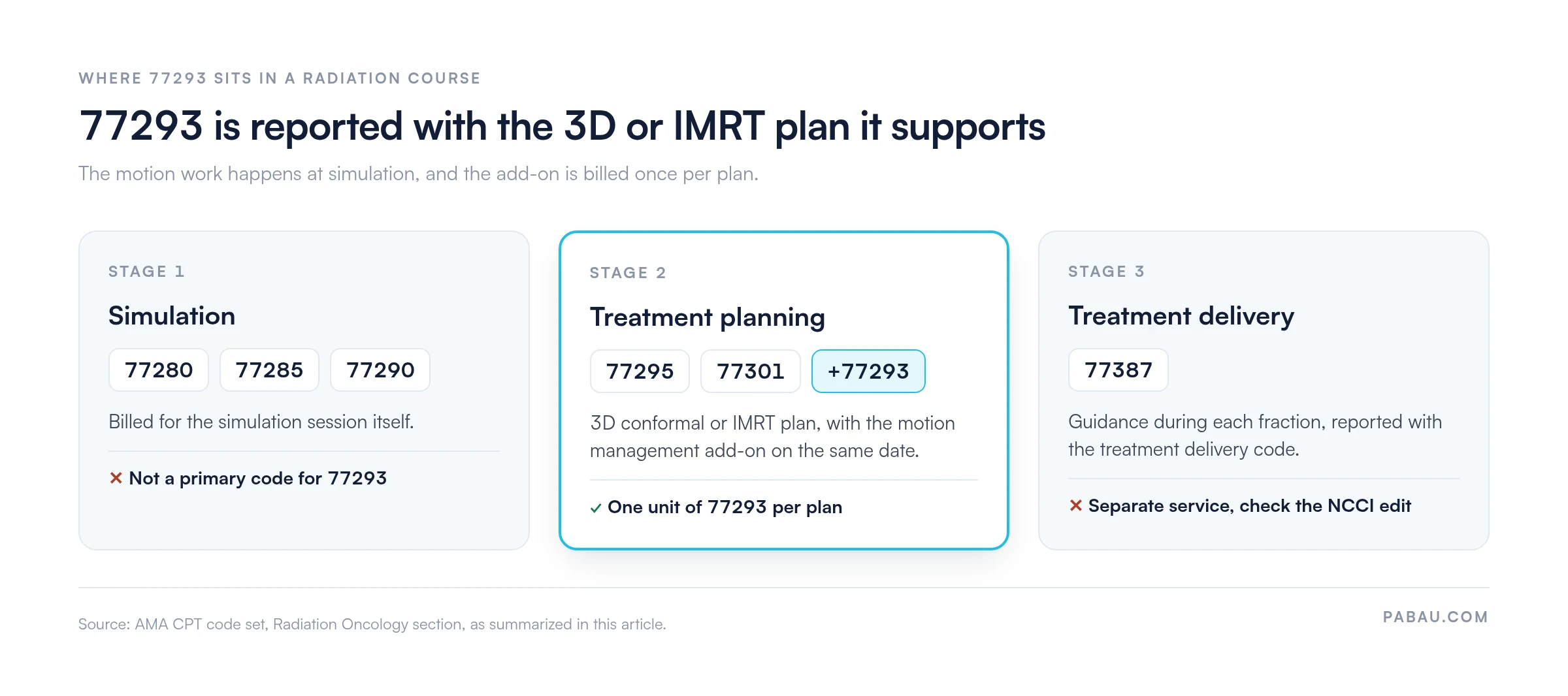
77293 is the CPT add-on code for respiratory motion management simulation. It is reported with a 3D conformal plan (77295) or an IMRT plan (77301) on the same date, once per plan.
The service covers 4D CT, respiratory gating, real-time tumor tracking, or abdominal compression set up during simulation. Payers expect the record to name the technique used and a diagnosis at a site that moves with breathing.
Let Pabau's smart automation suggest the right codes, reduce claim denials, and keep your practice compliant—effortlessly.
Automate repetitive tasks and focus on what matters most—your patients.
Reduce coding errors and ensure compliance with the latest regulations.
Clean claims, fewer denials, and faster reimbursements.
Powerful insights and reporting to help your practice thrive.
HIPAA compliant SOC 2 certified GDPR-compliant Trusted by 4,000+ clinics worldwide

CPT code 77293 covers motion management at simulation only. Motion management during treatment delivery is a separate service, reported under 77387.
77293 is an add-on code, reported only with 77295 or 77301 on the same date and billed once per 3D or IMRT plan.
Documentation must name the motion management technique used (4D CT, gating, real-time tracking, or abdominal compression), or medical necessity denials follow.
Medicare pays 77293 under the Physician Fee Schedule, while hospital outpatient billing packages it into the primary service with no separate OPPS payment.
Pabau’s claims management software checks each claim for missing or invalid details before submission and flags rejected claims with the payer’s reason.
CPT code 77293 is the add-on code for respiratory motion management simulation. It is reported on the same date as 3D conformal planning under 77295 or IMRT planning under 77301. The American Medical Association maintains the code. Its descriptor covers the work of simulating how a target volume moves with a patient’s breathing before radiation treatment begins.
Clinically, this service involves imaging the patient in the treatment position while capturing the full range of tumor motion driven by respiration. The output feeds directly into the treatment plan. Without it, the planning target volume must be expanded to cover the tumor’s worst-case position across the breathing cycle, which increases normal-tissue dose. Performing and documenting 77293 allows the treatment team to use a motion-adapted plan that spares more healthy tissue.
CPT code 77293 is an active, billable add-on code, listed as +77293 in the CPT code set. It sits in the Radiation Oncology section, within the Clinical Treatment Planning (External and Internal Sources) range, 77261-77299. As an add-on, it is reportable only with 77295 or 77301 on the same date of service, never on its own.
The code is not facility-only. The treating physician or the facility can bill it, depending on where the simulation takes place and how components are split.
CPT code 77293 covers four respiratory motion management techniques performed during the simulation session. Recording which one was used for the patient is the first documentation task.
The code bundles physician supervision of the simulation session, interpretation of the motion data, and documentation of the motion management approach into a single service. CT scanner time for the simulation itself is reported under the simulation code (77280, 77285 or 77290), not under 77293.
CPT 77293 covers motion management at simulation, while CPT 77387 covers guidance for localizing the target volume during treatment delivery. The two codes describe different phases of the same motion management strategy. 77293 is reported with the 3D or IMRT plan, and ASTRO’s coding guidance ties 77387 to the treatment delivery code.
Modifier 59 is not a routine part of reporting these two codes. Check the current National Correct Coding Initiative (NCCI) edit between 77293 and 77387 before submission, because NCCI tables update quarterly. Append 59 only where an edit applies and the record documents two distinct services.
Radiation oncology billing involves several closely related simulation and planning codes. Knowing where 77293 sits among its neighbors prevents both underbilling and add-on errors. The diagram below shows the one stage of a course where 77293 is reported.
Missing documentation is the primary reason CPT code 77293 claims are denied on medical necessity grounds. The record must show which technique was used and why it was clinically indicated for this patient and site. Review medical billing compliance requirements for the full documentation framework that applies to radiation oncology services.
Document the motion management technique in the simulation note on the day of service, not retrospectively. Payers and Medicare Administrative Contractors (MACs) treat backdated documentation as a red flag during audits. A note written after a denial persuades far less than one written before the claim was submitted.
The diagnosis code on a 77293 claim must reflect a tumor site where respiratory motion is clinically meaningful. A claim pairing 77293 with a pelvic malignancy diagnosis will frequently trigger a medical necessity denial because the site does not justify respiratory motion management. Common supporting ICD-10-CM codes include primary and secondary malignancies of thoracic and upper abdominal organs.
The pairing of 77293 with a code from the pelvic region (prostate, bladder, rectum) is a common coder error. Some pelvic structures do move with respiration. Even so, payers rarely accept 77293 as medically necessary for these sites without a strong clinical justification in the record. When in doubt, document the measured excursion amplitude and cite it as the basis for the service.
Medicare pays physicians for CPT code 77293 under the Physician Fee Schedule (PFS). In the hospital outpatient setting, 77293 is an add-on that is packaged into the primary service, so OPPS makes no separate payment for it.
PFS amounts vary by locality and change each January. Confirm the current amount with the CMS Physician Fee Schedule lookup tool before quoting expected reimbursement.
Traditional Medicare Part B does not require prior authorization for radiation therapy services, including 77293. Medicare Advantage plans set their own rules, and many require prior authorization for simulation services. Verify the patient’s plan requirements before scheduling, and never assume fee-for-service rules apply to Medicare Advantage.
Modifier selection for CPT code 77293 directly affects whether the claim pays at the correct rate and whether it survives NCCI edit review. Three modifiers are relevant: 26, TC, and 59.
Modifier 59 is commonly misapplied as a reflexive override whenever a bundling edit fires. Correct use requires that the two services were performed at separate sessions or are clearly distinct. Applying 59 without supporting documentation exposes the practice to audit risk.
CPT code 77293 is billed once per 3D or IMRT plan, as an add-on to the 77295 or 77301 it accompanies, and never per fraction. Billing more than one unit against a single plan is a frequent claim error.
The rationale: The simulation session sets the motion management parameters that the plan is built on. Those parameters hold between fractions unless the patient’s anatomy changes enough to warrant a new simulation and a new plan. Two scenarios support billing 77293 a second time:
CPT code 77293 denial reasons follow consistent patterns across payers. Most are preventable with a front-end documentation workflow rather than a back-end appeals process. A systematic denial management workflow for radiation oncology teams addresses these patterns before they become write-offs. The CARC codes that accompany each rejection type are listed in our guide to medical billing denial codes.
A consistent pre-submission workflow keeps CPT code 77293 claims compliant and acceptance rates high. Each step below maps to a specific denial risk. Building it into your revenue cycle management catches problems before they reach the payer.
CPT code 77293 itself is unchanged for the 2025-2026 code cycle: The descriptor, parenthetical guidelines, and code status are stable. The AMA’s CPT coding resources page confirms the current year’s radiation oncology code set. The AAPC CPT code lookup provides descriptor verification for the full radiation oncology range.
Relative value units (RVUs) for radiation oncology codes can move with each Physician Fee Schedule final rule. Check the 2026 PFS final rule for current RVUs on 77293 and its primary codes, 77295 and 77301, before updating your fee schedule.
ASTRO (American Society for Radiation Oncology) publishes updated coding guidance each year, including how 77293 pairs with the planning codes. Review ASTRO’s current coding resources when a MAC issues a new local coverage determination for radiation oncology services in your region.
Each October, review the AMA’s CPT changes for the coming year. Then review CMS’s final Physician Fee Schedule rule when it publishes in November. Both documents affect 77293 billing, and catching changes before January 1 prevents claim-form errors on the first billing cycle of the new year.
Radiation oncology billing teams often key 77293 claims by hand. A missing primary code or a misplaced modifier then surfaces only when the payer rejects the claim. Each rejection adds a rework cycle before the plan is paid.
Pabau, the practice management platform we build, includes claims management software that checks every claim for missing or invalid details before it leaves the system. Claims go out as electronic CMS-1500s through Claim.MD, Pabau’s clearinghouse integration, to thousands of US payers.
Rejected claims come back flagged with the payer’s reason, so your team can correct and resubmit them. Electronic remittance advice then settles payments against the claims they belong to, and eligibility checks confirm coverage before the simulation session.


Pabau checks each claim for missing details before submission and sends electronic CMS-1500 claims to thousands of US payers through Claim.MD. See how radiation oncology billing teams cut claim rework.

Bill 77293 the way the code is built, as an add-on to the 3D or IMRT plan and once per plan. Name the motion management technique in the simulation note on the day of service, and match the diagnosis to a site that moves with breathing.
Those habits prevent the denials this code attracts most often. The cost is a few extra minutes at simulation, which is far less than an appeal months later.
To see how Pabau catches radiation oncology claim errors before they reach the payer, book a demo.

Need to understand how clearinghouse claims submission works? Medical claims clearinghouse explained covers how 837P electronic claims reach payers and what happens when a claim is rejected at the gateway.
Want a reference for the 837 file format used in claim submission? 837 EDI file guide explains the transaction set structure that carries CPT codes including 77293 to payers and clearinghouses.
Confused by electronic remittance advice after a 77293 payment posts? Electronic remittance advice guide explains ERA 835 transaction codes and how to reconcile payments against submitted claims.
CPT code 77293 describes respiratory motion management simulation, an add-on service reported with a 3D or IMRT plan. The treatment team records how a tumor moves during the patient’s breathing cycle. It covers 4D CT acquisition, respiratory gating setup, real-time tracking, and abdominal compression set up before treatment begins.
CPT 77293 is reported once per 3D or IMRT plan, as an add-on to 77295 or 77301, for motion management at simulation. CPT 77387 is reported per fraction during treatment delivery, with the treatment delivery code. Where both share a claim, check the current NCCI edit before submission. Add modifier 59 only when an edit applies and the record shows distinct services.
One unit per 3D or IMRT plan, reported with the 77295 or 77301 it accompanies. A second unit is supported only when a new plan is billed, such as a new course for a different site or a recurrence. A full re-simulation and replan after major anatomic change also qualifies, with the clinical reason documented in detail.
Traditional Medicare Part B does not require prior authorization for radiation therapy simulation services, including 77293. Medicare Advantage plans set their own prior authorization policies, and many require it for simulation services. Verify the patient’s plan requirements before scheduling, even when the plan carries the Medicare name.
The most frequent denials come from four errors. The simulation note may not name the motion management technique, or the ICD-10 code may point to a site without meaningful respiratory motion. Others come from billing 77293 without 77295 or 77301, or billing more than one unit per plan. Each has a prevention step in the billing workflow section above.
Prior authorization requirements for 77293 vary by commercial payer and plan type. Many commercial plans require it for radiation therapy planning services, including motion management simulation. Check the payer’s current authorization matrix before scheduling. Include the motion management technique, the clinical rationale, and the supporting ICD-10 code in the request.
Yes. 77301 is one of the two primary codes 77293 can be reported with, alongside 77295. The pairing is standard for patients receiving IMRT with respiratory motion management, and both codes go on the same date of service. Confirm the current NCCI edit status before submission, as edit tables update quarterly.