CPT code 63081: Vertebral corpectomy, cervical spine
CPT code 63081: official descriptor and procedure overview CPT code 63081 descri...

Last Updated: Oct 6, 2026

CPT code 77014 was deleted effective January 1, 2026, and claims with a later date of service must use its replacement path.
The technical component of CT guidance is now bundled into the revised treatment delivery codes 77402, 77407 and 77412.
The professional component is reported with 77387 and modifier 26, so 77387 replaces only half of what 77014 used to cover.
Medicare no longer prices 77014, so payment follows the delivery level billed plus the 77387-26 professional read.
Claim.MD integration with Pabau flags unrecognized codes on remittance, which catches a stray 77014 before it repeats across a treatment course.
CPT code 77014 described computed tomography guidance for the placement of radiation therapy fields, and it was deleted effective January 1, 2026. Nothing replaces it one-for-one.
The technical component of that CT guidance now sits inside the revised treatment delivery codes 77402, 77407 and 77412, which include imaging guidance when performed. The physician read is billed separately as 77387 with modifier 26.
Each component now travels on a different line of the claim, which is where crosswalk errors begin. This reference covers the deletion, the crosswalk on both components, and the modifiers that still matter. It also sets out documentation and the denial patterns that follow a retired code.
CPT code 77014 was the American Medical Association code for computed tomography guidance for placement of radiation therapy fields. The radiation oncologist or medical physicist used CT imaging at the treatment unit to confirm that the planned fields lined up with the target volume.
The code captured that localization service separately from the radiation delivery itself. As of January 1, 2026 it no longer exists.
The service did not disappear with the code. CT guidance is still performed, still documented, and still paid. What changed is where it is reported. The 2026 CPT revision moved the equipment and staff work into the delivery codes and left the physician interpretation as a standalone professional service.
Code status note: the AAPC CPT code database lists 77014 among the deleted codes. The CY2026 Medicare Physician Fee Schedule and Hospital Outpatient final rules carry the same deletion. A claim that still contains 77014 for a 2026 date of service is rejected, not reduced.
Two codes replaced 77014, not one. The AMA revised the external beam delivery family into three complexity levels and folded image guidance into them.
The technical component now travels with the delivery code. Image guidance for all treatment delivery was then consolidated into 77387, which survives as a professional-only service reported with modifier 26. The split below is the shape to hold in mind before reading the crosswalk table.
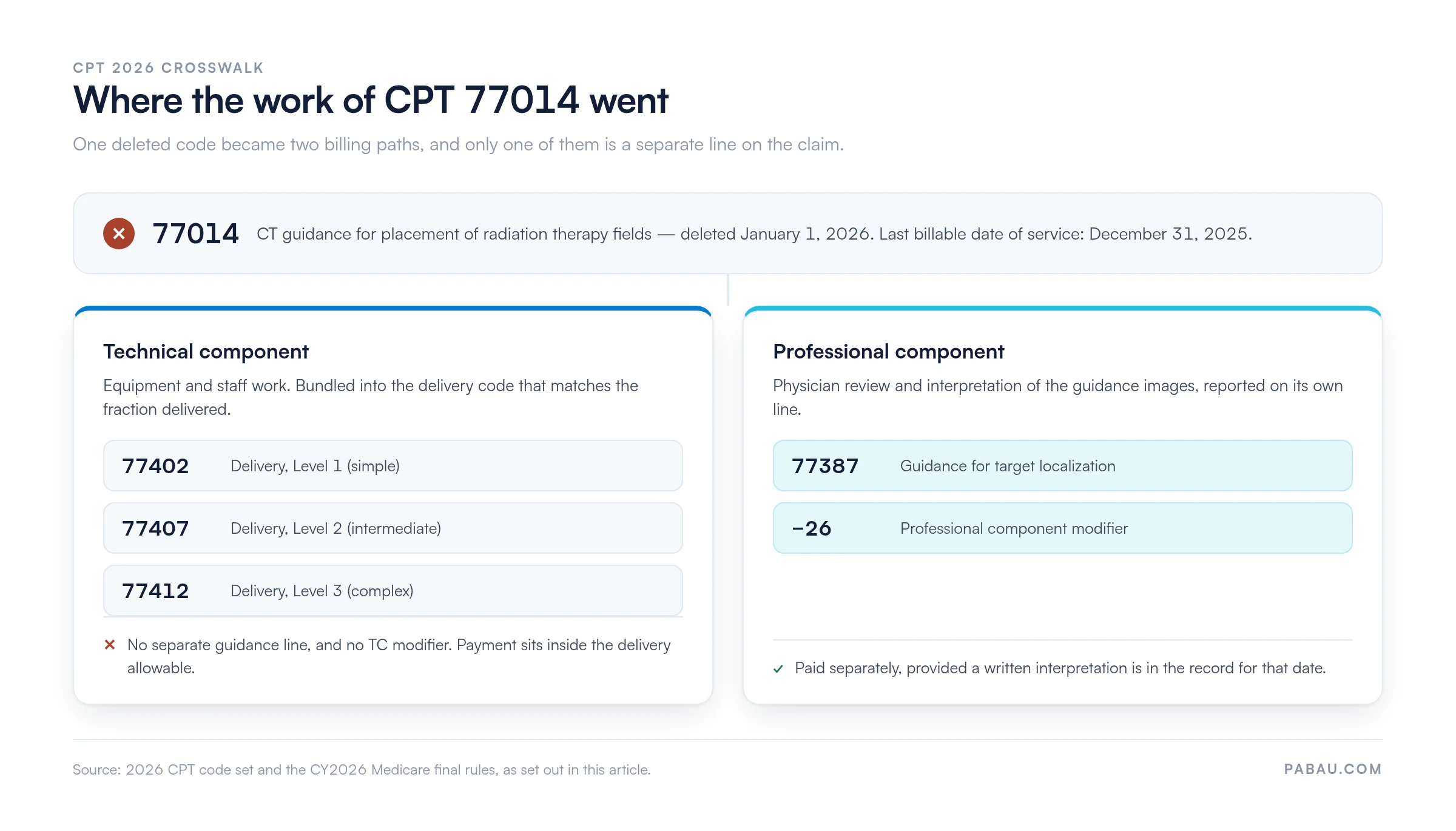
Read the crosswalk in that order and the billing follows. Pick the delivery level that matches what was actually delivered, then add 77387-26 for the physician read.
Do not append TC to 77387, and do not look for a separate guidance line item on the technical side. The equipment and staff work is already paid inside 77402, 77407 or 77412.
Run a report on every claim your practice filed with 77014 in the last quarter of 2025, then sort it by delivery code. That mix of 77402, 77407 and 77412 is the mix you should expect in 2026. A sudden drift toward one level usually means the delivery code is being picked from habit rather than from the treatment record.
Medicare no longer prices CPT code 77014, because a deleted code carries no fee schedule amount. Payment for the same clinical work now arrives in two pieces. The technical side is paid through the delivery code, and the professional side is paid through 77387-26.
Rates for both still come from the CMS Medicare Physician Fee Schedule (MPFS) and vary by locality. Hospital outpatient departments are paid under OPPS instead. Because the delivery codes were revised and revalued for 2026, last year’s figures are not a usable reference point.
Commercial allowables still vary by contract, and some payers apply local coverage policies that differ from Medicare. Checking the payer-specific fee schedule before a treatment course starts is the safest way to avoid a revenue surprise across twenty or thirty fractions.
Modifiers no longer attach to 77014, because the code cannot be submitted. They attach to the codes that replaced it. Modifier 26 is the important one. Code 77387 is reported as a professional service, and the technical component of image guidance sits inside the delivery code.
Medicare prefers the X modifiers (XE, XS, XP, XU) over modifier 59 when two services need to be distinguished. Check with your MAC before defaulting to 59 on a radiation oncology claim. Bundling edits between 77387 and the delivery codes are tighter than they were under the old structure.
Bundling changed the billing, not the chart. Payers still require contemporaneous documentation to support the guidance service. An incomplete record is the most common reason a radiation oncology imaging claim is denied. Following ASTRO’s coding guidance for CT guidance, the medical record should include:
The written interpretation carries more weight than it used to. It is the evidence behind the 77387-26 line, and a missing report now costs the only separately payable piece of the service. Before submission, match the imaging date on the CT report to the date of service on the claim. A mismatch alone can trigger a medical review request.
Build a CT guidance documentation template in your EHR. Have it auto-populate the imaging date, the physician name, the delivery level used, and the treatment plan reference number. Complete it the same day as the imaging session. Same-day completion removes the most common audit finding, which is documentation dated after the claim was submitted.
Medicare and commercial payers cover image guidance when it is medically necessary for accurate field placement. The relevant local coverage determination, L34652 in many jurisdictions, sets out the clinical indications. Coverage generally requires:
Payers do not assume guidance is warranted on every fraction. Some LCDs limit frequency, covering the initial field setup plus later sessions where a field modification is documented.
Reporting 77387-26 on every daily fraction without a clinical reason can still trigger a recoupment audit, even though the technical component is bundled. Find your MAC and its applicable LCD through the CMS Medicare Coverage Database.
Radiation oncology billing produces a concentrated set of denial patterns, and the 2026 restructure added a few. Most of them come from the same handful of mistakes.
Tracking denial codes at the CPT-code level exposes these patterns before they compound across a course. The diagnosis side deserves the same scrutiny, so check each claim against the ICD-10-CM diagnosis codes the applicable LCD covers. CARC codes returned on the remittance then point at the line that failed.
CPT code 77014 sat within a family of radiation oncology codes, and its work is now spread across several of them. The table below shows the companion codes a coder meets on a radiation therapy claim, and how each one relates to the guidance service.
The audit-sensitive distinction is now between the delivery level and the professional read. Confirm which delivery level was actually performed, then confirm that a physician interpretation exists before 77387-26 goes on the claim. Simulation codes 77280 to 77295 remain separate from both.
A code deletion hits radiation oncology harder than most specialties. Claims are high in volume and repetitive, so one wrong code repeats across every fraction in a treatment course. By the time a quarterly review finds it, the practice is rebilling weeks of work.
Practice management software like Pabau keeps that loop short. Pabau’s claims software for oncology practices, integrated with Claim.MD, submits claims electronically to thousands of US payers. T
he integration handles CMS-1500 and 837P claims, returns eligibility results while the claim is being prepared, and posts ERA remittances with CARC denial codes.
For a practice that used to bill 77014 alongside 77427 and 77336, that visibility is what surfaces the crosswalk error early. A rejection for an unrecognized code shows up on the remittance within days. The billing team can fix the charge template before the pattern spreads across the rest of the course.

The wider benefit is catching a retired code at the first remittance rather than at the next audit. Practices can also export superbills through the Claim.MD integration, then reconcile treatment session records against claim submissions each day.
Set up a payer-level denial tracking report filtered to your radiation oncology codes: 77387, 77402, 77407, 77412, 77427 and 77336. Review it weekly. Denial patterns grouped by code expose modifier errors, frequency violations and wrong delivery levels before they accumulate across a full multi-week treatment course.

Pabau’s claims management tools, integrated with Claim.MD, automate eligibility verification, code validation, and ERA posting for radiation oncology practices. See how it works for your billing workflow.

CPT code 77014 is gone, deleted effective January 1, 2026, and the service it described is now billed in two places. The technical component rides inside the delivery code, 77402, 77407 or 77412.
The professional component is reported as 77387-26. A billing team that carries only half of that crosswalk will either lose the physician read or chase a technical payment that no longer exists.
From there the recurring work is familiar: complete documentation, accurate modifiers, and payer-specific frequency limits.
Pabau’s integration with Claim.MD gives radiation oncology practices eligibility checks and denial-code visibility. That is what keeps a coding change from turning into a month of rework. Book a demo to see how the workflow fits your billing setup.

Need to understand denial codes on your ERA? Denial codes in medical billing explains how to read and act on CARC codes returned on remittance advice.
Want to verify claim accuracy before submission? Medical billing compliance covers the key rules that keep radiation oncology claims audit-ready.
Curious how ERA remittance posting works? Electronic remittance advice walks through the 835 transaction and how automated ERA posting reduces manual reconciliation.
CPT code 77014 reported computed tomography guidance for the placement of radiation therapy fields. It captured the CT-based localization that confirmed field accuracy at the treatment unit. The code was deleted effective January 1, 2026.
Yes. CPT code 77014 was deleted effective January 1, 2026, and December 31, 2025 was its last billable date of service. Submitting it on a 2026 claim produces an automatic rejection.
Two codes did, because the service was split. The technical component is bundled into the revised delivery codes 77402 (Level 1), 77407 (Level 2) and 77412 (Level 3). The professional component is reported separately as 77387 with modifier 26.
No. 77014 cannot be billed at all for a 2026 date of service. Image guidance is now reported as 77387-26 for the physician read, alongside the delivery code that already includes the technical component.
Yes, for the guidance work formerly billed under 77014. The technical component of image guidance sits inside 77402, 77407 and 77412, so a global 77387 asks for payment twice and draws a bundling denial.
The record needs a physician order for CT guidance, date-stamped images, and a written physician interpretation of the findings and any field adjustment. Add the updated treatment plan or setup sheet, plus identity verification linking the imaging to the fraction.
There is no rate. A deleted code carries no fee schedule amount. Look up the delivery code you billed, 77402, 77407 or 77412, and the professional value of 77387 for your locality in the current-year MPFS.
The closest are 77387 (guidance, professional component), 77402 (delivery, Level 1 simple), 77407 (delivery, Level 2 intermediate) and 77412 (delivery, Level 3 complex). Also common are 77427 (treatment management), 77301 (IMRT planning) and 77336 (continuing physics consultation).