HCPCS code J3471: Hyaluronidase ovine injection billing guide
HCPCS code J3471: Descriptor, code type, and quick-reference data HCPCS code J34...

Last Updated: Oct 14, 2026
77300 is the CPT code for a basic radiation dosimetry calculation performed during a course of radiation therapy, only when the treating physician prescribes it. It covers calculations such as central axis depth dose, gap, off-axis factor and tissue inhomogeneity factors.
One unit equals one calculation, usually one per static beam or arc, within the payer's daily unit limit. 77300 can be reported alongside 77301 for separate IMRT verification calculations, but it is included in isodose and brachytherapy planning codes.
Let Pabau's smart automation suggest the right codes, reduce claim denials, and keep your practice compliant—effortlessly.
Automate repetitive tasks and focus on what matters most—your patients.
Reduce coding errors and ensure compliance with the latest regulations.
Clean claims, fewer denials, and faster reimbursements.
Powerful insights and reporting to help your practice thrive.
HIPAA compliant SOC 2 certified GDPR-compliant Trusted by 4,000+ clinics worldwide

CPT code 77300 is billed per calculation, usually one per static beam or one per arc, not per treatment area, fraction or course.
The treating physician must prescribe the calculation, and the professional component is billed by the radiation oncologist, not by the physicist.
NCCI doesn’t bundle 77300 into 77301, so it can be reported with an IMRT plan for separate verification calculations within the MUE limit.
Isodose, brachytherapy isodose and special port plans already include basic dosimetry, so 77300 isn’t reported separately with those codes.
Pabau, the practice software we build, runs validation checks before each claim goes out, so your team can catch errors before submission.
CPT code 77300 is the code for a basic radiation dosimetry calculation, billed once for each calculation performed during a course of radiation therapy.
The American Medical Association descriptor lists the calculations it covers:
The descriptor adds two conditions. The calculation must be required during the course of treatment, and it counts only when the treating physician prescribes it.
In practice, a medical physicist or dosimetrist calculates the monitor units or treatment time needed to deliver the prescribed dose for a beam or arc. The radiation oncologist prescribes the calculation and reviews the result.
77300 describes a calculation, not a treatment plan. That separates it from 77301 (IMRT planning) and from isodose plans (77306 and 77307), which already include basic dosimetry. It can still be reported with 77301 for separate IMRT verification calculations.
Two billing components can be split under this code. The professional component covers the physician’s prescription and review. The technical component covers the equipment, staff and facility work behind the calculation. Split billing uses modifiers 26 and TC, as discussed in the modifier section below.
77300 applies to standard calculations for conventional photon and electron fields, 3D conformal beams, and independent monitor-unit checks on IMRT beams or arcs. It covers the calculation itself, not the plan that produced it.
The line that matters is between 77300 and the codes that already include it. An isodose plan (77306 or 77307) or a brachytherapy isodose plan (77316-77318) carries its own basic dosimetry. Report 77300 separately only for distinct calculations those codes don’t include, and document each one.
One unit of 77300 equals one basic dosimetry calculation. Practices usually report one unit per static treatment beam (portal) or one per arc. Each unit needs a calculation that was performed and documented separately.
A two-field parallel-opposed setup with a separate electron boost therefore supports three units — two photon beams plus the electron field. On an IMRT or VMAT plan, the physicist’s independent verification calculations can be reported as 77300 alongside 77301. A plan with four arcs, each verified separately, supports four units.
Units are not tied to fractions. A calculation performed once before a 30-fraction course is billed on the date it was completed, not on each treatment day. A new calculation after a plan change supports new units on the date it is performed.
Medicare also caps units per day through a Medically Unlikely Edit (MUE). At the time of writing, the 77300 MUE allows up to 10 units per day.
Commercial payers and Medicaid programs set their own limits. Check the current MUE table and any applicable Local Coverage Determination before submitting multiple units.
The medical record must support every unit billed. A unit with no matching calculation entry is a common reason 77300 claims fail payer review. A compliant record contains the following for each calculation billed:
American Association of Physicists in Medicine (AAPM) task group reports, such as TG-114 on monitor-unit verification, describe what a sound calculation check contains. Aligning internal templates with them also prepares practices for ACR accreditation reviews.
CPT 77301 describes an intensity modulated radiotherapy (IMRT) plan, including dose-volume histograms for target and critical structure partial tolerance specifications. The two codes describe different work: 77301 is the plan, while 77300 is a calculation. They aren’t alternatives to each other.
The NCCI Policy Manual (Chapter 9) does not list 77300 among the codes bundled into 77301. Practices can report 77300 with an IMRT plan for the separate dosimetry verification calculations a physicist performs. Payer policies vary, so check the current NCCI PTP and MUE tables before you submit.
Radiation oncology billing follows a defined sequence. Knowing where 77300 sits in that sequence helps you capture each calculation once, without dropping units or billing the same work twice. The pathway from planning to treatment management looks like this:
Simulation sits between planning and dosimetry in that sequence. The field setting is billed as 77280 when simple, 77285 when intermediate, and 77290 when complex.
Calculations performed before the first fraction are easy to leave off the claim once 77263 and the delivery codes have gone out. A checklist that matches each signed calculation to a claim line catches them.

CPT 77300 has a professional component (modifier 26) and a technical component (modifier TC). Reimbursement changes annually with the Medicare Physician Fee Schedule (MPFS) update. Always verify current rates using the CMS fee schedule lookup tool for the applicable calendar year.
Published figures in any reference, including this one, may not reflect mid-year corrections or locality adjustments.
Key payment mechanics to understand:
Because the descriptor requires the treating physician’s prescription, the professional component belongs to the radiation oncologist who ordered and reviewed the calculation. Confirm the supervision rules for the technical component with your MAC before setting up billing arrangements.
Three modifiers appear most often on 77300 claims. Using the wrong one, or omitting one when it is required, generates CO-4 denials (procedure inconsistent with modifier). An unsupported unbundling modifier can lead to CO-97 denials (payment included in another service) or post-payment recovery.
Before appending modifier 59 to a 77300 claim, document in the calculation record exactly why it is a separate service. Audit this documentation quarterly. Auditors target modifier 59 because it can bypass NCCI edits, and a generic justification note carries the same risk as no note at all.
The National Correct Coding Initiative (NCCI) has two parts. Procedure-to-procedure (PTP) edits define code pairs that can’t be billed together without a qualifying modifier, and MUEs cap units per day. CMS updates both quarterly, so verify the current tables on the CMS NCCI edits page before submitting claims.
NCCI Policy Manual Chapter 9 doesn’t list 77300 among the codes bundled into 77301. 77300 can be reported with an IMRT plan for separate dosimetry verification calculations, usually once per static beam or once per arc, within the MUE.
Chapter 9 does bar 77300 with certain brachytherapy codes: 77767-77772 and 77778. CPT also includes basic dosimetry in 77306 and 77307 (isodose planning), 77316-77318 (brachytherapy isodose planning) and 77321 (special teletherapy port plan). Don’t report 77300 separately with those codes for the same calculations. The chart below sets out which pairings are allowed.
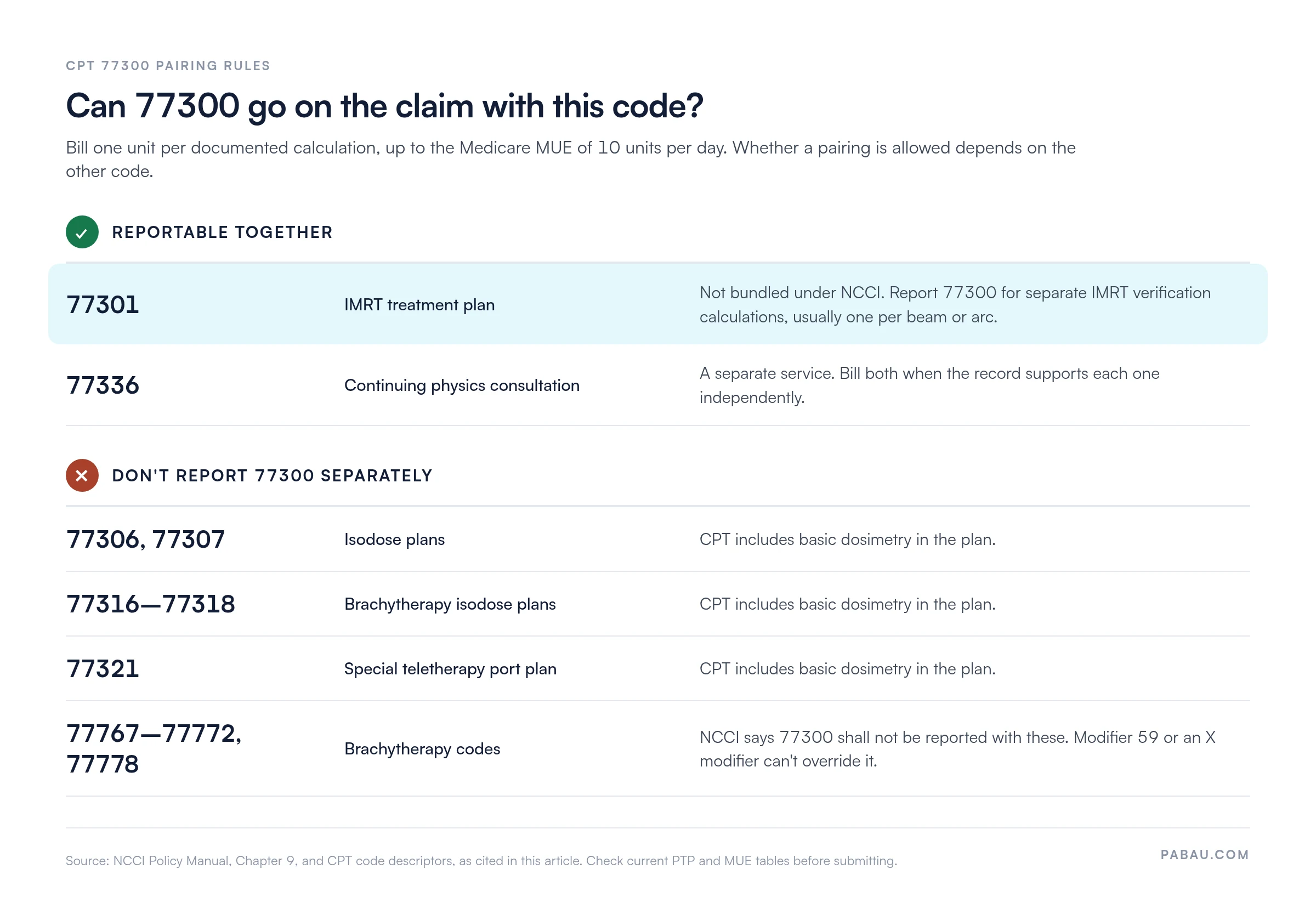
Commercial payers and Medicaid programs may apply their own edits, so check each payer’s policy as well as the current CMS PTP and MUE tables.
77336 is a separate service and does not bundle with 77300 under NCCI. Both can be billed when a discrete dosimetry calculation and ongoing physics oversight both occurred, provided the documentation supports each service independently.
Four medical billing denial codes appear repeatedly on 77300 claims across Medicare and commercial payers. Each has a specific root cause and a concrete fix.
A clearinghouse connection shortens the rework cycle when a line does deny. Pabau integrates with the Claim.MD clearinghouse, which submits electronic CMS-1500 claims and runs real-time eligibility checks. Claim statuses and remittance advice come back into Pabau. NCCI edits still need checking against the current CMS tables before submission.
A medical physicist or dosimetrist usually performs the 77300 calculation, but the descriptor requires the treating physician to prescribe it. Medicare doesn’t enroll medical physicists as billing providers. The radiation oncologist bills the professional component, and the facility or freestanding center bills the technical or global service.
Dosimetrists may perform calculations under a medical physicist’s supervision, and most centers have a board-certified physicist review them. The radiation oncologist then reviews the result as part of the prescription. Supervision rules for the technical component differ by setting, so confirm the applicable level with the MAC for the practice’s jurisdiction.
Commercial payers generally follow CMS enrollment standards, but some have their own credentialing rules for radiation oncology services. Billing the professional component under a physician who neither prescribed nor reviewed the calculation is a compliance risk. Checking provider enrollment records against payer directories once a year reduces this risk.
Run a quarterly audit matching every 77300 claim line to a signed calculation record and the prescribing physician’s order. Any line missing either one is a potential compliance finding. Catching these internally is far less costly than discovering them during a MAC review.
A single radiation therapy course generates planning, dosimetry, delivery and management codes. Each has its own documentation standard, unit basis and edit rules. Tracking them by hand across several physicists and oncologists leaves room for missed units and avoidable denials.
Pabau keeps claims, patient records and insurer details in one system. Its claims software for billers pre-fills each submission from the patient record and runs validation checks in the background before you send it. That helps your team check each 77300 line against the signed calculation record before submission.
Through the Claim.MD integration, claims go to US payers electronically, and statuses and remittance advice come back into Pabau. Your team sees which 77300 lines were paid or denied without switching portals. Pair that with a medical billing workflow built around a clean claim checklist, and rework drops.

Pabau’s claims management tools help radiation oncology billing teams check claims before submission, track claim status, and keep records linked to every 77300 line.

Unit counting carries more risk on 77300 than the 77301 pairing does. Bill one unit per documented calculation, usually one per static beam or arc, and stay within the current MUE.
The bundling hazard sits with the codes that already include basic dosimetry: isodose, brachytherapy isodose and special port plans. Check the NCCI PTP and MUE tables every quarter, because edits and payer policies change.
Then let the documentation carry the claim. That means a physician order, a signed calculation record for every unit, and a date of service that matches the work. Book a demo to see how Pabau helps your billing team check radiation oncology claims before they go out.

Need to understand how denial codes translate into corrective actions? Denial codes in medical billing explains the most common CARC and RARC codes and the appeal steps each requires.
Want to verify claim eligibility before submitting radiation oncology codes? Insurance eligibility verification covers the real-time checks that flag lapsed or inactive coverage before the claim reaches a payer.
Billing image guidance during the same radiation course? CPT code 77387 covers IGRT guidance billing, modifiers and reimbursement.
Looking for a guide to the 837 electronic claim file format used for 77300 submissions? The 837 file walks through the transaction set structure and how clearinghouses process it.
CPT code 77300 covers a basic radiation dosimetry calculation prescribed by the treating physician during a course of radiation therapy. Examples include central axis depth dose, gap, off-axis and tissue inhomogeneity calculations. It is billed per calculation and doesn’t cover IMRT planning (77301), isodose planning (77306 or 77307) or continuing physics consultation (77336).
Bill one unit per calculation performed and documented, usually one per static beam or one per arc. At the time of writing, Medicare’s MUE allows up to 10 units of 77300 per day. Billing a unit for every fraction without a new calculation is an error. Commercial payer limits vary, so check the current MUE table and the payer’s policy before submitting multiple units.
CPT 77300 is a basic dosimetry calculation, billed per calculation. CPT 77301 is the full IMRT treatment plan, including dose-volume histograms, billed per plan. NCCI doesn’t bundle 77300 into 77301, so 77300 can be reported with 77301 for separate verification calculations, usually once per beam or arc. Payer policies vary, so check the current NCCI PTP and MUE tables.
Yes. CPT 77336 (continuing medical physics consultation, per week of therapy) and 77300 address different services and are not bundled under NCCI. 77336 covers ongoing treatment oversight, while 77300 covers a discrete dosimetry calculation. Both may appear on the same claim when documentation supports each service and the 77300 date matches the date of the calculation.
Yes. Medicare pays 77300 under the Physician Fee Schedule. The radiation oncologist bills the professional component, and the facility or freestanding center bills the technical component. In hospital outpatient settings, the technical component is paid under OPPS. Verify current payment rates via the CMS fee schedule lookup tool each January.
CO-97 is common when 77300 is reported with a code that already includes it, such as 77306, 77307 or brachytherapy planning codes. CO-4 follows modifier errors in split billing, CO-11 a diagnosis mismatch, and CO-B7 a billing provider who isn’t enrolled with the payer. Units above the MUE also deny. Checking current NCCI PTP and MUE tables and auditing modifiers by setting prevents most of these.