HCPCS code Q4154: Biovance billing, Medicare rate and denial guide
HCPCS code Q4154: definition and code details HCPCS code Q4154 is a Level II cod...

Last Updated: Oct 6, 2026
77280 is the CPT code for therapeutic radiology simulation-aided field setting; simple. It covers a simulation session for a single treatment area, set up with one or two fields and standard patient positioning.
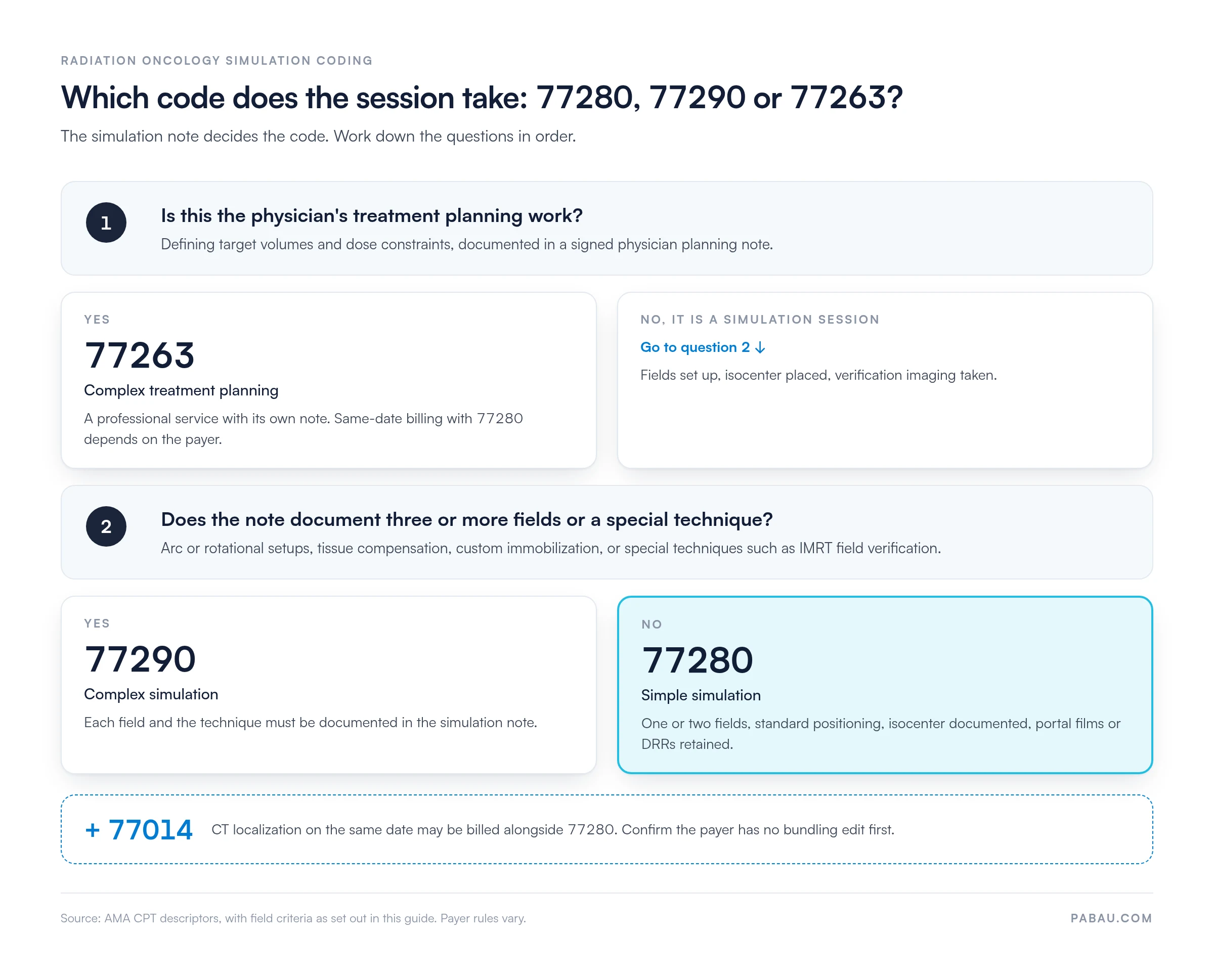
The documented field count and setup decide the code. Three or more fields, arc or rotational techniques, or custom immobilization move the session to 77290. The physician's complex treatment planning is a separate service, billed under 77263.
Let Pabau's smart automation suggest the right codes, reduce claim denials, and keep your practice compliant—effortlessly.
Automate repetitive tasks and focus on what matters most—your patients.
Reduce coding errors and ensure compliance with the latest regulations.
Clean claims, fewer denials, and faster reimbursements.
Powerful insights and reporting to help your practice thrive.
HIPAA compliant SOC 2 certified GDPR-compliant Trusted by 4,000+ clinics worldwide

CPT Code 77280 covers a simple radiation therapy simulation: one treatment area, one or two fields, isocenter placement and portal imaging verification.
Three or more fields or a special technique moves the session to 77290, while 77263 covers the physician’s complex treatment planning as a separate service.
Billing 77290 when the simulation note documents only one or two fields invites downcoding and denial, so the note has to carry the field count.
Claims management software such as Pabau flags missing fields on 77280 claims before submission and tracks each claim across payers.
CPT Code 77280 is the code for a simple radiation therapy simulation. The American Medical Association descriptor reads: Therapeutic radiology simulation-aided field setting; simple.
That “simple” qualifier carries the code’s clinical and billing weight. It means one treatment area, set up with one or two fields and standard patient positioning. The isocenter is placed and confirmed with portal imaging or digitally reconstructed radiographs (DRRs). Arc or rotational techniques, irregular field geometry and multi-field arrangements all take the session out of this code.
The procedure is performed jointly by a radiation oncologist and a medical physicist or dosimetrist. The oncologist determines the treatment site and field orientation. The physics staff handle beam setup, block or multileaf collimator (MLC) placement, and verification film acquisition. Both roles must be documented for a clean claim.
Common clinical scenarios billed under 77280 include:
Coders often mix up 77280, 77290 and 77263 because the three codes sit close together. They describe different services, and the table shows where each one applies.
77263 sits apart from the other two. It’s a professional treatment planning service that pays for the radiation oncologist’s work defining target volumes and dose constraints. It needs its own signed physician note documenting how complex that planning decision was.
Billing 77280 and 77263 on the same date requires distinct documentation for each service. Payer policies vary on whether the pair is allowed at all, so check each payer before submitting both.
CPT Code 77280 is billable when the simulation session meets all of these criteria:
Simulations with three or more fields, arc or rotational techniques, tissue compensation, or special techniques such as IMRT field verification fall under 77290.
When the setup includes CT-based localization on the same date, 77014 may be billed alongside 77280 as a companion code. That pairing is widely accepted, but confirm your payer has no bundling edit before submitting both on one claim. The decision path below shows how the simulation note settles the code.
Medicare reimbursement for CPT Code 77280 comes from the Physician Fee Schedule (MPFS). Relative value units (RVUs) are multiplied by the Medicare conversion factor, then adjusted for geographic locality.
Rates change with each annual MPFS update, so the table below shows the payment structure rather than a fixed dollar amount. Always verify the current-year rate using the CMS Physician Fee Schedule lookup tool, selecting the applicable year and locality.
For current RVU values, use the FastRVU lookup tool, which pulls directly from the CMS MPFS data file. Enter code 77280, select the applicable year and modifier (if any), and note both the facility and non-facility payment amounts. The non-facility rate typically applies to freestanding radiation oncology offices. The facility rate applies at hospital outpatient departments.
Run a place-of-service audit on every 77280 claim before submission. Billing POS 22 (outpatient hospital) for a service performed in a freestanding office (POS 11) is a frequent mismatch. It causes claim rejection and delayed payment. Verify the POS code matches the actual treatment facility type on each date of service.
Several codes are commonly submitted on the same claim as or concurrent with CPT Code 77280. Each has specific conditions that govern whether it can be billed on the same date of service.
Modifier 59 (distinct procedural service) is the most commonly applied modifier when submitting companion codes. Use it only when a bundling edit exists and the record justifies separate billing. Applying it without supporting documentation is an audit risk in its own right.
Traditional Medicare (fee-for-service) does not generally require prior authorization for CPT Code 77280. The picture changes significantly with Medicare Advantage plans, commercial payers, and plans managed through authorization vendors.
Maintaining medical billing compliance across payer types means checking authorization when the simulation is scheduled. By the time a claim reaches coding, an unresolved prior authorization has already become a denial. That denial is harder to overturn than a problem caught before the appointment.
A complete CPT Code 77280 claim rests on documentation that covers six elements. Missing any one of them is sufficient cause for denial.
The superbill documentation process for radiation oncology should capture all six elements at the point of service. Retroactively reconstructing a simulation note after a denial is difficult and raises additional audit concerns about record integrity.
Denial patterns for CPT Code 77280 are consistent enough across payers that a targeted pre-submission checklist catches most of them. Understanding denial management in healthcare starts with knowing which denials are preventable at submission.
Timing matters as well as complexity. A June 2019 HHS Office of Inspector General audit (A-09-18-03026) looked at planning services billed separately from a 3D conformal plan, 77295.
Simulation codes, 77280 among them, were on its list. Medicare paid hospitals an extra $125.4 million for these services from 2008 through 2017. Most were billed up to 14 days before the plan, where same-date edits didn’t catch them.
When a denial does arrive, build the appeal from four documents. Include the original simulation note, the portal films or DRRs, the signed physician order, and a written explanation of how the service met medical necessity. Reference the denial codes in medical billing to correctly categorize the denial reason before drafting the appeal letter.
Audit your 77280 claims quarterly against your 77290 submission rate. If your 77290 volume is disproportionately high relative to case mix, payer data mining is likely to flag it. The documentation in the simulation note, not the code selected, determines which code is correct.
This step-by-step process covers the full claim lifecycle for CPT Code 77280, from scheduling through submission. Each step targets a handoff point where 77280 claims tend to fail.
In many radiation oncology offices, a biller checks each 77280 claim by hand. They confirm the field count, the physician signature, the place-of-service code and the authorization number, often days after the simulation.
Pabau’s claims management software moves that review ahead of submission. It flags missing fields before the claim reaches the clearinghouse. A missing signature or the wrong POS code gets fixed while the chart is still fresh.
Claims then go out through Pabau’s US clearinghouse integration with Claim.MD. It supports 837P claim formats, real-time eligibility verification and electronic remittance advice (ERA/835). When a claim returns, its CARC denial reason code comes with it, so your team can start the appeal sooner.

Pabau’s claims management tools help radiation oncology teams track CPT Code 77280 claims and catch POS mismatches before submission. Denial reasons show up as soon as claims return.

Let the simulation note pick the code. If it can’t show the field count, the isocenter and the verification images, no code choice will survive a payer review.
The fixes are cheap: a note written on the day, a place-of-service check and an authorization number on file before the appointment. A few minutes of review per claim costs far less than weeks of appeal work later. Book a demo to see how Pabau flags missing fields on radiation oncology claims before they reach the clearinghouse.

Need to understand how clearinghouses process radiation oncology claims? How a medical claims clearinghouse works explains the 837P submission pathway, ERA processing, and how CARC codes surface on returned claims.
Looking to understand the full revenue cycle behind radiation oncology billing? What is revenue cycle management maps the end-to-end process from eligibility verification through payment posting.
CPT Code 77280 covers simple simulation in radiation treatment planning. That means a therapeutic radiology simulation session with one or two treatment fields, isocenter placement and verification on portal films or digitally reconstructed radiographs (DRRs). It does not include treatment delivery or complex multi-field setups.
77280 is simple simulation with one or two standard fields. 77290 is complex simulation, requiring three or more fields, rotational or arc techniques, tissue compensation, or special treatment configurations. The field count and technique complexity documented in the simulation note determine which code applies, not the clinician’s intent.
Medicare reimbursement for CPT 77280 is set annually through the Physician Fee Schedule and varies by locality and place of service. Non-facility rates (freestanding office, POS 11) are generally higher than facility rates (hospital outpatient, POS 22). Use the CMS Physician Fee Schedule lookup tool at cms.gov, selecting the current year and your locality, to get the precise current payment amount.
Traditional Medicare does not typically require prior authorization for CPT 77280. Medicare Advantage plans, commercial payers and plans managed through vendors like eviCore often do. Requirements vary by plan and change annually. Check each payer’s authorization requirements before scheduling the simulation appointment.
Billing 77280 and 77263 on the same date is payer-dependent. Some payers apply a bundling edit; others permit it with modifier 59 or XS and a separate, signed physician planning note supporting the 77263 service. Verify each payer’s policy before co-billing and ensure the 77263 documentation is distinct from the simulation note.
The CPT code for simple simulation in radiation therapy is 77280. Its official AMA descriptor is “Therapeutic radiology simulation-aided field setting; simple.” It applies to sessions involving one or two treatment fields with standard patient positioning and isocenter verification.