



CCSD code G5100: Bypass of duodenum billing guide
CCSD code G5100 bills a bypass that leaves the duodenum in place CCSD code G5100...

Last Updated: Oct 16, 2026

CPT Code 77065 describes unilateral diagnostic mammography, including computer-aided detection (CAD) when performed, for imaging a single breast.
77065 needs a physician order and a documented indication. Billing it for routine screening instead of CPT 77067 is a leading cause of denial.
Medicare pays roughly $122 to $124 for 77065 on the 2025-2026 fee schedule, and the facility and non-facility rates are now almost identical.
A screening study that converts to a diagnostic study the same day still pays. Append modifier GG to the diagnostic code, 77065 or 77066.
Practice management software like Pabau keeps CPT code libraries and claim scrubbing in the billing workflow, so coding errors surface before submission.
CPT Code 77065 is the standard billing code for unilateral diagnostic mammography, including computer-aided detection (CAD) when performed.
It covers imaging of a single breast ordered for a diagnostic purpose, not routine annual screening. The code pays cleanly when the order, the diagnosis code, and the modifier all agree with the chart.
The American Medical Association (AMA) publishes and maintains the CPT code set, including 77065. The code’s full descriptor reads: “Mammography, unilateral; diagnostic, including computer-aided detection (CAD) when performed.”
CAD software reviews the mammography image for findings the radiologist then evaluates. When a facility uses CAD, it is bundled into 77065 and cannot be billed separately.
The most common coding error in mammography billing is using the wrong code from this family. The distinction turns on two variables: clinical purpose (diagnostic vs screening) and laterality (unilateral vs bilateral).
77065 and 77067 can be billed together on the same date when a screening study converts to a diagnostic study of the same breast. Append modifier GG to 77065 so the payer can see that the diagnostic study followed a screening that day.
The same rule covers 77066. When a bilateral screening converts to a bilateral diagnostic study, bill 77066 with modifier GG appended. Only the tomosynthesis add-on codes take modifier 59 instead of GG. The diagram below follows both decisions in the order a coder makes them.
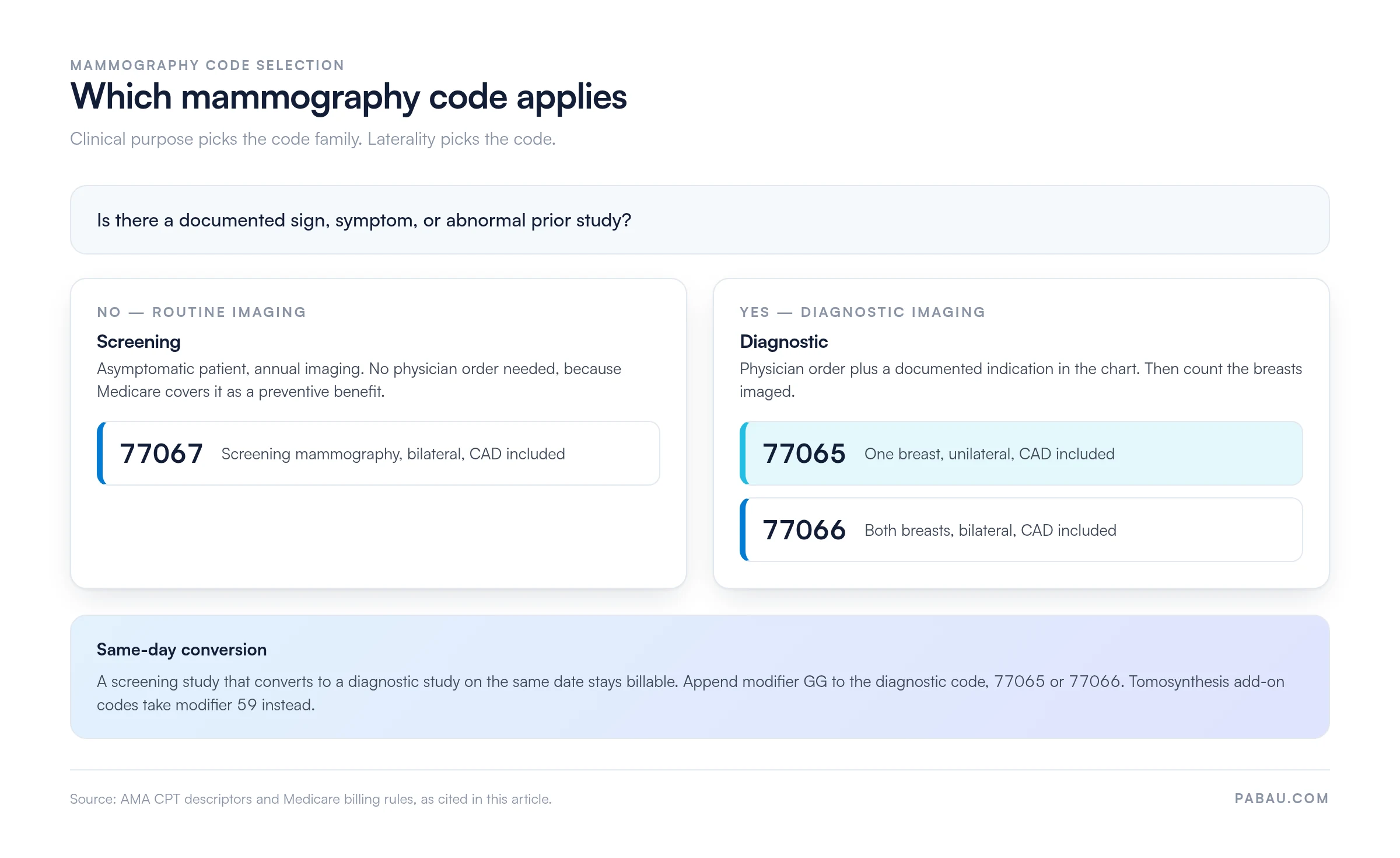
Medicare Part B covers CPT Code 77065 when a treating physician orders the study to evaluate signs or symptoms of breast disease. Coverage requires medical necessity. Routine annual imaging belongs on 77067, not 77065.
Clinical scenarios that typically support 77065 billing:
Local Coverage Determinations (LCDs) issued by Medicare Administrative Contractors (MACs) govern the specific covered diagnoses in each region.
Coverage criteria can vary between MACs, so always verify the applicable LCD for your billing jurisdiction before finalizing a claim. Review the CMS Physician Fee Schedule lookup to confirm current payment status by code and locality.
Every 77065 claim must carry a supporting ICD-10-CM diagnosis code that establishes medical necessity. Using a screening-only diagnosis code (such as Z12.31) on a 77065 claim is a common denial trigger because Z12.31 is reserved for routine screening mammography. The ICD-10-CM code library lists the laterality-specific option for each symptom.
Always select the most specific ICD-10-CM code available. Use laterality-specific codes (right, left, bilateral) wherever the documentation supports them. Verify current pairings against the AAPC Codify CPT lookup or the applicable MAC LCD before finalizing your claim.
Modifier selection on a 77065 claim affects both payment and compliance. Using the wrong modifier is among the most frequent mammography coding errors.
LT and RT modifiers are not universally required by all payers, but adding them reduces ambiguity on unilateral claims and can prevent automated claim edits. Check your MAC’s policy before applying them routinely.
The Medicare Physician Fee Schedule (MPFS) sets payment for CPT Code 77065 from Relative Value Units (RVUs). Those RVUs are then adjusted by the Geographic Practice Cost Index (GPCI) for the provider’s locality.
Published fee schedule data puts the 2025-2026 national average for 77065 at roughly $121.95 to $123.92. Facility and non-facility payment are now essentially the same, at about $123.92 each. Verify current rates directly using the FastRVU 2026 RVU lookup tool, as rates are updated annually.
Geographic adjustment can raise or lower these figures by 10-30% depending on the locality. High-cost areas such as San Francisco and Manhattan typically receive higher GPCI adjustments than rural regions. Commercial payer rates vary independently and are often negotiated above the Medicare floor.
Check your MAC’s local fee schedule rather than relying on national averages. Use the CMS Physician Fee Schedule lookup tool with your specific locality code to get the exact payment amount applicable to your claims.
Before January 1, 2017, Medicare mammography billing used a separate set of G codes. CMS eliminated those codes and transitioned all mammography claims, including Medicare, to the standard CPT code family. Coders processing legacy claims or working with older billing systems may still encounter these codes.
G0202, G0204, and G0206 are no longer valid for claims with dates of service on or after January 1, 2017. Submitting a claim with a retired G code will result in denial. If your billing system still contains these codes, remove them and update to the current CPT equivalents.
Insufficient documentation is the second most common reason 77065 claims are denied, after incorrect code selection. The chart must support the clinical reason for ordering a diagnostic study rather than routine screening. That evidence has to exist at the point of care, because no clearinghouse edit can supply it after the fact.
Required documentation for a defensible 77065 claim:
Most 77065 claim denials are preventable. The errors below account for a significant share of returned claims in radiology billing. Focusing on submitting a clean claim from the outset eliminates the cost of rework and resubmission.
Reading the superbill once before submission catches most of these mismatches while they are still cheap to fix.
Medicare does not require prior authorization for CPT Code 77065, but commercial payers vary widely. Some plans require pre-authorization for all diagnostic imaging. Others exempt mammography specifically. There is no universal rule.
Best practices for managing prior authorization across payers:
Failing to obtain required prior authorization when a commercial payer requires it is a leading cause of 77065 denials that cannot be corrected on appeal. Always check before the study is performed.
Most coding errors in mammography billing happen between the clinical encounter and the submitted claim. A coder who checks a lookup tool, then retypes the result into a separate billing system, has several chances to introduce an error.
Practice management software like Pabau keeps the code set in the same place as the chart. Our claims software for imaging pairs CPT codes with ICD-10 diagnoses inside the clinical workflow, so nobody has to cross-reference by hand.

Practices using Pabau can route claims through our Claim.MD clearinghouse integration, which reaches thousands of US payers. Real-time eligibility checks cover a smaller set of roughly 400 payers, so check your own payer mix before you lean on them. Either way, staff submit and track a 77065 claim without logging into a separate portal.
Code libraries, claim scrubbing, and ERA (electronic remittance advice) processing in one platform make denial patterns visible at the code level. A practice can see that its 77065 claims deny more often than its 77066 claims. The pattern usually traces to one modifier or one ICD-10 pairing, so the fix is a single rule change.
Automated checks flag a missing order or a missing indication while the claim is still editable. That is the difference between a denial you appeal for a month and a claim you never had to rework.

Pabau embeds CPT code libraries, ICD-10 pairing, and automated claim scrubbing directly into your practice workflow. Reduce denials and submit cleaner claims for 77065 and your full CPT code set.

Billing 77065 well is a documentation habit rather than a coding trick. The order, the indication, the laterality, and the modifier either agree with each other before submission or they do not.
Fix that sequence once and the same claim stops coming back. A practice that checks authorization before the study spends far less on rework. Pairing 77065 with a symptom diagnosis works the same way, and both beat arguing the case after a denial.
Pabau puts CPT code libraries, eligibility checking, and claim scrubbing in one billing workflow for imaging teams. Book a demo to see how much of your 77065 rework disappears.

Managing denials after they happen? Denial codes in medical billing covers the most common CARC codes and how to respond to each.
Looking for a wider billing compliance framework? Medical billing fundamentals walks through the full revenue cycle from charge capture to payment posting.
CPT Code 77065 covers unilateral diagnostic mammography, including computer-aided detection (CAD) when performed. It applies when one breast is imaged for a sign or symptom, such as a palpable mass, nipple discharge, or an abnormal prior screening. CAD software analysis is bundled into the code and cannot be billed separately.
77065 is the diagnostic code for one breast. 77066 is the diagnostic code for both breasts, and 77067 is bilateral routine screening for asymptomatic patients. The distinctions are clinical purpose and how many breasts are imaged.
Yes, but only when a screening mammogram (77067) converts to a diagnostic study (77065) of the same breast on the same date of service. In that scenario, append modifier GG to 77065 to identify the conversion to the payer. A bilateral screening that converts to a bilateral diagnostic study works the same way: bill 77066 with modifier GG.
The modifiers used most often on 77065 are GG, LT, RT, 26, TC, and 52. GG marks a screening study that converted to a diagnostic study the same day. LT and RT identify left or right breast laterality. Use 26 for the radiologist interpretation alone and TC for the facility technical component. Modifier 52 covers reduced services, when the study could not be completed.
Medicare’s national average for CPT 77065 is roughly $121.95 to $123.92 on the 2025-2026 fee schedule. Facility and non-facility payment are now almost identical, so the setting rarely changes the amount. Verify the exact amount for your locality using the CMS Physician Fee Schedule lookup tool, as rates update each January.
Medicare does not require prior authorization for CPT 77065. Commercial payer requirements vary by plan, and some require pre-authorization for all diagnostic imaging procedures. Always verify authorization requirements at eligibility check, before the study is performed, to avoid denials that cannot be corrected on appeal.
CPT 77065 replaced G0204, diagnostic mammography unilateral, on January 1, 2017. That is when CMS moved all mammography billing from legacy G codes to standard CPT codes. G0202 was replaced by 77067 (screening) and G0206 by 77066 (bilateral diagnostic). G codes from this family are no longer valid for claims with service dates after December 31, 2016.



