HCPCS Code L0472: Hyperextension TLSO billing guide
HCPCS code L0472: Official descriptor and device definition HCPCS code L0472 des...

Last Updated: Nov 5, 2026
77047 is the CPT code for magnetic resonance imaging, breast, without contrast material(s); bilateral. It covers one MRI session that images both breasts, with no gadolinium given at any point.
Laterality and contrast decide between 77047 and its neighbors. CPT 77046 is the same non-contrast study on one breast, and 77049 is the bilateral study without and with contrast. A code that doesn't match the radiology report on both points can trigger a denial.
Let Pabau's smart automation suggest the right codes, reduce claim denials, and keep your practice compliant—effortlessly.
Automate repetitive tasks and focus on what matters most—your patients.
Reduce coding errors and ensure compliance with the latest regulations.
Clean claims, fewer denials, and faster reimbursements.
Powerful insights and reporting to help your practice thrive.
HIPAA compliant SOC 2 certified GDPR-compliant Trusted by 4,000+ clinics worldwide

CPT code 77047 reports one MRI session that images both breasts, with no contrast given at any point in the study.
Laterality and contrast pick the code: 77046 is one breast without contrast, and 77049 is both breasts without and with contrast.
Medical necessity rides on a specific ICD-10 code, such as Z15.01 for genetic susceptibility or Z80.3 for a family history of breast cancer.
Most commercial payers and many Medicare Advantage plans require prior authorization, and an approval issued for a neighboring code is a common denial reason.
Pabau’s claims management checks eligibility and submits US claims through Claim.MD, with each prior authorization attached to the booking.
CPT code 77047 is the code for an MRI of both breasts performed without contrast.
The American Medical Association’s CPT code set defines it as magnetic resonance imaging, breast, without contrast material(s); bilateral. It sits in the Breast, Mammography subsection of the radiology codes, alongside the other breast MRI codes, 77046 through 77049.
Two words in that descriptor decide whether you can use it. “Bilateral” means both breasts were imaged in the same encounter. “Without contrast” means no gadolinium or other agent was given at any point, including a pre- and post-contrast sequence.
Because the descriptor already says bilateral, modifier 50 doesn’t belong on the claim. The code also leaves out computer-aided detection (CAD), which CPT bundles only into the contrast studies, 77048 and 77049.
If your practice bills breast imaging through radiology claims management software, set up 77047 as its own charge, separate from the contrast studies.
The four breast MRI codes share one structure built on two variables. One is laterality (one breast or both), and the other is contrast (without, or without and with). Pick the wrong cell and the claim no longer matches the report.
Since both cover two breasts, 77047 and 77049 are the pair coders most need to tell apart. If the report lists any post-contrast sequence, the study is 77049.
A 77047 claim stands on two documents: the radiologist’s report and the referring clinician’s order. Each one has to state the key facts outright, because a payer reviewer won’t infer them from context.
Required in the radiology report:
Required in the order:
A non-contrast study fits when the patient can’t receive gadolinium, for example because of severe chronic kidney disease. It also fits when the protocol calls for structural assessment without dynamic enhancement. When the clinical question needs contrast, 77049 (bilateral) or 77048 (unilateral) is the correct code, not 77047.
Build laterality and contrast into your EHR or radiology information system (RIS) order template as required fields, not free text. A required field forces the answer at order entry, before the scan, rather than during a records review months later.
Payers check medical necessity by matching 77047 against a qualifying diagnosis code. Local Coverage Determinations (LCDs) vary by Medicare Administrative Contractor (MAC), but the codes below appear across most payer policies. Check the current policy on CMS.gov before billing.
Use the most specific subcode available. A C50 code without its subsite digits, or an N63 code without laterality, is a common denial trigger. You can look up each subcode in our ICD-10-CM code library.
Run an insurance eligibility check before each breast MRI appointment. It confirms active coverage and the benefit category before the scan, and shows whether prior authorization is needed before the patient arrives.
Traditional Medicare covers 77047 under Part B when medical necessity is documented and the service meets the applicable LCD.
Breast MRI is covered only as a diagnostic service, so the Part B deductible and 20% coinsurance apply. The preventive deductible waiver belongs to screening mammography (77067), not to MRI.
Outside traditional Medicare, coverage shifts in four ways:
Medicare pays for 77047 under the Medicare Physician Fee Schedule (MPFS), which multiplies relative value units (RVUs) by a conversion factor. At 6.48 total RVUs, the national global payment comes to about $210 in 2025 and $216 in 2026.
These figures come from the FastRVU lookup tool, a third-party source. Confirm them against the CMS PPRRVU file before you set fees, because the conversion factor changes every January.
The global payment covers both the scan and the read. When a hospital owns the scanner, the radiologist bills 77047 with modifier 26 for the interpretation, and the facility bills the technical side. An imaging center that owns the equipment and employs the reader bills the global code.
Geographic Practice Cost Indices (GPCI) adjust each RVU component by locality. High-cost markets pay above the national figure, and many rural localities pay below it. For a precise estimate, use the CMS MPFS lookup or the AAPC Codify CPT lookup with your MAC locality.
Payment comes back on the electronic remittance advice (ERA). Check each 77047 line against the expected rate for your locality, so an underpayment gets appealed rather than written off.
Most commercial payers and Medicare Advantage plans require prior authorization (PA) for breast MRI, including 77047.
Traditional Medicare fee-for-service doesn’t require PA across the board, but MAC policies and imaging programs vary. Run insurance eligibility verification at scheduling, so the PA rules are known before the appointment.
A standard PA request for 77047 usually needs four pieces:
If your practice sends breast MRI requests every week, a set prior authorization process with one checklist per payer saves a lot of resubmissions.
Follow one claim from start to finish and the weak points are easy to spot. The path below shows the five stops a typical 77047 claim makes, and the most common way each one fails.
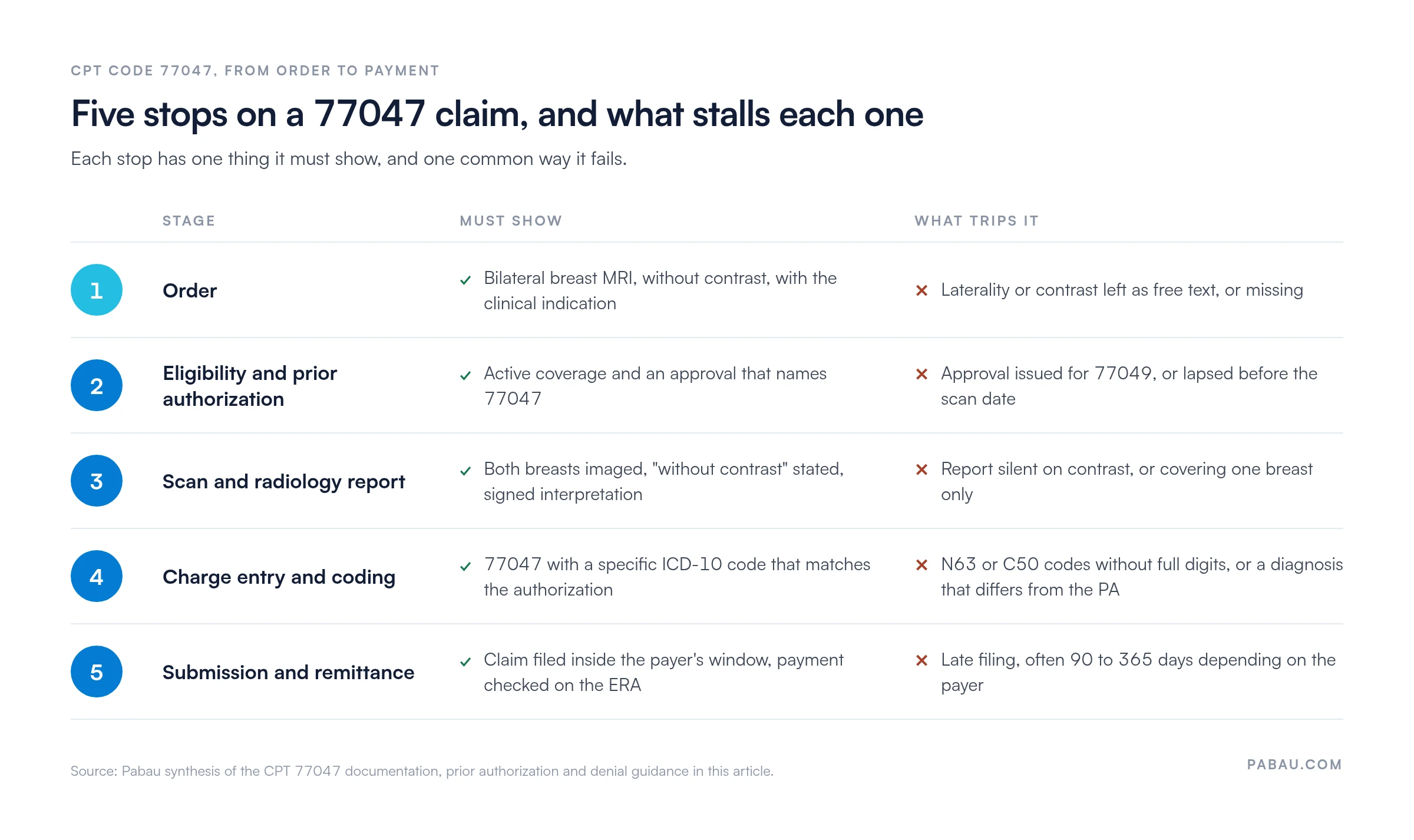
Here’s how that looks for one patient. A 42-year-old BRCA1 carrier with severe chronic kidney disease needs supplemental screening, but gadolinium isn’t safe for her. Her physician orders a bilateral breast MRI without contrast and documents the kidney disease as the reason.
The front desk confirms coverage and requests PA for 77047 with Z15.01. After the scan, the report states both breasts were imaged without contrast. The biller codes 77047 with Z15.01, matching the approval, and checks the ERA when payment posts.
The denials below come up again and again on breast MRI claims, and most start with authorization or documentation. Good denial management tracks which one hit, so the same fix lands on the next claim.
Run this check on every 77047 claim before it leaves the practice. It takes about a minute, while a denied breast MRI claim can take weeks to rework.
CPT 77047 shows up often in supplemental screening for patients with dense breasts or confirmed genetic risk. Dense tissue lowers mammography sensitivity. Since September 2024, FDA mammography rules require facilities to tell patients whether their breasts are dense, and those notices often prompt a referral for MRI.
Density alone rarely secures coverage, though. Most payers want a high-risk designation on top of it. A patient with heterogeneously dense tissue (BI-RADS category C) but no family history, genetic risk or prior atypia may not meet the LCD.
The pathway that most reliably supports 77047 combines:
Screening mammography, 77067, is a lower-complexity service with broader coverage. When a patient moves from annual mammography to MRI, the record should explain why MRI was chosen and support the specific code billed.
In many imaging practices, the pieces of one claim live in different places. The PA approval sits in a payer portal, the report sits in the RIS, and the charge sits in a billing spreadsheet.
In Pabau, the practice software we build for scheduling and insurance billing, each prior authorization is stored as a case and attached at booking. The authorization code carries through to the claim, and a claim without one is flagged before it goes out.
For US practices, Pabau checks eligibility through Claim.MD before the visit and submits CMS-1500 claims through the same connection. Payments settle straight from the ERA file, so each 77047 line can be checked against the expected rate.

Pabau attaches each prior authorization at booking, checks eligibility through Claim.MD and submits US claims, so 77047 claims leave with their approval on file.

Coding 77047 is simple once the record is right. The hard part is making sure the order, the authorization, the report and the claim all describe the same study.
If you change one habit, make laterality and contrast required fields at order entry. That one step protects the PA, the report language and the charge at once. It costs a few seconds per order, against weeks spent reworking a denial.
Book a demo to see how Pabau carries each breast MRI authorization from the booking to the paid claim.

Submitting claims through a clearinghouse? Pabau’s Claim.MD clearinghouse guide explains how electronic claim submission works and which payers are covered.
Sending a breast MRI authorization request? Medical prior authorization form gives you a ready template for documenting the clinical reason behind a request.
Checking imaging payments line by line? Electronic remittance advice explains how to read an ERA and spot an underpaid claim.
Want to understand how denials are coded? Denial codes in medical billing covers CARC and RARC codes and how to read your EOB remark codes.
Need a full primer on medical billing workflows? What is medical billing walks through the claims process from patient encounter to payment posting.
No. The 77047 descriptor already includes both breasts, so modifier 50 would report the bilateral service twice. Bill one unit of 77047 with no laterality modifier, and use 77046 for one breast.
No. CPT bundles computer-aided detection (CAD) into the contrast breast MRI codes, 77048 and 77049, when performed. CAD analyzes how contrast enhances tissue, so it has no role in a non-contrast study.
Yes. When the radiologist reads for a hospital-owned scanner, they bill 77047 with modifier 26, and the facility bills the technical side. A practice that owns the scanner and employs the reader bills the global code.
Both cover both breasts. CPT 77047 is performed without contrast, while 77049 is without and with contrast and includes CAD when performed. If the report shows any post-contrast sequence, bill 77049, because billing 77047 can trigger a denial.
Common choices are Z15.01 (genetic susceptibility to breast cancer, including BRCA1/BRCA2 carriers), Z80.3 (family history), C50.x with full subsite digits, and N63.x with laterality. Z12.39 may work for supplemental screening, but payer policies vary.
Medicare covers breast MRI only as a diagnostic service, so the Part B deductible and 20% coinsurance apply, even for high-risk patients. Commercial plans may classify the same scan differently, so confirm the benefit with the payer first.