



CCSD code G5100: Bypass of duodenum billing guide
CCSD code G5100 bills a bypass that leaves the duodenum in place CCSD code G5100...

Last Updated: Oct 16, 2026

CPT code 77049 covers a bilateral breast MRI performed without and with contrast, including computer-aided detection.
Modifier 50 never belongs on 77049, because the descriptor already says bilateral.
CAD sits inside the descriptor, so there is no separate CAD code to add to the claim.
Medicare pays roughly $300 to $410 for 77049 in 2026, depending on setting and locality.
Practice management software like Pabau sends the claim to a clearinghouse and files the remittance against the same record.
CPT code 77049 is the billing code for a bilateral breast MRI performed without and with contrast, with computer-aided detection included. That last part is what catches billing teams out, because CAD sits inside the descriptor and there’s no second line to add for it.
Line the code up with the right modifier and a supported diagnosis, and a 77049 claim pays roughly $300 to $410 in 2026. Miss one of the three, and it comes back before it gets that far.
The American Medical Association (AMA) descriptor names three things: both breasts, both contrast phases, and CAD when performed.
Its full wording sits in the table below. 77049 is a global code. One unit captures the whole bilateral study, the scan and the radiologist’s read together. A modifier is what splits the two apart.
Two questions settle the code: how many breasts were imaged, and whether the study ran both before and after contrast.
Only four codes are billable for breast MRI, and CAD is written into two of them. The AAPC Codify CPT lookup is handy for reading the descriptors side by side.
Set out as a grid, the four codes sort themselves by those same two questions.
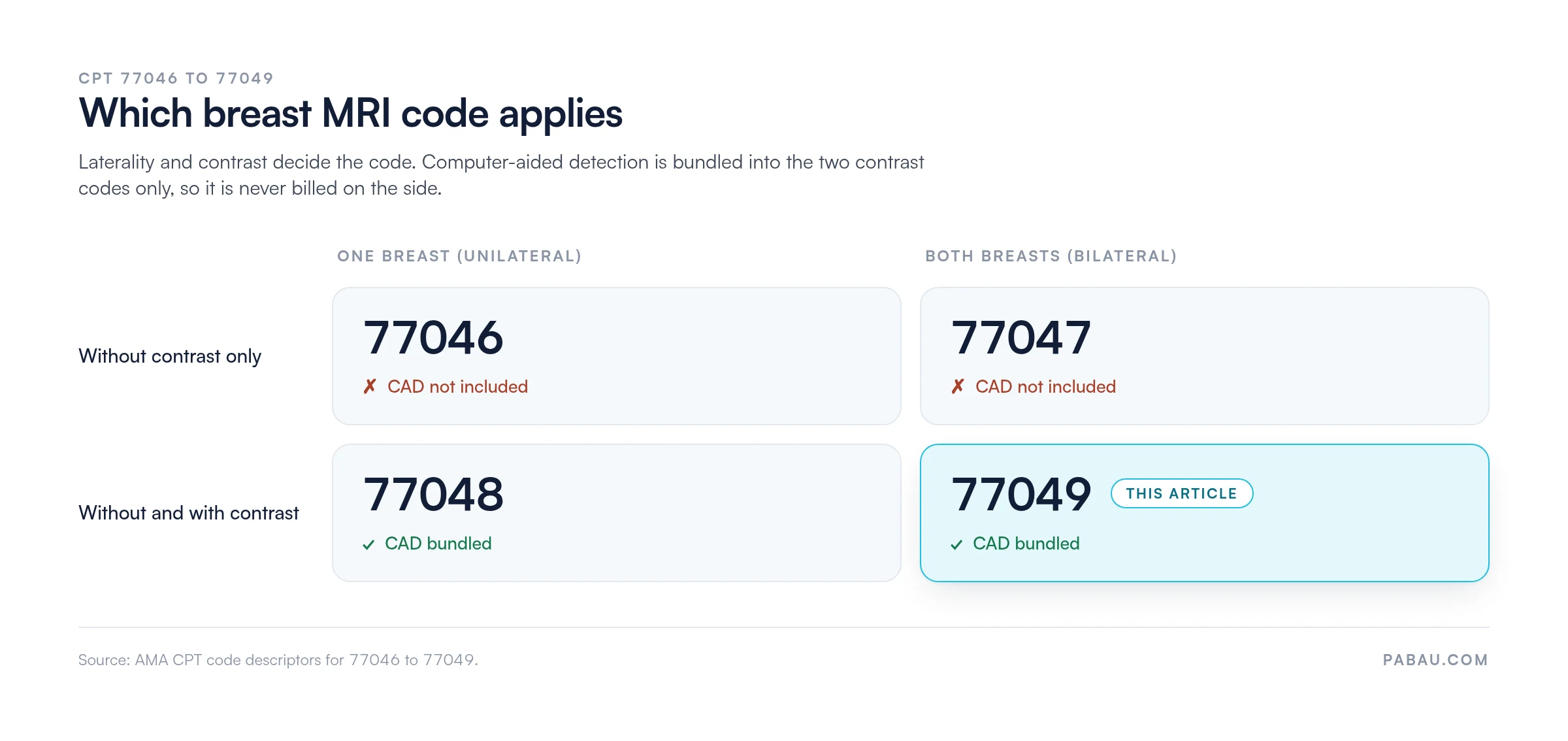
Note that 77061 and 77067 are not on the list. Those codes cover tomosynthesis and screening mammography, so they never stand in for a breast MRI. Picking the right code is only half the job, though. The diagnosis has to hold it up.
Medical necessity decides whether a 77049 claim survives. The Centers for Medicare and Medicaid Services (CMS) covers bilateral breast MRI for a defined list of conditions. Your diagnosis code has to match one of them.
CMS article A56448, which sits under LCD L33950, is the current billing and coding article for breast imaging. It names high-risk screening, pre-operative staging, and treatment response as covered indications.
One detail catches coders out here. ICD-10 has no separate code for a BRCA2 carrier, so BRCA1 and BRCA2 both take Z15.01.
The table lists the diagnoses payers accept most often by indication. Coverage still varies by Local Coverage Determination (LCD), so check the policy for your Medicare Administrative Contractor (MAC) first. Where the documentation points somewhere else entirely, our ICD-10-CM code reference lists the diagnosis families in full.
With the diagnosis settled, the modifier decides who gets paid for what. A global 77049 pays for the scan and the read together. Split it, and each side bills its own share.
Radiologists reading in a hospital almost always need modifier 26. An imaging center that owns the scanner and employs the reader bills globally, with no modifier at all. Getting this one wrong is among the most common reasons a 77049 underpays.
Modifier 50 is the trap. It marks a bilateral procedure, and 77049 is already bilateral by descriptor, so adding it duplicates what the code says. Payers read that as either a denial or an overpayment to recover later.
The 2026 Medicare Physician Fee Schedule (MPFS) puts 77049 at roughly $300 to $410. Two things decide where a claim lands in that band. One is facility or non-facility setting. The other is the Geographic Practice Cost Index (GPCI) for the practice location.
Non-facility rates run higher because the practice expense RVU carries the cost of owning and running the scanner. Check your own locality on the CMS Physician Fee Schedule lookup tool.
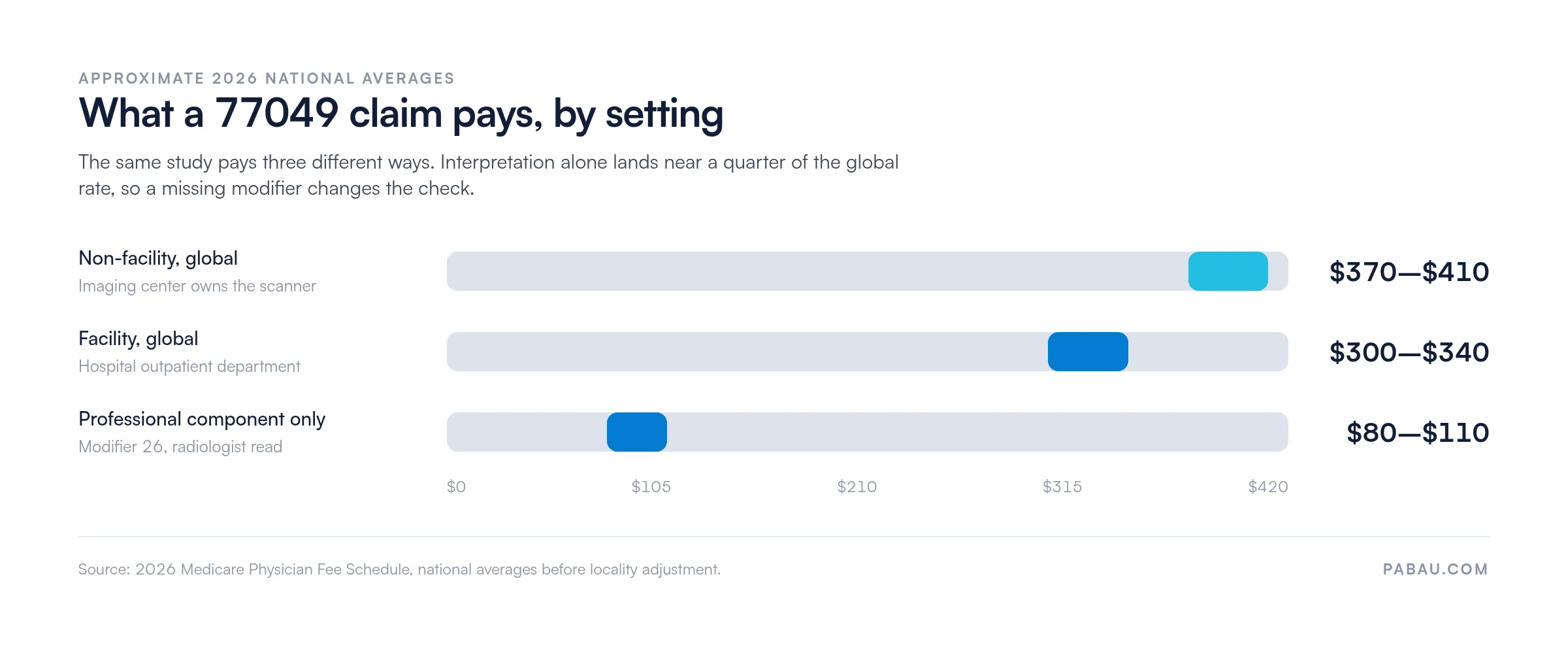
Treat those numbers as national averages, not quotes. Your locality adjustment can move each figure by a double-digit percentage in either direction. Those rates only apply, though, if the payer authorized the scan in the first place.
Medicare covers bilateral breast MRI when the ordering physician’s notes support the indication. Local Coverage Determinations govern the detail, and they vary by MAC region. Commercial plans add their own layer on top, usually through a Radiology Benefit Manager.
Run eligibility and prior authorization checks at least 48 hours before the scan date. Most RBMs want the ordering physician’s history and physical, prior imaging reports, and genetic test results where they exist. An incomplete request is the fastest way to push the scan back a week and collect a denial afterwards.
Authorization gets the scan approved. Documentation is what keeps the payment after an audit. Six elements do the heavy lifting on a breast MRI record:
It helps to see where each of those pieces gets created. A breast MRI claim passes through six hands before the money arrives:
Steps two and five are where the delay usually sits. An authorization that expires before a rescheduled scan sends the claim back, and so does a diagnosis keyed by hand into a second system. Both show up weeks later in the remittance, when fixing them costs far more.
Denials on this code cluster into a short list. Every one of them is catchable before the claim leaves the queue.
Six questions take about a minute and catch nearly all of the above. A 77049 that answers all six is a clean claim, and it usually pays on the first pass.
Most radiology billing teams work that checklist across three systems. Eligibility gets checked in a payer portal, the authorization number lands in a spreadsheet, and the claim is keyed into the clearinghouse by hand. Each step works fine on its own. The handoffs between them are where the authorization number goes missing.
Practice management software like Pabau pulls those steps into one claims management workflow. Pabau connects to Claim.MD, a US clearinghouse reaching more than 4,000 payers. Eligibility runs against the payer in real time. The claim goes out as an 837 file, and the remittance advice posts back onto the same patient record.

On a code like 77049, the gain is simple. The diagnosis your coder verified is the diagnosis that reaches the payer, because nobody retypes it on the way out. When a denial does come back, it lands beside the claim it belongs to instead of in a separate inbox.

Pabau links eligibility checks, 837 claim submission through Claim.MD, and remittance processing to the same patient record. Your billing team stops moving breast MRI claims between systems by hand.

77049 rewards precision on three points. Both breasts have to be imaged, both contrast phases documented, and the diagnosis has to be one the payer already accepts. Get those right and CAD takes care of itself, because it was never a separate line to begin with.
The trade-off worth remembering is timing. Almost every fix on this code is cheap before submission and expensive afterwards.
That is why the authorization check and the six-question review earn their minute back. Book a demo to see how Pabau keeps breast imaging claims and their remittances on one record.

Need a framework for reducing claim denials across your practice? Denial management in healthcare covers the workflows and tracking that help billing teams resolve rejections faster.
Wondering what actually makes a claim clean? What is a clean claim breaks down the fields payers check first and the errors that send a claim straight back.
Unsure how clearinghouses process your 837 files? Medical claims clearinghouse guide explains payer routing, NCCI edits, and remittance processing end to end.
Worried about what an auditor would ask for? Medical billing compliance sets out the record-keeping that holds up when a payer reviews imaging claims after payment.
Want to see how revenue cycle metrics connect to coding accuracy? What is revenue cycle management maps the financial lifecycle from patient registration through final payment.
No. The code pays for the imaging and the read. Gadolinium is billed separately under its own HCPCS supply code, such as A9579. Whether the payer pays for it on top depends on the setting.
Not by traditional Medicare. The LCD limits breast MRI to high-risk screening, staging, treatment response, and problem solving. For an average-risk patient, issue an Advance Beneficiary Notice before the scan.
Not 77049. Use 19085 for the first lesion and 19086 for each additional lesion. Both include the imaging guidance, so the MRI is not reported separately.
Yes. Issue the Advance Beneficiary Notice before the study, not after the denial. Have the patient sign it, keep the copy on file, and append modifier GA to the 77049 line.
It follows where the scan happened. Use 11 for a physician office, 22 for a hospital outpatient department, and 19 for an off-campus outpatient site.
Rarely, and only with two documented sessions. A repeat study on the same date takes modifier 76. Attach the reason for the repeat so the payer can see why two studies were needed.



