

HCPCS code E0198: Water pressure pad billing guide
HCPCS code E0198 is a water pad for a standard mattress HCPCS code E0198 is the ...

Last Updated: Oct 13, 2026
76818 is the CPT code for fetal biophysical profile; with non-stress testing. It covers an obstetric ultrasound biophysical profile and a non-stress test performed at the same encounter, with five parameters each scored 0 or 2.
Most denial problems with this code trace back to incomplete documentation and bundling errors, especially confusion with 76819 and billing 59025 alongside it. Coders who understand the five-parameter scoring requirement and the 76818-versus-59025 bundling rule submit cleaner claims from the start.
Let Pabau's smart automation suggest the right codes, reduce claim denials, and keep your practice compliant—effortlessly.
Automate repetitive tasks and focus on what matters most—your patients.
Reduce coding errors and ensure compliance with the latest regulations.
Clean claims, fewer denials, and faster reimbursements.
Powerful insights and reporting to help your practice thrive.
HIPAA compliant SOC 2 certified GDPR-compliant Trusted by 4,000+ clinics worldwide

CPT code 76818 covers a fetal BPP plus NST in the same session, requiring documentation of all five scored parameters.
76818 already includes the NST, so billing 59025 on the same date triggers an NCCI bundling edit.
Modifier 26 applies when the physician only interprets the study, and modifier TC when the facility only performs the technical work.
Pabau’s claims management software helps practices prepare and submit claims with fewer errors.
CPT code 76818 is “Fetal biophysical profile; with non-stress testing,” a code published by the American Medical Association. It sits in the Diagnostic Ultrasound subsection (76506-76999) of the Radiology chapter.
It describes one encounter in which a sonographer or physician scores four biophysical profile (BPP) parameters on real-time obstetric ultrasound. An electronic fetal monitoring strip then records the non-stress test (NST), which assesses fetal heart rate reactivity.
The code sits alongside 76819 (BPP without NST) in the same subsection. The two codes are mutually exclusive on the same date of service. Use 76818 when the NST is performed and interpreted during the same encounter, and 76819 when it is not.
The fetal BPP with NST evaluates five distinct parameters, each scored 0 or 2, for a maximum composite score of 10. All five must be assessed and individually documented in the procedure note for CPT code 76818 to be supported. Missing even one parameter score is a common documentation deficiency that triggers post-payment audits.
A score of 8-10 with normal fluid volume is generally reassuring. A score of 6 is equivocal and usually prompts repeat testing; 4 or below is abnormal and prompts clinical evaluation for delivery. The interpreting provider must document each parameter’s score individually. A single composite number without subscores does not meet payer documentation standards for CPT code 76818.
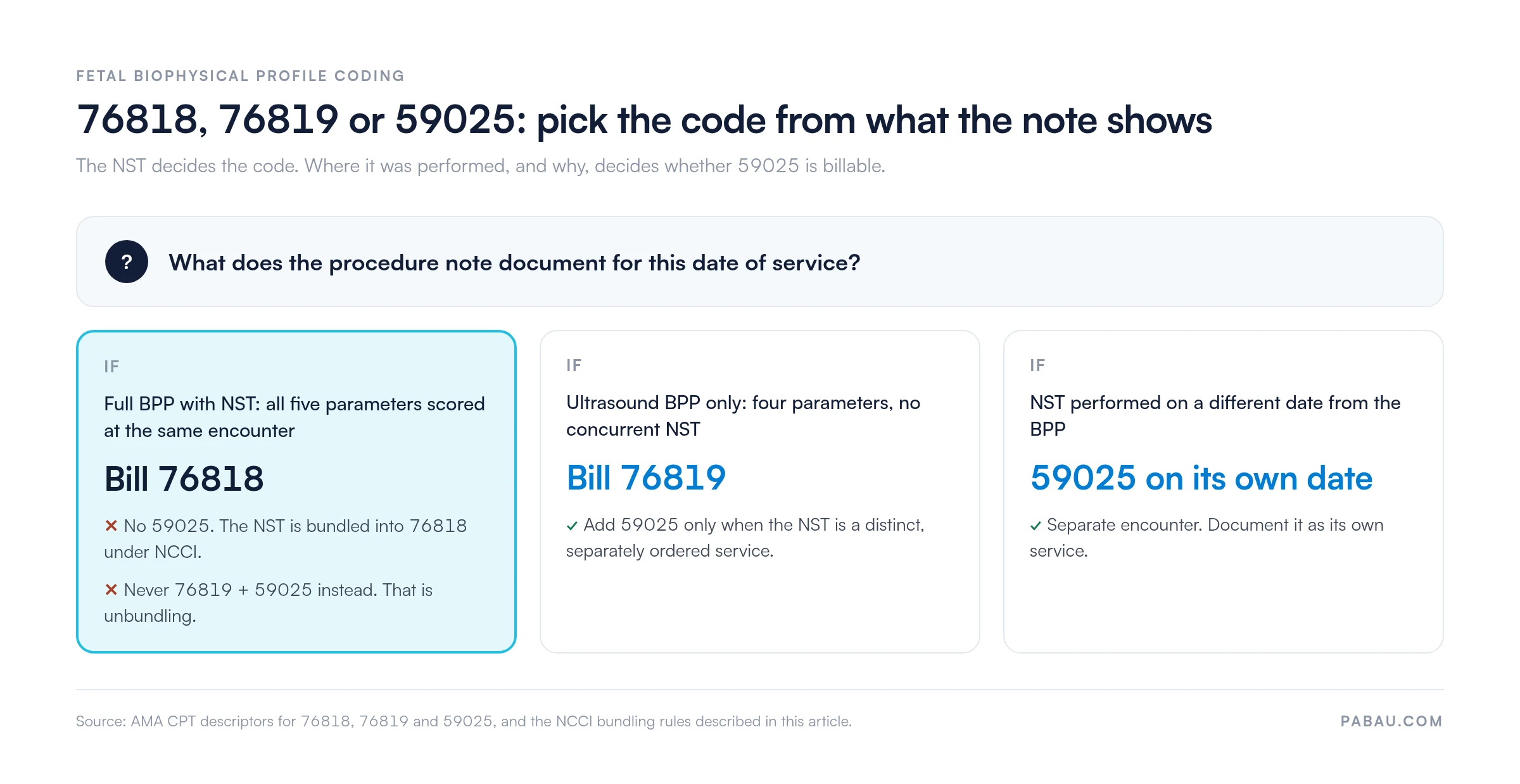
76818 includes the NST, and 76819 does not. That single difference drives the coding decision. The wrong code either overstates or understates the service delivered, and both errors create compliance exposure.
When the ordering physician requests a BPP and the NST is performed by the same team at the same visit, always bill 76818. Billing 76819 plus 59025 when a full BPP with NST was performed is unbundling and creates overpayment liability. 59025 is separately billable with 76819 only when the NST is a distinct, separately ordered service. If the NST is performed on a different date, that is a separate encounter, so document it accordingly.
CPT code 76818 lives in a family of OB ultrasound codes that payers bundle aggressively. If you’re newer to medical billing basics, start with the bundling column below. It decides which codes can share a date of service with 76818.
Follow-up scans are the row most likely to vary by payer. When a separate indication supports a same-day follow-up scan, check the billing rules for 76816 and the payer’s LCD before adding it to the claim.
No. The National Correct Coding Initiative (NCCI) bundles CPT code 59025 into 76818 because the non-stress test is a component of the BPP-with-NST procedure. Submitting both on the same date of service produces an automatic denial.
59025 is separately billable in only two cases. In the first, the NST is performed on a different date from the BPP. In the second, the BPP is billed as 76819 and the NST is a distinct, separately ordered service.
Some practices bill 76819 plus 59025 to sidestep the bundling edit, which can claim a higher total than 76818 would pay. Payers recognize the pattern. If the record shows a complete BPP with NST, that combination is unbundling and creates overpayment liability. The diagram below maps each documentation scenario to the code it supports.
CPT code 76818 is a diagnostic imaging procedure, so it supports the professional/technical component split and other standard radiology modifiers. Choosing the wrong modifier is a common denial trigger.
In a hospital outpatient or facility setting, the facility bills TC and the physician bills 26. In a private OB office where the practice owns the equipment and the same physician interprets, no modifier is appended and the global rate applies. Never append both 26 and TC to the same claim line.
Payer audits for fetal BPP claims almost always target the procedure note. A complete note for CPT code 76818 must address every element of the five-parameter scoring system, not just the composite result. Before submitting a clean claim, confirm the record contains all of the following.
A note that reads “BPP 8/10, reactive NST” without individual subscores is insufficient for audit purposes. The coder cannot tell from that summary which parameter scored zero, and neither can a payer reviewer.
Payers approve CPT code 76818 when the procedure is ordered for an accepted high-risk obstetric indication. The Centers for Medicare and Medicaid Services and most commercial payers publish Local Coverage Determinations (LCDs) that list covered diagnoses. Coverage outside those indications requires additional documentation or prior authorization. The indications below are the ones payers most commonly accept.
Frequency limits vary by payer. Some commercial plans cap BPP billing at once or twice weekly per pregnancy episode. Medicare covers fetal BPP under Part B for pregnant patients when the service is ordered by the physician managing the pregnancy. Verify current frequency limits against the applicable LCD before billing serial BPPs, and document each visit’s distinct clinical indication separately.
Medicare reimbursement for CPT code 76818 is set annually through the Medicare Physician Fee Schedule (MPFS). Rates vary by geographic locality and by whether the service is provided in a facility or non-facility setting. Always verify current rates using the CMS Physician Fee Schedule lookup tool or an RVU calculator like FastRVU before quoting expected reimbursement to practice leadership.
*Approximate national non-facility Medicare rates, based on published fee schedule data. Actual payment depends on the geographic practice cost index (GPCI) and the conversion factor in effect for the claim date. Commercial payers typically reimburse at a multiple of Medicare rates. OB practices can submit electronic claims through the Claim.MD integration.
Most claim denials for CPT code 76818 trace back to six root causes. Effective denial management workflows catch these before they reach the payer.
Understanding common denial reason codes helps billing teams route each rejected claim to the correct correction workflow before it ages unpaid. Teams tracking revenue cycle management KPIs should report the 76818 denial rate separately from the broader OB ultrasound bucket. Its root causes differ enough to warrant individual tracking.
Run a quarterly audit of all 76819 claims and cross-reference against procedure notes. Any note documenting an NST, reactive or not, should have been billed as 76818. Recurring downcoding from 76818 to 76819 represents lost revenue and is as much a compliance issue as overbilling.
In many OB practices, a 76818 claim is still assembled by hand after the scan. Someone re-keys the patient, the insurer and the code into a separate billing tool, and each hand-off is another chance for an error.
Pabau’s medical claims management tools store the insurer and policy on the patient record. The BPP invoice then routes to the right payer, and the claim pre-fills from the record without re-keying.
Validation checks run each time you go to send a claim. If a required detail such as a membership number or authorization code is missing, the Send button stays disabled until it’s fixed.
US practices submit through the Claim.MD integration, which also runs eligibility checks, tracks claim status and posts electronic remittance advice. Every claim sits on one dashboard as pending, submitted, processing, paid or error. A rejected 76818 claim gets corrected while the encounter is still fresh.
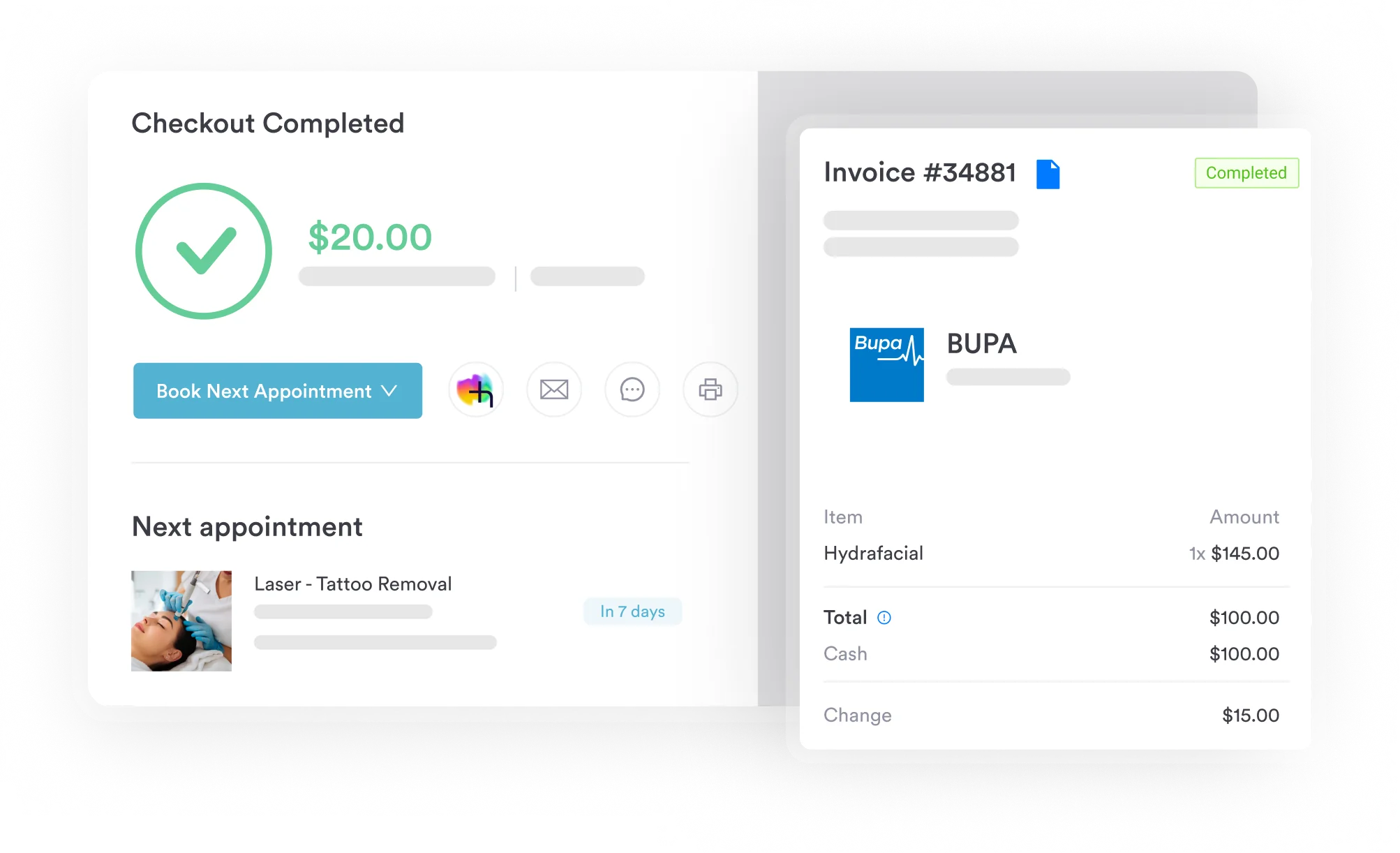

Pabau’s claims management software helps OB-GYN practices prepare and submit claims with fewer errors, then track each one to payment from one dashboard.

The 76818 decision rests on one question: Was the NST performed and interpreted at the same encounter as the BPP? If it was, bill 76818 alone and leave 59025 off the claim. If it wasn’t, bill 76819 and add 59025 only for a distinct, separately ordered NST.
The cheapest fix sits upstream of billing. A BPP note template that requires all five subscores and the NST interpretation makes the right code obvious to the coder. It also gives an auditor a complete record. Pair it with the quarterly 76819 audit, and both downcoding and unbundling surface before a payer finds them.
Book a demo to see how Pabau helps OB practices submit cleaner 76818 claims and track each one to payment.

Need to understand how claims reach payers? Medical claims clearinghouse guide explains how electronic claims are validated and routed to payers.
Want a primer on the full billing lifecycle? Superbill best practices covers how charge capture connects to CMS-1500 submission.
Coding the detailed fetal anatomy scan? CPT code 76811 covers the detailed fetal anatomic exam and its documentation rules.
Billing an early pregnancy ultrasound? CPT code 76801 covers the first-trimester OB ultrasound that comes before any BPP.
CPT code 76818 covers a fetal biophysical profile with non-stress testing in a single encounter. The ultrasound scores four fetal parameters (breathing, movement, tone, and amniotic fluid), and an electronic fetal monitoring strip assesses heart rate reactivity.
76818 includes the non-stress test, and 76819 does not. Use 76818 when the NST is performed and interpreted during the same visit as the BPP ultrasound. Use 76819 when the BPP is performed without concurrent electronic fetal monitoring.
No. The NCCI bundles 59025 into 76818 because the NST is already a component of the procedure. Billing both on the same date of service results in an automatic denial. If the NST is genuinely a separate encounter on a different date, 59025 may be billed independently.
Modifier 26 applies when the physician only interprets the study. Modifier TC applies when the facility bills for equipment and technical staff. Bill globally, with no modifier, when the same provider performs and interprets the study in a non-facility setting. Never apply both 26 and TC to the same claim line.
Medicare rates change annually and vary by locality. The global rate is approximately $115-130 at national non-facility rates. The professional component (modifier 26) is approximately $40-55. Always verify the current rate using the CMS Physician Fee Schedule lookup tool before quoting figures to practice leadership.
The procedure note must include individual subscores for all five BPP parameters, not just the composite total. It also needs the NST interpretation and acceleration count, gestational age, the diagnosis, the fluid measurement and the interpreting provider’s signature. A composite score without subscores fails payer audit standards.
Accepted indications include post-term pregnancy, decreased fetal movement, intrauterine growth restriction (IUGR), and gestational hypertension or preeclampsia. Poorly controlled diabetes, oligohydramnios or polyhydramnios, complicated multiple gestation, and prior stillbirth are also commonly accepted. Coverage outside these indications requires additional documentation or prior authorization per the applicable payer LCD.



