CPT code 63081: Vertebral corpectomy, cervical spine
CPT code 63081: official descriptor and procedure overview CPT code 63081 descri...

Last Updated: Oct 6, 2026
76825 is the CPT code for echocardiography, fetal, cardiovascular system, real time with image documentation (2D), with or without M-mode recording.
It describes a diagnostic cardiac ultrasound of the fetus, performed by a qualified specialist such as a maternal-fetal medicine physician or pediatric cardiologist. It is not interchangeable with a standard obstetric ultrasound. Doppler is not part of 76825, so coders who bill a Doppler study without separate 76827 or 76828 codes lose that revenue. Follow-up studies of the same fetus are reported with 76826.
Let Pabau's smart automation suggest the right codes, reduce claim denials, and keep your practice compliant—effortlessly.
Automate repetitive tasks and focus on what matters most—your patients.
Reduce coding errors and ensure compliance with the latest regulations.
Clean claims, fewer denials, and faster reimbursements.
Powerful insights and reporting to help your practice thrive.
HIPAA compliant SOC 2 certified GDPR-compliant Trusted by 4,000+ clinics worldwide

CPT Code 76825 covers a fetal echocardiogram with real-time 2D imaging, with or without M-mode recording. Doppler is reported separately with 76827 or 76828.
A complete fetal echo is usually billed as 76825 plus 76827 and add-on 93325, though some payers won’t pay 76827 alongside 76825.
Medical necessity needs a documented indication, such as family history of congenital heart disease, maternal diabetes, or a suspected cardiac anomaly on a prior scan.
Modifier 26 (professional component) and TC (technical component) apply when interpretation and equipment are billed by separate entities. Global billing needs neither.
Pabau’s claims management software helps maternal-fetal medicine (MFM) and OB/GYN practices flag missing modifiers and mismatched diagnosis codes before a 76825 claim goes out.
CPT Code 76825 covers echocardiography, fetal, cardiovascular system, real time with image documentation (2D), with or without M-mode recording.
The American Medical Association (AMA), which maintains the CPT code set, assigns it to a fetal cardiac study rather than a routine anatomy scan.
Real-time two-dimensional imaging of the fetal heart is what satisfies the 76825 descriptor. M-mode, which measures chamber dimensions and wall motion, is optional. Spectral Doppler of blood flow across the valves and great vessels is billed separately as 76827 or 76828. Color flow mapping is billed as add-on 93325.
The code sits in the Obstetrical subsection of Diagnostic Ultrasound (76801-76828), within the Radiology chapter of the CPT code set. Its partner, 76826, is the follow-up or repeat study of 76825. The study is typically performed between 18 and 24 weeks of gestation, though some indications prompt earlier or later imaging.
CPT Code 76825 is medically necessary when a clinical indication puts the fetus at elevated risk of congenital heart disease (CHD) or another cardiac anomaly. Routine low-risk pregnancy surveillance is explicitly excluded from coverage by most payers. Coders at OB/GYN practices should confirm the ordering diagnosis before submitting a 76825 claim.
Accepted clinical indications vary by payer Local Coverage Determination (LCD). Most major commercial insurers and CMS guidelines recognize the indications below. They follow the American Society of Echocardiography (ASE) and American Institute of Ultrasound in Medicine (AIUM) practice parameters:
The ICD-10-CM diagnosis code attached to the claim must support the specific indication. Common supporting codes include:
Payers check the diagnosis code against their LCD before adjudicating the claim. A generic diagnosis such as Z34.02 (encounter for supervision of normal first pregnancy) will trigger a medical necessity denial.
CPT Code 76825 describes the initial fetal echocardiogram, and 76826 describes each follow-up or repeat study on the same fetus during the same pregnancy. The two codes form a defined pair. Billing 76825 for every session, after the initial study is done, is a coding error that payers deny.
Billing 76825 and 76826 on the same date of service for the same fetus needs modifier 59 (distinct procedural service) and a documented clinical basis. Even then, it invites scrutiny. The safer practice is to bill 76825 for the initial study and reserve 76826 for every later session.
Several adjacent codes are frequently confused with CPT Code 76825. Selecting the wrong code is one of the leading causes of denials for fetal cardiac studies.
Doppler and color flow: Doppler is not part of 76825. According to the SMFM coding guidance, a full study with spectral Doppler and color flow is billed as 76825, 76827, and add-on 93325. Some payers still refuse 76827 on the same claim as 76825, so check the contract first. Billing 76816 and 76825 on the same date for the same fetus requires modifier 59 and a documented clinical rationale.
The map below shows which code each part of the study lands on, for the first scan and for every follow-up.
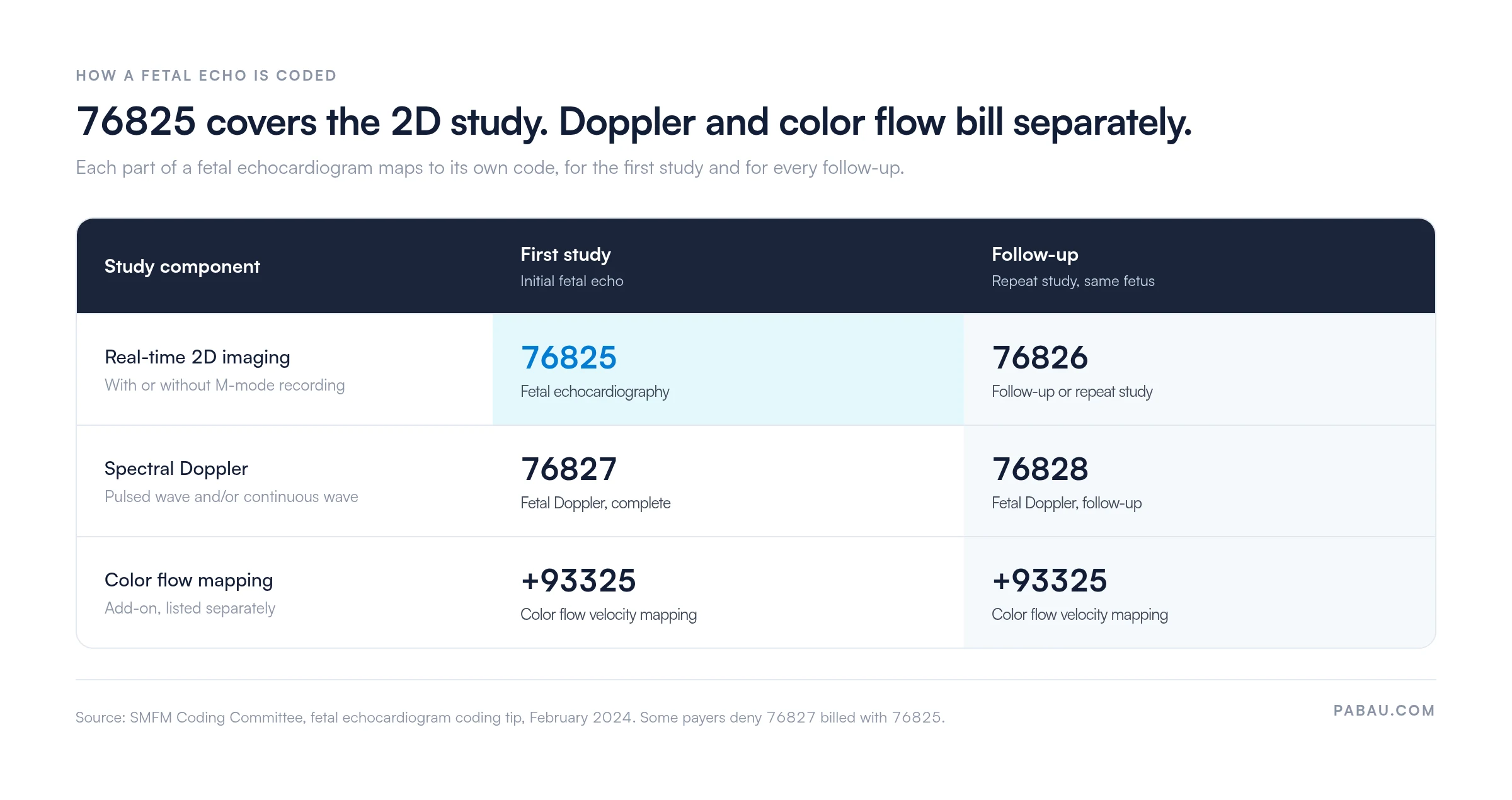
One caution on the Doppler line: it only pays if the report carries the Doppler findings, which the documentation section below covers.
The modifier for CPT Code 76825 depends on who owns the equipment, who interprets the study, and the facility setting. A wrong or missing modifier leads to a payment reduction or a denial.
The CMS Physician Fee Schedule assigns 76825 a split-billing indicator, so the professional and technical components are separately billable. Verify the indicator each year, because CMS updates the fee schedule every January. The global period for 76825 is XXX, which means the global surgery concept does not apply to this diagnostic imaging code.
Incomplete documentation is the most common denial trigger for 76825 claims across commercial payers and Medicare. To hold up at audit, the fetal echocardiography report needs the following elements.
Payer auditors look for a structured fetal echo report rather than a brief addendum to a routine obstetric ultrasound. Cardiac findings tucked into an anatomy scan report as a footnote will not support the claim.
Medicare pays 76825 under the Medicare Physician Fee Schedule (MPFS). The 2026 national payment for the global service is $261.86 before locality adjustment. Your rate varies with your geographic payment locality and the component you bill.
The figures above come from the FastRVU 2026 RVU lookup tool. Apply your locality’s geographic practice cost index (GPCI) for a precise estimate. The CMS lookup tool also lists the separate amounts for 76825-26 and 76825-TC, which this table does not reproduce.
Medicaid rates for fetal echocardiography vary widely by state. Most state Medicaid programs cover 76825 when medical necessity criteria are met, but prior authorization rules and payment rates differ. Some states apply their own coverage policies and may limit covered studies per pregnancy. Check the state agency’s current fee schedule before projecting revenue.
Most major commercial payers and many managed Medicaid plans require prior authorization for CPT Code 76825. Medicare fee-for-service generally does not. A study performed without a required authorization is denied as non-covered, even when the clinical indication is clear. That denial cannot be appealed on medical necessity grounds alone.
Sound insurance eligibility verification before scheduling the study is the first line of defense. During the verification call or portal check, confirm whether the patient’s plan requires prior authorization for 76825. If it does, ask which clinical documents the payer needs to approve the request.
If your team is still mapping out its prior authorization process, start with the paperwork. A complete submission for fetal echocardiography typically includes:
Commercial payer turnaround for urgent obstetric authorizations is typically 24 to 72 hours. Standard requests may take 5 to 10 business days. When a payer denies a prior authorization, cite the ASE or AIUM clinical practice guidelines directly in the appeal.
Run eligibility and prior auth verification on the date the fetal echo is scheduled, not the day before the procedure. Payer plan details change at month boundaries, and a verification run too early can miss a plan change that voids the authorization you received. Build this step into your scheduling workflow for every 76825 order.
Fetal echocardiography denials cluster around a predictable set of root causes, and the cause decides the appeal path. Payers report each one with a claim adjustment reason code, and our guide to denial codes explains how to fix them. Use a structured denial management workflow to sort and route each denial within 24 hours.
Most 76825 billing errors are preventable. A pre-submission checklist catches the majority of them before the claim leaves the practice.
Run the checklist on every claim, not only the ones that look complicated. Our guide to the clean claim standard walks your billing team through what payers check on first pass.
Today, most MFM and OB/GYN billing teams catch a missing modifier or a mismatched diagnosis code only after the denial arrives. Pabau, the practice management platform we build, moves that check to before submission.
In Pabau’s claims management software, claim rules flag missing modifiers, mismatched diagnosis codes, and NCCI edit conflicts before a 76825 claim goes out. The built-in CPT and ICD-10 catalogs show coders the relevant code combinations at the point of entry.
Claims then go out through Pabau’s Claim.MD clearinghouse integration, which also runs real-time eligibility checks before the visit. When the payer pays, the 835 electronic remittance advice comes back into Pabau and matches the payment to the claim. Your team reconciles fetal echo revenue without logging in to a payer portal.

Pabau flags missing modifiers and mismatched diagnosis codes before submission, then sends 76825 claims through the Claim.MD clearinghouse. Payments match back to each claim automatically.

Treat 76825 as one line of a fetal echo claim, not the whole claim. Code the 2D study, then add 76827 and 93325 when the report documents Doppler and color flow, after checking that the payer allows them together.
The payoff is that the study you already performed gets paid in full, the first time. The trade-off is discipline up front: the indication, the authorization, and the report all have to be in place before the claim goes out.
Pabau helps flag missing modifiers and mismatched diagnosis codes before submission, so fewer fetal echo claims come back denied. Book a demo to see how Pabau handles fetal echo billing for MFM and OB/GYN practices.

Need a structured framework for managing denied claims? Denial management in healthcare covers root-cause analysis and appeal workflows for common billing denials.
Want to understand how clearinghouse claim submission works end to end? Electronic remittance advice (ERA) explains how 835 ERA files map payer decisions back to individual claims.
Looking for guidance on IVF and reproductive medicine procedure coding? IVF CPT codes covers the procedure codes used alongside fetal echocardiography in reproductive medicine billing.
Coding the detailed anatomy scan that often comes first? CPT Code 76811 covers the detailed fetal anatomic examination and how to bill it.
Tired of chasing fetal echo authorizations by phone? Prior authorization software compares tools that submit and track requests for you.
CPT Code 76825 covers echocardiography, fetal, cardiovascular system, real time with image documentation (2D), with or without M-mode recording. It describes a diagnostic cardiac ultrasound of the fetus built on two-dimensional imaging, with M-mode added when performed. Doppler is reported separately with 76827 or 76828, and color flow mapping with add-on 93325. It is not a standard obstetric anatomy scan and is only appropriate when a specific clinical indication exists.
CPT 76825 is the initial fetal echocardiogram, and CPT 76826 is the follow-up or repeat study on the same fetus during the same pregnancy. Once 76825 has been billed for a fetus, later sessions are billed as 76826. Billing 76825 for every session is a coding error that payers deny.
Modifier 26 applies when the physician bills only for interpretation and the written report. Modifier TC applies when the facility or equipment owner bills only for the technical component. No modifier is appended when the same provider owns the equipment and performs and interprets the study (global billing). Modifier 59 is used when 76825 is billed alongside a code that NCCI would otherwise bundle it with, provided a distinct clinical service is documented.
The most common reason is a diagnosis code that doesn’t match a payer-recognized indication, followed by no prior authorization on file. An incomplete report also triggers denials, such as a missing view list, or missing Doppler findings when 76827 or 76828 is billed. NCCI edits flag 76825 and 76826 billed on the same date without modifier 59. Payers also deny studies read by a physician they haven’t credentialed for fetal echocardiography.
Fetal echocardiography is medically necessary when the patient has a specific clinical risk factor for fetal congenital heart disease (CHD). Accepted risk factors include CHD in a first-degree relative, maternal pregestational diabetes, and elevated nuchal translucency. A suspected cardiac anomaly on a prior scan, maternal lupus with anti-Ro or anti-La antibodies, or a fetal chromosomal abnormality also qualifies. Routine surveillance of low-risk pregnancies is not a covered indication under most payer policies.
Yes, Medicare covers CPT 76825 when medical necessity criteria are met and the claim is billed by a qualified provider. Medicare fee-for-service generally does not require prior authorization for 76825, but Medicare Advantage plans may apply their own prior authorization requirements. Reimbursement rates vary by geographic locality and component billed; verify the current year’s rate through the CMS Physician Fee Schedule lookup tool before projecting revenue.