



CCSD code G5100: Bypass of duodenum billing guide
CCSD code G5100 bills a bypass that leaves the duodenum in place CCSD code G5100...

Last Updated: Oct 16, 2026
CPT code 76519 is the code for ophthalmic biometry by ultrasound echography, A-scan, with intraocular lens (IOL) power calculation. Practices bill it when an A-scan measures the eye before cataract surgery so the surgeon can choose the implant.
The A-scan measures axial length, and that figure goes into an IOL formula alongside keratometry readings. The formula returns the lens power. Medicare covers 76519 when a cataract diagnosis, such as a code in the H25 range, sits next to a documented surgical plan.
Most denials on this code trace back to how the claim lines are built. The technical work covers both eyes on one line, and only the professional component is billed per eye. 76519 also cannot be paired with 92136, the optical version of the same service.

CPT code 76519 covers A-scan ultrasound biometry with the intraocular lens power calculation, used to plan cataract or IOL surgery.
Bill 76516 when the A-scan is done without a lens calculation, and 92136 when optical biometry replaces the ultrasound.
76519 and 92136 are two methods for the same service, so Medicare pays for only one of them.
The global or technical line covers both eyes once, with no -50. Only the professional component names an eye.
A cataract diagnosis and a documented surgical plan are what support medical necessity.
CPT code 76519 has one official descriptor: Ophthalmic biometry by ultrasound echography, A-scan; with intraocular lens power calculation. The American Medical Association’s CPT code set places it in the diagnostic ultrasound section, under ophthalmic ultrasound.
The code pays for two pieces of work. An A-scan probe measures axial length, the distance from the front of the cornea to the retina. The surgeon then combines that figure with keratometry readings in a formula, such as SRK/T, to choose the IOL power.
Key facts about the procedure:
The lens calculation is what separates 76519 from 76516. If the A-scan only measures the eye and no IOL power is calculated, report 76516 instead.
Contact lens fitting is a different service altogether. It is reported with codes 92310 to 92313, never with a biometry code.
The usual indication is planned cataract surgery. The patient carries a cataract diagnosis from the ICD-10-CM code set, such as an H25 code for age-related cataract. The chart also records the decision to operate on a named eye, usually by cataract extraction with lens implant, reported as 66984.
An A-scan is often chosen where optical biometry cannot get a reading. A dense cataract, poor fixation, or another media opacity can block the light that 92136 relies on, so ultrasound takes its place.
A note that only says “biometry performed” does not support the claim. Record the values themselves, because they are what an auditor checks against the code.
Run a quick pre-bill check on every 76519 chart. Confirm the surgical plan, the axial length values, the IOL power, and a signed interpretation before the claim is released.
Bill 76519 when an A-scan feeds an IOL calculation, 76516 when an A-scan is done without one, and 92136 when optical biometry does the measuring. The device and the lens calculation decide the code.
76519 and 92136 are alternative methods for the same service, and Medicare pays for only one of them. Wellpoint (formerly NGS) billing article A56549 adds that the same provider should not bill both for a patient within 12 months.
Check every pairing against the current CMS NCCI edits before the claim goes out. A distinct-service modifier such as 59 or XU is no fix here, because both codes describe the same service.
The component decides how 76519 goes on the claim, so settle it before any eye modifier. CMS gives the global and technical parts of 76519 a bilateral indicator of 2, which means their payment already assumes both eyes.
So the global or technical line goes on the claim once, with no -50. The professional component carries bilateral indicator 3 and is paid per eye, so it is the line that names an eye. The diagram below maps the lines for each situation.
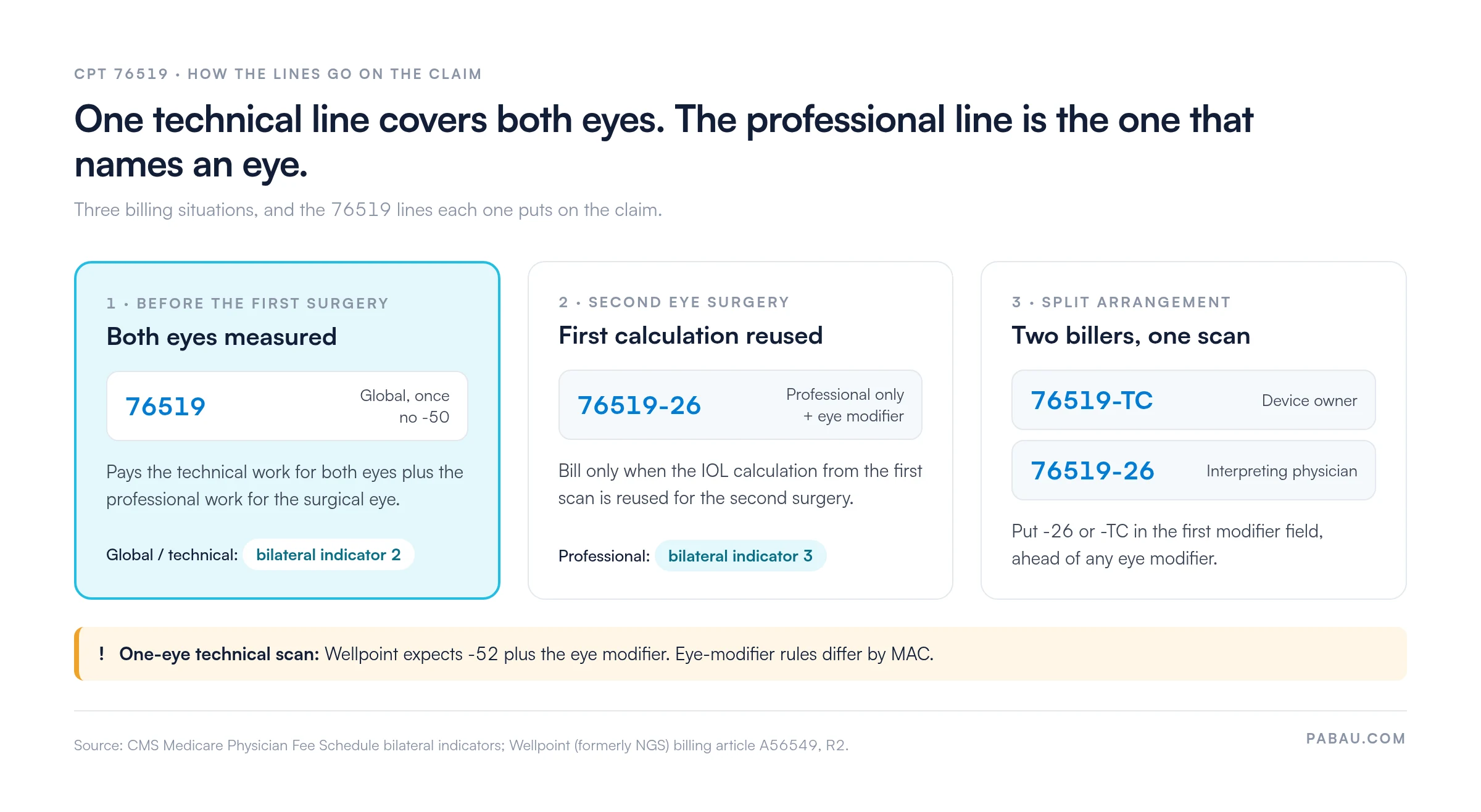
MACs differ on eye modifiers. Wellpoint asks for -RT or -LT on the second professional line, and a one-eye technical scan takes -52 plus the eye modifier. Palmetto GBA tells providers to leave -RT, -LT, and -50 off these codes. Read your own MAC’s biometry article before you set up the charge.
Medicare covers 76519 when it sets IOL power for planned cataract surgery. The detail lives in each MAC’s local coverage determination (LCD) and billing article, so rules shift by jurisdiction.
Payment follows the Medicare Physician Fee Schedule and resets every January. Rates vary by locality and by component, so look up the global, -TC, and -26 amounts in the CMS Physician Fee Schedule lookup tool.
Commercial plans usually apply similar medical necessity rules, but some require prior authorization for diagnostic ultrasound. Check eligibility and benefits against the patient’s plan before the scan.
Several codes turn up around a pre-cataract workup. Knowing how each relates to 76519 keeps a coder from billing a duplicate or reaching for a modifier that cannot help.
Denials on 76519 follow a short, predictable list. Most are preventable with a check at charge entry.
For a denied claim, quote the covered indication from your MAC’s billing article in the appeal. Attach the signed biometry report with the IOL calculation. Tagging each denial by reason code, as part of a denial management routine, shows when one error keeps repeating.
Watch for 76519 denials that repeat the same reason two months running. When one reason passes 5% of these claims, look at your chart template or charge setup first.
A few setup choices in your billing system prevent most of the errors above. Work through them once, and the checks run on every claim after that.
Biometry claims go wrong when the measurements, the surgical plan, and the charge line live in different places. A biller retypes the eye, the diagnosis, and the component, and each retyped field invites an error.
Pabau, the practice management and EHR platform we build, keeps the exam note, the surgical plan, and the billing details in one patient record. Its claims management software builds the claim from those details, so the diagnosis and provider carry over without re-entry.
Pabau sends claims electronically through the Claim.MD integration. Fewer manual steps mean more clean claims on first submission and fewer 76519 corrections later.

Pabau links clinical documentation to claims, so diagnosis and provider details reach each 76519 claim without retyping. Claims go out electronically through the Claim.MD integration.

The device and the lens calculation pick the biometry code, so read both off the chart before you choose. An A-scan with a calculation is 76519, an A-scan without one is 76516, and an optical biometer means 92136.
Most 76519 claims that fail do so on line structure, so fix the charge setup once. Put the technical work on a single line, tie the second-eye -26 line to a reused calculation, and block 92136 for the same patient.
Practices that record the surgical plan and the measurements in structured fields spend less time correcting claims. Book a demo to see how Pabau carries biometry documentation through to a clean 76519 claim.

Need to understand how medical billing claims flow from submission to payment? What is medical billing walks through the end-to-end revenue cycle steps for clinical practices.
Dealing with repeated claim rejections? Denial codes in medical billing explains the most common CARC codes and how to respond to each one.
Want to understand how ERA files work after claims adjudicate? Electronic remittance advice covers how 835 files map payments back to submitted claims.
Billing optical biometry instead? CPT code 92136 covers partial coherence interferometry with the IOL power calculation.
Need the B-scan code for the same workup? CPT code 76512 covers diagnostic B-scan ultrasound of the eye.
CPT code 76519 covers ophthalmic biometry by A-scan ultrasound with intraocular lens power calculation. The axial length it measures is combined with keratometry readings in a formula to choose the IOL before cataract surgery. It is not a contact lens fitting code.
Yes, when it sets IOL power for planned cataract or lens implant surgery. The claim needs a valid diagnosis, such as a cataract code in the H25 range, and a documented surgical plan. Your MAC’s billing article sets the covered diagnoses and frequency limits.
76516 is A-scan biometry without an IOL power calculation, and 76519 is A-scan biometry with the calculation. 92136 is optical biometry by partial coherence interferometry with the calculation. So a claim carries 76519 or 92136, never both.
No. They are two methods for the same service, and Medicare pays for only one. Wellpoint guidance says the same provider should not bill both for a patient within 12 months.
Bill only the professional component, 76519-26, for the second eye when the calculation done at the first scan is reused for the second surgery. The first global claim already paid the technical work for both eyes. Add the eye modifier your MAC asks for.
Use -TC or -26 when the components are split, placed in the first modifier field. Never use -50, because the technical payment already assumes both eyes. Eye modifiers apply to the professional line only, and MAC rules on them differ.
The chart needs the cataract diagnosis, the surgical plan, the A-scan axial length values, and the keratometry used. It also needs the formula, the resulting IOL power, and a signed, dated interpretation.



