

CCSD code G5100: Bypass of duodenum billing guide
CCSD code G5100 bills a bypass that leaves the duodenum in place CCSD code G5100...

Last Updated: Oct 16, 2026
76512 is the CPT code for ophthalmic ultrasound, diagnostic; B-scan (with or without superimposed non-quantitative A-scan). Ophthalmologists and optometrists report it when media opacity blocks a clear view of the posterior segment.
The code is unilateral, so each eye scanned is reported as its own unit. Two decisions drive most denials. The first is billing 76510 when only a B-scan was performed. The second is a note that records the scan without explaining why it was needed.
Let Pabau's smart automation suggest the right codes, reduce claim denials, and keep your practice compliant—effortlessly.
Automate repetitive tasks and focus on what matters most—your patients.
Reduce coding errors and ensure compliance with the latest regulations.
Clean claims, fewer denials, and faster reimbursements.
Powerful insights and reporting to help your practice thrive.
HIPAA compliant SOC 2 certified GDPR-compliant Trusted by 4,000+ clinics worldwide

CPT code 76512 covers a diagnostic B-scan of one eye, with or without a superimposed non-quantitative A-scan.
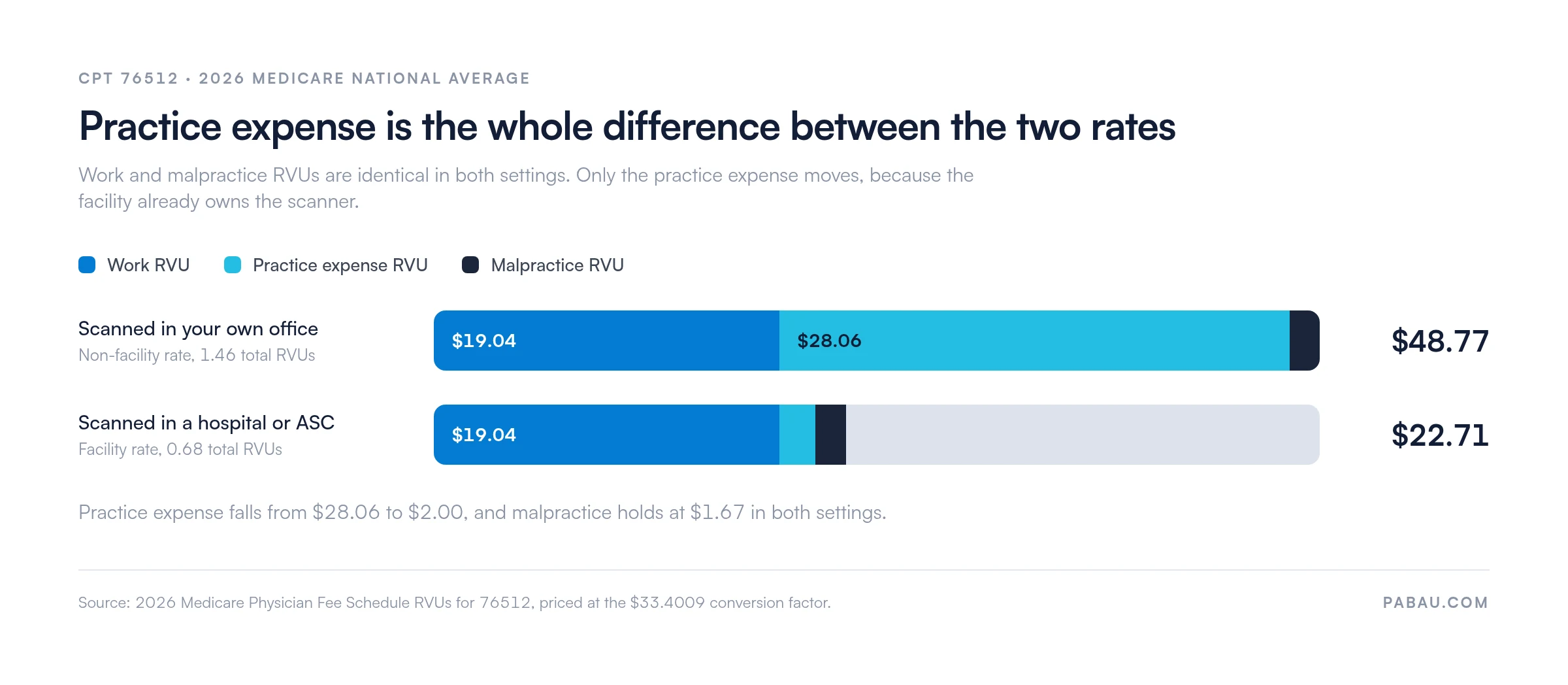
The 2026 Medicare national average works out at roughly $48.77 in your own office and $22.71 in a facility.
Modifier 26 applies when you interpret a scan the facility performed, and the global code triggers a duplicate-service denial.
Coverage sits under a B-scan policy such as LCD L33904, not the SCODI policy that governs the OCT codes.
Pabau’s claims management software links the signed interpretation to the claim and routes it through a clearinghouse.
CPT code 76512 is the diagnostic ophthalmic ultrasound code for a B-scan, with or without a superimposed non-quantitative A-scan. Clinicians order it when they cannot see the posterior segment through the pupil.
Media opacity is the usual reason: a dense cataract, a vitreous hemorrhage, a corneal scar. The scan produces a two-dimensional cross-section of the globe, so the retina and choroid can be assessed without a clear view.
The A-scan matters here only in one respect. A non-quantitative A-scan adds echo amplitude during the study and stays inside 76512. A quantitative A-scan measures, and once it is performed alongside the B-scan the study becomes 76510 instead. The code follows what the report records.
The code sits in the AMA CPT code set under Radiology, in the diagnostic ultrasound procedures of the head and neck (76506-76536). The ophthalmic family runs 76510 through 76519. It is a unilateral code, so each eye you scan is a separate unit with its own laterality modifier.
Read the report before you pick the code. A B-scan generates a two-dimensional image of a cross-section of the eye. An A-scan measures the amplitude of returning sound waves along a single axis. The coding then turns on one question: did that A-scan produce a measurement?
76512 applies when the B-scan is the study and any A-scan performed is non-quantitative. Amplitude data alone does not change the code.
Once a quantitative A-scan is performed with the B-scan, the pair is reported as 76510. Where the A-scan is done for biometry rather than diagnosis, the codes move again, to 76516 or 76519 for lens power planning.
In practice the test is short. If the note says “B-scan performed, echo amplitude noted” and carries no measurement, code 76512.
If it records an axial length of 23.4 mm, an instrument measured something, and 76510 or 76511 fits instead. Coders who treat the two as interchangeable collect NCCI edits and audit letters for the trouble.
An ophthalmic ultrasound that matches none of these codes falls to 76999, the unlisted ultrasound code. Payers price that claim by report, so attach a special report describing the procedure and why no specific code fits.
The 2026 Medicare national average for CPT 76512 is roughly $48.77 in the non-facility setting and $22.71 in a facility. Those figures come from the code’s 1.46 and 0.68 total RVUs, priced at the 2026 conversion factor of $33.4009.
Clinicians who qualify as advanced APM participants are paid at $33.5675, which lifts the office rate to about $49.01. The geographic practice cost index then moves your own rate again. Confirm it in the CMS Physician Fee Schedule lookup for your MAC jurisdiction.
Split those totals into their parts and the setting difference stops looking arbitrary.
Commercial rates sit somewhere else again. Many contracts pay a percentage of Medicare, often between 110% and 150%, while others run an independently negotiated schedule.
Read your own contract rather than assuming the Medicare number carries across. Then compare what each payer remits against what you expected, because a quiet 15% shortfall on a high-volume code is easy to miss.
Reconcile your 76512 claims once a quarter. Pull every claim submitted in the period. Compare the expected rate for your locality against what the payer sent, and flag any line below 90% of expected. Systematic shortfalls on ophthalmic ultrasound usually trace back to a missing TC or 26, not to the contract.
Two modifier decisions carry almost all of the risk on this code: which component you are billing, and which eye you scanned. Get either wrong and the claim either duplicates someone else’s or fails a laterality edit.
Split billing applies whenever the entity running the machine is not the entity reading the images. An ophthalmology practice that owns its B-scan unit bills the global code with no modifier, because it does both jobs. In a hospital outpatient department, the hospital bills 76512-TC and the interpreting physician bills 76512-26.
The scenario that costs practices money looks like this. The physician scans a patient in a hospital outpatient department on the hospital’s equipment, and the practice bills 76512 with no modifier. The hospital has already billed 76512-TC, so the two claims collide and one gets denied as a duplicate service.
The rule underneath is whoever owns and operates the equipment bills TC, and whoever reads and signs the report bills 26. Ask a certified ophthalmic coder to review any arrangement that does not fit either pattern cleanly.
Every 76512 claim needs a diagnosis that establishes medical necessity, and payers check it against a B-scan coverage policy. LCD L33904 is a published example, and it addresses 76510, 76512 and 76513 together.
One warning before you build edits around the wrong document. LCD L34061 covers scanning computerized ophthalmic diagnostic imaging, the OCT family that includes 92134. It is not the policy for ultrasound.
Check the coverage article your own MAC publishes for B-scan, then build your diagnosis list from that.
Pick the laterality-specific code that matches the eye in the report. The codes above are all right-eye examples; the left-eye and bilateral versions end in 2 and 3. Submitting an unspecified code when the chart clearly names an eye is a preventable edit, and it is one payers catch automatically.
Documentation has to prove two things: that the scan happened, and that it needed to happen. Reviewers work through the chart in roughly the order below. A claim missing any one element is exposed on pre-payment review or a later audit.
Repeat scans get their own scrutiny. A payer that sees the same indication scanned again within a short window will ask what changed. Write the answer into the note: new symptoms, a documented change in status, or a finding that needs tracking. “Follow-up” on its own reads as a routine recheck, and routine rechecks are not covered.
It helps to see the whole path once, because each handoff is where a clean claim turns into a denied one.
Three handoffs break most often. Eligibility is skipped and the plan turns out not to cover the scan. The diagnosis says one eye while the modifier says the other. Or the facility bills TC on the same date that the practice bills globally.
When a claim does come back unpaid, the remark code on the remittance names which control failed. Our guide to denial codes maps the ones you will see most often.
Denials on this code cluster around four errors, and each one is caught by a check that takes seconds.
Run this on every 76512 claim before it leaves the practice. It takes under a minute and catches the four errors above.
Most of the errors above start in the chart, not in the billing software. The indication is thin, the laterality is implied rather than stated, or the signed interpretation sits in a separate system from the claim. Practice management software like Pabau closes that distance by holding the note and the claim in one record.
In Pabau, the clinical record captures the indication, the eye scanned and the interpretation in a structured note. The diagnosis and procedure codes attached to that note carry straight into the claim, so nobody rekeys them.
Our claims software for ophthalmology then submits electronically and tracks each claim to its remittance. Eligibility checks run before the appointment, so a plan that will not cover the scan is flagged while the patient can still be told.
Pabau’s US clearinghouse connection is Claim.MD, which reaches thousands of US payers through 837P transactions. Remittances come back into the same screen as the claims, so you can compare expected against paid without exporting a spreadsheet.

Pabau links the signed B-scan interpretation to the claim, checks eligibility before the visit, and tracks every remittance in one place. See the workflow on a live demo.

76512 is a small code with a narrow set of failure points, and all of them are decided before the claim goes out. Choose between 76512 and 76510 from what the report measured. Choose between global and 26 from who owns the machine. Choose the diagnosis from your MAC’s own B-scan policy, with the eye named.
Practices that get this right do not work harder at billing. They write the indication and the laterality into the note while the patient is still in the chair, so the coder never has to guess.
Book a demo to see how Pabau carries that note straight into a clean ophthalmic ultrasound claim.

Want to understand how claims flow through a clearinghouse? Superbill fundamentals for medical practices explains how superbills feed into electronic claim submission and remittance reconciliation.
Need guidance on clean claim submission standards? What makes a clean medical claim covers the elements payers check before processing any CPT code claim.
Credentialing with payers for ophthalmic billing? How to get credentialed with insurance companies walks through the enrollment process for specialty practices.
76513 covers an anterior segment ultrasound performed by immersion, sometimes called a water bath B-scan. 76512 images the posterior segment through the closed lid. The reporting rule differs too: 76513 is reported once whether you scan one eye or both, while 76512 is unilateral.
Yes. A trained ophthalmic technician or sonographer can capture the images while the physician reads them and signs the report. That division is what modifiers TC and 26 describe. The signed interpretation still has to come from the interpreting physician.
Usually yes. Diagnostic tests carry no global period, so a separately identifiable evaluation can be reported alongside the scan. Append modifier 25 to the visit code rather than to 76512, and document the visit’s own reason.
Yes, where the state scope of practice covers ocular ultrasound and the optometrist is credentialed with the payer. The documentation standard does not change. The same order, indication, laterality statement and signed interpretation apply.
No. Coverage turns on a documented reason the posterior segment cannot be examined directly. A scan performed on a patient with clear media, with no symptom or finding behind it, is denied as not medically necessary.



