



CCSD code G5100: Bypass of duodenum billing guide
CCSD code G5100 bills a bypass that leaves the duodenum in place CCSD code G5100...

Last Updated: Oct 16, 2026

CPT code 92136 covers ophthalmic biometry by partial coherence interferometry, including the intraocular lens power calculation.
The 2026 national non-facility Medicare payment is roughly $48.10, from 1.44 total non-facility RVUs and the $33.4009 conversion factor.
Modifiers -RT and -LT belong on the professional component only. The global and technical lines carry no laterality modifier and no -50.
Medicare will not pay 92136 and 76519 for the same patient, same provider, on the same day.
Practice management software like Pabau pre-fills the CMS-1500 from the record, validates required fields, and posts ERA responses back.
CPT code 92136 covers ophthalmic biometry by partial coherence interferometry, and the intraocular lens power calculation comes bundled into the same code. It is the optical scan a surgeon leans on to pick the right implant before cataract surgery.
One rule decides whether the claim pays. The technical side of 92136 is already priced for both eyes, so -RT and -LT never belong on that line. Only the professional component names an eye. Get that split right and most 92136 claims clear on the first pass.
The rest of this page maps the 2026 rate, the modifiers by component, coverage rules, chart notes, and the denials worth heading off early.
One code pays for both halves of the service. CPT code 92136 describes ophthalmic biometry by partial coherence interferometry (PCI), with intraocular lens power calculation. The device measures axial length, anterior chamber depth, and keratometry using laser light rather than sound.
Those three measurements feed the formula that picks the implant. Without them, the lens can leave a patient over- or under-corrected once the eye settles. Most practices run the scan on an IOLMaster or a Lenstar.
The code also splits into a technical and a professional component, and that matters more here than on most diagnostic codes. Whoever owns the device bills the technical work.
The physician who reads the measurements and settles the lens power bills the professional work. Where one practice does both, it bills the global code.
Which of those three forms you bill decides both what you are paid and which modifiers belong on the line.
The 2026 national non-facility payment is about $48.10. That comes from 1.44 total non-facility RVUs multiplied by the 2026 conversion factor of $33.4009. Facility rates run lower, because the practice expense shifts across to the facility. Your own payment then moves with your MAC’s geographic adjustment.
It helps to know what the global rate covers. CMS treats the global payment as the technical work for both eyes plus one professional component. A second professional line for the other eye is paid on top of it, not folded into it.
Rates reset every January 1, so pull your own locality figure from the CMS Physician Fee Schedule lookup tool rather than reusing last year’s number.
Watch your remittance advice through January too, because that is where a rate change first shows up.
Most commercial contracts set 92136 either as a percentage of the Medicare allowable or as a flat contracted amount. The spread between payers is wide, so the contract matters more than the national figure.
Check eligibility and benefits before the scan, because some plans still require prior authorization for biometry.
Pull your MAC’s fee schedule for all three forms of the code, not just the global one. The -TC and -26 amounts tell you what a split-billing arrangement is worth. They are also the only way to check that a co-managed claim paid correctly.
Medicare covers 92136 when cataract surgery is planned and the scan sets the lens power. Coverage sits in each MAC’s local coverage determination, so the fine detail shifts by jurisdiction. The national rule behind all of them is stricter than most billers expect.
Where cataract is the only diagnosis, Medicare routinely covers one comprehensive eye examination and one scan. Additional tests get denied as not reasonable and necessary unless a second diagnosis and a documented clinical need support them.
The core criteria for a covered 92136 claim:
Read your own MAC’s coverage article before you rely on any of this, because covered diagnoses and frequency limits are set locally. CGS Administrators and Palmetto GBA both publish detailed biometry articles that list covered codes eye by eye.
Specificity matters as much as the code list itself. An unspecified code such as H25.9 names no eye, so it cannot support a professional-component line that carries -RT or -LT. Take the laterality straight from the exam note and code to it.
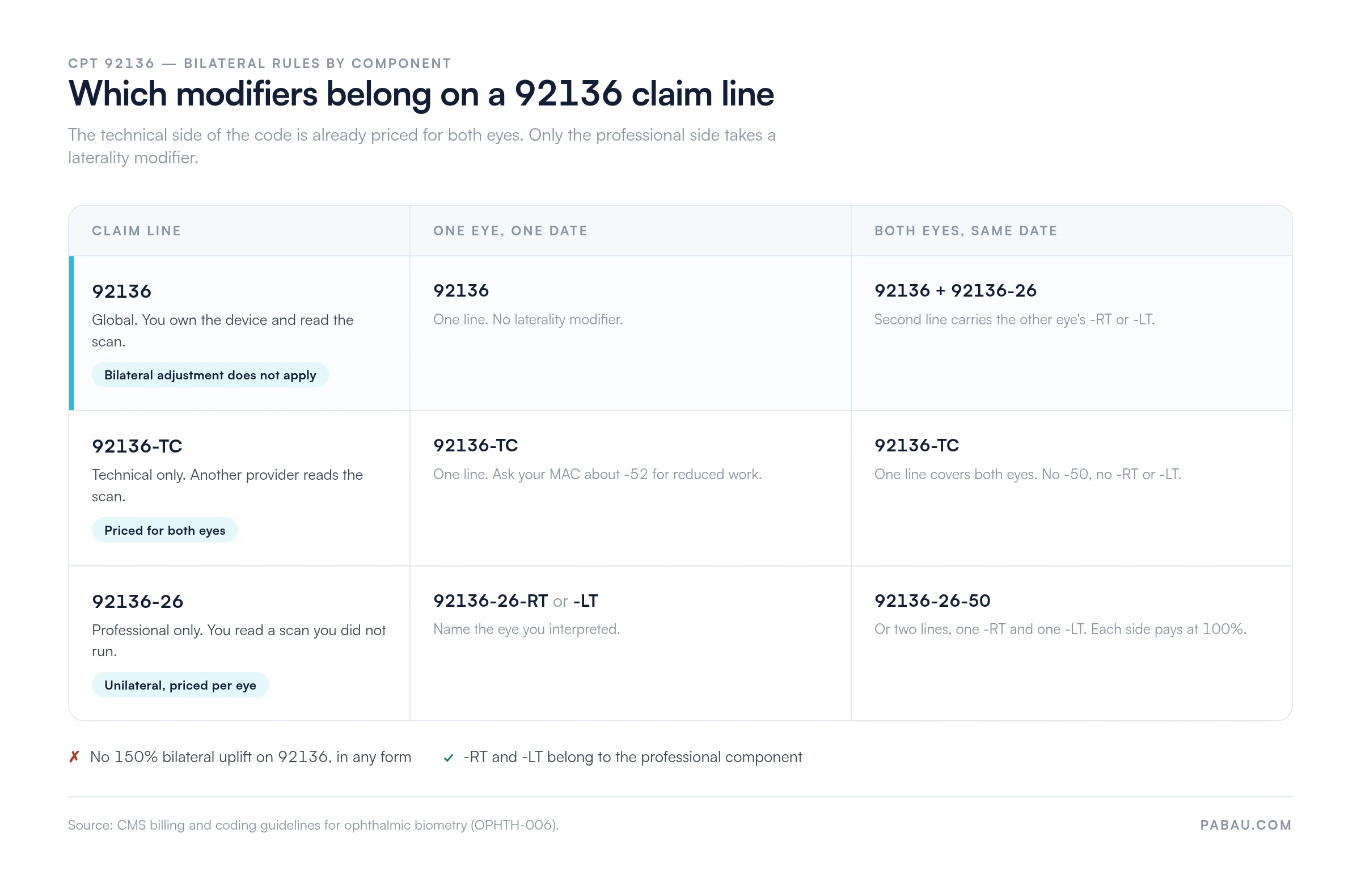
Start with the component, not the eye. CMS classifies the global and technical parts of 92136 as bilateral procedures where the bilateral adjustment does not apply. One line covers both eyes. That line carries no -50, no -RT, and no -LT.
This rule is not local custom. CMS billing and coding guidance for ophthalmic biometry says it plainly. Report the technical work on a single claim line, without the -50 or -RT and -LT modifiers.
The professional component works the other way around. CMS prices it per eye, so it is the line that names the eye. Interpret one eye and you bill 92136-26 with -RT or -LT. For both eyes on the same date, send 92136-26-50, or two lines carrying -RT and -LT.
Neither route pays 150%. The bilateral payment adjustment is switched off on this code, so a -50 on the professional line buys 100% per side rather than a premium.
MAC guidance from CGS, NGS, Noridian and Palmetto GBA all points the same way. Keep -50 off the global and technical lines entirely.
The grid below is the whole rule in one screen. It is worth pinning next to the charge-entry desk, because the wrong component is the error that costs a practice the most rework.
One more warning about modifiers. A -59 does not rescue a bundling rejection here. Medicare will not pay 92136 and 76519 for the same patient, same provider, same day, and a distinct-service modifier cannot force that pair through.
Payers want three things in the record: the measurement, the calculation, and the surgeon’s sign-off. Thin documentation is what turns a paid claim into a recoupment two years later. Capture it at the point of service rather than reconstructing it during an audit.
A note stored as a scanned attachment satisfies an auditor but not a biller. Where the measurements live as structured fields in the record, the charge line can be built from them instead of retyped. That is where most transcription errors disappear.
Seven checks catch almost every 92136 rejection. Work down them in this order, because each one fails at a different stage of the claim’s journey.
Those checks map onto the path the claim takes. Charge capture is where the component and the modifier get decided. Your clearinghouse catches format and field errors next, usually within minutes. The payer’s own edits, including NCCI pairs and coverage rules, only fire during adjudication days later.
That timing is why front-loading matters. A modifier fixed at charge entry costs a few seconds. The same modifier fixed after adjudication costs a corrected claim, a fresh clock on payment, and a note in someone’s follow-up queue.
One item on that list deserves its own section. The difference between 92136 and 76519 is light versus sound. 92136 is optical biometry, 76519 is A-scan ultrasound, and both include the lens calculation.
Report the code that matches the device you used. Auditors check the instrument named in the chart against the code on the claim.
A dense cataract is the usual reason a practice keeps both devices. Where the optical scan cannot get a reading through the lens, the ultrasound does the job, and the claim moves to 76519 for that eye.
Several imaging and diagnostic codes turn up around a pre-cataract workup. Knowing which ones bundle keeps a clean claim clean, and it stops a coder reaching for -59 to unpick a pair that was never separable.
92136 cannot be billed on the date of the cataract surgery. The procedure’s own global package absorbs a same-day scan, which is why the biometry belongs in a pre-operative visit. That single date field causes more automatic denials on this code than any clinical question.
Two other edits are worth committing to memory. Payment for 76519 and 92136 together, same patient and same provider on one day, is simply not made. And 76516 is included in 76519, so it earns no extra payment when the two appear side by side.
NCCI edits change quarterly, so a pairing that cleared last year may not clear now.
Denials on 92136 cluster tightly. Five patterns cover almost all of them, and each has a fix that lives upstream of the rejection rather than in the appeal.
Each of those arrives with a remittance code rather than an explanation, which is what makes the first read confusing. Our reference on denial codes translates the common CARC and RARC combinations into the action they call for.
Almost every item on that denial list is clerical rather than clinical. It is the wrong component, a laterality modifier on the wrong line, or a date that matches the surgery.
Practice management software like Pabau will not make the coding call for you, but it does remove the retyping step where those errors get in.
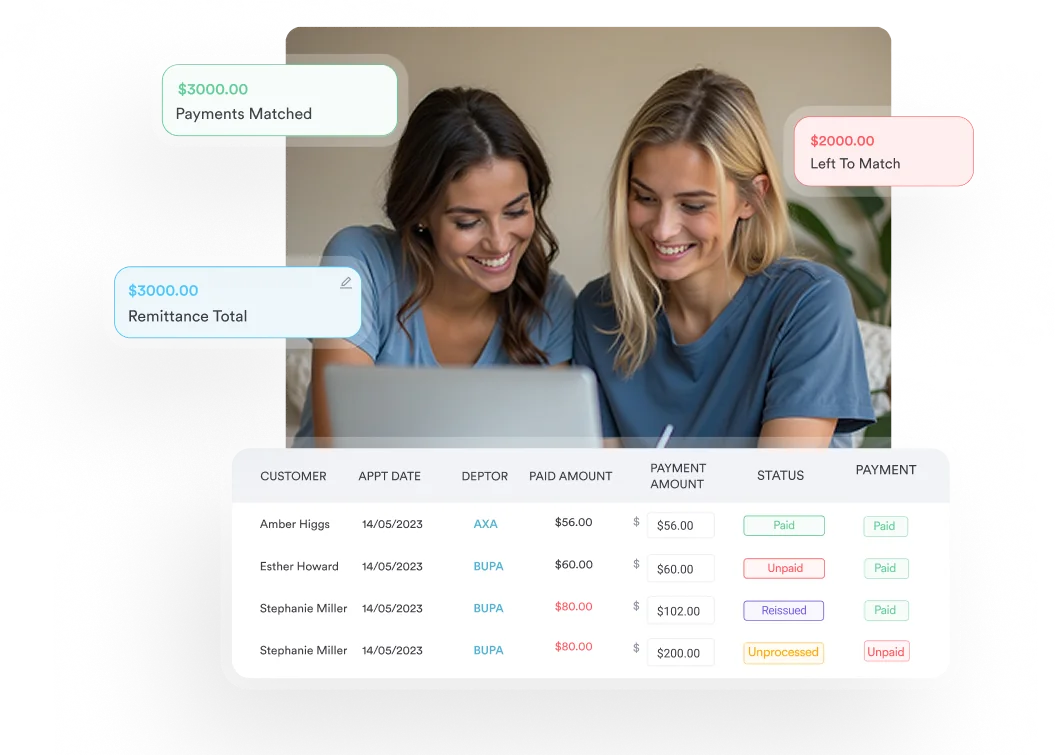
Pabau pre-fills the CMS-1500 from the client record. The CPT code attached to the service lands on the charge line, and the ICD-10 slots are seeded from the recorded problem list.
Built-in ICD-10-CM and CPT lookup libraries sit behind a search icon, so a coder can confirm H25.011 without leaving the claim.
Before the send button unlocks, Pabau checks that claim-required fields are complete. Submission then runs through Claim.MD, our US clearinghouse partner, which reaches thousands of US payers and handles CMS-1500 and 837P claims.
Real-time eligibility checks, claim-status tracking, and ERA remittance posting all land back in the same screen.
Component and laterality decisions stay with your coder, which is exactly why the seven-point check above still earns its place.
What the software takes off the team is the second round of typing and the missing membership number. It also removes the two-week wait to learn a claim never reached the payer.
Pabau’s claims software for practices carries that whole loop, from charge capture through to the remittance.

Pabau pre-fills the CMS-1500 from the client record, validates required fields before the claim can send, and posts ERA responses back into the same screen. See how ophthalmology billing teams keep their claims moving.

92136 is a short code with one expensive assumption buried in it. Treat the scan as a per-eye service and you will keep sending laterality modifiers where CMS does not want them. Read the technical line as already covering both eyes, and the modifier questions mostly answer themselves.
Two habits close most of what is left. Keep the scan off the surgery date, and code the eye the exam note names. Neither takes clinical judgment, and both fail silently when the claim is built from memory instead of from the record.
Software will not choose your modifier, and it should not pretend to. What it can do is stop the same claim being typed twice and tell you the day a remittance arrives. Book a demo to see how Pabau moves an ophthalmology claim from charge capture to ERA without the paper chase.

Billing the surgery the scan was run for? CPT code 66984 covers extracapsular cataract removal with lens insertion, including its global period rules.
Facing a dense or complicated cataract? CPT code 66982 sets out when complex cataract surgery is billable and what the record has to show.
Need the diagnosis side of the claim? ICD-10 code H25.9 explains unspecified age-related cataract and when a laterality-specific code is required.
Billing the pre-operative eye exam as well? CPT code 92014 covers comprehensive ophthalmological services for an established patient.
Want the full path a claim takes to the payer? Medical claims clearinghouse guide walks through submission, edits, and ERA receipt.
The practice that owns the biometry device bills the technical work. The physician who reviews the measurements and settles the lens power bills the professional component with -26. Where one practice does both, it bills the global code with no component modifier at all.
No. Screening is statutorily excluded, so report the -GY modifier if a patient asks you to bill it anyway. Where you expect a medical-necessity denial instead, use -GA when a signed ABN is on file and -GZ when one is not.
Medicare pays the technical component in the office (11), independent clinic (49), federally qualified health center (50), and rural health clinic (72). The professional component adds inpatient hospital (21), outpatient hospital (22), and ambulatory surgical center (24).
No. Medicare’s coverage determination pairs one comprehensive eye examination with one scan for a routine cataract, and both are payable. A further test needs a second diagnosis and a documented clinical reason in the chart.
No. The code has the XXX indicator, so the global surgery concept does not apply and no postoperative days attach to it. That is not permission to bill it on the surgery date. The cataract procedure’s own global package absorbs a same-day scan.



