

HCPCS Code L0472: Hyperextension TLSO billing guide
HCPCS code L0472: Official descriptor and device definition HCPCS code L0472 des...

Last Updated: Nov 5, 2026
74022 is the CPT code for a complete acute abdomen series. That means two or more views of the abdomen, such as supine, erect or decubitus, plus a single chest view. Teams order it for suspected bowel obstruction, free air or an acute abdomen.
Coders often confuse this code with 74021, which needs three or more abdominal views and no chest view. The chest view decides the code, so the radiology report has to name it.
Let Pabau's smart automation suggest the right codes, reduce claim denials, and keep your practice compliant—effortlessly.
Automate repetitive tasks and focus on what matters most—your patients.
Reduce coding errors and ensure compliance with the latest regulations.
Clean claims, fewer denials, and faster reimbursements.
Powerful insights and reporting to help your practice thrive.
HIPAA compliant SOC 2 certified GDPR-compliant Trusted by 4,000+ clinics worldwide

CPT code 74022 covers a complete acute abdomen series: two or more abdominal views, such as supine, erect or decubitus, plus a single chest view.
Without a documented chest view, the study codes to 74018, 74019 or 74021, depending on how many abdominal views were taken.
Modifiers -26 and -TC split global billing, and -59 or -XS applies only when a separately ordered 71046 is billed on the same date.
The 2026 national non-facility Medicare rate is about $49, so check your MAC locality in the CMS fee schedule before quoting it.
Search the radiology report for the word “chest” before you submit, because a missing chest view is the most common 74022 denial.
CPT code 74022 is the code for a complete acute abdomen series, as defined by the American Medical Association. The official descriptor reads:
Radiologic examination, abdomen; complete acute abdomen series, including 2 or more views of the abdomen (eg, supine, erect, decubitus), and a single view chest.
In plain terms, you need at least two abdominal views and one chest view from the same series.
That chest view is what makes the series complete. Leave it out and the study drops to a lower abdomen code, however many abdominal views were taken. Teams order the series for suspected bowel obstruction, free air under the diaphragm or an acute abdomen.
The code sits in the Radiology section of CPT (70010-79999), under Diagnostic Radiology. Billed without a modifier, it is a global code. The claim then covers the technical work (equipment, staff, imaging) and the radiologist’s interpretation and report.
The report needs to name both parts of the series.
List each view by name. A report that says “three views of the abdomen” without naming the chest view won’t support 74022 on review.
The 74018-74022 family turns on two questions. Was a chest view part of the series, and how many abdominal views were taken?
Read the family as a decision rather than a ladder. Many coders assume 74022 needs three abdominal views because 74021 does. It needs two, plus the chest view, and the diagram below shows the order to check them in.
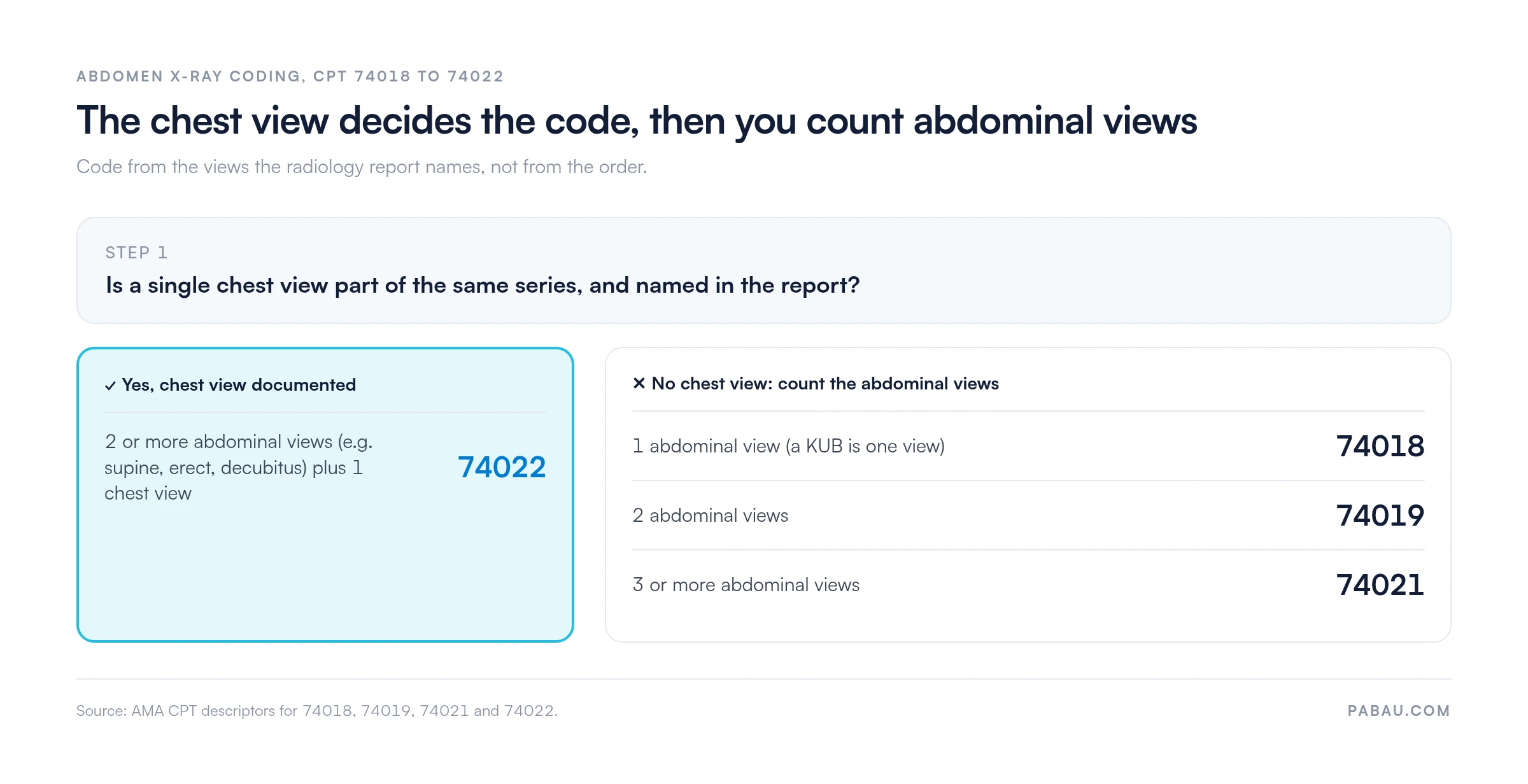
The errors run both ways. Billing 74022 without a documented chest view is upcoding, and recoupment audits look for it. Splitting a complete series into 74019 plus a single chest view code (71045) is the reverse mistake, because CPT directs that combination to 74022.
The chest view inside 74022 is a single view, and it is bundled into the series. You can’t bill it again on its own.
Sometimes the patient also needs a full two-view chest study, 71046, as a separate exam on the same date. When both studies are medically indicated and separately ordered, 74022 and 71046 can be billed together.
The CMS National Correct Coding Initiative (NCCI) may apply a bundling edit to this pair, so check the current edit table first. Where an edit exists, use modifier -59 or the more specific -XS. Separate orders and separate reports have to back it up.
Don’t add -59 by default to push a claim through. The record has to explain why a full chest study was needed on top of the chest view already in the series.
A KUB (kidneys, ureters, bladder) is a single supine abdominal film, so it maps to 74018. Billing 74022 for a KUB-only study is upcoding, even when the order mentions abdominal pain.
Keep 74022 for presentations that need the full series, such as suspected obstruction, perforation or acute abdominal pain. A routine KUB for kidney stone follow-up stays at 74018.
The right modifier depends on who owns the equipment and who reads the films. A mismatch in a split-billing setup is a common denial trigger.
In an office that owns its imaging equipment and employs the radiologist, the global code covers both components.
In a hospital outpatient setting, the facility bills the technical component and the radiology group bills the professional one. If one entity bills the global code and a component for the same date, the claim reads as a duplicate.
Medical necessity reviews of 74022 come down to two records, the radiology report and the ordering provider’s note. Together they have to show that the full series was done and clinically warranted.
Before you submit a 74022 claim, open the radiology report and search for the word “chest.” If the chest view isn’t named, ask the radiologist to amend the report before billing. An amendment takes minutes. An appeal takes weeks.
Medicare pays 74022 under the annual CMS Medicare Physician Fee Schedule (MPFS). Rates change by locality and by setting (facility or non-facility). The figure below is a 2026 national estimate, so confirm your MAC locality rate before you rely on it.
Commercial rates depend on each payer contract and market. Check the contract itself rather than treating Medicare as a benchmark.
Most 74022 problems start well before the claim reaches the payer. This is the usual path, with the point where each step tends to slip.
Denials for 74022 cluster around documentation, bundling and billing the wrong level. Good denial management workflows catch each one at the step where it starts, not after the remittance arrives.
The diagnosis on the claim has to support an acute presentation. These ICD-10-CM codes are common pairings for 74022.
Use the most specific code the note supports, such as K56.2 for volvulus rather than K56.609. R10.9 only holds when the note documents the acute picture. Payers increasingly compare the diagnosis with the report findings during automated review, and our ICD-10-CM code library lists the more specific options.
Run this quick check on every 74022 claim before it leaves the practice.
After payment, watch the denial reason codes. The remittance lists a Claim Adjustment Reason Code (CARC) for each denial. Tracking them for 74022 over 90 days shows whether your denials come from documentation, bundling or modifiers. Our guide to electronic remittance advice explains how to read the 835 file.
Once a quarter, pull every denied 74022 claim and sort it by CARC. Documentation denials get fixed in the radiology report. Bundling denials get fixed at claim scrubbing, and modifier denials in your billing setup. Each cause needs its own fix, so track them separately.
In many imaging practices, the coder reads the report in one system and types the charge into another. Eligibility gets checked on a payer portal. Each handoff is a chance to lose the chest view or the right modifier.
Pabau, our all-in-one practice software, handles insurance claims inside the patient record. Its claims software for radiology and other specialties pre-fills the CMS-1500 from the record. The 74022 charge line and diagnosis codes carry over without retyping. Claims can’t be sent until the required fields are complete.
In the US, claims go out through Claim.MD. Your team gets real-time eligibility checks before the study date, claim-status tracking and ERA posting in the same place. That leaves coders more time for the report check that decides 74022.
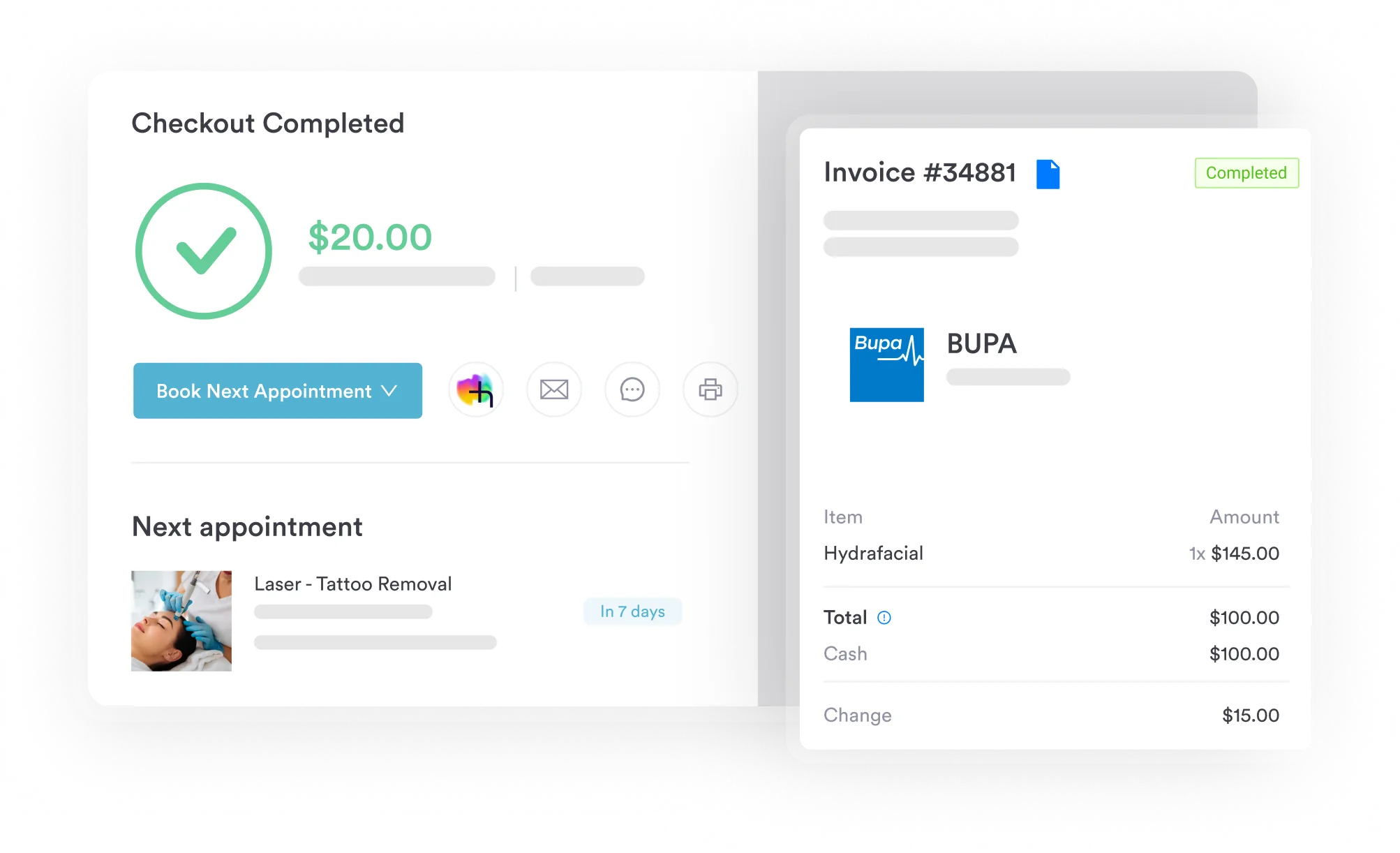

Pabau pre-fills claims from the patient record and checks required fields before sending. US claims go through Claim.MD, with real-time eligibility checks and ERA posting in the same platform.

Treat the chest view as the gate for 74022. If the report names it alongside two or more abdominal views, bill 74022 with confidence. If it doesn’t, code the abdominal views and ask for an amendment rather than hoping the payer won’t look.
The trade-off is a few minutes of checking against weeks of appeals. Build the “chest” search into charge entry, and the most common 74022 denial stops before it starts.
Want radiology claims, eligibility checks and remittances in one place? Book a demo to see how Pabau helps your billing team get 74022 paid on the first submission.

Need to understand how clearinghouses route your radiology claims? Medical claims clearinghouse guide explains how electronic claims travel between providers and payers.
Tracking denial trends across your radiology practice? Denial codes in medical billing covers how to read Claim Adjustment Reason Codes and prioritize appeals by root cause.
Want to confirm coverage before the imaging study? Insurance eligibility verification walks through payer checks that flag coverage problems before the patient arrives.
Billing a separate single-view chest X-ray? CPT code 71045 covers when a one-view chest study is billed on its own.
Billing imaging to Medicare for the first time? Medicare billing guide explains how Medicare claims, fee schedules and MACs fit together.
In 2020, CPT deleted 74000, 74010 and 74020 and replaced them with 74018, 74019 and 74021. Code 74022 stayed in place and now describes two or more abdominal views plus a single chest view.
No. The descriptor asks for a single view of the chest and names no projection. An AP chest from a patient who can’t stand still counts, as long as the report names it.
Yes. A supine view plus a left lateral decubitus view counts as two abdominal views. Name the decubitus view in the report so a reviewer can see why there’s no erect film.
Yes, if it’s a separate, medically necessary study with its own order and report. Bill it as 71045 or 71046 with modifier -59 or -XS. A chest view from the same session is already part of 74022.
About $49 nationally in a non-facility setting, based on 1.48 RVUs and the $33.4009 conversion factor. Your locality rate will differ, so check the CMS fee schedule look-up tool.



