CCSD code F4600: Incisional drainage of salivary gland abscess
CCSD code F4600: what the descriptor covers CCSD code F4600 covers incisional dr...

Last Updated: Oct 20, 2026
74019 is the CPT code for radiologic examination, abdomen; 2 views. It reports a plain-film abdominal X-ray with exactly two projections, usually supine plus upright or decubitus, read and documented in a signed report.
View count decides the code. A single view is 74018, three or more views are 74021, and a series that adds a chest view is 74022.
Let Pabau's smart automation suggest the right codes, reduce claim denials, and keep your practice compliant—effortlessly.
Automate repetitive tasks and focus on what matters most—your patients.
Reduce coding errors and ensure compliance with the latest regulations.
Clean claims, fewer denials, and faster reimbursements.
Powerful insights and reporting to help your practice thrive.
HIPAA compliant SOC 2 certified GDPR-compliant Trusted by 4,000+ clinics worldwide

CPT 74019 reports an abdominal X-ray with exactly two views. Bill 74018 for one view, 74021 for three or more, and 74022 when a chest view is added.
Append modifier 26 or TC when one party owns the equipment and another interprets the study. A missing or wrong modifier is a frequent denial cause.
The 2026 national Medicare rate for 74019 is about $36 before locality adjustment, and the professional component is roughly 30% of it.
Pabau, the practice management platform we build, sends claims through the Claim.MD clearinghouse with eligibility checks before the study and remittance tracking after it.
The American Medical Association publishes the official descriptor for CPT code 74019 as Radiologic examination, abdomen; 2 views. It reports a plain-film abdominal X-ray with exactly two views, interpreted and documented in a signed report. The code sits in the Radiology section of the CPT code set, under Diagnostic Radiology (Diagnostic Imaging) Procedures of the Abdomen (74018-74190).
CPT code 74019 applies when a radiologist or physician performs a plain-film radiographic study of the abdomen using two projections. The study images the abdominal cavity, including the bowel gas pattern, soft tissue outlines, bony pelvis, and any radiopaque foreign bodies or calcifications.
Common clinical indications that support medical necessity for CPT 74019 include:
The CPT descriptor does not name which projections to acquire. It requires two views, obtained and documented. In practice, the AP supine and upright abdomen combination is the most common pairing. When a patient cannot stand, a left lateral decubitus view replaces the upright projection. A series of three or more abdominal views is reported with 74021, not 74019.
A frequent coding error in abdominal X-ray billing is picking the wrong code within the 74018-74022 family. View count decides the code, not anatomy or clinical indication. The chart below maps each view count to its code and its 2026 national Medicare rate.
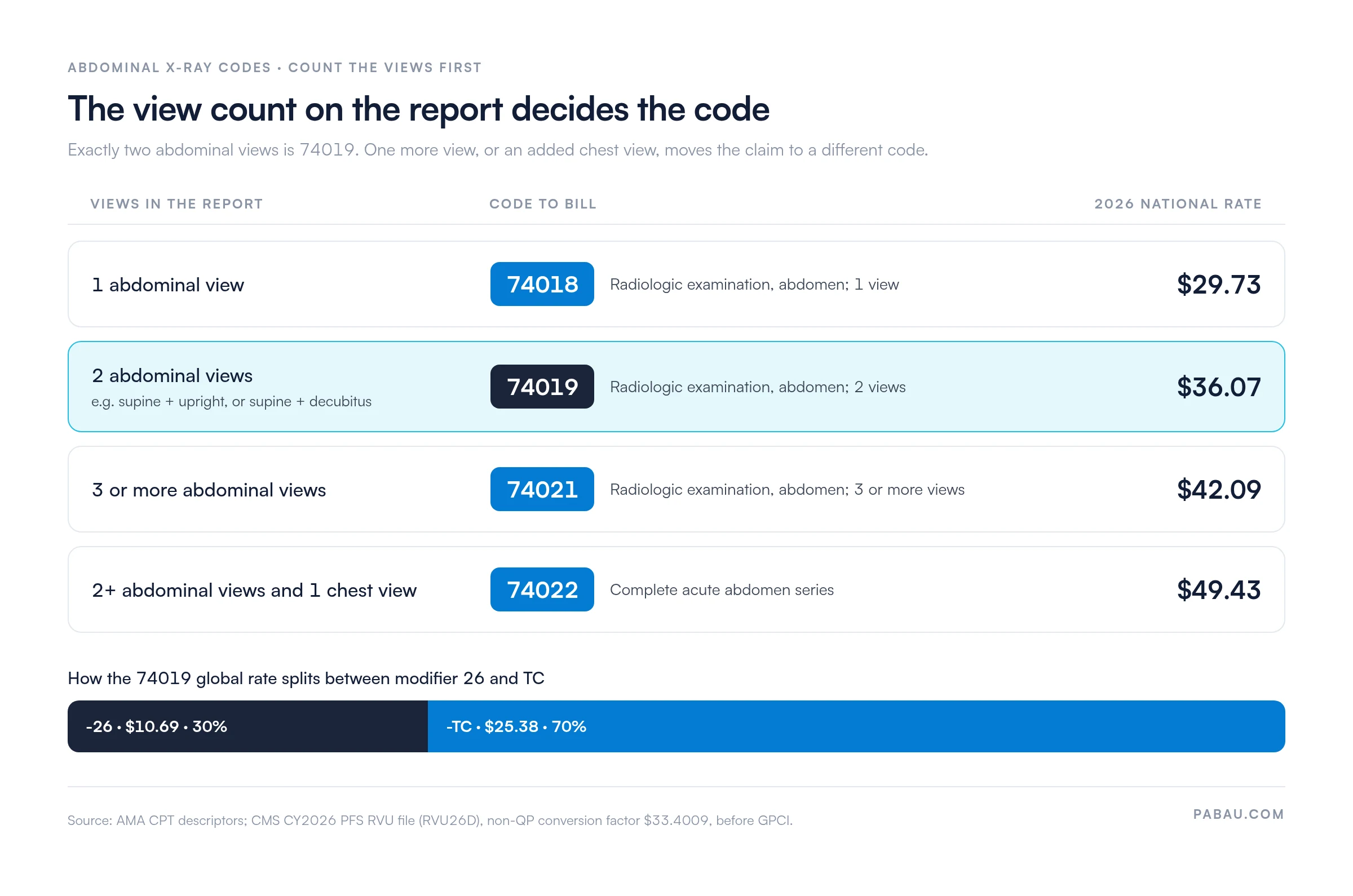
Bill 74019 only when the radiology report confirms that two views were acquired and interpreted. A single-view study belongs under 74018, and upcoding it to 74019 exposes the practice to audit risk. A three-view series billed as 74019 is undercoded, because 74021 is the correct code.
Accurate documentation is the bridge between the procedure performed and a paid claim. For CPT 74019, the radiology report must support three elements. It has to show that the abdomen was imaged, that two views were obtained, and that a physician interpreted and signed the study.
Flag any radiology report that states only one view was taken or does not specify view count. Billing CPT 74019 against a report documenting a single projection is a documentation mismatch that payers catch on post-payment audit.
Radiology codes, including CPT 74019, can be billed globally or split into professional and technical components. The choice depends on who owns the equipment and who performs the interpretation. Getting modifiers right is especially important for hospital outpatient and independent imaging center settings.
Physician offices that own their own X-ray equipment and employ the interpreting radiologist bill globally. When the hospital provides the equipment and the radiologist bills separately, the hospital bills 74019-TC and the radiologist bills 74019-26. Billing both globally in this scenario results in a duplicate-claim denial.
Medicare Part B reimburses CPT code 74019 under the CMS Physician Fee Schedule. Rates are set annually and adjusted by geographic practice cost index (GPCI) factors, so the allowed amount varies by MAC jurisdiction and locality.
Abdominal plain-film codes like 74019 are low-RVU studies. For 2026, 74019 carries 1.08 total RVUs, which works out to a national global rate of about $36 at the non-QP conversion factor of $33.4009. The professional component (modifier 26) is 0.32 RVUs, about 30% of the global rate, and the technical component (TC) carries the rest.
Locality adjustments move these figures, and CMS resets them each calendar year. Check the CMS MPFS Look-Up Tool before quoting rates to patients or negotiating commercial contracts.
For practices that send claims through Pabau’s Claim.MD clearinghouse integration, real-time eligibility checks (270/271) confirm Medicare Part B coverage and patient cost-sharing before the study. That cuts down on billing surprises after the visit.
Verify your locality’s current 74019 allowed amount on the CMS MPFS Look-Up Tool each January. Geographic adjustments between the lowest- and highest-cost localities can shift the allowed amount by 20-30%, making a mid-year fee schedule review worthwhile for multi-site practices.
Medicare generally does not require prior authorization for abdominal radiographs. Commercial payers are less consistent. Some managed care plans do require pre-authorization for outpatient diagnostic imaging, including plain-film abdominal studies ordered in non-emergency settings.
The ICD-10-CM diagnosis code paired with CPT 74019 must support the medical necessity of the study. Payers cross-reference the diagnosis against their Local Coverage Determinations (LCDs) and National Coverage Determinations (NCDs) to determine whether the imaging was appropriate.
When ordering a study for a non-specific symptom like R10.9, document the clinical reasoning in the order or encounter note. Payer LCDs for abdominal radiology often list covered diagnoses explicitly; check the applicable MAC policy before billing.
Four denial reasons come up most often for CPT 74019. Each one is preventable with front-end checks rather than appeals after the fact.
For practices with recurring 74019 denials, a denial management workflow that tracks denials by reason and payer shows patterns faster than reading single remittances. With electronic remittance advice (ERA/835), the claim adjustment reason codes arrive in a structured form. That lets your team route each denial to the right person without manual sorting.
Submitting a clean claim the first time is always faster than appealing a denial. For abdominal X-ray billing, that means confirming view count, modifier logic, and ICD-10 pairing before the claim leaves the practice.
Radiology billing holds up when the report, the code, and the claim agree. Most practices still check eligibility in one portal, build claims in another, and post remittances by hand. Pabau’s claims software for radiology keeps those steps in one place, from the eligibility check to the remittance.

Through the Claim.MD clearinghouse integration, Pabau generates CMS-1500 claims from your invoices and sends them to thousands of US payers. Eligibility checks (270/271) run before the visit, and ERAs are matched back to the claims they pay. Denied claims are flagged for rework, so your team sees which 74019 claims need attention without sorting remittances by hand.
Your coders still assign the code and modifier from the signed report. Pabau keeps the claim, its status, and its remittance together, so a view-count or modifier denial is easy to trace back to its source. If the revenue side is new to you, our guide on how medical billing works covers the full cycle.

Pabau sends your CMS-1500 claims through Claim.MD, checks patient eligibility before the study, and matches ERAs back to each claim. See how it works in a live demo.

CPT 74019 pays for one specific study: two abdominal views, interpreted and documented in a signed report. Read the view count off the report before you assign a code, and let it decide between 74018, 74019, 74021, and 74022.
Get that step right, add the correct modifier in split-billing settings, and pair a specific ICD-10 code. Most 74019 denials then never happen. The cost is a few seconds of report review per claim, which is far cheaper than an appeal.
Book a demo to see how Pabau keeps radiology claims, eligibility checks, and remittances in one place.

Want to reduce abdominal imaging claim denials? Denial management in healthcare covers the systematic approach to tracking, appealing, and preventing payer denials across radiology and other specialties.
Need to understand clearinghouse submission for radiology codes? Medical claims clearinghouse guide explains how 837P transactions, ERA posting, and payer connectivity work in practice.
Looking for a complete billing compliance reference? Medical billing compliance outlines the documentation and audit-readiness requirements that protect practices billing diagnostic radiology codes.
Checking coverage before an imaging study? Insurance eligibility verification walks through what to confirm before the patient arrives.
Working with a payer that requires authorization? The prior authorization process explains how to request, track, and document approvals for outpatient imaging.
CPT code 74019 is the billing code for a radiologic examination of the abdomen with 2 views. It sits in the diagnostic radiology section of the AMA CPT code set. It reports a plain-film abdominal X-ray with two projections, typically AP supine plus an upright or lateral decubitus view.
CPT 74018 covers a single-view abdominal radiograph, while CPT 74019 covers two views. Use 74018 for a single portable or scout image. Use 74019 when the radiology report confirms two projections were acquired and interpreted. Billing 74019 when only one view was performed is a documentation mismatch that payers flag on audit.
CPT 74019 requires two views. The descriptor does not specify which two projections, but AP supine with an upright abdomen is the most common pairing. When the patient cannot stand, a left lateral decubitus view replaces the upright projection. Three or more abdominal views are coded 74021, and the radiology report must state how many views were obtained.
Four reasons come up most often. The report documents only one view, or a global claim goes out in a split-component setting that needed modifier 26 or TC. The ICD-10 code may be too vague to support medical necessity. A plan that requires prior authorization may never have received a request. Most of these denials can be prevented before submission rather than through appeals.