CPT code 90473: Nasal and oral vaccine billing guide
CPT code 90473 covers one nasal or oral vaccine per visit CPT code 90473 reports...

Last Updated: Oct 16, 2026
71100 is the CPT code for radiologic examination, ribs, unilateral; 2 views. It covers a two-view x-ray of the left or right ribs, ordered for trauma, a suspected fracture, or localized rib pain.
Coders most often confuse it with CPT 71101, a one-sided rib series that adds a posteroanterior chest view. It is also mixed up with the bilateral rib codes 71110 and 71111 and with the chest x-ray codes 71045 and 71046. Missing laterality documentation drives many 71100 denials.
Let Pabau's smart automation suggest the right codes, reduce claim denials, and keep your practice compliant—effortlessly.
Automate repetitive tasks and focus on what matters most—your patients.
Reduce coding errors and ensure compliance with the latest regulations.
Clean claims, fewer denials, and faster reimbursements.
Powerful insights and reporting to help your practice thrive.
HIPAA compliant SOC 2 certified GDPR-compliant Trusted by 4,000+ clinics worldwide

CPT Code 71100 covers a unilateral (one-sided) rib x-ray and requires a minimum of 2 views to bill correctly.
CPT 71101 is not the bilateral code. It is a unilateral rib series that adds a posteroanterior (PA) chest view, with at least three views.
Billing 71100 twice for a bilateral exam is incorrect. Use CPT 71110 when both sides are imaged, or 71111 when a PA chest view is included.
Missing laterality in the radiology report is the single most common reason 71100 claims are denied by payers.
Practice software such as Pabau keeps the order, diagnosis code, and claim together, so staff can check laterality and modifiers before submission.
CPT Code 71100 is defined by the American Medical Association as “Radiologic examination, ribs, unilateral; 2 views.” It sits in the Radiology section of CPT (70010-79999), within diagnostic radiology procedures of the chest (71045-71555).
The code applies when a clinician orders an x-ray of one side of the ribcage only. The imaging must capture two distinct projections of that side.
Two points trip up coders consistently. First, 71100 needs two views, so a single-view rib study billed under it is a documentation error and a denial risk. Second, the code explicitly covers ribs, not the chest.
Ordering a “chest x-ray with rib views” does not automatically make 71100 the right code. The clinical indication and the documented anatomical focus must be the ribs themselves.
CPT 71100 is appropriate when a clinician needs one side of the ribcage imaged to assess trauma, fracture, or pathology on that side. The most common clinical triggers are blunt chest trauma and a suspected rib fracture after a fall or motor vehicle accident. A metastatic workup for a one-sided lesion and pleuritic or costal pain with documented laterality also qualify.
The supporting ICD-10-CM code must reflect the same laterality as the x-ray order. Common pairings include:
Payers increasingly apply automated edits that cross-check the ICD-10 laterality character against the documented side in the radiology report. A left-sided rib pain ICD-10 code paired with a report that says “right ribs imaged” will trigger a denial regardless of clinical logic.
Coders should confirm the ICD-10 laterality character matches the radiologist’s report before submission, not after. A bilateral diagnosis such as S22.43XA (multiple fractures of ribs, bilateral) points to a two-sided study, which is coded 71110 or 71111 rather than 71100.
CPT 71100 is one of four rib x-ray codes, and two questions decide between them. Were one or both sides of the ribcage imaged? And did the study include a posteroanterior (PA) chest view?
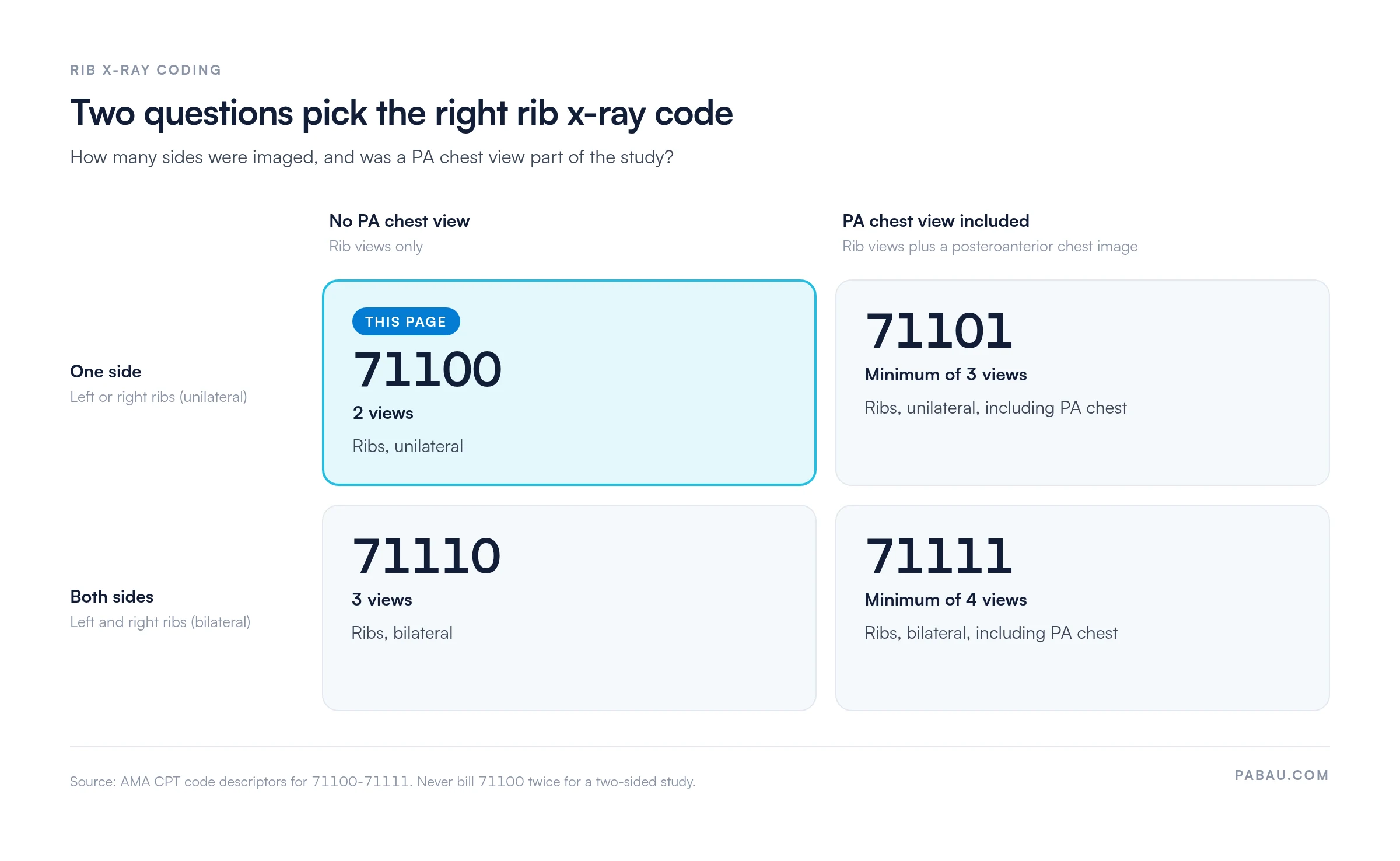
CPT 71101 causes the most confusion. Its descriptor still reads “unilateral,” so it never covers the second side of the ribcage. It applies when a one-sided rib series also includes a PA chest view, usually ordered to check the lungs for complications such as a pneumothorax.
When both sides are imaged, the study is reported with 71110, or with 71111 if a PA chest view is part of it. Billing 71100 twice on the same date of service, once per side, is incorrect coding. It typically triggers a duplicate-claim edit or a medical necessity denial, depending on the payer’s adjudication logic.
The chest x-ray codes and the rib codes are anatomically adjacent but clinically distinct. CPT 71100 images the ribs. CPT 71045 and 71046 image the chest cavity (lungs, heart, mediastinum). Reporting one in place of the other misstates the documented study, which creates compliance exposure in either direction.
If the only chest image is a PA view taken as part of a one-sided rib series, the whole study is coded 71101. The PA chest view is already in that descriptor, so a separate 71045 for the same view would report it twice.
Same-day billing of 71100 alongside 71045 or 71046 is sometimes appropriate when the clinical record documents a separate indication for each study. An example is a suspected rib fracture plus a separate pulmonary evaluation. NCCI edits may restrict same-day billing of rib and chest x-ray codes in certain scenarios. Check the current CMS NCCI table before billing both codes on the same date of service.
Check the CMS National Correct Coding Initiative (NCCI) table before billing CPT 71100 alongside 71045 or 71046 on the same date. Even when the clinical indications are genuinely separate, a bundling edit can trigger an automatic denial. Append the NCCI edit findings to the claim note so the reviewer can see the rationale upfront.
Radiology codes like CPT 71100 can be billed globally or split into two components, depending on who performs and interprets the study. Getting the split right prevents the most common modifier errors in radiology billing.
A common error occurs when a hospital outpatient department bills globally for 71100 while the independent radiologist group also bills globally. The result is a duplicate claim. The facility bills TC, the radiologist bills with Modifier 26, and together they equal the global payment. Neither party bills the full global unless they genuinely perform and interpret in-house.
Medicare pays for CPT 71100 under the CMS Medicare Physician Fee Schedule, with rates adjusted by Geographic Practice Cost Index (GPCI) for each payment locality. The figures below reflect approximate national averages for the 2025 fee schedule year. Verify current rates in the CMS MPFS lookup tool before quoting any payment amount.
Private payer rates vary substantially from Medicare and may be negotiated as a percentage of the MPFS or as flat contracted rates. Practices should check payer contracts individually. The FastRVU lookup tool provides a quick reference for current RVU values and location-adjusted Medicare rates without requiring a paid subscription.
According to the American Medical Association, CPT codes are updated annually. Work RVU values for radiology codes, including 71100, can change in each year’s MPFS rulemaking cycle. Always confirm rates for the current fiscal year before setting billing expectations with clinical staff.
Rib x-rays under CPT 71100 are plain film studies, so they never fell under the Appropriate Use Criteria (AUC) program. The Protecting Access to Medicare Act (PAMA) created that program for advanced imaging such as CT, MRI, nuclear medicine, and PET. CMS paused it indefinitely and rescinded its regulations from January 1, 2024. No imaging modality, plain film included, currently faces an AUC requirement. Prior authorization rules still vary significantly by payer class.
The safest practice is to verify coverage and authorization requirements for each patient’s specific plan before the study is performed. MAC Local Coverage Determinations for outpatient diagnostic radiology are publicly available and worth reviewing for your jurisdiction. Pabau’s integration with the Claim.MD clearinghouse includes real-time eligibility verification. Front-desk staff can confirm a patient’s imaging coverage before the appointment instead of learning about it from a denied claim.
A clean 71100 claim requires six documentation elements. Missing any one of them is enough to trigger a denial or a request for additional information from the payer.
Practices that route rib x-ray orders through integrated claims management software can build pre-submission checks. Those checks flag incomplete laterality, mismatched diagnosis codes, and missing view counts before the claim leaves the practice.
The majority of 71100 denials stem from a small set of repeatable errors. Auditing for these seven patterns before submission catches most of them. When one slips through, the remittance names the cause with a claim adjustment reason code (CARC). Our guide to medical billing denial codes explains what each one asks you to fix.
Build a pre-submission audit step specifically for rib x-ray claims. The checklist should take under 60 seconds. Confirm that (1) laterality is documented in the report and (2) the view count meets the minimum. Then check that (3) the ICD-10 laterality character matches the report and (4) the modifier fits your billing arrangement. Finally, (5) look for duplicate 71100 lines on the same date. Catching these five items before submission prevents most avoidable 71100 denials.
In many practices, the coder reads the radiology report and keys the code into a separate billing system. A missing side, a wrong view count, or the wrong rib code only surfaces when the denial arrives. By then, the radiologist has moved on and an addendum can take weeks.
Pabau keeps the imaging order, the ICD-10 selection, and the claim in the same patient record. Coding staff can check laterality, view count, and the choice between 71100, 71101, 71110, and 71111 while the study is still fresh.
Claims then go out through Claim.MD, our integrated US clearinghouse partner, which also handles eligibility checks and electronic remittance advice (ERA). Any denial that still comes back can be logged with its CARC reason code. It is then routed through a structured denial management workflow until it is resolved.

Pabau keeps the radiology order, diagnosis code, and claim in one workflow. Your team can check laterality, view count, and the right rib code before 71100 claims go out.

CPT Code 71100 has a short list of requirements, and every one of them lives in the radiology report. If the report names one side, documents two views, and shows no PA chest image, 71100 is the right code. If it doesn’t, fix the report or move to 71101, 71110, or 71111 before the claim goes out.
The trade-off is a minute of checking at the front of the process. That costs far less than chasing a radiologist for an addendum weeks after the denial lands.
Practices that connect radiology orders to their billing system make that check routine rather than dependent on one coder’s memory. To see how Pabau’s medical billing and claims tools keep rib x-ray claims clean, book a demo with the team.

Need to understand how claims move from submission to payment? Revenue cycle management explained walks through every stage of the billing lifecycle, from coding to ERA reconciliation.
CPT Code 71100 is used to bill a unilateral rib x-ray with two views of one side of the ribcage. It applies when a clinician needs imaging of only the left or right ribs, typically for trauma, a suspected rib fracture, or localized costal pain. Bilateral rib studies use 71110 or 71111, a one-sided series with a PA chest view uses 71101, and chest x-rays use 71045 or 71046.
Both codes cover one side of the ribcage. CPT 71100 is a two-view rib x-ray, while CPT 71101 adds a posteroanterior (PA) chest view and requires at least three views. Neither code is bilateral, so a two-sided rib study is reported with 71110 or 71111.
No. CPT 71100 covers only unilateral (one-sided) rib imaging. Bilateral rib x-rays are reported with CPT 71110, which covers three views. CPT 71111 applies when the bilateral study also includes a PA chest view, with at least four views.
No modifier converts 71100 into a bilateral code. When both sides are imaged, bill CPT 71110, or 71111 if a PA chest view is included, rather than appending a modifier to 71100. Modifiers TC and 26 apply only to split component billing (technical vs professional), not to laterality.
Sometimes. Same-day billing of 71100 alongside 71045 or 71046 may be appropriate when separate clinical indications are documented for each study. However, NCCI edits may bundle these codes depending on the payer. Verify the current CMS NCCI table before submitting both codes on a single claim date. If the only chest image is a PA view taken within a one-sided rib series, code the study as 71101 instead.
The claim must be supported by six elements. Laterality (left or right) must appear in both the order and the radiology report, and the report must document at least two views. The ordering provider’s notes must record a clinical indication that the claim’s ICD-10-CM code supports. That code’s laterality character must match the report, and the ordering physician’s NPI must be on the claim. If Modifier 26 is billed, a signed radiologist interpretation is also required. Missing laterality is the most common denial trigger for this code.