



CCSD code G5100: Bypass of duodenum billing guide
CCSD code G5100 bills a bypass that leaves the duodenum in place CCSD code G5100...

Last Updated: Oct 16, 2026
CPT code 75572 bills a contrast-enhanced CT of the heart performed to evaluate cardiac structure and morphology.
One detail drives most of its denials. 3D image postprocessing and cardiac function assessment are already bundled into the code, so billing either one separately is unbundling. The other recurring problem is its neighbor 75574, which covers coronary CTA and pays more.
Get the choice wrong and the claim comes back denied, or the payment gets pulled back on audit. The rest of this page works through the money, the diagnoses, the modifiers, and the paperwork that keeps 75572 paid.

CPT code 75572 covers cardiac CT with contrast for structure and morphology, not coronary artery CTA, which is 75574.
3D image postprocessing and cardiac function assessment are bundled into 75572 and cannot go on a separate claim line.
Medicare pays roughly $229 nationally for the global service, about $149 for the technical component and about $80 for the read.
Coverage rests on a supported ICD-10 diagnosis and a report that addresses every element named in the descriptor.
Many commercial plans require prior authorization for 75572, while Medicare reviews medical necessity after payment instead.
CPT code 75572 describes computed tomography of the heart with contrast material, performed to evaluate cardiac structure and morphology.
The descriptor then names three services that travel with it. Those are 3D image postprocessing, assessment of cardiac function, and evaluation of venous structures where performed. All three are bundled into the one code.
Put 3D postprocessing on its own line next to 75572 and you have unbundled the code. The American Medical Association’s CPT code set uses inclusive parenthetical language to signal the bundling.
Payers then enforce it with National Correct Coding Initiative (NCCI) edits, so the extra line simply denies.
The cardiac CT family runs from 75571 through 75580, and each code answers a different clinical question. Reading the set together is the quickest way to stop picking the wrong sibling, which is the fastest route to an audit.
The 75572 and 75574 mix-up is the common one. 75572 is a single-source CT of overall cardiac structure, so chambers, valves and morphology. CPT 75574 is what most cardiologists mean when they say cardiac CTA.
Billing 75572 for a coronary study undercodes the work, while billing the coronary code for a morphology-only study overcodes it. Either direction creates audit exposure.
Medicare pays roughly $229 for a global 75572 at the national unadjusted rate. Split the service and the professional read comes to about $80, while the technical component takes about $149.
The code carries 1.71 work RVUs and 6.87 total RVUs. All of these figures come from the CMS Physician Fee Schedule.
The spread between the three arrangements is what makes the modifier worth settling early.
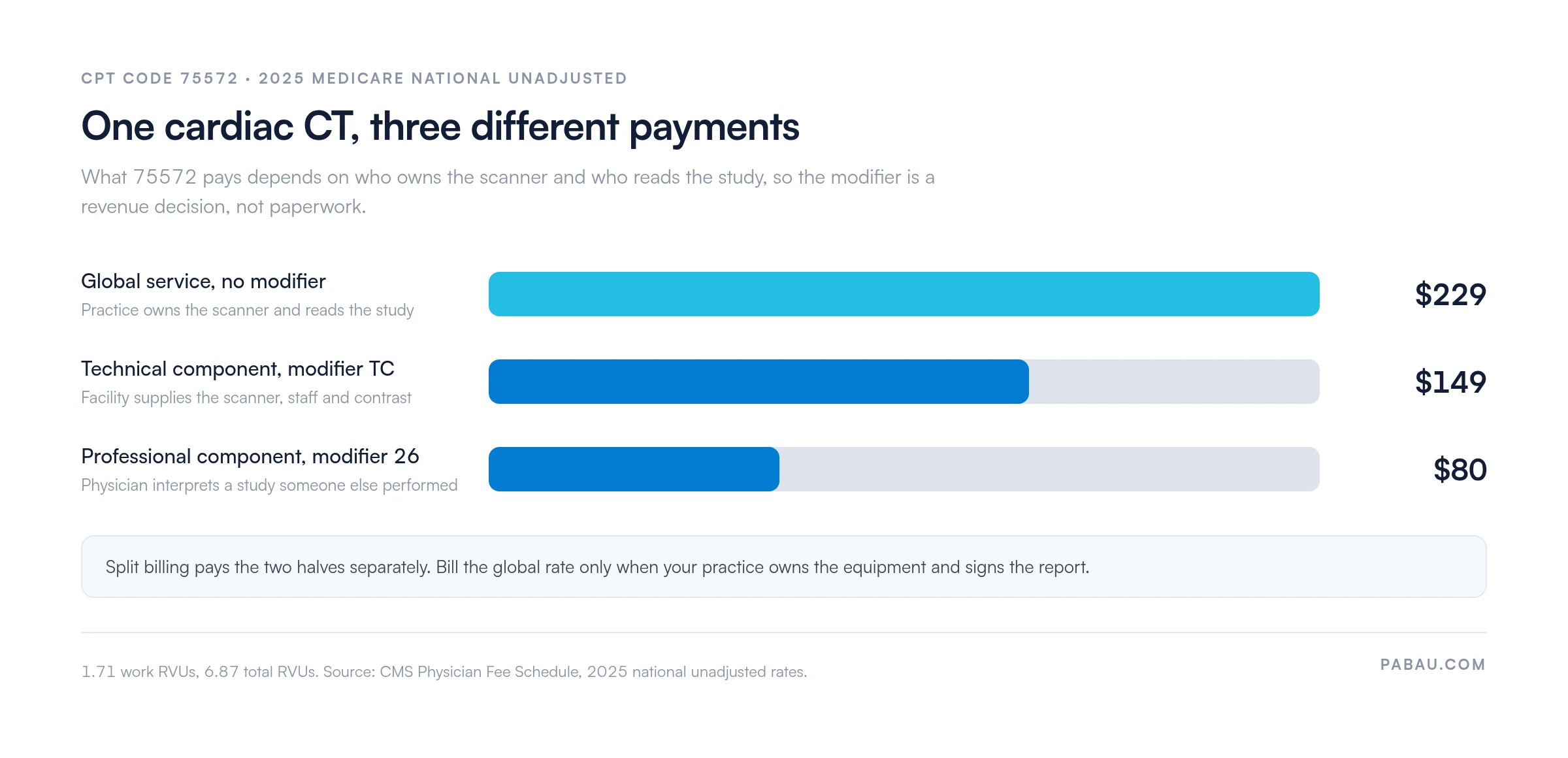
Geographic adjusters move these numbers by roughly 15% to 25% either side of the national base. Pull your own locality rate from the CMS fee schedule lookup tool before you quote a patient or reprice the chargemaster.
Run a Medicare rate check quarterly rather than annually. CMS releases mid-year corrections and MAC-specific payment notices that shift the effective rate for 75572 between fee schedule cycles. Set a calendar reminder for April and October.
Medicare coverage for 75572 sits under CMS article A56691, “Billing and Coding: Cardiac Computed Tomography & Angiography (CCTA)”. Coverage is never automatic.
The claim has to carry a medically necessary indication, and the record has to demonstrate it. A non-covered use will deny however cleanly the rest of the claim is built.
Coverage criteria still vary by Medicare Administrative Contractor (MAC). Check your own MAC’s Local Coverage Determination before you submit a borderline case, because the national article is only the starting point.
Every 75572 claim needs an ICD-10 diagnosis that supports medical necessity. An unsupported diagnosis is the second biggest denial driver, behind missing prior authorization. The pairings below are the ones payers accept most often under CMS coverage criteria.
That last row is in the table as a warning. A history code from another body system carries no cardiac information, so it will not support the claim on its own.
Modifier choice on 75572 comes down to two questions. Who owns the scanner, and who reads the study? Answer both at charge capture and the modifier settles itself. Answer them in the billing office a week later and you are reconstructing the facts from memory.
Never put modifier 26 and TC on the same claim line for the same provider. That pairing reads as a billing system fault and triggers an automatic review.
The report has to address every component the descriptor names. Payers read the report against the descriptor during medical necessity review, so a missing element becomes a missing payment.
Store the report with the order and the clinical notes so the billing file stands on its own. When a post-payment audit lands 18 months later, that file is what answers it.
Many commercial plans require prior authorization for 75572. Medicare does not, and reviews medical necessity after the fact instead.
The difference changes how you triage the work. Skipping prior auth with a commercial payer guarantees a denial, while a thin Medicare file is a recoverable audit finding.
EviCore Healthcare handles cardiac imaging authorization for many large commercial insurers. Their portal asks for the referring diagnosis, the clinical history, any prior cardiac workup and the CPT code you want approved. Standard requests usually clear in two to five business days, and expedited clinical reviews in 24 to 48 hours.
It helps to see where a cardiac CT claim can stall before it gets there. Six handoffs sit between the order and the payment, and each one has its own failure mode.
Steps two and four cause most of the rework. Both happen before anyone in billing touches the claim, which is exactly why denial rates on cardiac imaging rarely improve by working the queue harder.
Denials on 75572 cluster around five causes, and every one of them is preventable at the front end.
Each denial arrives with a reason code, and reading it correctly decides whether you correct and resubmit or start an appeal. The guide to medical billing denial codes sets out what the common ones mean.
The AMA’s CPT Editorial Panel creates and issues CPT codes. The genuinely new code in this corner of cardiac imaging is CPT 75577, a Category I code effective January 1, 2026.
It covers software quantification and characterization of coronary atherosclerotic plaque. It replaced Category III codes 0623T to 0626T, which had been in use since January 1, 2021.
Practices billing 75572 and 75574 should carry 75577 and 75580 as separate line items in the chargemaster. Neither substitutes for the coronary CTA code, and coverage for both still varies by payer, so check each policy before you bill.
The documentation needs to show which software was used, what it produced, and that a physician interpreted the output and signed a report.
If your practice runs plaque analysis or FFR-CT software, audit how those studies have been billed. A claim that swaps 75574 for 75577 or 75580 gives up the coronary CTA interpretation payment and invites a recoupment request. Both codes are add-ons, so bill them alongside 75574 and keep the software output in the record.
Most of the failures above happen long before anyone opens the claim form. The order says one thing and the report says another, or the authorization number sits in an email nobody can find at submission.
Practice management software like Pabau keeps those pieces on one patient record. Its claims management software pulls the CPT code attached to the service straight onto the charge line.
The ICD-10 slots are seeded from the patient’s recorded problem list. Searchable ICD-10 and CPT libraries sit beside the form, so a coder checks a descriptor without opening a second tab.
Submission stays locked until the claim’s required fields are complete. A missing membership or authorization number therefore stops the claim at your desk rather than at the payer.
In the US, claims route through our Claim.MD integration, so eligibility checks, claim status and electronic remittance come back into the same record. Your billing team can follow a 75572 from charge capture to payment posting without leaving the patient file.

Pabau builds the claim from the patient record, holds it until every required field is complete, and tracks status and remittance in one place. Your team spends less time rebuilding claims that should have gone out right the first time.

75572 rewards precision at the front of the process. The descriptor bundles more than it looks like it does, and the neighboring coronary code pays differently. Coverage then rests on a diagnosis somebody else wrote into the order.
Three habits close most of the denials in this article. Fix the modifier at charge capture, check the diagnosis against your MAC’s list, and make the report answer the descriptor line by line. All three cost less than appealing the same denial every month.
Book a demo to see how Pabau builds a cardiac imaging claim from the patient record and tracks it through to payment.

What does the calcium scoring code cover? CPT code 75571 explains the without-contrast sibling of 75572 and when a calcium score is the right study to bill.
Need a structured way to work claim denials? Denial management in healthcare walks through how to categorize, track and appeal rejections by denial code type.
What has to be right before a claim goes out? Clean claim submission covers the checks that keep a claim from bouncing back on a technical error.
How does electronic claim submission work end to end? Medical claims clearinghouse guide explains how 837 files travel from practice to payer and what happens when they are rejected.
Where does claim submission sit in the wider process? Revenue cycle management fundamentals covers the full claim lifecycle from eligibility check through payment posting.
Diagnostic radiology codes like 75572 carry a global period indicator of XXX, so the global surgery concept does not apply. There is no pre-service or post-service period attached to the scan. A separately documented evaluation and management service on the same day is billed on its own terms.
Use POS 11 when the scan happens in a physician office that owns the scanner, which is also where the global rate applies. Hospital outpatient departments take POS 22 on campus and POS 19 off campus, and the physician then bills the read with modifier 26.
No. 75572 is computed tomography only. Cardiac MRI has its own family in the 75557 to 75565 range. Those codes split by contrast use, and by whether stress imaging or flow quantification was performed.
Yes. Give the patient an Advance Beneficiary Notice before the scan, then append modifier GA to the claim line. Without a signed notice on file you cannot bill the patient for a service Medicare denies as not medically necessary.



