

HCPCS Code E0272: Foam rubber mattress billing guide
HCPCS Code E0272: official descriptor and code overview HCPCS Code E0272 is the ...

Last Updated: Nov 6, 2026
73201 is the CPT code for computed tomography, upper extremity; with contrast material(s). It covers one contrast-enhanced CT acquisition of any segment from the shoulder to the hand.
Providers order it when a soft tissue mass, vascular lesion, infection or post-surgical change needs enhancement that a non-contrast scan cannot show. A scan without contrast is 73200, and a non-contrast phase followed by a contrast phase in one session is 73202.
Let Pabau's smart automation suggest the right codes, reduce claim denials, and keep your practice compliant—effortlessly.
Automate repetitive tasks and focus on what matters most—your patients.
Reduce coding errors and ensure compliance with the latest regulations.
Clean claims, fewer denials, and faster reimbursements.
Powerful insights and reporting to help your practice thrive.
HIPAA compliant SOC 2 certified GDPR-compliant Trusted by 4,000+ clinics worldwide

CPT code 73201 describes CT of the upper extremity with contrast, distinct from 73200 (without contrast) and 73202 (with and without contrast).
Contrast must be documented in the radiologist’s report and the ordering clinician’s referral. Undocumented contrast use is the top denial trigger.
Modifier 26 (professional component) or TC (technical component) applies when the interpreting physician and the facility bill separately.
The 2026 national non-facility Medicare rate is about $199 before GPCI adjustment, so check your locality in the CMS Look-Up Tool.
Pabau, the practice management platform we build, connects to the Claim.MD clearinghouse for electronic claims, eligibility checks and ERA posting.
CPT code 73201 is defined by the American Medical Association (AMA) CPT code set as: Computed tomography, upper extremity; with contrast material(s). The upper extremity encompasses the shoulder, arm, elbow, forearm, wrist, and hand. A single 73201 claim covers one complete CT acquisition of any anatomical segment within that range, performed with intravenous (IV) or other contrast material.
The key clinical trigger for 73201 over 73200 is the presence of contrast. Contrast enhancement improves delineation of soft tissue tumors, synovial lesions, osteomyelitis, vascular malformations, and post-operative changes. If the ordering indication does not clearly require contrast, payers may question medical necessity and request supporting documentation.
73202 covers a single session with two acquisition phases, non-contrast first and then contrast. Payers bundle two separate 73200 or 73201 claims submitted for the same date and extremity. Select 73202 when the radiologist performed both phases in one session.
Two questions settle the code, as the decision path below shows: Which modality ran, and how contrast was used.
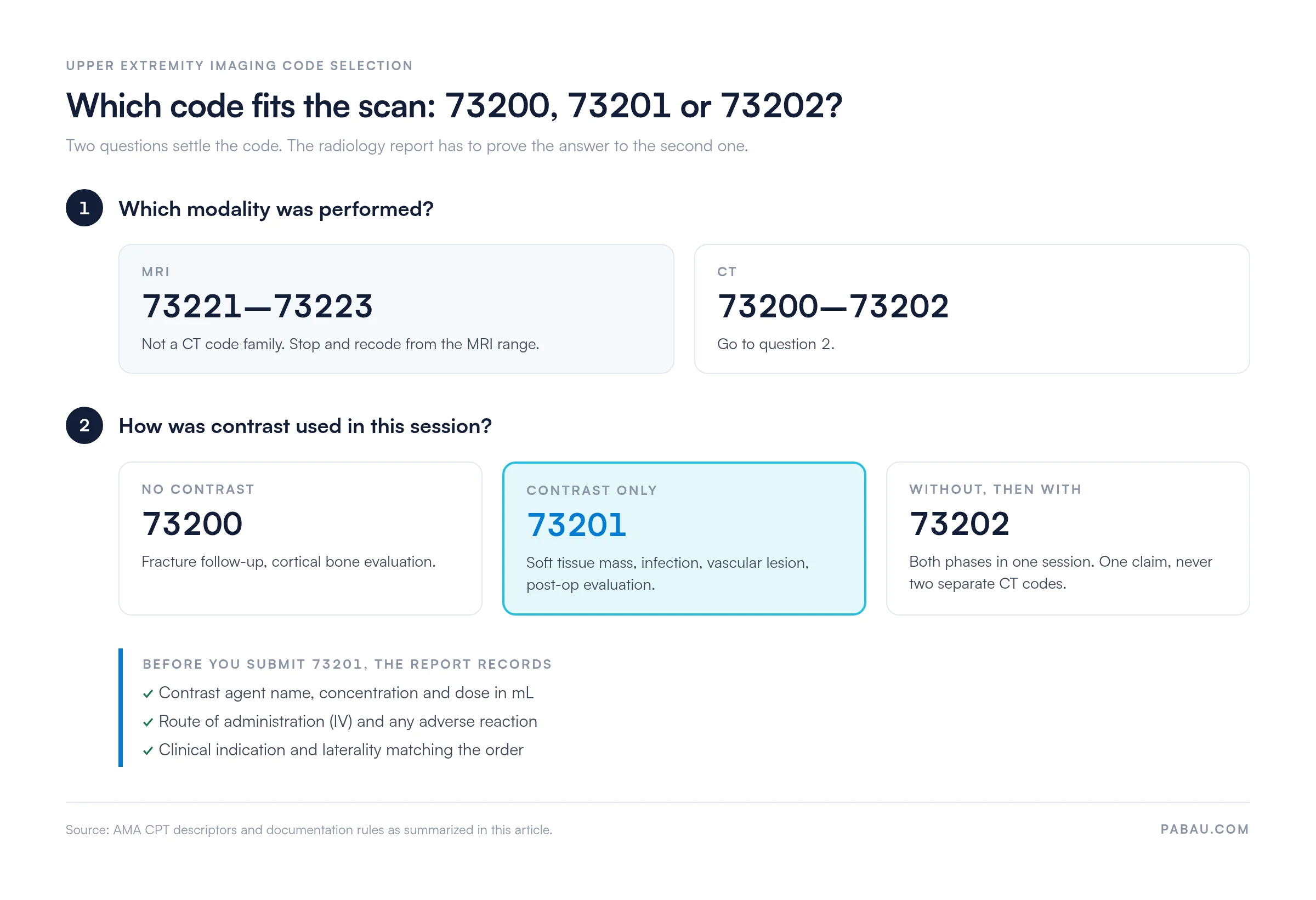
Confusing CT (73200-73202) with MRI (73221-73223) is a documented coder error. Confirm the modality on the radiology order before selecting a code. CT uses ionizing radiation and cross-sectional reconstruction from X-ray data. MRI uses magnetic resonance. Payers flag CT claims with MRI ICD-10 linkage and vice versa.
Modifier selection for CPT code 73201 depends on where the service was performed and who is billing. Radiology practices commonly split the professional and technical components. Bilateral studies need laterality modifiers, and some payers want modifier 59 to separate the CT from other same-day services.
The PGM Billing CPT lookup tool lets you verify current modifier edits for 73201 using CMS data. Confirm bilateral billing rules with each payer before claims submission. Some reject modifier 50 on diagnostic radiology codes and require separate line items instead.
CPT 76377 describes 3D rendering requiring image postprocessing on an independent workstation. It is a standalone code, not an add-on, and can be reported in addition to CPT code 73201. That applies when the radiologist or a qualified technologist goes beyond the standard MPR reconstructions the scanner console generates.
The ICD-10-CM diagnosis linked to a CPT code 73201 claim must justify both the CT modality and the use of contrast. A generic musculoskeletal pain code rarely satisfies payer medical necessity criteria for contrast-enhanced imaging. The diagnosis should reflect a condition where soft tissue enhancement, vascularity, or infectious spread is clinically relevant.
Medicare local coverage determinations (LCDs) may restrict billable diagnoses beyond what the code descriptor implies. Always cross-reference the ordering physician’s clinical indication against the relevant MAC’s LCD before submission. Use the AAPC Codify CPT lookup to review crosswalk guidance between CPT code 73201 and associated ICD-10-CM codes.
Prior authorization requirements for CPT code 73201 vary by payer, plan type, and state. There is no single universal rule. The safest approach is to verify authorization requirements for each specific payer and plan before scheduling the scan. Knowing your medical billing compliance obligations helps practices avoid costly retroactive denials.
Turnaround for PA decisions is typically 1-3 business days for non-urgent cases and same-day or next-day for urgent or expedited requests. Document the PA number in the claim and retain the approval confirmation in the patient record.
Medicare reimburses CPT code 73201 under the Medicare Physician Fee Schedule (MPFS). Rates vary by geographic locality, payment year and the component billed. The 2026 national non-facility global payment is about $199, before geographic practice cost index (GPCI) adjustment.
That figure is 5.97 total RVUs multiplied by the 2026 conversion factor of $33.4009. For your exact rate, use the CMS Physician Fee Schedule Look-Up Tool with your MAC locality. The FastRVU 2026 RVU lookup tool shows the current work and practice expense RVUs.
Documentation for CPT code 73201 must satisfy two audiences: The payer reviewer and the radiologist’s own professional standard. A report that falls short for either one invites a denial or an audit. Set documentation protocols before the scan, then let claims software for billers check each claim before it goes out.
Claims for CPT code 73201 are denied for predictable reasons. Most are preventable with pre-submission review. Understanding your denial management workflow and building a checklist around the most common triggers reduces rework significantly.
When a 73201 claim is denied, check the common billing denial codes in the explanation of benefits (EOB) before drafting an appeal. CARC 4 means the service is inconsistent with the modifier used, or a required modifier is missing. CARC 97 means the benefit is included in payment for another service already adjudicated. CARC 167 means the diagnosis is not covered.
Each of those codes has its own appeal path and time limit. Maintaining clean claim submission standards reduces the share of claims that ever reach the appeals stage.
Run a monthly audit of all 73201 claims that received a documentation or diagnosis denial (CARC 50 or 167). Extract the radiology reports for those claims and look for the phrase ‘with contrast’ in the findings section. If it is absent, the documentation workflow is the root cause, not the code selection.
Many 73201 denials start with a claim that left the practice before anyone matched it to the radiology report. Coders check contrast, laterality and the linked diagnosis by hand, then rekey the claim into a clearinghouse portal.
Pabau connects to the Claim.MD clearinghouse to send electronic claims to thousands of US payers. Eligibility checks run before the scan, and electronic remittance advice files post payments back against each claim.
Your billing team then spends its time on the documentation checks in this guide, not on chasing claim status by phone.

Pabau connects to the Claim.MD clearinghouse for electronic claims, eligibility checks and ERA posting. See how it fits your billing team’s workflow for codes like 73201.

CPT code 73201 claims fail most often at the documentation layer. Contrast gets administered but not recorded, the diagnosis does not justify enhancement, or the modifier split does not match the billing arrangement.
So the fix starts before the scan. Write the order to name contrast, extremity and indication, then hold the claim until the report mirrors it. That hold costs a day, which is far cheaper than an appeal.
Book a demo to see how Pabau handles electronic claims, eligibility checks and ERA posting for your billing team.

Need to understand how clearinghouse submissions work for CT claims? Medical claims clearinghouse guide explains the 837P transaction flow from practice to payer.
Tracking denial patterns across your radiology billing? Revenue cycle management overview covers how to structure denial tracking and appeal workflows.
Managing credentialing for your radiologists? Insurance credentialing guide walks through payer enrollment and participation agreements.
CPT code 73201 is the procedure code for computed tomography of the upper extremity with contrast material, covering any segment from shoulder to hand. It is used when IV contrast is given during the CT acquisition. The contrast enhances soft tissue structures, vascular anatomy or infection that a non-contrast scan would not show clearly.
CPT 73200 is CT upper extremity without contrast, used for fracture evaluation and cortical bone assessment. CPT 73201 is the with-contrast version, selected when IV contrast was administered. CPT 73202 covers both phases in a single session: Non-contrast acquisition followed by contrast-enhanced acquisition. Billing two separate 73200 or 73201 claims for the same extremity on the same date is incorrect. 73202 is the right code when both phases occur.
Yes, in most cases. Medicare Advantage and most commercial payers require prior authorization for contrast-enhanced CT studies. Traditional Medicare does not currently require it for outpatient CT under the PAMA appropriate use criteria program. CMS paused that program and rescinded it from January 1, 2024. Always verify with the specific payer before scheduling. A retroactive denial for missing PA is rarely reversible on appeal.
The most common modifiers with CPT code 73201 are 26 and TC. Modifier 26 is the professional component, used when the radiologist bills for interpretation only. TC is the technical component, used when the facility bills for equipment and staff. Modifier 50 marks a bilateral study, and LT/RT replace it when the payer wants separate line items. Modifier 59 applies when 73201 is performed alongside another procedure that would otherwise be bundled.
Medicare pays about $199 nationally for the 2026 non-facility global service on CPT code 73201, before GPCI adjustment. The rate varies by locality and changes with each annual MPFS update. Use the CMS Physician Fee Schedule Look-Up Tool for the exact rate in your locality, and never rely on a prior-year figure.
Yes. CPT 76377 is a separately reportable code, not an add-on. It can be reported in addition to 73201 when 3D postprocessing ran on an independent workstation. The standard reformats the scanner generates automatically do not qualify. The radiology report must document the 3D rendering, identify the workstation and describe its clinical contribution. Many commercial payers restrict covered diagnoses for 76377, so verify coverage before billing it.
Diagnoses that typically support contrast use include osteomyelitis (M86.x) and soft tissue infections or myositis (M60.x). Others are neoplasms of uncertain behavior (D48.1), vascular malformations (Q27.x) and hardware complications (T84.1x for fixation devices). The diagnosis must justify why contrast was necessary, not just why CT imaging was ordered. Medicare LCDs and payer policies may restrict covered diagnoses further, so check the relevant policy before submission.




