CPT code 63081: Vertebral corpectomy, cervical spine
CPT code 63081: official descriptor and procedure overview CPT code 63081 descri...

Last Updated: Oct 6, 2026
73706 is the CPT code for computed tomographic angiography, lower extremity, with contrast material(s), including noncontrast images, if performed, and image post-processing. It covers one leg, imaged with timed IV contrast to show the arteries or veins.
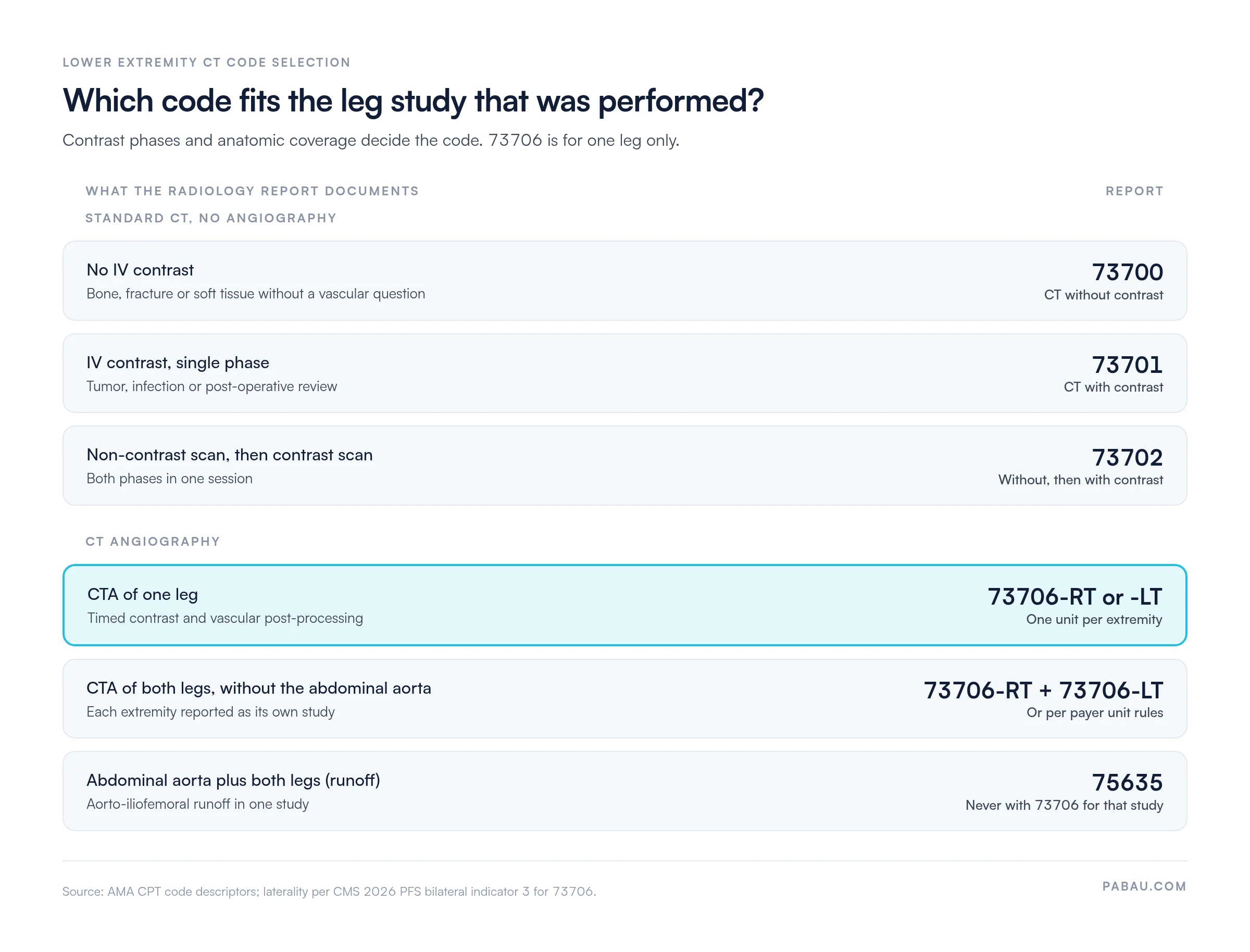
It sits in the lower extremity CT family with 73700 (without contrast), 73701 (with contrast), and 73702 (without, then with contrast). A CTA of both legs is reported per extremity with RT and LT. A runoff study that also covers the abdominal aorta is reported with 75635 instead.
Let Pabau's smart automation suggest the right codes, reduce claim denials, and keep your practice compliant—effortlessly.
Automate repetitive tasks and focus on what matters most—your patients.
Reduce coding errors and ensure compliance with the latest regulations.
Clean claims, fewer denials, and faster reimbursements.
Powerful insights and reporting to help your practice thrive.
HIPAA compliant SOC 2 certified GDPR-compliant Trusted by 4,000+ clinics worldwide

CPT 73706 covers CT angiography of one lower extremity with contrast, not a routine CT leg scan or non-contrast study.
A CTA of both legs is billed as 73706-RT and 73706-LT, while an aorta-to-legs runoff study is CPT 75635.
When a non-contrast and a contrast CT of the leg are both performed, report 73702, never 73700 plus 73701.
Medicare’s 2026 national global payment for 73706 is about $321.65, based on 9.63 total RVUs.
Pabau’s claims management software submits 73706 claims through Claim.MD and tracks their status with US payers.
CPT code 73706 is the code for computed tomographic angiography (CTA) of one lower extremity, with contrast, including any noncontrast images and the image post-processing. The official descriptor reads “computed tomographic angiography, lower extremity, with contrast material(s), including noncontrast images, if performed, and image post-processing.” The American Medical Association (AMA) maintains the CPT code set and publishes the descriptor each year.
The word “angiography” is what separates 73706 from the rest of the CT leg series. The study uses a timed contrast injection to show the arteries or veins, not just bone or soft tissue.
A 73706 study typically includes the following components, all bundled into one code for one leg:
Report one unit of 73706 for each extremity imaged. A CTA of both legs takes 73706-RT and 73706-LT. A runoff study from the abdominal aorta through both legs is a different code, 75635. It is never billed with 73706 for the same study.
Four codes cover CT of the lower extremity, and they are separated by contrast phases and procedural intent. A fifth, 75635, takes over once the abdominal aorta is in the study. Selecting the wrong one is the most common coding error in lower extremity CT billing.
When a non-contrast and a contrast CT of the same leg are both performed, the combined code is 73702. Billing 73700 and 73701 together for that session breaks a Correct Coding Initiative (CCI) edit. If the study was a CTA, none of the three applies, and the single correct code is 73706. Check edit pairs in the AAPC Codify CPT lookup before you submit.
Once the study is a CTA, laterality and coverage decide the claim, as the grid below shows.
Medical necessity documentation links the ordering physician’s clinical rationale directly to the procedure. Without a supporting ICD-10-CM diagnosis code on the claim, 73706 will deny regardless of how correctly it is otherwise coded.
Medicare Administrative Contractors (MACs) publish Local Coverage Determinations (LCDs) that specify acceptable diagnoses by region. The ordering physician’s documentation must reflect the specific clinical presentation, not just the diagnosis code. A chart note stating only “rule out PAD” won’t support medical necessity on appeal. It needs documented symptoms, ankle-brachial index (ABI) findings, or failed conservative management.
Adequate documentation protects the claim at both initial submission and on audit. The medical record must contain all of the following to show that CPT code 73706 was medically necessary and correctly performed.
Practices with high 73706 volume should run each claim through medical billing compliance checkpoints to confirm these elements are on file. One step older guides still list no longer applies. CMS paused the Appropriate Use Criteria (AUC) program and rescinded its regulations at 42 CFR 414.94, effective January 1, 2024. Medicare claims for 73706 need no clinical decision support consultation.
Run a monthly audit of 73706 claims older than 30 days. Filter for claims where the prior auth field is blank or a 73706 line carries no RT or LT. These are your highest-denial-risk submissions. Catching them before adjudication saves the turnaround time on appeals.
Modifier selection for 73706 depends on the leg imaged, the billing setting, and the relationship between the imaging facility and the interpreting radiologist.
73706 describes one lower extremity, so a CTA of both legs is reported per leg. Bill 73706-RT and 73706-LT, either on two lines or as your payer’s unit rules direct. The CMS fee schedule gives 73706 bilateral indicator 3, so the 150% bilateral adjustment doesn’t apply and each side is paid as its own service.
Both legs scanned in one session also fall under Medicare’s diagnostic imaging multiple procedure payment reduction, which cuts the second study’s technical component by 50%. If the study also covers the abdominal aorta, it is a runoff study, so report 75635 rather than two units of 73706.
Medicare pays CPT code 73706 under the Medicare Physician Fee Schedule (MPFS), which CMS updates each year. The figures below come from the CMS 2026 relative value file and use the standard conversion factor of $33.4009. Payment equals total RVUs multiplied by that factor, before any geographic adjustment.
The global total breaks down into 1.85 work RVUs, 7.62 practice expense RVUs, and 0.16 malpractice RVUs. Qualifying APM participants are paid at a slightly higher 2026 conversion factor of $33.5675. Use the CMS Physician Fee Schedule lookup tool for locality-adjusted rates, or the FastRVU 2026 RVU lookup for RVU detail.
Geographic Practice Cost Indices (GPCIs) adjust these national rates by MAC locality. A radiology practice in Manhattan will receive a higher allowable than one in rural Mississippi. Rates are updated each January 1.
The billing setting determines both who submits the claim and what reimbursement is available. The most common error here is a global 73706 claim for a scan performed in a hospital outpatient department. Practices that move to simpler claims management still need the place of service right on every encounter before the claim goes out.
A radiologist interpreting from an off-site reading room while the scanner is owned by a hospital still bills modifier 26. The physical location of interpretation does not change the billing component split.
Most commercial payers and many Medicare Advantage plans treat CPT code 73706 as advanced diagnostic imaging that needs prior authorization before the scan. Skip it, and the claim denies for lack of authorization. That denial is very hard to overturn, because the payer judges the missing approval rather than the medical necessity.
Document the authorization number in the patient’s record and include it in field 23 of the CMS-1500 or the appropriate loop segment of the 837P. An authorization obtained but not appended to the claim is treated as no authorization by the payer.
CPT code 73706 denials cluster around a predictable set of errors. A structured denial management workflow catches most of these before they reach the payer. Below are the most frequent denial reasons with their corresponding remediation paths.
Understanding medical billing denial codes helps billing staff triage denials faster. A CO-50 (not medically necessary) denial requires clinical documentation. A CO-4 (modifier issue) denial requires a technical correction and resubmission. Tracking denials by reason code over time shows which pre-submission step keeps failing, such as one ordering physician whose notes never record ABI results.
Sending each 73706 out as a clean claim from the start reduces the denial rate and shortens the cash collection cycle. That means the auth number, the correct ICD-10 code, and the right modifiers are all in place before submission.
Build a 73706-specific claim scrubbing checklist in your billing system. Before any claim transmits, confirm the ICD-10 code is on the covered diagnosis list and the auth number is in field 23. Then check modifier 26 or global, RT or LT on every line, and 75635 for any runoff study. Five checks, five fewer denial types.
Most 73706 denials trace back to data that was missing or wrong before the claim left the practice. A missing RT or LT, a global claim from a hospital setting, or a blank authorization number all fail at the payer.
Pabau builds the claim from what’s already on the patient record: the encounter, the diagnosis your clinician documented, and the authorization number your team entered. It then submits the claim through Claim.MD, the US clearinghouse it connects to, and tracks its status with the payer.
Your billing team still makes the coding calls, from 73706 versus 75635 to the laterality modifiers. What changes is that nobody re-keys claims or phones payers for status updates. Denials surface sooner, so appeals start well inside the filing window.

Pabau builds claims from the patient record and submits them through Claim.MD. Your billing team spends less time re-keying 73706 claims and chasing their status.

Code 73706 by the legs scanned and the anatomy covered, not by habit. One leg is one unit with RT or LT, and two legs are two lines. Add the abdominal aorta and the study becomes 75635.
Build those three rules into your pre-submission check, and the costliest 73706 denials stop before they start. The trade-off is a minute more with the radiology report, which costs far less than working an appeal. Our guide to what medical billing is covers the wider cycle from encounter to payment.
Book a demo to see how Pabau submits and tracks claims for your radiology or vascular practice.

Need to understand how clearinghouse submission works for radiology claims? Medical claims clearinghouse guide covers how 837P claims route through to payers and what happens when they reject.
Want to understand ERA and how payment posting works after adjudication? Electronic remittance advice explains 835 transaction files and how to reconcile payments against submitted claims.
Looking to verify eligibility before scheduling advanced imaging? Insurance eligibility verification walks through how to confirm coverage and auth requirements before the patient arrives.
Was the leg CT done without contrast? CPT code 73700 covers the non-contrast lower extremity CT and how it differs from a CTA.
Was the angiogram catheter-based rather than CT? CPT code 75716 explains billing for bilateral extremity angiography supervision and interpretation.
CPT code 73706 is the billing code for computed tomography angiography (CTA) of one lower extremity performed with contrast material, including post-processing. Physicians order it to visualize arterial or venous structures in the leg, not as a routine CT with incidental contrast.
73700 is a CT of the lower extremity without contrast, and 73701 is a CT with contrast for a non-vascular question. 73702 covers both phases, without and then with contrast, in one session. 73706 is CT angiography of one leg, used specifically for vascular imaging. Never bill 73700 and 73701 together, because the combined study is 73702.
73706 is unilateral, so one unit covers one lower extremity. For a CTA of both legs, bill 73706-RT and 73706-LT, or follow the payer’s unit rules. If the study also covers the abdominal aorta, it is a runoff study coded as 75635, never billed alongside 73706.
The most common are 26 for the professional component and TC for the technical component billed by the facility. RT and LT mark which leg was imaged and belong on every 73706 line. Modifier 59 applies only when 73706 is billed the same day as another code with a CCI edit, for a distinct service.
Yes, in most cases. Most Medicare Advantage plans and commercial payers (BCBS, Aetna, Cigna, UHC) require prior authorization, often through a radiology benefit manager. Traditional Medicare does not, and its AUC consultation requirement has been paused since January 1, 2024. Confirm with each specific plan before scheduling.
The most common reasons are a missing prior authorization and an ICD-10 diagnosis that isn’t on the payer’s covered list. Others include billing 73700 and 73701 instead of 73702, coding a runoff study as 73706, and leaving off RT or LT. A missing modifier 26 in a facility setting is another. Each has a distinct appeal path.