HCPCS Code G0163: Skilled nursing observation and assessment
What is HCPCS Code G0163? HCPCS Code G0163 is a deleted Level II code for skille...

Last Updated: Oct 15, 2026
73120 is the CPT code for radiologic examination, hand; 2 views. It covers plain-film imaging of the metacarpals and phalanges when exactly two projections are captured and interpreted.
The code splits from 73130 on view count alone. Billing 73120 when three or more views were taken is the most common cause of denial on hand x-ray claims.
Let Pabau's smart automation suggest the right codes, reduce claim denials, and keep your practice compliant—effortlessly.
Automate repetitive tasks and focus on what matters most—your patients.
Reduce coding errors and ensure compliance with the latest regulations.
Clean claims, fewer denials, and faster reimbursements.
Powerful insights and reporting to help your practice thrive.
HIPAA compliant SOC 2 certified GDPR-compliant Trusted by 4,000+ clinics worldwide

CPT code 73120 covers a hand x-ray with exactly two views, and 73130 takes over at three or more.
Modifier 26 covers the interpretation and Modifier TC covers the equipment, so hospital and teleradiology claims split into two lines.
Traditional Medicare rarely asks for prior authorization on a plain-film hand x-ray, but Medicare Advantage plans set their own rules.
A claim needs an ICD-10 diagnosis coded to full specificity, including laterality and the encounter character where the code requires one.
Practice management software like Pabau checks the view count and the diagnosis before a 73120 claim leaves the practice.
CPT code 73120 is the American Medical Association code for “Radiologic examination, hand; 2 views.” It covers plain-film imaging of the metacarpals, the phalanges, and the joints between them, when two projections are captured and interpreted.
The code sits in the diagnostic radiology section of the CPT code set, among the imaging codes for the upper extremity.
The two standard projections are posteroanterior (PA) and lateral. An oblique view can stand in for one of them, depending on the clinical question. What matters for billing is that the count is exactly two. Fewer projections cannot support 73120, and a third one moves the claim to 73130.
CPT code 73120 covers the hand from the base of the metacarpals through the fingertips, with at least two views documented. A few clinical situations push the claim to a neighboring code instead.
What 73120 includes:
What belongs to another code:
The exclusion that trips coders up most often turns on the field of view. If the order names the fingers only, and the technologist images one digit or several without the metacarpals, the code is 73140.
If the exam captures the whole hand, 73120 applies even when the clinical concern is a single finger. The hand was imaged as a unit, and that is what the code reports.
View count alone separates the two codes. Two views means 73120, and three or more means 73130. No other clinical factor changes the selection.
73120 and 73130 are mutually exclusive for the same hand on the same date of service. Billing both creates a duplicate-procedure edit, which ends in denial or recoupment. Check the technologist’s view count in the radiology report before you pick the code. The physician order often says “hand x-ray” with no count attached, but the billed code has to match what was performed.
Billers in orthopedics and urgent care work inside a tight group of upper-extremity radiology codes. Two facts settle the choice every time. The first is what the image includes, and the second is how many views the report documents. The grid below maps both onto a code.
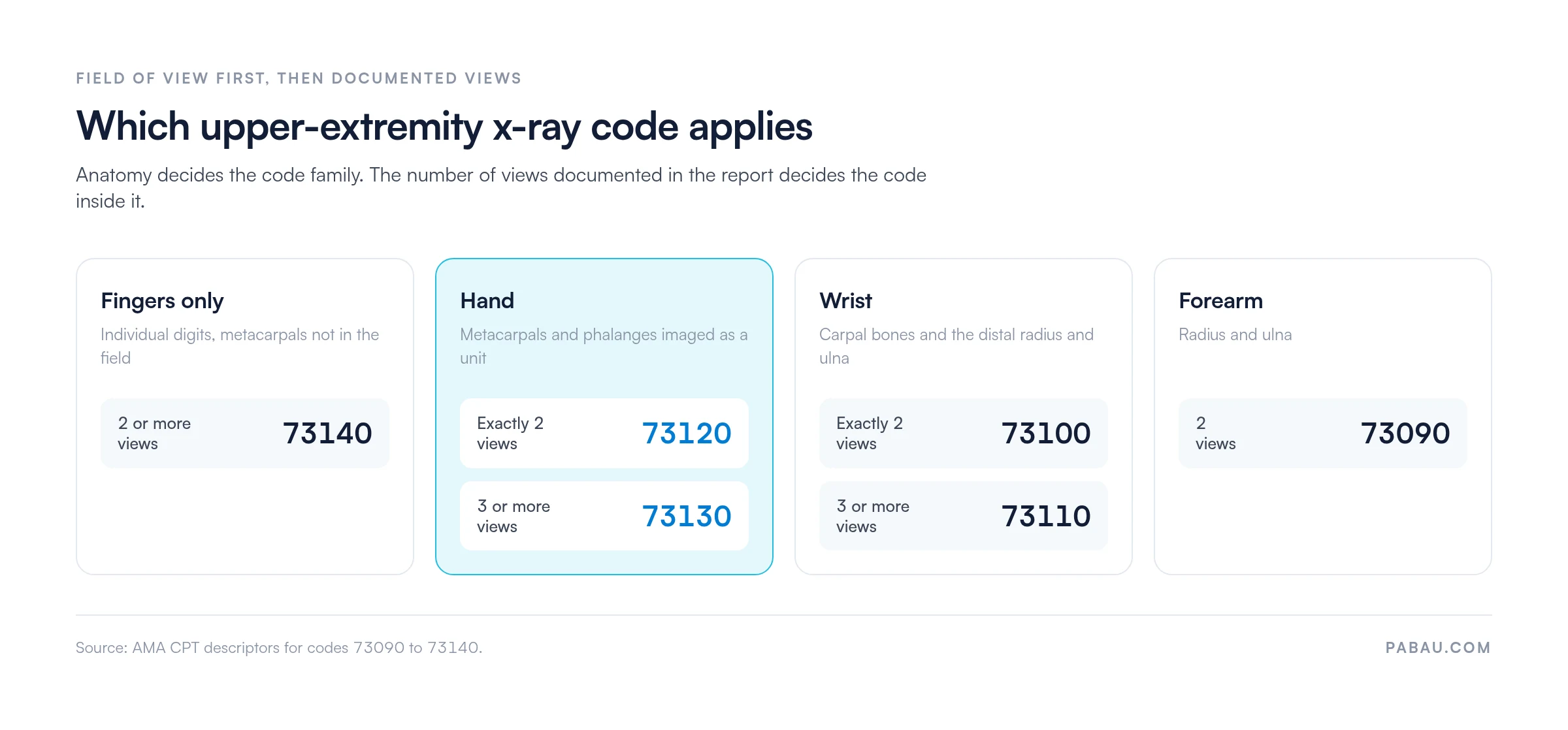
The full descriptor for each code, with the anatomy it covers, is set out below.
A quick rule of thumb keeps most claims straight. If the metacarpals are in the field and two projections were captured, start at 73120. Then ask whether a third view was taken, which moves the claim to 73130. If the study was wrist-focused instead, 73100 or 73110 applies.
An order that reaches past the wrist needs the forearm code. Two views of the radius and ulna are reported as 73090, not 73120.
The grid stops at the elbow. A study of the upper arm bone is reported with CPT code 73060, which the AMA descriptor sets at a minimum of two views.
Before choosing between 73120 and 73130, pull the imaging report and count the documented views. Do not rely on the physician order alone. Technologists sometimes add a third view on clinical judgment. Billing 73120 when three views sit in the record creates a mismatch that automated claim edits catch.
Three billing scenarios apply to CPT code 73120, and equipment ownership decides which one. The wrong modifier, or a missing one where the billing splits, is among the top denial drivers for radiology claims.
When a radiologist reads a film taken at a hospital outpatient department, the radiologist bills 73120-26 and the hospital bills 73120-TC. Together the two components equal the global payment. Billing globally in a hospital setting, where the physician does not own the equipment, creates a split-billing conflict that payers deny.
Medicare pays CPT code 73120 through the Medicare Physician Fee Schedule (MPFS), which CMS updates each year. Rates vary by component and by place of service. Check the current figure in the CMS MPFS lookup tool before you quote a number to anyone.
The amounts below are typical 2026 national rates, unadjusted for the Geographic Practice Cost Index (GPCI) in your locality.
RVU values for 73120 sit low because a plain-film hand study is quick to acquire and quick to read. The work RVU of 0.17 reflects the time it takes to interpret two projections. Locality adjustment then moves the allowable amount either side of the national figure.
Commercial payer rates vary widely from Medicare allowables. Some plans pay above MPFS, and others set their own schedule as a percentage of Medicare. Never present a Medicare rate to a commercial payer as a negotiated figure.
Submit the claim electronically in X12 837P format, as HIPAA transaction standards require. The 835 electronic remittance advice that comes back shows the allowed amount, any adjustments, and the reason code behind each reduction.
Every 73120 claim needs a supporting ICD-10 diagnosis that establishes medical necessity. A vague or unsupported diagnosis is one of the top denial triggers on hand x-ray claims. The table below lists the pairings billing teams reach for most often.
Fracture codes in the S62 series need full 7th-character specificity, so the truncated stem is not billable. A claim carrying S62 alone rejects on edit. Assign the encounter character and the laterality character wherever the code structure calls for one. A covers initial treatment, D covers subsequent encounters, and S covers sequela.
Validate the diagnosis at charge capture rather than at submission, while the chart is still open and the clinical detail is easy to check.
Traditional Medicare does not require prior authorization for a plain-film hand x-ray coded to 73120 with a documented indication. The procedure sits outside the CMS prior authorization program for outpatient hospital services, which targets high-cost elective procedures.
Medicare Advantage plans run their own coverage policies. Some ask for authorization even on plain-film imaging, particularly where the study is a follow-up rather than an acute injury. Commercial insurers differ just as widely. Most waive authorization for acute-presentation x-rays, while some want a documentation review on chronic-condition imaging.
Where authorization is required, payers typically ask for:
CPT code 73120 claims fail for a predictable set of reasons, and most are preventable at charge capture. Reading your denial codes after each remittance cycle shows which pattern is hitting your practice hardest.
Tracking denial reason codes by CPT code surfaces these patterns within weeks. The AAPC’s CPT code reference is a useful second opinion on edit logic before you appeal.
A correct code on a thin chart still loses money. Post-payment review reads the record rather than the claim, so recoupment can land months after the payment cleared. Five items carry a 73120 claim through an audit.
Capturing the view count, the ordering provider, and the diagnosis at the point of service is what keeps the chart audit-ready. Practices that key charges manually from a day-old worksheet lose the view count most often. A quarterly audit of ten radiology charts catches documentation drift before a payer finds it.
Who owns the equipment and who reads the study changes by setting, and the setting decides the modifier. Getting that mapping wrong is one of the most common structural errors in radiology billing.
Practices running claims software for billers can set rules that append the modifier from the place-of-service code on the claim. That removes the most common structural error before the claim leaves the practice.
Use the X12 837P format for electronic submission, with the place-of-service code that matches the setting. Code 11 is a physician office, 22 is an outpatient hospital, and 20 is urgent care.

In most practices the charge is keyed after the patient has left. The coder reads the order, sees “hand x-ray”, and picks 73120 without opening the radiology report. Nobody notices the third view until the remittance comes back.
Practice management software like Pabau keeps the imaging record and the charge on one patient file. The view count, the ordering provider, and the diagnosis are on screen when the charge is raised. Claims then go out to the clearinghouse from that same record, so the code and the report cannot drift apart.
The payoff is fewer rework cycles on low-value radiology claims. A global 73120 line pays about $22 to $28. A denial and an appeal cost more staff time than the claim is worth. Catching the error at charge capture is the only version that pays for itself.

Pabau holds the imaging report, the diagnosis, and the charge on one patient record. Your team checks the view count while the chart is still open.

Nothing about 73120 is complicated, which is exactly why it leaks money. The code is cheap and the volume is high. The denial is almost always clerical, and a second pair of eyes would have caught it.
So the work sits upstream of the claim. Count the views in the report rather than the order, code the diagnosis to full specificity, and pick the modifier from who owns the equipment. Do those three things at charge capture and the appeal queue stops filling with twenty-dollar claims.
The trade-off is that someone has to open the report, every time. Book a demo to see how Pabau puts the view count in front of whoever raises the charge.

Need to understand how clearinghouse submission works for radiology claims? Medical claims clearinghouse guide explains how claims route from provider to payer and where edits apply.
Want to reduce claim denials across your full billing operation? Claim.MD clearinghouse overview covers real-time eligibility checks, ERA processing, and denial reason codes.
Looking for a structured approach to billing audits? Medical billing compliance guide outlines quarterly audit frameworks for CPT and ICD-10 accuracy.
CPT code 73120 is the billing code for a radiologic examination of the hand with two views. It covers plain-film imaging of the metacarpals and phalanges when two projections are captured and interpreted. Practices, urgent care centers, and radiology departments use it for a standard two-view hand x-ray.
View count is the only difference. 73120 covers a hand x-ray with exactly two views, and 73130 covers the same study at three or more views. The two are mutually exclusive for the same hand on the same date. Bill whichever matches the view count in the radiology report.
Three apply most often. No modifier means global billing, used where the physician owns the equipment and reads the film. Modifier 26 covers the professional component, billed by a radiologist in a hospital or teleradiology setting. Modifier TC covers the technical component, billed by the facility that owns the equipment. Laterality modifiers LT and RT apply where payer rules ask for them.
Payment varies by component and by locality. Global billing typically yields about $22 to $28 in a non-facility setting, and the professional component alone runs about $10 to $14. Confirm the current figure in the CMS Medicare Physician Fee Schedule lookup tool, since rates change annually and by geography.
Traditional Medicare does not generally require prior authorization for a plain-film hand x-ray. Medicare Advantage plans and many commercial insurers set their own policies, which can apply to non-acute indications. Verify the requirement with the specific plan before the study is ordered.
Common pairings include fracture codes from the S62 series, carried to full 7th-character specificity. Osteoarthritis codes M19.041 and M19.042 and hand pain codes M79.641 and M79.642 also appear often. Rheumatoid arthritis codes in the M05 and M06 series round out the list. Every code needs laterality where the structure requires it.