



CCSD code G5100: Bypass of duodenum billing guide
CCSD code G5100 bills a bypass that leaves the duodenum in place CCSD code G5100...

Last Updated: Oct 16, 2026

CPT code 73560 describes a radiologic examination of the knee with 1 or 2 views, maintained by the American Medical Association.
The 2026 Medicare national average runs about $22 to $28 for the professional component and $15 to $20 for the technical component.
Upcoding to 73562 or 73564 when the report documents only 1 or 2 views is the most common denial trigger in this family.
CPT 73565 is a bilateral standing anteroposterior view of both knees, not a substitute for billing 73560 on each side.
Practice management software like Pabau supports clean claim submission for radiology and orthopedic practices, including bilateral modifier application.
CPT code 73560 is the billable code for a radiologic examination of the knee with 1 or 2 views. The American Medical Association (AMA) maintains it in the diagnostic radiology section of the CPT code set.
This reference covers the official descriptor, Medicare rates, modifier rules, the ICD-10 crosswalk, documentation requirements, and the billing errors that trigger denials.
The code-family comparison and modifier guide below matter most to orthopedic practices, urgent care centers, and radiology groups that bill in-house. Knowing what separates 73560 from 73562 and 73564 catches selection errors before a claim reaches the payer.
CPT code 73560 captures a radiologic examination of the knee with 1 or 2 views. The full AMA descriptor reads: Radiologic examination, knee; 1 or 2 views. The code sits in the Diagnostic Radiology (Diagnostic Imaging) subsection of the CPT manual, which covers conventional X-ray procedures for the knee joint.
The code applies only when 1 or 2 views are captured. Three views moves the claim to 73562, and four or more requires 73564. Confirm the view count documented in the radiology report before selecting from this family. The ladder below reads in the same order a coder works, from the report to the code.
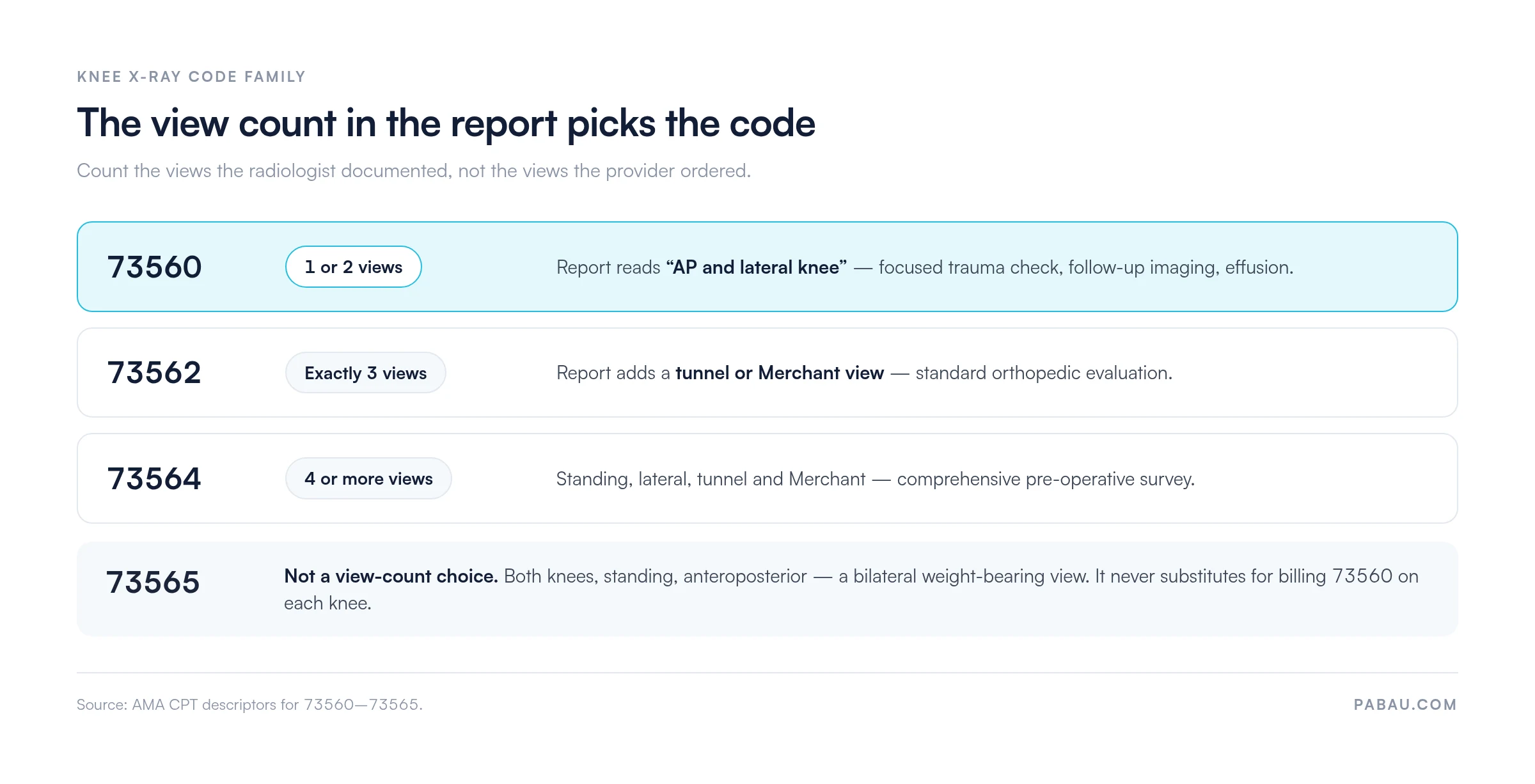
A 1 or 2 view knee X-ray answers a specific, time-sensitive clinical question rather than surveying the whole joint. Ordering providers request this view count in straightforward presentations, where a focused image settles the question on its own.
Medical necessity must be supported by a documented clinical indication. Payers routinely deny claims where the ordering note does not reflect a condition that warrants imaging. Local Coverage Determinations (LCDs) issued by Medicare Administrative Contractors set the diagnosis requirements for each region.
The CMS Physician Fee Schedule sets national payment rates for CPT code 73560, adjusted by geographic pricing locality. The figures below reflect national averages from available fee schedule data.
Always verify the current year’s rates in the CMS MPFS Look-Up Tool before submitting claims, since rates are updated annually. Geographic adjustment factors can move reimbursement by 15-25% either way, depending on locality.
Rates apply at the place of service level. Hospital outpatient departments (POS 22) typically reimburse at the facility rate. Physician offices (POS 11) and independent imaging centers (POS 19) may qualify for non-facility rates when billing the global service.
Use the FastRVU 2026 RVU lookup to check work, practice expense, and malpractice RVU values for 73560 in your locality.
Practices can make reimbursement more predictable by routing claims through a clearinghouse that validates the data before submission. Practice management software like Pabau submits electronic claims through Claim.MD, which reaches thousands of commercial and government payers. Real-time eligibility checks and 835 ERA retrieval let billing teams reconcile payments faster.
Verify your locality’s 2026 GPCI (Geographic Practice Cost Index) multiplier before quoting expected reimbursement to physicians. High-cost metros like San Francisco and New York can yield 20-25% above the national average for 73560, while rural localities may fall 10-15% below it. Pull your MAC’s locality file from the CMS MPFS download page annually.
Modifier selection is where most 73560 billing errors originate. The correct modifier depends on who performs and interprets the study, where the service is rendered, and whether both knees are imaged.
The professional and technical split reaches further than plain film. A cardiac CT billed under CPT code 75572 is reported globally, or split between modifier 26 and modifier TC.
Bilateral billing is where payer policy diverges most sharply. Medicare generally accepts modifier 50 on a single claim line with 73560, paid at 150% of the allowed amount. Some MACs require two separate lines with RT and LT instead.
Check your MAC’s LCD and the payer’s own billing guide before submitting bilateral knee claims. Misapplying the bilateral rule produces systematic underpayments or denials that are hard to audit after the fact.
Pairing CPT code 73560 with a specific, well-documented ICD-10-CM diagnosis is the single most important step in establishing medical necessity.
The table below covers the most commonly paired diagnoses, and it is not exhaustive. The wider ICD-10-CM code index carries the full set, and your MAC’s Local Coverage Determinations decide which are covered in your region.
Use the most specific laterality code available. Bilateral diagnoses such as M17.0 pair with bilateral claim submissions using modifier 50 or RT/LT. Avoid non-specific pain codes like M25.569 as a standalone diagnosis when a more precise code exists. Payers increasingly flag them as insufficient to establish medical necessity.
Complete documentation protects the claim and supports audit defense. Every element below must appear in the patient record before the claim goes out. A payer can request records or issue a denial over any single missing item.
A structured superbill that captures view count and clinical indication at the point of service keeps documentation complete. Practices that pre-populate the superbill template with the 73560-73564 family and its modifiers catch selection errors before the claim leaves the office.
Five billing patterns generate most of the denials and compliance risk on CPT code 73560. Each one maps to a process failure that can be corrected at the point of claim creation.
Equipment ownership decides the modifier on contrast studies as well. A single-contrast upper GI series billed under CPT code 74240 is reported globally, or divided between modifier 26 and modifier TC.
Denial patterns on 73560 usually trace back to the claim-creation workflow rather than deliberate coding choices. Claims software for imaging practices can flag a missing modifier or a code-family mismatch at the moment the claim is built. Tracking denial reason codes by CPT code then shows billing teams which payers reject the same item repeatedly.
The knee X-ray code family covers four distinct scenarios. Selecting among them requires knowing how many views appear in the radiology report, not how many were ordered.
The AAPC Codify CPT lookup carries the full descriptor for each code in this family.
A practical rule sorts most claims. If the report says “AP and lateral knee,” that is 2 views and 73560 is correct. If it lists AP, lateral, and a tunnel or Merchant view, that is 3 views and 73562 applies. Never assign a higher code without explicit view documentation.
X-ray and MRI serve different diagnostic purposes for knee pathology and are billed separately. Understanding the clinical pathway prevents inappropriate code selection when both are ordered in a single encounter.
When X-ray and MRI are ordered on the same date of service, both codes may be billed. The clinical documentation has to support each one as independently indicated.
X-ray commonly precedes MRI in the diagnostic pathway. The AP and lateral view rules out fracture and checks alignment before MRI looks at soft tissue. Check NCCI bundling edits before billing 73560 and 73721 together, since an edit may prohibit the pair for a specific payer.
Yes, both knees can be billed when both are examined, but the method depends on payer policy. Reporting bilateral imaging for CPT code 73560 means choosing between two approaches. The wrong choice for a given payer produces systematic denials or underpayment.
Hip studies do not follow the same pattern. A bilateral hip exam billed as two 73501 lines draws a duplicate-service denial, since 73521 through 73523 cover both hips.
Reviewing electronic remittance advice on bilateral 73560 claims shows which payer applied the denial and why. A payer-specific reference sheet for bilateral radiology billing takes the trial and error out of the next claim. Refresh it each year, when MACs republish their LCDs.
Build a modifier matrix spreadsheet listing your top 10 payers and their bilateral imaging preference (modifier 50 vs RT/LT two-line). Update it each January when MACs publish revised LCDs. Share it with billing staff and set a calendar reminder for Q1 each year. This one document removes the most common bilateral denial pattern across the whole 73560-73564 family.
Most radiology billing still runs on memory and a printed cheat sheet. A coder reads the report, recalls which view count maps to which code, and types the modifier by hand. Each of those steps is a place where 73560 turns into 73562, or where a bilateral claim goes out with the wrong modifier.
Pabau keeps the code, the modifier, and the supporting diagnosis on the same record as the imaging appointment. Billing staff build the claim from what the clinician documented, rather than from a separate spreadsheet. Claims then go out electronically through Claim.MD, with eligibility checked before the patient is imaged.
The outcome is fewer claims coming back over a view count or a missing modifier. Remittance advice lands in the same place, so a denial on 73560 surfaces the week it happens rather than at month end. Every Pabau subscription includes the full feature set, so claims tooling is never a separate tier.

Pabau’s claims management software helps orthopedic and imaging practices submit clean claims, with modifier application, ICD-10 crosswalks, and ERA reconciliation built into the workflow.

Three checks decide whether a 73560 claim survives. Count the views in the signed report. Match the modifier to the payer’s bilateral rule. Pair the code with the most specific lateralized ICD-10 diagnosis the record supports.
Building those checks into claim creation costs far less than working the denials afterward. A practice that fixes the workflow once stops re-arguing the same rejection every quarter. The trade-off is the up-front discipline of documenting view count at the point of service, every time.
Book a demo to see how Pabau carries a knee X-ray from the imaging appointment through to the remittance.

Need to understand how clearinghouse submissions work for radiology codes? Medical claims clearinghouse guide explains how claims route from practice to payer and where rejections start.
Want to reduce denial rates across all imaging codes? Denial codes in medical billing covers the most common CARC codes and how to respond to each.
Building a credentialing foundation for your imaging practice? How to get credentialed with insurance companies walks through provider enrollment step by step.
CPT code 73560 is a diagnostic radiology procedure code that describes a radiologic examination of the knee with 1 or 2 views. The American Medical Association maintains it. Orthopedic, primary care, and radiology practices use it to bill conventional knee X-rays when the report documents only 1 or 2 views.
The 2026 Medicare national average runs about $22 to $28 for the professional component and $15 to $20 for the technical component. Total global reimbursement lands between $34 and $50, depending on the setting and the geographic locality. Verify current rates in the CMS Physician Fee Schedule Look-Up Tool, since they adjust annually.
Four modifiers cover almost every 73560 claim. Modifier 26 reports the professional component when the radiologist interprets but does not own the equipment. Modifier TC reports the technical component for the facility or imaging center. Modifier 50 reports a bilateral procedure on one claim line, and RT/LT split the two sides across two lines.
The codes differ by the number of views documented in the radiology report. 73560 covers 1 or 2 views, 73562 covers exactly 3, and 73564 covers 4 or more. The view count in the signed report determines the correct code, not the number of views ordered. Selecting a higher code than the documented view count is upcoding.
Commonly paired ICD-10-CM codes include M17.11 and M17.12 for primary osteoarthritis of the right and left knee. M25.661 covers stiffness of the right knee, and S80.00XA covers a knee contusion at the initial encounter. M23.200 covers derangement of an unspecified meniscus in the right knee. Use the most specific lateralized code available, and confirm coverage in your MAC’s Local Coverage Determination.
Yes. Bill 73560-50 on a single claim line, or 73560-RT and 73560-LT on two separate lines, depending on payer policy. Medicare generally accepts modifier 50, but some MACs require the RT/LT two-line format. Do not use CPT 73565 as a bilateral substitute. That code describes a bilateral weight-bearing view of both knees, standing, anteroposterior. It does not stand in for routine knee X-rays.



