HCPCS Code Q4185: Cellesta flowable amnion billing guide
HCPCS Code Q4185: definition and official descriptor HCPCS Code Q4185 is the Lev...

Last Updated: Nov 20, 2026
77075 is the CPT code for radiologic examination, osseous survey; complete (axial and appendicular skeleton). It reports a plain-radiograph skeletal survey that images the skull, spine, rib cage, girdles and limbs in one session.
Surveys are ordered for suspected physical abuse in young children, multiple myeloma, bone metastases and skeletal dysplasias. Although 77075 sits among the bone studies, it is not a bone density test. DXA scans are billed with 77080, 77081 or 77085.
Let Pabau's smart automation suggest the right codes, reduce claim denials, and keep your practice compliant—effortlessly.
Automate repetitive tasks and focus on what matters most—your patients.
Reduce coding errors and ensure compliance with the latest regulations.
Clean claims, fewer denials, and faster reimbursements.
Powerful insights and reporting to help your practice thrive.
HIPAA compliant SOC 2 certified GDPR-compliant Trusted by 4,000+ clinics worldwide

CPT 77075 reports a complete radiographic skeletal survey of the axial and appendicular skeleton, not a DXA bone density scan.
Bill 77074 for a limited survey, 77076 for an infant survey, and 77080, 77081 or 77085 for DXA bone density.
Common indications are suspected child physical abuse, multiple myeloma, bone metastases and skeletal dysplasias, each with its own ICD-10-CM code.
Modifier 26 reports the interpretation alone and TC the technical component alone. Bill globally when one entity does both.
Pabau’s claims management software runs eligibility checks, submits 837P claims through Claim.MD and tracks skeletal survey denials.
CPT code 77075 reports a complete osseous survey, a series of plain radiographs that covers the axial and appendicular skeleton in one examination.
The American Medical Association’s CPT code set places it among the radiology bone and joint studies, next to the limited and infant surveys.
The official descriptor reads: Radiologic examination, osseous survey; complete (axial and appendicular skeleton). “Complete” is the operative word. The survey must image both skeletal regions, so a targeted series of selected areas is a limited survey under 77074.
The axial skeleton covers the skull, spine and rib cage. The appendicular skeleton covers the shoulder and pelvic girdles and the bones of the limbs. A complete survey is read for fractures, lytic lesions and signs of skeletal dysplasia, not for bone density.
The osseous survey family has three codes, and the choice turns on the extent of the survey and the patient’s age. A survey that images both skeletal regions is complete. One that targets selected regions is limited.
The 77076 descriptor sets no age limit for “infant”. Coding references often apply it to children aged one year or younger, so confirm your payer’s definition. A complete survey of an older child or an adult is reported with 77075.
In suspected abuse cases, a follow-up survey is commonly repeated about two weeks after the first. When the repeat series leaves out regions, such as the skull, code it to the extent performed. That is often 77074 rather than 77075.
Count the regions in the report, not the number of films. A long series of chest and spine views is still a limited survey if the limbs were not imaged.
Use 77075 for a complete radiographic skeletal survey, 77074 for a limited one, and 77080 for an axial DXA bone density scan. The three codes sit in the same CPT range, which is why 77075 gets confused with DXA. A skeletal survey looks for fractures and lesions on X-ray films. A DXA scan measures bone mineral density and reports T-scores.
If the order mentions a bone density scan, DEXA, T-scores or osteoporosis screening, it is a DXA study. Code it with CPT code 77080, with 77081 for peripheral sites, or with 77085 when vertebral fracture assessment is added. A CT bone density study is 77078.
The Medicare two-year bone mass measurement rule belongs to those DXA codes, not to 77075. So do osteoporosis diagnosis pairings such as M81.0 and Z79.83. The flow below puts the coding checks in the order a coder should ask them.
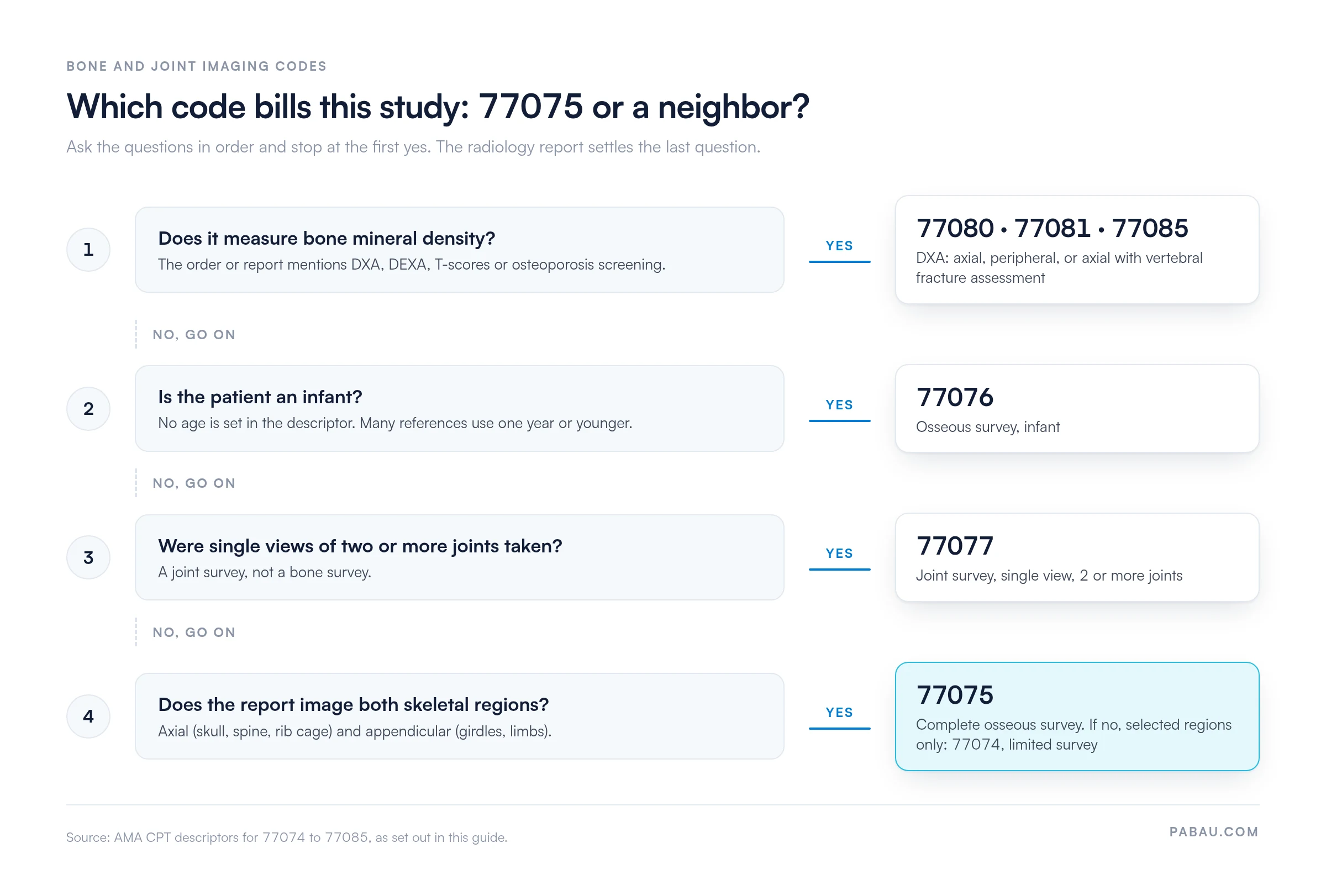
Medical necessity for 77075 rests on the reason the survey was ordered. The diagnosis on the claim should match the indication in the order and the findings in the radiology report.
ICD-10-CM guidelines send a suspected abuse case to the T76 category while abuse is neither confirmed nor ruled out. Once it is ruled out, Z04.72 replaces it.
For myeloma, the International Myeloma Working Group now favors whole-body low-dose CT over the conventional skeletal survey. Some payers ask why a plain-film survey was chosen. Document the reason, such as CT not being available or the patient’s clinical status.
Medicare has no national coverage determination written for 77075. Coverage follows the reasonable-and-necessary standard, so the indication and the diagnosis carry the claim. There is no fixed frequency limit like the two-year rule for DXA.
Prior authorization decisions are easier to defend when your medical billing workflow records the payer rule you checked and the date you checked it. When a payer questions a repeat survey, the follow-up order and its clinical reason settle most disputes.
Modifier choice depends on who owns the X-ray equipment and who reads the films. 77075 has separate professional and technical components on the Medicare Physician Fee Schedule.
Hospital outpatient surveys usually carry the technical component on the facility claim, with the radiologist billing modifier 26. An office that owns its X-ray equipment bills globally, with no modifier.
Medicare pays 77075 from the Medicare Physician Fee Schedule using work, practice expense and malpractice RVUs. Rates are adjusted by locality through Geographic Practice Cost Indices. Look up current amounts with the CMS Physician Fee Schedule lookup tool or the FastRVU 2026 RVU lookup.
Pabau, a practice management platform, submits 77075 claims electronically through Claim.MD, its US clearinghouse partner. Claim.MD connects to thousands of US payers and supports real-time eligibility checks alongside CMS-1500 and 837P submission.
Rates change each year in the fee schedule final rule. Confirm the current amounts before you set charges or reconcile remittances.
A clean claim needs the order and the radiology report to agree on the indication and the extent of the survey. Submitting a clean claim means every required field is populated before the claim leaves the practice.
The ordering note should include:
The radiology report should include:
Build a structured report template that lists every standard view. A ticked list makes the complete-versus-limited choice clear to the coder and to an auditor.
Most denials on 77075 come from a code that does not match the report or a diagnosis that does not match the indication. A structured denial management workflow catches these before they become write-offs. For the reason codes behind each rejection, see the reference on denial codes in medical billing.
Good revenue cycle management for skeletal surveys means settling the code before the films are taken. Each step below stops one of the denial causes above.
Skeletal surveys are low-volume for most radiology and orthopedic practices, so coders often pick the code from memory. That is how DXA scans and limited series end up billed as 77075, and each correction costs a rebill.
Pabau keeps the order, the report and the claim in one patient record. Its claims tools run eligibility checks and send 837P claims through Claim.MD to thousands of US payers.
Remittances post from 835 files, so a denied survey surfaces quickly with its reason code. Your billing team spends less time on rework and more on clean first submissions.

Pabau’s claims management and eligibility tools help radiology practices code skeletal surveys correctly, submit clean claims through Claim.MD and track denials.

CPT code 77075 bills a complete radiographic skeletal survey, never a DXA bone density scan. Three facts from the chart decide the claim: the extent of the survey, the patient’s age and the indication. Together they choose between 77074, 77075 and 77076 and support the diagnosis.
Put those checks at the order stage, and the report and the claim follow the same story. See how Pabau handles radiology claims with a live demo.

Billing a DXA bone density scan instead? CPT code 77080 covers axial DXA, including Medicare’s frequency rule and osteoporosis diagnosis pairings.
Need a step-by-step guide to medical billing fundamentals? What is medical billing explains the full revenue cycle from encounter to payment posting.
Confused about which denial code you received? Denial codes in medical billing covers CARC and RARC codes with corrective actions for each.
Looking to understand how clearinghouse claims submission works? Claim.MD clearinghouse guide explains 837P file routing, ERA remittances and payer enrollment.
CPT code 77075 covers a complete radiographic osseous survey of the axial and appendicular skeleton. It is a series of plain X-rays of the skull, spine, rib cage, girdles and limbs, read for fractures, lesions or dysplasia. It is not a bone density test.
No. CPT 77075 is a plain-film skeletal survey. DXA bone density is billed with 77080 for the axial skeleton, 77081 for peripheral sites, or 77085 when vertebral fracture assessment is added.
CPT 77074 is a limited osseous survey of selected regions, such as a targeted metastatic series. CPT 77075 is a complete survey of both the axial and appendicular skeleton. Code from the regions listed in the radiology report.
Use 77076 for an osseous survey of an infant. The descriptor sets no age, and coding references often apply it up to age one. Confirm your payer’s definition, and use 77075 for an older child or an adult.
Common pairings are T76.12XA for suspected child physical abuse and T74.12XA when abuse is confirmed. Others include C90.00 for multiple myeloma, C79.51 for bone metastases and Q78.0 for osteogenesis imperfecta. Use Z04.72 when alleged abuse is ruled out.
Modifier 26 reports the radiologist’s interpretation alone. Modifier TC reports the technical component when a facility owns the equipment and another physician reads the films. Bill globally, with no modifier, when one entity does both.
Medicare sets no fixed frequency limit for 77075. Each survey must be reasonable and necessary for the documented indication. The two-year limit applies to DXA bone mass measurement, not to skeletal surveys.