HCPCS Code L0472: Hyperextension TLSO billing guide
HCPCS code L0472: Official descriptor and device definition HCPCS code L0472 des...

Last Updated: Nov 5, 2026
73525 is the CPT code for radiologic examination, hip, arthrography, radiological supervision and interpretation. It covers the imaging and the radiologist's report for a hip arthrogram. The needle and contrast injection are billed separately as 27093 or 27095.
Coders often confuse it with plain hip radiography codes like 73502, which involve no contrast. The biggest claim errors on 73525 are missing laterality modifiers, billing 77002 alongside it, and incomplete procedure documentation.
Let Pabau's smart automation suggest the right codes, reduce claim denials, and keep your practice compliant—effortlessly.
Automate repetitive tasks and focus on what matters most—your patients.
Reduce coding errors and ensure compliance with the latest regulations.
Clean claims, fewer denials, and faster reimbursements.
Powerful insights and reporting to help your practice thrive.
HIPAA compliant SOC 2 certified GDPR-compliant Trusted by 4,000+ clinics worldwide

CPT code 73525 is the radiological supervision and interpretation of a hip arthrogram, billed once per hip.
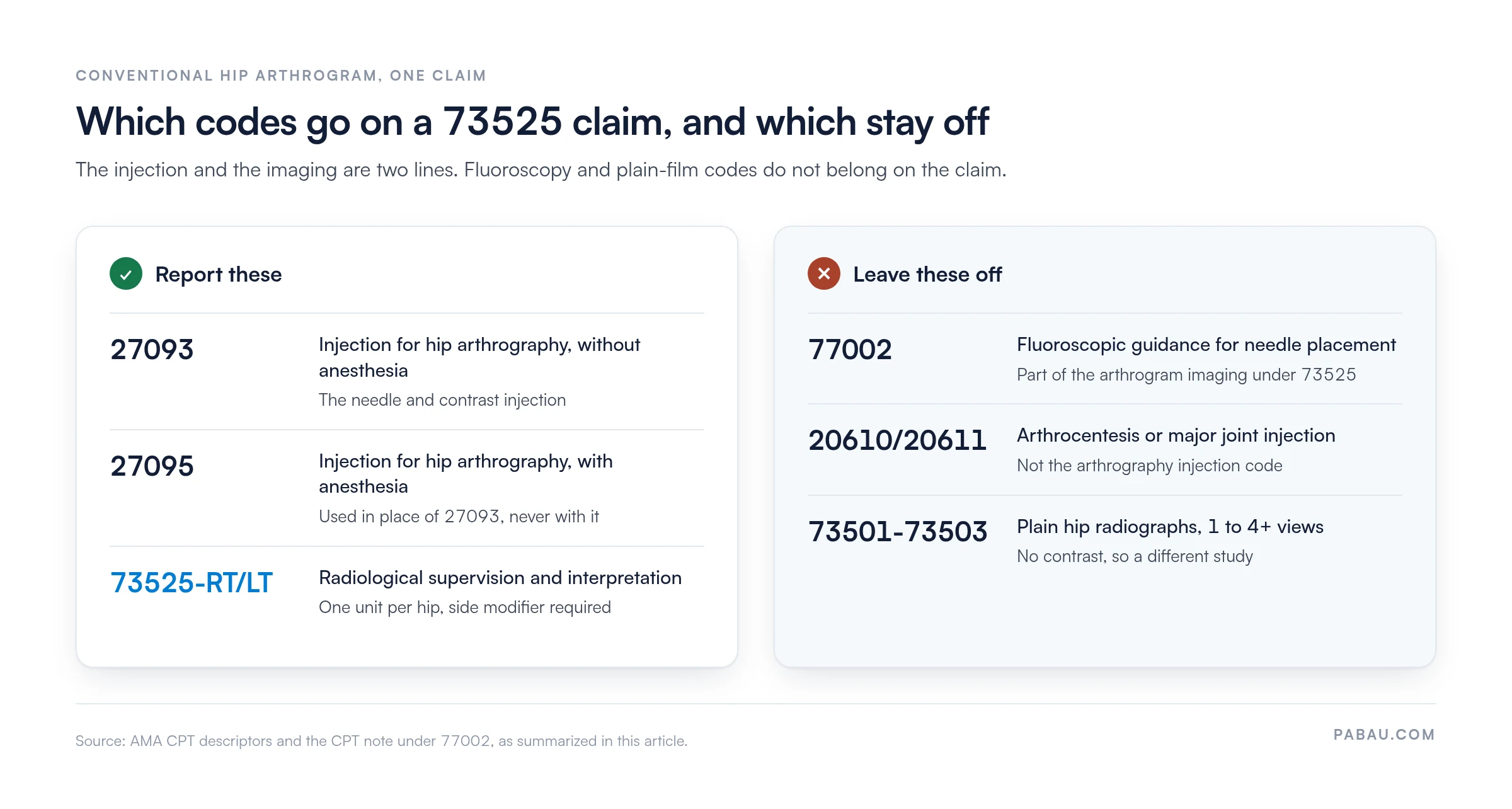
The needle and contrast injection go on their own line as 27093, or 27095 when anesthesia is used.
Fluoroscopic guidance is part of the arthrogram imaging, so 77002 is not reported with 73525.
A missing RT or LT modifier, or a diagnosis on the wrong side, is a common reason 73525 claims are denied.
Pabau, the practice management platform we build, pre-fills 73525 claims from the patient record and checks required fields before they are sent.
CPT code 73525 is the code for the radiological supervision and interpretation of a hip arthrogram. Its official AMA CPT code set descriptor reads Radiologic examination, hip, arthrography, radiological supervision and interpretation.
During the study, a physician places a needle in the hip joint, injects contrast, and captures images that outline the joint. 73525 pays for supervising and reading those images. The injection goes on a separate line, as 27093 when no anesthesia is given or 27095 when it is.
That split shapes the whole claim. Fluoroscopy used to guide the needle is part of the arthrogram imaging, so 77002 is not reported on top of 73525.
73525 covers the radiological supervision and interpretation component of hip arthrography. Knowing what sits inside and outside the code prevents both underbilling and unbundling errors.
One code stays off the claim entirely. The CPT note under 77002 lists 73525 among the arthrography codes it must not be reported with, because fluoroscopy is part of the arthrogram imaging. The two lines below are the whole claim for a conventional hip arthrogram.
Plain hip radiographs are coded 73501 to 73503, by view count, with no contrast and no injection. 73525 applies only when intra-articular contrast was injected for an arthrogram.
A two-view film of one hip, for example, is 73502, not 73525. The older plain-film code 73510 was deleted on January 1, 2016.
Billing a plain-film code when contrast was injected misrepresents the service. Billing 73525 when no contrast went in is upcoding. The procedure note has to confirm whether intra-articular contrast was given.
CPT code 73525 is unilateral, so one unit covers one hip. When both hips are examined in the same session, payers differ on the format they want.
Medicare lists 73525 with bilateral indicator 3 on the fee schedule. The usual 150% bilateral adjustment does not apply, so each side is paid at 100%. When only one hip is examined, append RT or LT. A single-hip claim with no side modifier is a common denial trigger.
Modifier selection for CPT code 73525 depends on laterality and on who bills which component. The table below covers the options you will use.
The 26/TC split applies when the radiologist and the facility bill separately. The radiologist appends 26 to 73525 for the interpretation, and the facility appends TC for the technical service. Never bill the global code and the split components for the same study.
Modifier 59 does not rescue 77002 on this claim. The CPT note bars 77002 with 73525, so a distinct-service modifier does not make it billable.
Check each payer’s bilateral format before you submit. Some plans reject 73525-50 and want two lines with RT and LT instead. A quick look at the payer’s policy costs far less than a resubmission.
Thin procedure notes are a frequent cause of 73525 denials. Payers expect a record that supports both the procedure and the diagnosis billed. A defensible arthrogram claim rests on these elements.
A note that says only “hip arthrogram performed” won’t survive an audit. It needs the contrast volume, the approach, and the side. Good medical billing compliance means building these fields into your note templates, so none are skipped at the point of care.
Every claim for CPT code 73525 needs at least one ICD-10-CM code that establishes medical necessity. The side in the diagnosis code must match the side modifier on the CPT line.
A right-hip diagnosis such as M25.551 paired with 73525-LT is a mismatch that invites a denial. These diagnosis codes come up most often with hip arthrography.
Use the most specific code available. Pain codes (M25.55x) fit when no definitive diagnosis exists yet. Once the arthrogram confirms a condition, use that diagnosis on later claims.
Medicare reimbursement for CPT code 73525 is set each year through the CMS Medicare Physician Fee Schedule (MPFS).
Rates vary by locality because of geographic practice cost indices (GPCIs). Since the figures change every calendar year, this article does not quote a dollar amount. Use the CMS look-up tool for your locality’s current rate.
Keep these reimbursement points in mind:
For RVU-based calculations, the FastRVU 2026 RVU lookup tool shows the work, practice expense, and malpractice RVUs for 73525. Apply your locality’s conversion factor to estimate the rate.
Whether CPT code 73525 needs prior authorization depends entirely on the payer. Traditional Medicare generally does not require it for diagnostic radiology codes. Medicare Advantage and many commercial plans often do.
When a plan does require authorization, the request typically needs:
Skipping authorization when a plan requires it is one of the most avoidable denials. The denial arrives fast, and the appeal is slow. Build the authorization check into scheduling, before the procedure date.
Denials on 73525 tend to repeat, which makes them preventable. These are the patterns orthopedic and radiology billing teams run into.
Good denial management workflows catch these patterns at the front end. The same modifier tends to go missing, or the same POS error recurs, across many claims. Reviewing the medical billing denial codes on your remittances for 73525 shows which error is most frequent in your practice.
A hip arthrogram reaches the payer as two lines built from two notes. The injection note supports 27093 or 27095, and the radiologist’s report supports 73525. If either note is thin, its line is the one that comes back denied.
Run these checks on every hip arthrogram claim before it leaves the practice:
A hip arthrogram claim draws on the injection note and the radiology report. When a biller rekeys both into a claim form, the side, the injection code and the diagnosis are the details that slip.
Pabau’s claims management software pre-fills the claim from the patient record and the appointment. Built-in CPT and ICD-10 lookup libraries let billers find 27093, 73525 or M25.551 by code or description. Before you press Send, Pabau checks that the required fields are complete, then submits the claim through Claim.MD.
Eligibility checks, claim tracking and ERA posting sit in the same system. When a 73525 line comes back denied, the remittance shows which line failed and why. Your billers still make the coding calls.
They fix a denied claim from the patient’s record instead of a spreadsheet. Running claims through a clean claim process like this cuts first-pass rejections and shortens the wait for payment.

Pabau pre-fills claims from the patient record, checks required fields before submission, and tracks each claim through Claim.MD to the remittance. See how it fits an orthopedic or imaging billing workflow.

Treat a hip arthrogram as two services on one claim. Bill the injection as 27093 or 27095, bill the images as 73525 with the right side, and leave 77002 off.
Denials on this code usually trace back to that split going wrong, or to a side that doesn’t match the diagnosis. Fix your injection note and report templates once, and the coding follows the documentation.
The coding judgment stays with your team. Pabau handles the claim around it, from pre-fill to required-field checks to the remittance. Book a demo to see how it fits your imaging billing workflow.

Sending claims to US payers? How the Claim.MD clearinghouse works explains how electronic claim routing gets a claim from your system to the payer.
Want to understand what happens when claims are rejected? Electronic remittance advice (ERA) guide covers how to read 835 remittances and act on CARC denial codes.
Doing an MR or CT arthrogram instead? CPT code 77002 explains when fluoroscopic guidance is billed on its own line.
Was the hip injection therapeutic, with no arthrogram? CPT code 20610 covers major joint injections and aspirations.
Looking for billing software built for clinical practices? Best medical billing software for US practices reviews the top platforms handling CPT-based claim workflows.
CPT code 73525 covers the radiological supervision and interpretation of a hip arthrogram, meaning the imaging and the written report. The needle and contrast injection are billed separately as 27093 or 27095. Fluoroscopy is part of the arthrogram imaging, so 77002 is not added.
No. 20610 and 20611 describe arthrocentesis or a joint injection without arthrography. When the injection is done for an arthrogram, report 27093 without anesthesia or 27095 with anesthesia, alongside 73525.
It can be. When the injection feeds an MR or CT arthrogram and no conventional arthrogram images are taken, 77002 is reported with 27093. The MR or CT study is coded on its own, for example 73722 or 73701. If conventional arthrogram images are also taken, 73525 applies and 77002 drops off.
Bill one unit of 73525 per hip. Depending on the payer, use 73525-50 on one line, or 73525-RT and 73525-LT on two lines. Medicare pays each side at 100% for this code, because the 150% bilateral adjustment does not apply.
The usual causes are a missing RT or LT modifier, missing prior authorization and thin procedure documentation. A diagnosis that doesn’t support medical necessity, or a place of service mismatch, also gets claims denied. Billing 77002 with 73525, or 20610 or 20611 in place of 27093 or 27095, is another frequent error.