

CPT Code 52352: Ureteroscopic stone removal billing guide
CPT Code 52352: Official descriptor and procedure overview CPT Code 52352 descri...

Last Updated: Oct 30, 2026
72196 is the CPT code for magnetic resonance (eg, proton) imaging, pelvis; with contrast material(s). It reports a pelvic MRI in which only post-contrast sequences are acquired after an IV gadolinium-based agent.
Mixing it up with 72195 or 72197 is a common cause of preventable radiology denials. A study with sequences before and after contrast is reported as 72197, never as 72195 plus 72196.
Let Pabau's smart automation suggest the right codes, reduce claim denials, and keep your practice compliant—effortlessly.
Automate repetitive tasks and focus on what matters most—your patients.
Reduce coding errors and ensure compliance with the latest regulations.
Clean claims, fewer denials, and faster reimbursements.
Powerful insights and reporting to help your practice thrive.
HIPAA compliant SOC 2 certified GDPR-compliant Trusted by 4,000+ clinics worldwide

CPT 72196 reports pelvic MRI with contrast material only, so a study that also has non-contrast sequences is coded 72197.
Billing 72195 and 72196 together for one pelvic study breaks an NCCI edit, and modifier 59 does not override it.
Modifier 26 bills the radiologist’s interpretation, TC bills the technical component, and no modifier bills both as a global claim.
Under Medicare, the gadolinium agent is billed separately with a HCPCS A-code and is not part of the technical component.
Pabau’s claims management software stores each prior authorization as a case and submits CMS-1500 claims through Claim.MD.
CPT code 72196 is the American Medical Association code for “Magnetic resonance (eg, proton) imaging, pelvis; with contrast material(s).” It reports a pelvic MRI in which a gadolinium-based contrast agent is given intravenously and only contrast-enhanced sequences are acquired. A study that also includes non-contrast sequences is coded 72197 instead.
The pelvis includes the bladder, prostate or uterus, rectum, pelvic floor muscles, ovaries, seminal vesicles, and pelvic vessels. Each of these falls within the scope of 72196 when it is imaged under the with-contrast-only protocol.
CPT 72196 covers the with-contrast-only pelvic MRI protocol. That means pre-contrast localizer images, intravenous GBCA administration, and post-contrast T1-weighted sequences of the pelvic structures. The radiologist interprets each acquired sequence and issues a report that supports the clinical indication.
Billing errors on this code usually start with one of the exclusions below.
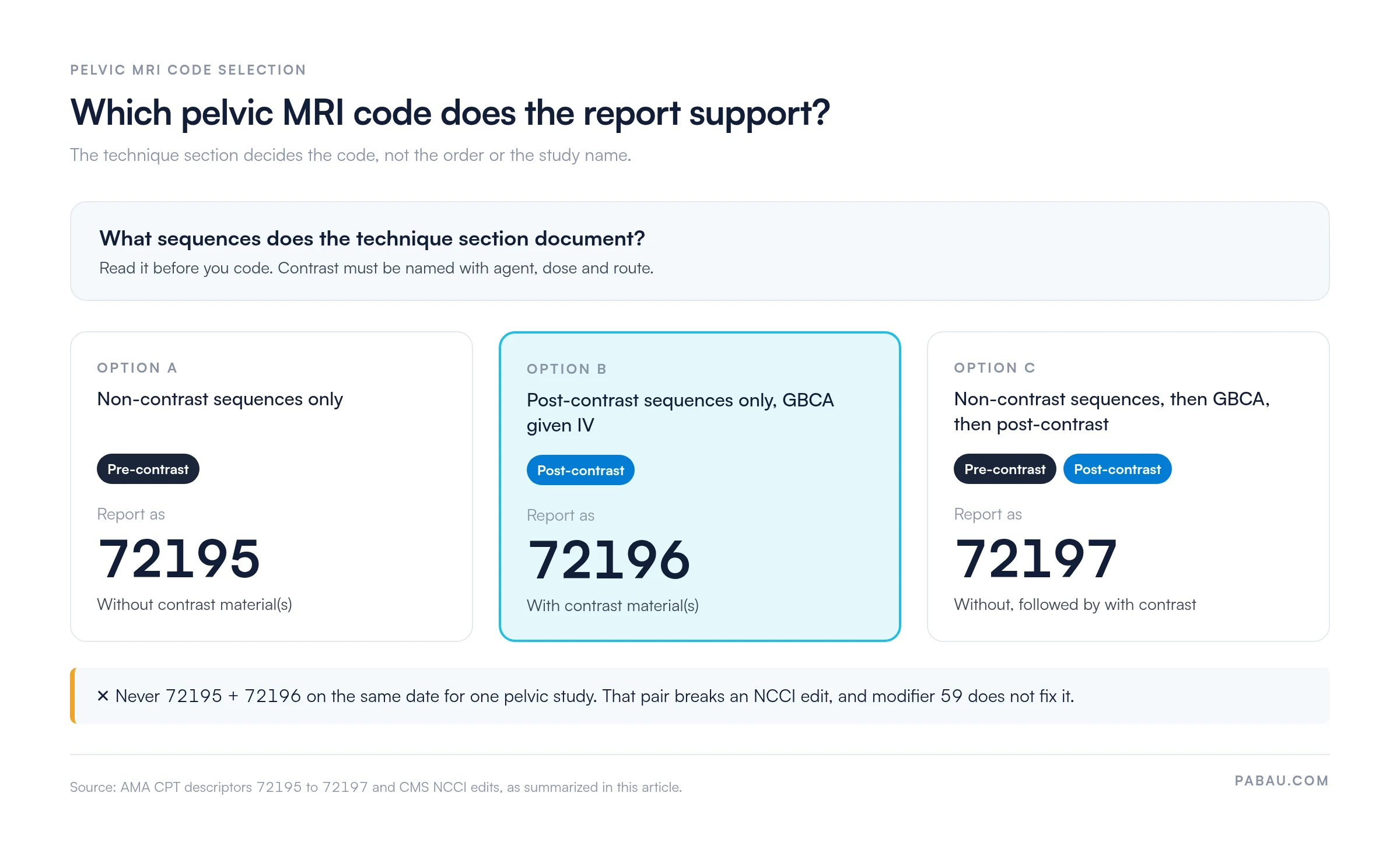
The 72195-72197 series covers three contrast protocols for the same region, and picking the wrong one is a frequent cause of pelvic MRI denials. The choice turns on one question: which sequences did the scanner acquire?
The “with-only” trap: Many imaging centers run a combined protocol by default, acquiring non-contrast and post-contrast sequences in one session. That protocol is 72197, not 72196. Coding 72196 on a combined study selects the wrong code and invites a denial or an audit finding. Check the radiology report to confirm which sequences were documented before you choose between the two.
Under the CMS National Correct Coding Initiative, billing 72195 and 72196 together for the same body region on the same date violates a column-one/column-two edit. When both without-contrast and with-contrast sequences are acquired, report 72197 alone. The diagram below maps each documented protocol to its code.
Four elements must appear in the radiology report for CPT 72196 to hold up on audit. If any one of them is missing, the payer has grounds for a medical necessity denial or a post-payment recoupment.
Meeting clean claim requirements for 72196 means the contrast documentation in the report matches the code on the claim. A mismatch between what the report says was performed and what the claim bills is a common audit trigger.
Before coding any pelvic MRI, read the technique section of the radiology report first. It states which sequences were acquired and whether contrast was given. If it mentions both pre-contrast and post-contrast sequences, the correct code is 72197, not 72196. Coding from the study description alone is how many 72196-vs-72197 errors start.
CPT 72196 supports the standard radiology professional/technical split. Modifier choice depends on where the service is rendered and who owns the equipment.
Place-of-service interaction: In a hospital outpatient department, the radiologist bills 72196-26 on the CMS-1500, and the hospital is paid for the technical side under OPPS. A freestanding imaging center that owns the scanner bills the global code, which pays both components. A modifier that doesn’t match the setting creates a compliance problem and changes the allowable the payer calculates.
Medicare pays CPT 72196 under the CMS Medicare Physician Fee Schedule. The rate is relative value units (RVUs) times the annual conversion factor, adjusted by Geographic Practice Cost Indices (GPCI) for the provider’s locality. The figure below is an approximate national amount before geographic adjustment. Confirm the rate for your locality and year in the CMS MPFS lookup tool. Geographic adjustment can shift the allowable by up to roughly 10-15%.
Commercial payers often reimburse above Medicare rates for radiology. They may apply their own fee schedules, utilization management programs, or contracted rates for imaging centers. Check each 72196 remittance against the contracted rate before the payment posts.
Prior authorization for CPT 72196 is required by most commercial payers and Medicare Advantage plans. Traditional Medicare fee-for-service generally does not require it. Requirements vary by payer, plan, and state, so verify with the specific payer before scheduling the study. A claim sent without a required authorization number is usually denied, and retroactive authorization is rarely granted.
Running insurance eligibility verification at scheduling rather than at billing gives the practice time to obtain authorization before the scan. A practice that checks eligibility on the day of service learns about auth requirements too late to act on them.
Record the authorization number and its expiration date at approval, and schedule the scan inside the authorized window. A practice that tracks authorizations next to the schedule spots an expiring approval before the patient arrives.
Denials for CPT 72196 cluster around a predictable set of causes. A structured review before submission prevents many of them.
Structured denial management workflows assign each CARC reason code a corrective action. Our denial codes reference maps CARC/RARC pairs from 72196 ERAs to the right billing correction.
Build a 72196 pre-submission checklist into your billing workflow. Confirm (1) contrast is documented in the report and (2) the code matches the sequences performed. Then confirm (3) the auth number is on file where required and (4) the modifier matches the place of service. Running these four checks catches the denial causes in the table above before the claim leaves the practice.
The diagnosis code on a 72196 claim establishes medical necessity for pelvic MRI with contrast. The ICD-10-CM code must reflect the clinical indication documented in the ordering physician’s notes. A diagnosis code that doesn’t match the documented indication invites a medical necessity denial and creates compliance exposure.
These codes are reference examples, not a pre-approved list. Payer coverage policies (LCDs and NCDs) define which diagnosis codes support medical necessity for pelvic MRI with contrast. Review the applicable LCD from your Medicare Administrative Contractor before submitting. ResDAC’s coding resources explain how diagnosis and procedure code pairs are cross-referenced in Medicare claims data.
Radiology coders regularly field body-site and modality crossover questions. The table below lists the codes most often confused with, or referenced alongside, CPT 72196.
Pelvic MRI denials usually trace back to a skipped manual check. That is the authorization, the code against the report, or the modifier against the setting. When those checks live in separate spreadsheets and payer portals, one missed step costs the whole claim.
Pabau, the practice management and billing platform we build, keeps those checks in its claims software for billers. Each insurer authorization is stored as a case that shows how many approved sessions have been used. Insurance eligibility verification runs through Claim.MD before the visit, and Pabau submits CMS-1500 claims through Claim.MD to thousands of payers.
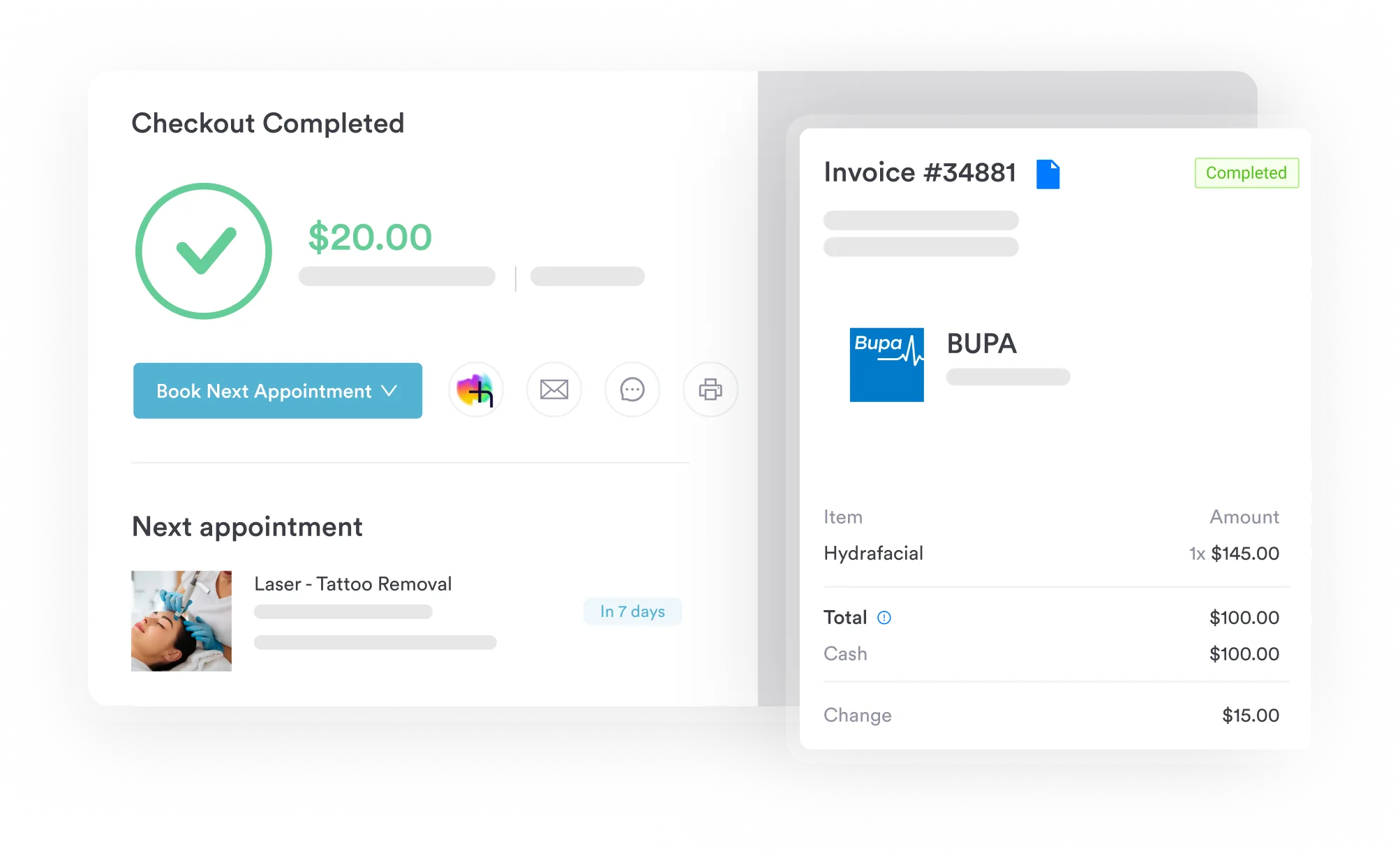
Claim validation scrubs each 72196 claim for missing or invalid details before it leaves Pabau. A rejected claim is flagged “Needs action,” and Fix shows what went wrong with a link to the field to correct. The dashboard tracks every claim from Pending to Paid, and practices settle payments straight from electronic remittance advice files.

Pabau stores prior authorizations as cases, scrubs each claim for missing or invalid details, and submits CMS-1500 claims through Claim.MD. Your CPT 72196 claims leave with the authorization on file and any errors flagged for a fix.

Code CPT 72196 from the technique section of the radiology report, never from the order or the study name. If the report shows sequences before and after contrast, the claim is 72197, and no modifier changes that.
Build four checks into the step before submission: contrast documented, code matched to sequences, authorization on file, and modifier matched to setting. The trade-off is a few minutes per claim against a denial, a correction and a resubmission.
Book a demo to see how Pabau tracks authorizations and scrubs pelvic MRI claims before they reach the payer.

Need to understand how claims reach payers after coding? Medical claims clearinghouse guide explains how electronic claim routing works between practice, clearinghouse, and payer.
Choosing a clearinghouse for imaging claims? Claim.MD clearinghouse overview covers how Claim.MD routes claims and eligibility checks for US practices.
Want a deeper look at the 837 claim file format? 837 file guide breaks down the HIPAA-compliant transaction set that carries CPT and diagnosis codes to payers electronically.
CPT code 72196 is the code for magnetic resonance imaging of the pelvis with contrast material only. It covers pelvic structures such as the bladder, prostate or uterus, rectum, and pelvic vessels when gadolinium-based contrast is given and post-contrast sequences are acquired. A study that adds without-contrast sequences is reported under CPT 72197.
Medicare’s approximate national non-facility global rate for CPT 72196 is about $230-$280 before geographic adjustment. Professional (modifier 26) and technical (TC) amounts vary by locality and year, so check them in the CMS Physician Fee Schedule lookup. Geographic adjustment can shift the allowable by up to roughly 10-15%.
CPT 72195 is pelvic MRI without contrast, 72196 is pelvic MRI with contrast only, and 72197 is pelvic MRI without contrast followed by with contrast. When a facility acquires both sequence types in one session, 72197 is the correct code. Billing 72195 and 72196 together for that study is an NCCI bundling violation.
Modifier 26 applies when the radiologist bills only the professional component (interpretation). Modifier TC applies when the facility bills only the technical component: equipment, technologist staff and supplies, with the contrast agent billed separately. No modifier (global billing) applies when one entity provides and bills both components, typically a freestanding imaging center. LT and RT do not apply, because the pelvis is a midline structure.
Usually, yes. Most commercial payers and Medicare Advantage plans require prior authorization for CPT 72196. Traditional Medicare fee-for-service generally does not require prior authorization for pelvic MRI. Verify each payer’s requirement at the eligibility check, and obtain authorization before the study, because retroactive approvals are rarely granted for advanced imaging.
No, not for the same anatomical region. CPT 72196 and 72197 describe the same body site at different contrast levels. They are mutually exclusive for one pelvic study on one date. If both without-contrast and with-contrast sequences are acquired in a session, report 72197 alone.



