CCSD code G5100: Bypass of duodenum billing guide
CCSD code G5100 bills a bypass that leaves the duodenum in place CCSD code G5100...

Last Updated: Oct 16, 2026

CPT Code 72100 covers a lumbosacral spine X-ray with 2 or 3 views, the standard code for routine lumbar imaging.
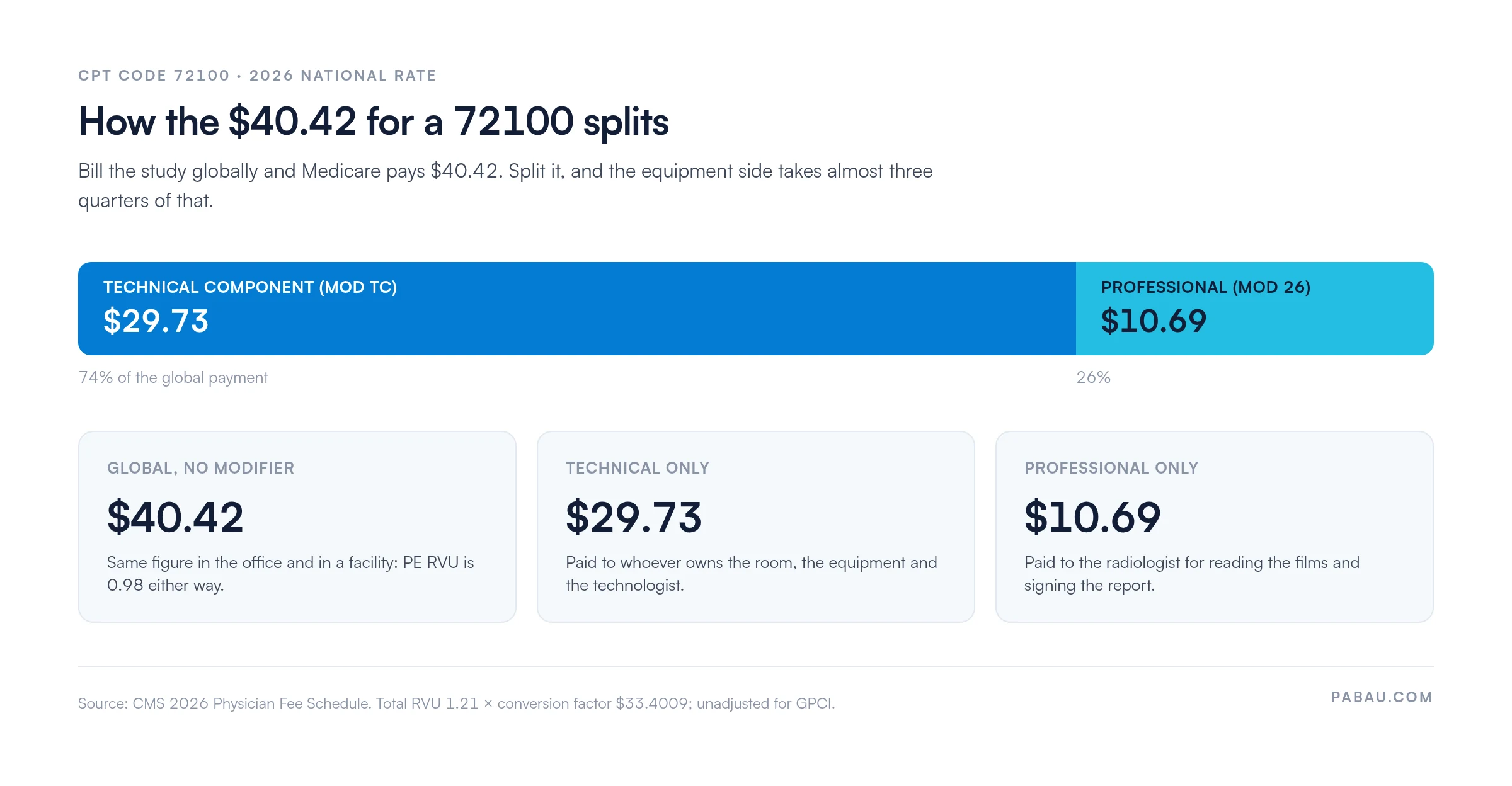
Medicare pays $40.42 nationally for 72100 in 2026, the same figure in a facility as in an office.
Split the code and the technical component (mod TC) takes $29.73 of that, leaving $10.69 for the interpretation.
Modifiers TC and 26 apply when the imaging and the interpretation are billed by different entities.
Practice management software like Pabau flags NCCI conflicts between 72100, 72040 and 72070 before a claim is submitted.
CPT Code 72100 is the billing code for a radiologic examination of the lumbosacral spine with 2 or 3 views. It is the code for a routine lumbar spine X-ray, and the view count is what separates it from 72110 and 72114. This guide covers the descriptor, indications, modifiers, 2026 fee schedule, and bundling rules.
The American Medical Association lists 72100 in the Radiology section of the CPT code set. Its official descriptor reads: Radiologic examination, spine, lumbosacral; 2 or 3 views. Bill one view short and the claim is unsupported. Bill four views under 72100 and the code is wrong.
Payers reimburse 72100 when the diagnosis on the claim shows the imaging was clinically justified. The scenarios below commonly meet that standard.
Local Coverage Determinations vary by Medicare Administrative Contractor, and some add requirements beyond the diagnosis code. Check your MAC’s LCD before assuming a diagnosis establishes necessity on its own. The supporting diagnosis itself comes from the ICD-10-CM codes documented in the order.
The record has to support the procedure on its own if a payer audits the claim. Vague documentation is a common reason 72100 claims are denied or recouped on post-payment review.
Every 72100 claim record should carry all of the following elements to support clean claim submission:
For Medicare claims, documentation of medical necessity has to exist at the time of service. Reconstructing it after a denial does not satisfy the standard. Practices using templated radiology order forms should confirm the indication field is completed per patient, not left on a default.
Modifier selection depends on how the service is split between the facility and the interpreting physician. Radiology codes divide into a technical component for the imaging and a professional component for the read. Misapplying these two is a frequent source of denials on radiology claims.
When neither TC nor 26 is appended, the code is billed globally. One entity performs the study, interprets it, and bills for both components. This is typical for a physician-owned imaging center. Never append TC and 26 to the same line item, because they are mutually exclusive.
Modifier 59 is not a blanket bundling override. CMS guidance requires that modifier 59 be used only when procedures are genuinely distinct in terms of anatomy, clinical circumstance, or encounter. Applying it routinely to avoid an NCCI edit without supporting documentation is a compliance risk. Review the claim record carefully before appending 59 to any 72100 line.
Medicare pays 72100 from the CMS Physician Fee Schedule, which CMS updates every year. The national figures below are unadjusted. Actual payment depends on the geographic practice cost index (GPCI) your Medicare Administrative Contractor applies.
The split is where the money actually sits. The technical component carries $29.73 of the $40.42, so whoever owns the room and the equipment collects most of the payment.
Verify the current rate in the CMS MPFS lookup tool before you publish a fee schedule internally. Rates change each calendar year and vary by MAC jurisdiction.
RVUs set the payment before geographic adjustment. Medicare multiplies each RVU component by its own GPCI, sums the three, and multiplies by the conversion factor. For 72100 the total is 1.21 RVUs, and the 2026 conversion factor is $33.4009, which gives $40.42.
CMS publishes the component values in its relative value files, updated with each quarterly release. Commercial payers usually price 72100 as a multiple of the Medicare rate.
Contracts commonly land between 100% and 150% of Medicare for routine spine imaging, and some plans use a schedule of their own. Audit your contracted rates against the Medicare benchmark once a year.
NCCI bundles certain radiology codes when they are billed on the same date for the same patient. For 72100 the common scenario is same-day billing of several spine codes covering overlapping anatomy.
72040 (cervical), 72070 (thoracic) and 72100 (lumbosacral) are each billable when the regions are genuinely imaged separately. Billing the same region under two codes on one date triggers an edit. Catching that conflict before the claim leaves the practice is cheaper than appealing it.
Configure your practice management system to flag these edit pairs before the claim is generated. Manual review of bundled claims raises both denial risk and rework cost.
View count is the only difference between 72100 and 72110, and it is the most common coding error on lumbar spine claims. Two or three views is 72100. Four or more is 72110.
The technologist’s acquisition log decides the code, not the ordering physician’s intent. If the protocol calls for 3 views and the tech acquires 4, the correct code is 72110. If only a single view is acquired, the study falls short of 72100 and is billed as 72020. Bill what was performed.
The wider spine radiology family helps a coder pick the right code and avoid crossover errors. The AAPC CPT reference groups these codes inside the Radiology section.
Manual radiology billing fails in predictable places. Three of them account for most preventable denials on a 72100:
Practice management software like Pabau closes those three off at the point of submission. Pabau connects to the Claim.MD clearinghouse, which reaches thousands of US payers. Eligibility checks, CMS-1500 and 837P generation, and ERA/835 remittance all sit in the same platform as the schedule and the clinical note.
The claims management software flags NCCI bundling conflicts before submission. A 72100 plus 72110 same-day conflict surfaces at billing review, rather than in a denial 30 days later.

Pabau also builds the superbill for each encounter, exporting CPT codes, modifiers and supporting diagnosis codes together. That removes the retyping step between the clinical note and the billing system.
Run a quarterly audit of your 72100 vs 72110 ratio. If 72100 claims outnumber 72110 by a wide margin, confirm that your protocols really specify 2-3 views. Also confirm technologists are not routinely acquiring a fourth view without a code change. The inverse is worth checking too: consistent 72110 billing on notes that document three views signals upcoding risk.

Pabau’s claims management tools flag modifier conflicts and NCCI bundling edits before submission, so your lumbar spine claims go out clean the first time.

72100 is a narrow code, and the view count is the whole of it. Get the acquisition log and the billed code to agree, and most of the denial risk on lumbar spine imaging disappears.
The trade-off worth remembering is the payment split. At $40.42 globally, a 72100 does not leave room to work a denial twice, so the controls belong upstream of submission. Book a demo to see how Pabau keeps lumbar spine claims clean before they go out.

Need a broader overview of how medical billing works? What is medical billing covers the end-to-end process from charge capture to payment posting.
Dealing with claim denials on radiology codes? Denial management in healthcare explains how to structure a denial tracking and appeal workflow.
Want to understand how RCM fits your billing strategy? Revenue cycle management explained outlines the full financial lifecycle from scheduling to collections.
Worried about an audit of your imaging claims? Medical billing compliance sets out the record-keeping that survives a post-payment review.
Submitting radiology claims electronically? The 837 file explained walks through the format payers actually receive your claim in.
CPT Code 72100 is used to bill for a radiologic examination of the lumbosacral spine with 2 or 3 views. It is the standard code for routine lumbar spine X-rays ordered for conditions such as low back pain, sciatica, suspected fracture, or degenerative disc disease.
The 2026 national Medicare rate for CPT 72100 is $40.42, in both facility and non-facility settings. Billed with modifier TC the payment is $29.73, and with modifier 26 it is $10.69. Check your MAC’s locality-adjusted amount in the CMS fee schedule lookup.
CPT 72100 covers a lumbosacral spine X-ray with 2 or 3 views. CPT 72110 covers the same area with a minimum of 4 views. The correct code is set by the number of views acquired, not the number ordered. Billing 72100 for a 4-view study is undercoding, and billing 72110 for a 3-view study is upcoding.
The two most common are TC (technical component) and 26 (professional component). They apply when the imaging and the physician interpretation are billed separately. Modifier 52 covers a study with fewer views than the code minimum. Modifier 59 can apply to a bundled pair, but only with documentation that the services were distinct.
Yes. 72100 may be billed with 72040 (cervical) and 72070 (thoracic) when those are genuinely separate studies of distinct regions. Each study needs its own order and documentation. 72100 and 72110 on the same date for the same region is not appropriate, because 72110 subsumes 72100.
The record needs a signed order naming the lumbosacral spine and the view count. It also needs a supporting ICD-10-CM diagnosis and a signed radiologist report with findings and impression. A technologist log or PACS record must confirm the views acquired. Every element has to be in the record at the time of service.