

CCSD code G5100: Bypass of duodenum billing guide
CCSD code G5100 bills a bypass that leaves the duodenum in place CCSD code G5100...

Last Updated: Oct 16, 2026
72114 is the CPT code for radiologic examination, spine, lumbosacral; complete, including bending views, minimum of 6 views.
The descriptor sets two conditions, and both must appear in the finalized radiology report. The study needs at least six views, and at least one of those must be a bending projection: flexion, extension, or lateral bending. A six-image series with no bending view is coded 72110 or 72100 instead.
Let Pabau's smart automation suggest the right codes, reduce claim denials, and keep your practice compliant—effortlessly.
Automate repetitive tasks and focus on what matters most—your patients.
Reduce coding errors and ensure compliance with the latest regulations.
Clean claims, fewer denials, and faster reimbursements.
Powerful insights and reporting to help your practice thrive.
HIPAA compliant SOC 2 certified GDPR-compliant Trusted by 4,000+ clinics worldwide

CPT Code 72114 needs a minimum of 6 views and documented bending views, so image count alone does not qualify the code.
Billing 72114 when only the 72110 criteria are met is upcoding, because 72110 carries no bending-view requirement.
Modifier 26 covers the professional read and TC covers the technical component, while no modifier means one entity does both.
Medicare pays roughly $61.79 nationally for the global service in 2026, and the technical component takes about three-quarters of it.
Pabau submits and tracks 72114 claims through your clearinghouse, so a rejection surfaces against the patient record.
CPT Code 72114 describes a “radiologic examination, spine, lumbosacral; complete, including bending views, minimum of 6 views.” The American Medical Association’s CPT code set builds four billing elements into that descriptor:
Every word in that descriptor carries billing weight. “Complete” means a full diagnostic series, not a limited or follow-up study. “Including bending views” means flexion, extension, or lateral bending films were performed and documented. “Minimum of 6 views” applies to the whole encounter, not to any subset of projections.
CPT descriptors are legal definitions of what was performed. If the radiology report does not match each element, the code is wrong, whatever the technologist ordered and whatever images sat in PACS.
A standard 72114 series typically contains the following projections:
Some facilities add a spot lateral of L5-S1, bringing the total to 7. The minimum is 6, and at least one of those views must be a bending projection. If the obliques are omitted and no bending views are taken, the correct code is 72100 or 72110.
If the report names a single spine view at a specified level, 72020 is the correct code. One projection never supports a complete series, so 72100, 72110 and 72114 are all wrong for it.
These three codes cover the same anatomy but differ in view count and whether bending projections are required. Confusing them is the top upcoding risk in lumbosacral spine radiography.
The practical rule is short. If bending views were not performed and documented, 72114 cannot be billed. Billing it when only the 72110 criteria are met constitutes upcoding under federal billing rules. Payers cross-reference the view count and projection list in the radiology report against the submitted code. A discrepancy triggers an automated denial or a post-payment audit.
When the ordering physician notes instability or spondylolisthesis evaluation in the clinical indication, that is the strongest signal that bending views are medically necessary. Without that documented rationale, 72114 claims face heightened scrutiny even when the views were taken.
Lumbosacral spine X-rays split into professional and technical components when the reading radiologist and the facility performing the imaging are separate entities. Three modifier scenarios apply to CPT Code 72114:
Modifier 59 does not typically apply to 72114 on its own. It becomes relevant only when 72114 is billed alongside another radiology code on the same date and a payer’s NCCI edit bundles them incorrectly. In that scenario, modifier 59 or its preferred X-modifier variant signals a distinct service.
Laterality modifiers (RT, LT) do not apply to lumbosacral spine imaging, which is an axial midline structure. Applying them to 72114 is a billing error that triggers rejection.
Before appending modifier 26, confirm the radiologist’s employment or contract structure. A radiologist employed by the same entity that owns the imaging equipment should bill globally. Splitting the service incorrectly creates duplicate billing exposure and a compliance risk under the False Claims Act.
Medicare reimburses CPT Code 72114 under the CMS Medicare Physician Fee Schedule (MPFS). Rates are expressed as relative value units (RVUs) and converted to dollars with the annual conversion factor. CY2026 carries two conversion factors: $33.5675 for qualifying APM participants and $33.4009 for everyone else. Geographic practice cost indices then adjust the result by locality, so a practice in Manhattan is paid differently from one in rural Arkansas.
The 2026 national non-facility figures below come from the CMS relative value file, priced at the $33.4009 non-qualifying conversion factor.
At the $33.5675 conversion factor that applies to qualifying APM participants, those same three figures read $62.10, $14.43 and $47.67. The split matters when you decide whether to bill globally or separately, because the two components are nowhere near equal.
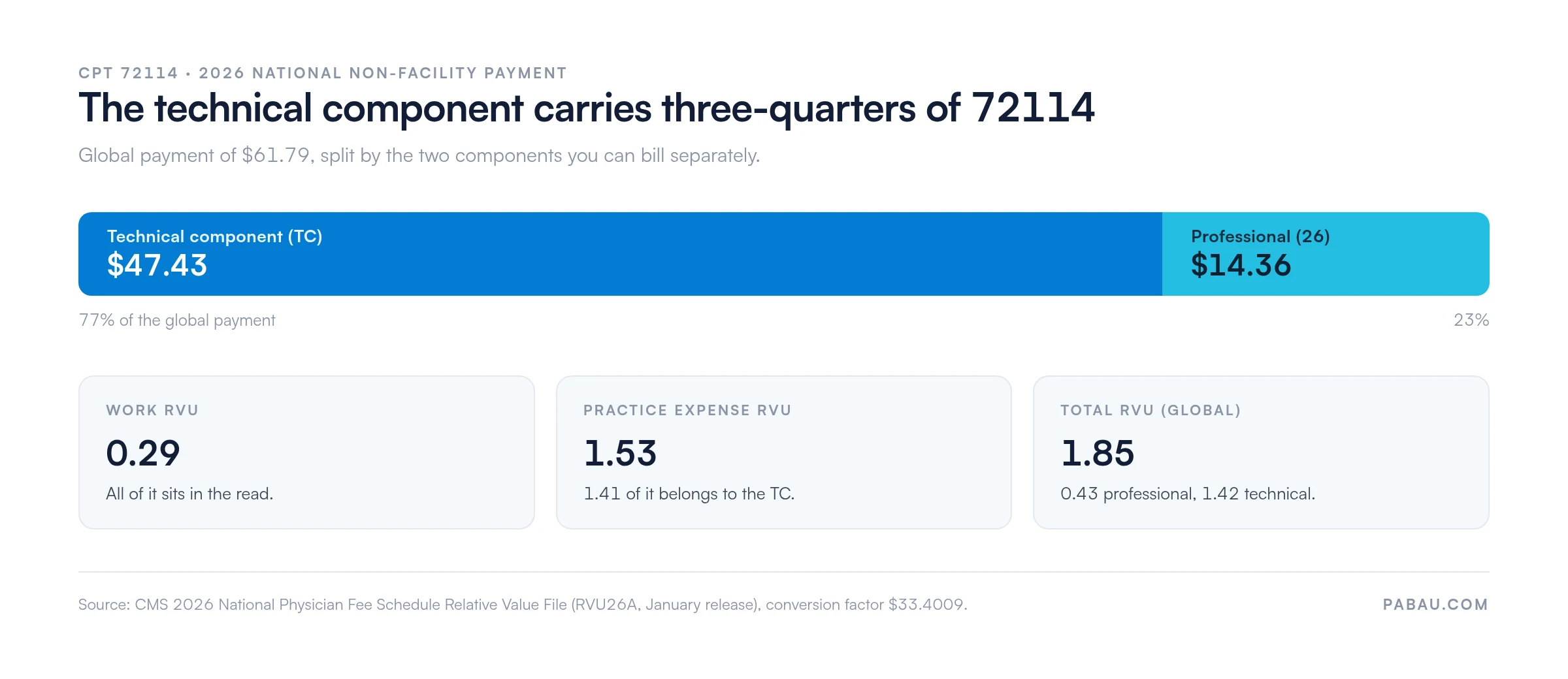
These are national averages. Pull locality-adjusted rates from the CMS MPFS Look-Up Tool before quoting reimbursement to an ordering provider. Commercial payers typically reimburse at a multiplier of the MPFS rate, commonly 110 to 150%, though that varies by contract.
Traditional fee-for-service Medicare generally does not require prior authorization for CPT 72114. Individual Medicare Administrative Contractors (MACs) may still publish Local Coverage Determinations (LCDs) setting medical necessity criteria you have to document before billing. Checking your MAC’s LCD database before submission is standard practice rather than optional.
Prior authorization requirements are most common in these payer categories:
For any payer requiring authorization, the supporting documentation should include:
Verifying eligibility before the appointment flags authorization requirements while the imaging can still be rescheduled.
CPT Code 72114 claims are denied more often than most radiology codes. The descriptor sets hard documentation requirements that many radiology reports never explicitly confirm. These are the most frequent causes:
Treat 72114 rejections as a root-cause problem rather than a run of individual claim failures. If your denial rate on this code passes 5%, review the documentation workflow instead of only the appeals. Because the diagnosis drives so many of these rejections, keep the payer’s accepted ICD-10-CM codes beside the coding protocol.
CPT Code 72114 is frequently ordered alongside other lumbar imaging codes. Whether they can be billed together depends on NCCI edits and medical necessity documentation.
When 72114 and 72148 are billed together, make sure the electronic claim carries a separate diagnosis code or claim note supporting each indication. Some MAC LCDs specify when plain film and MRI may be co-billed for the same spine region on the same date.
Billing 72114 accurately takes a five-step check before the claim leaves your practice. The first step carries the most weight, because it is the only one that reads the finalized report.
Build a superbill template just for lumbosacral spine imaging. Prompting the coder to confirm view count and bending views before code selection removes the most common 72114 error at no extra cost. Pair it with a periodic audit of your 72114 denial rate against your 72110 volume, so upcoding drift shows up before a payer finds it.
Build your spine-radiography coding protocol against the AAPC’s CPT code reference, then pair it with claims software that tracks each radiology submission through to payment. Systematic pre-submission checks are what hold a radiology clean claim rate above 95%.
Run a quarterly internal audit. Pull every claim where 72114 was billed, then compare the average documented view count against the code requirement. If the mean sits at exactly 6, your coders may be rounding up. A legitimate 72114 series usually runs 6 to 7 views. Consistent 6-view billing with no bending view documented is the pattern auditors flag first.
Most practices code the study in one system, key the claim into a clearinghouse portal, and then check that portal by hand for a status. When a 72114 claim stalls, nobody at the front desk can see it from the patient record.
Pabau, our practice management software, holds the imaging order, the radiology report and the claim on the same patient record. Claims go out to your clearinghouse from there, and each status update comes back against that record.

Your coders still confirm the view count and the bending projections before the claim goes out, because no software reads that off a radiology report. What changes is the chase afterwards. A rejected 72114 appears next to the study it belongs to, so the correction takes minutes instead of a portal hunt.

Pabau submits your radiology claims through your clearinghouse and tracks each one to payment. Your team sees where a 72114 claim stands without leaving the patient record.

72114 is an audit-prone code because its two conditions are explicit and easy to read past. If the finalized radiology report does not name six or more views and at least one bending projection, the correct code is 72110 or 72100. The image count on its own decides nothing.
Confirm the view count and the bending projection before coding, then settle the modifier scenario before submission. Those two habits keep 72114 out of the audit pile. The trade-off is a slower coding step in exchange for far less rework later. Book a demo to see how Pabau tracks your radiology claims from submission to payment.

Need a primer on how clearinghouses handle radiology claims? Claim.MD clearinghouse guide explains how electronic claim submission works before the payer sees it.
Want to understand how payer responses map back to billing errors? Medical claims clearinghouse overview covers how those responses translate into actionable corrections.
Curious how to get credentialed with payers who require prior auth for imaging? Credentialing with insurance companies outlines the steps for payer enrollment and network participation.
CPT Code 72114 is a radiologic examination of the lumbosacral spine. It requires a complete series with bending views and a minimum of 6 total views. The standard series includes AP, lateral, bilateral obliques, and at least one bending projection (flexion, extension, or lateral bending).
CPT 72110 covers a lumbosacral spine X-ray with a minimum of 4 views and does not require bending projections. CPT 72114 requires a minimum of 6 views and mandates that bending views be performed and documented. Billing 72114 when only 72110 criteria are met is upcoding.
Modifier 26 applies when the radiologist provides only the professional (reading) component. Modifier TC applies when the facility provides only the technical (imaging) component. No modifier is used when the same entity performs and reads the study (global billing). Laterality modifiers do not apply to lumbosacral spine imaging.
The 2026 Medicare national non-facility rate for CPT 72114 is about $61.79 for the global service. The professional component (modifier 26) pays about $14.36 and the technical component (TC) about $47.43. Those figures use the CY2026 conversion factor of $33.4009. Rates vary by locality, so check the CMS MPFS Look-Up Tool before billing.
Yes. They can be billed together when there is a distinct clinical reason for both the X-ray and the MRI on the same date. NCCI does not automatically bundle them, but payers may question co-billing without documentation of separate clinical indications. Include a distinct diagnosis code or ordering note for each study.
The most common denial reasons are bending views that the radiology report never names, and a total view count below 6. Missing or low-specificity ICD-10 diagnosis codes are the next most frequent. A missing prior authorization from a Medicare Advantage or commercial plan is another. So is an NCCI bundling conflict with another spine code on the same date.



