CPT code 93503: Swan-Ganz catheter billing and modifiers
CPT code 93503: Official descriptor and procedure overview In the AMA CPT code s...

Last Updated: Oct 23, 2026
71550 is the CPT code for magnetic resonance imaging, chest (eg, for evaluation of hilar and mediastinal lymphadenopathy); without contrast material(s). It reports a chest MRI acquired entirely without gadolinium, usually to assess the mediastinum, hilar nodes, pleura or chest wall.
Contrast status decides the code. Once gadolinium is injected, the study becomes 71551 or 71552, and payers check the radiology report against the billed code. Below are the documentation, ICD-10 pairings, prior authorization rules, 2026 Medicare rate and denial fixes that keep a 71550 claim clean.
Let Pabau's smart automation suggest the right codes, reduce claim denials, and keep your practice compliant—effortlessly.
Automate repetitive tasks and focus on what matters most—your patients.
Reduce coding errors and ensure compliance with the latest regulations.
Clean claims, fewer denials, and faster reimbursements.
Powerful insights and reporting to help your practice thrive.
HIPAA compliant SOC 2 certified GDPR-compliant Trusted by 4,000+ clinics worldwide

CPT code 71550 reports a chest MRI with no contrast at any point in the session. Once gadolinium is injected, the study becomes 71551 or 71552.
When pre- and post-contrast sequences run in one session, bill 71552 alone rather than 71550 plus 71551.
Most commercial payers and many Medicaid managed-care plans require prior authorization for 71550, so request it before the scan.
The 2026 national Medicare non-facility rate for the global 71550 is about $333, based on 9.97 total RVUs.
Pabau’s claims management software submits HIPAA-compliant 837P claims through its Claim.MD clearinghouse integration.
The American Medical Association (AMA) defines CPT code 71550 as “Magnetic resonance imaging, chest (eg, for evaluation of hilar and mediastinal lymphadenopathy); without contrast material(s).” It sits in the Chest subsection of Diagnostic Radiology, which runs from 71045 to 71555.
The code covers acquiring and interpreting a non-contrast MRI of the thoracic cavity. Use it only when no gadolinium is given at any point in the session. If contrast goes in, the study becomes 71551 or 71552.
71550 covers a non-contrast MRI of the whole chest. That includes the mediastinum, hilar regions, pleural spaces and nearby soft tissues.
Radiologists choose it when the clinical question doesn’t need gadolinium. Sometimes the patient can’t have contrast because of renal impairment or a prior reaction. Other times, anatomy rather than enhancement is the goal.
Orders billed under 71550 commonly document these indications:
Read “without contrast material(s)” as the billing criterion, not as optional phrasing. If gadolinium is injected at any point, the code changes. Billing 71550 after an injection is a coding error that a payer audit will find.
All three chest MRI codes share the same region and modality. They differ only on contrast. Use 71550 with no contrast, 71551 with contrast only, and 71552 when images are taken before and after contrast in one session.
The decision chart below walks through the same choice, starting from what the radiology report says.
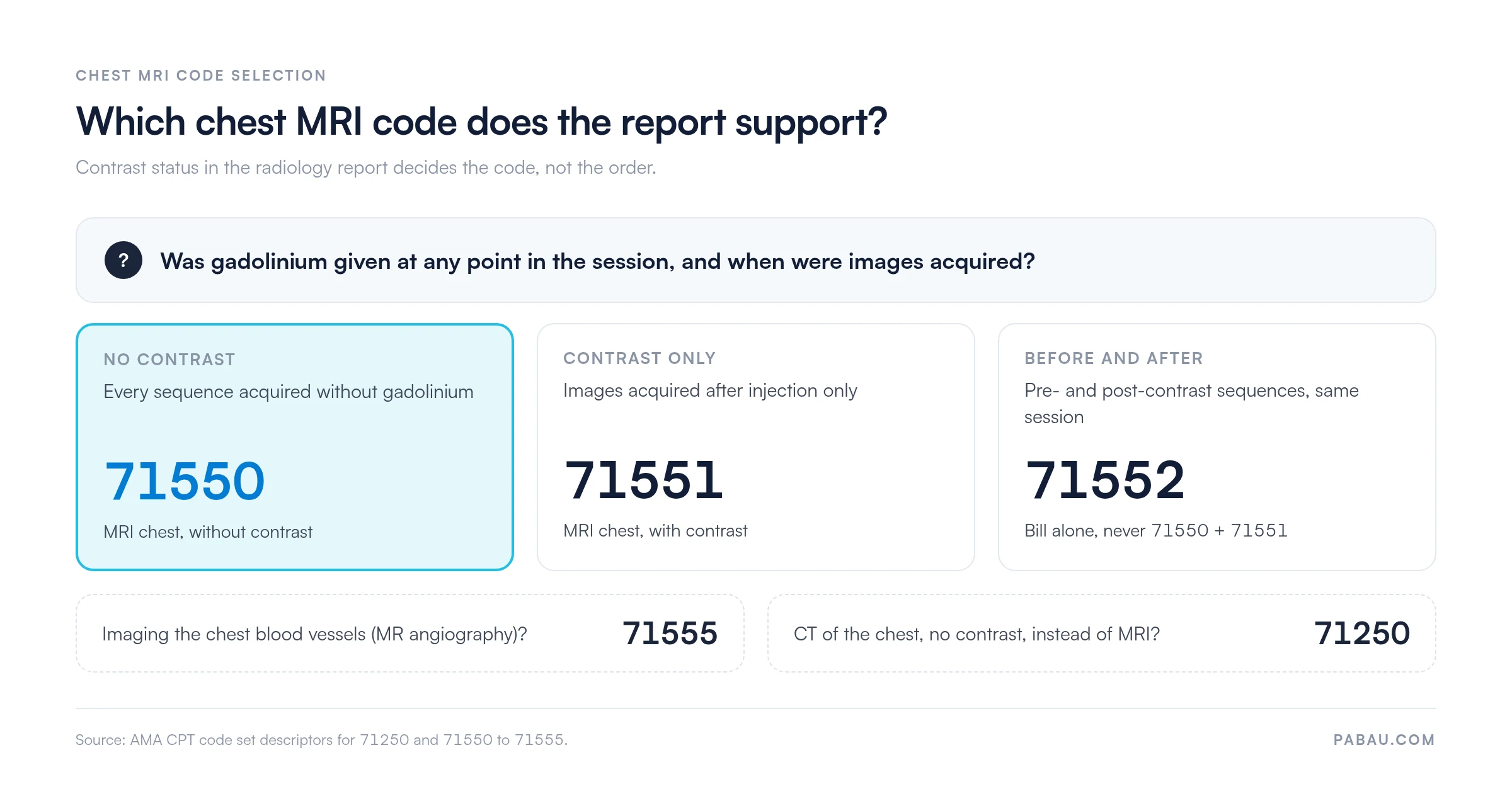
Under CMS National Correct Coding Initiative (NCCI) edits, 71550 and 71551 should not be reported together for one session. Submitting both separately triggers an edit denial. When both sequences run in one session, bill 71552 alone.
CPT code 71250 covers a CT scan of the thorax without contrast, not an MRI. Coders often see orders for both on the same patient. Each modality needs its own clinical rationale in the record.
Many commercial payers apply step therapy. They expect a CT first and deny the MRI unless the notes show why CT was insufficient or contraindicated. The ordering physician’s notes must state that rationale for 71550 to pass medical necessity review.
A payer reviewer should be able to follow every 71550 claim from clinical question to imaging result. Incomplete records are a common and preventable denial cause. A clean claim checklist built into the ordering workflow stops them early.
Every 71550 claim needs a diagnosis from the ICD-10-CM codes that matches the ordering physician’s notes and the radiology report. Check the pairing against any Local Coverage Determination (LCD) your MAC applies. Not every diagnosis establishes medical necessity under every payer’s policy.
Use a nonspecific code such as R91.8 only until a more specific diagnosis is documented. After that, the claim should carry the specific code. LCDs vary by jurisdiction, so check the CMS Medicare Coverage Database before you submit.
Most commercial payers and many Medicaid managed-care organizations require prior authorization for 71550. Make a PA check a standard part of insurance eligibility verification before any chest MRI is booked.
Many payers deny retro-authorization requests, and the appeal window after a retro-denial is short. A written prior authorization process gets the request out with the order, not on scan day.
Medicare pays 71550 under the 2026 Medicare Physician Fee Schedule (MPFS), with separate non-facility and facility rates. The imaging center or hospital usually bills the technical component (TC). The interpreting radiologist bills the professional component with modifier 26, and the global code covers both.
The global figure is a national amount before locality adjustment. Geographic Practice Cost Indices (GPCIs) move it up or down, so high-cost markets such as San Francisco or Manhattan pay more. Qualifying APM participants use a slightly higher conversion factor of $33.5675.
Check the TC and 26 splits, and your locality rate, in the CMS Physician Fee Schedule lookup tool before using any figure for projections. CMS updates rates each January 1 through the MPFS final rule, usually published in November. Confirm the billing locality on the claim before you submit.
71550 claims fail for a predictable set of reasons, and most can be fixed before submission. The table pairs each common denial pattern with its fix. A structured denial management workflow helps your team resolve repeat issues before they reach the payer.
Sending 71550 through the 837P electronic claim submission workflow helps catch missing required fields and eligibility problems before the claim reaches the payer.
Modifiers tell the payer about circumstances that change how it pays a 71550 claim. The wrong modifier, or a missing one, leads to a denial or a payment error that can trigger a post-payment audit.
The TC and 26 split is the most common modifier scenario for 71550 in hospital-based radiology. A provider who bills the global code should not also bill TC or 26 for the same study, because that pays the same work twice.
Pabau’s claims management software pre-fills the claim form from the patient record and checks that required fields are complete before submission.

When TC and 26 are billed separately at a split-facility site, match the service date, patient identifier and place-of-service code on both claims. A mismatch on any of these fields can get one component denied, even when both are coded correctly.
A 71550 claim moves from the order to authorization, the scan, the signed report, coding and submission. Run these checks at the coding step, while a fix still takes minutes.
In many imaging practices, staff still assemble each 71550 claim by hand. They copy the code, the diagnosis and the authorization number from separate screens. A missing field only shows up when the payer rejects the claim.
Pabau, the practice management platform we build, does that assembly from the patient record. It runs US eligibility checks, validates required fields such as the authorization number, and sends the claim through Claim.MD.
Coding decisions stay with your coders. What changes is that fewer claims come back for missing data, and claim-status tracking shows where each one sits.

Pabau pre-fills claims from the patient record and checks required fields before they go to Claim.MD, so fewer imaging claims bounce back for missing data.

Treat the signed radiology report as the source of truth for 71550. If it states that no contrast was given, and the order explains why MRI beat CT, the code choice defends itself on review.
When either detail is vague, fix it before the claim leaves the practice. A corrected claim or an appeal costs weeks, while a question to the radiologist costs minutes.
Pabau’s claims management software submits claims through Claim.MD, with US eligibility checks, claim-status tracking and required-field validation before the claim is sent. Book a demo to see how it fits your imaging billing workflow.

Getting denials you can’t decode? Denial codes in medical billing covers the most common CARC reason codes and how to respond to each one.
Want to see how clearinghouse submission works end to end? Medical claims clearinghouse guide explains the 837P transaction flow and how clearinghouses validate claims before payer adjudication.
Reconciling a 71550 payment? Electronic remittance advice (ERA) explains how to read 835 files and post payment adjustments on imaging claims.
Billing a chest CT with contrast instead? CPT 71260 covers CT of the thorax with contrast and how it differs from 71250.
Comparing tools for imaging authorizations? Best prior authorization software ranks platforms that help practices submit and track authorization requests.
The 2026 national non-facility rate for the global 71550 is about $333, from 9.97 total RVUs at a $33.4009 conversion factor. Local rates vary by GPCI. The CMS Physician Fee Schedule lookup tool lists the TC and 26 splits.
Yes, when the ordering physician documents that the scan is reasonable and necessary. National MRI coverage sits in NCD 220.2, and some MACs add local policy on top. Traditional Medicare doesn’t require prior authorization for it.
Use 71555 for magnetic resonance angiography of the chest, excluding the myocardium, with or without contrast. 71550 is the wrong code for vascular imaging of the chest, even when no contrast is given.
No. Cardiac MRI has its own codes, 75557 to 75565, covering heart morphology, function, stress imaging and flow mapping. 71550 is for the chest structures around the heart, such as the mediastinum and hila.
Yes, if each scan has its own documented clinical reason. CT and MRI are separate procedures, so 71250 and 71550 are not one service. Check the NCCI edit tables for the date of service before you submit.