

CPT Code 52352: Ureteroscopic stone removal billing guide
CPT Code 52352: Official descriptor and procedure overview CPT Code 52352 descri...

Last Updated: Oct 30, 2026
70554 is the CPT code for a functional MRI of the brain that does not require physician or psychologist administration. It includes selecting and administering repetitive body part movement or visual stimulation tasks, usually run by a technologist.
When a physician or psychologist administers the entire neurofunctional testing, the study is reported with 70555 instead. Most 70554 studies map eloquent cortex before epilepsy surgery, brain tumor resection, or arteriovenous malformation treatment.
Let Pabau's smart automation suggest the right codes, reduce claim denials, and keep your practice compliant—effortlessly.
Automate repetitive tasks and focus on what matters most—your patients.
Reduce coding errors and ensure compliance with the latest regulations.
Clean claims, fewer denials, and faster reimbursements.
Powerful insights and reporting to help your practice thrive.
HIPAA compliant SOC 2 certified GDPR-compliant Trusted by 4,000+ clinics worldwide

CPT Code 70554 reports a brain functional MRI in which a technologist or other non-physician staff member selects and administers the tasks.
70555 applies instead when a physician or psychologist administers the entire neurofunctional testing, and it is reported only when 96020 testing is performed.
Medicare covers presurgical fMRI mapping under National Coverage Determination 220.2, and MAC Local Coverage Determinations add local detail.
Many commercial payers and Medicare Advantage plans require prior authorization for 70554, while traditional Medicare does not.
Pabau’s claims management software checks claims for missing details, stores prior authorizations as cases, and tracks each claim through Claim.MD to payment.
CPT Code 70554 reports a functional MRI of the brain in which a technologist or other non-physician staff member selects and administers the tasks. When a physician or psychologist administers the entire neurofunctional testing, the study moves to 70555.
Its official descriptor comes from the American Medical Association. Magnetic resonance imaging, brain, functional MRI; including test selection and administration of repetitive body part movement and/or visual stimulation, not requiring physician or psychologist administration.
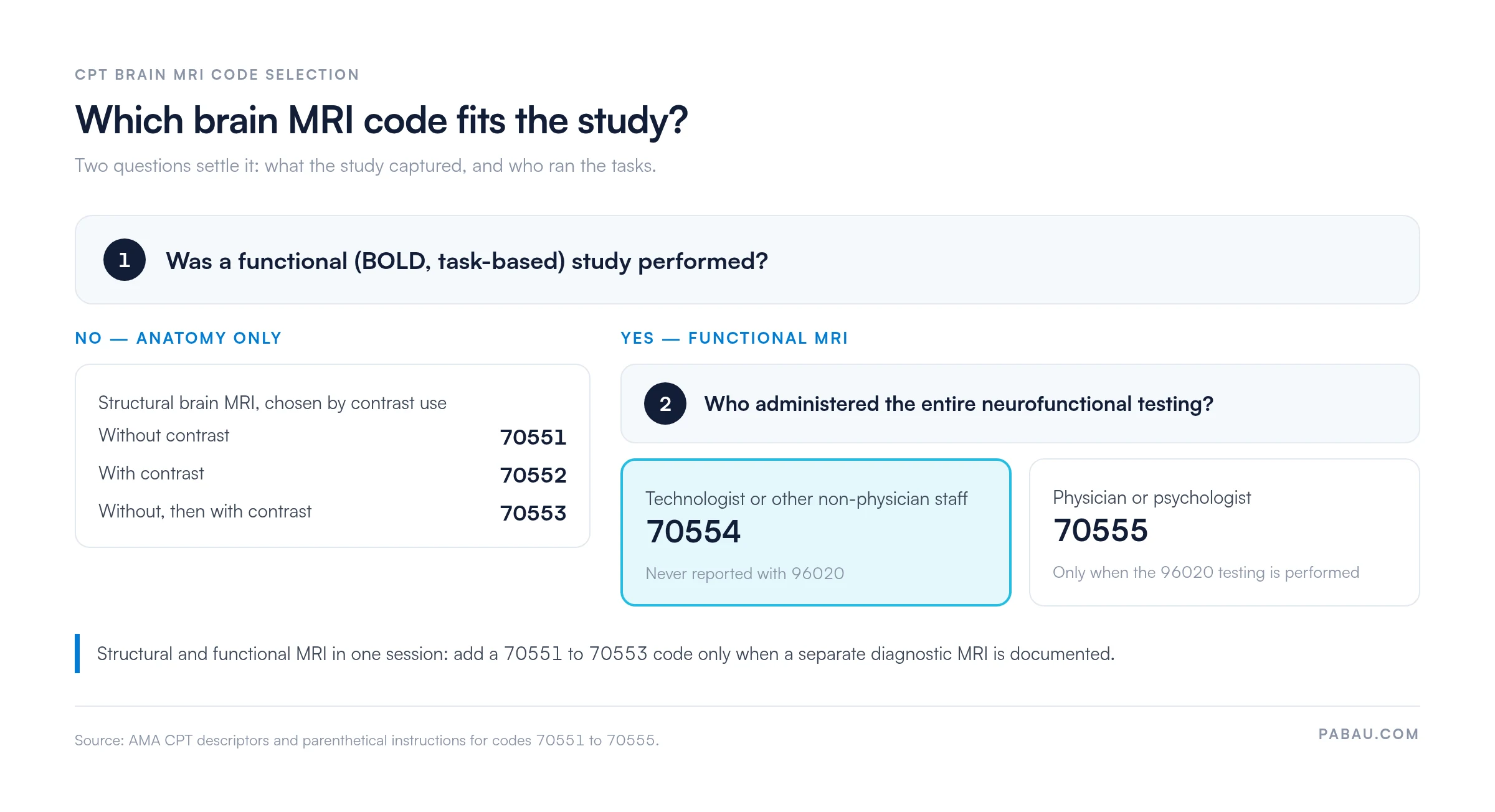
Functional MRI measures neural activity indirectly through the blood oxygen level-dependent (BOLD) signal. When neurons fire, local blood oxygenation rises. The scanner detects this change and generates activation maps showing which brain regions are active during specific motor, language, or visual tasks. Unlike structural MRI codes (70551, 70552, 70553), CPT Code 70554 captures a dynamic physiological process, not anatomy alone.
The 70554/70555 split rests on one question: who administered the neurofunctional testing during the scan. A technologist or other non-physician staff member means 70554. A physician or psychologist administering the entire testing means 70555. Get it wrong and the claim is either undercoded or denied.
A common billing mistake is using 70555 because a neuropsychologist reviewed the results. Reviewing the maps afterward does not meet the code’s administration requirement. CPT guidance pairs 70555 with 96020, the separately reported neurofunctional testing, and says not to report 70555 unless that testing is performed. It also says not to report 96020 with 70554.
The AAPC code range listing shows both codes side by side. Because the two descriptors cover the same study with different administration, report one of them per session, never both.
Structural brain MRI codes and CPT Code 70554 are frequently confused because they sit in the same code family. The dividing line is simple. Codes 70551-70553 capture anatomy, while 70554 captures function.
A radiologist may perform a structural brain MRI and a functional MRI in the same session. CPT says not to report 70554 or 70555 with 70551-70553 unless a separate diagnostic MRI is performed and documented.
Coders working the structural side can check the 70552 and 70553 guides for their contrast rules. The decision path below puts both questions in one place.
Medical necessity documentation is non-negotiable for CPT Code 70554. For Medicare, functional MRI falls under National Coverage Determination 220.2 for MRI, which covers presurgical fMRI mapping. MAC Local Coverage Determinations (LCDs) add local detail, and Medicaid and commercial plans set their own policies. An unsupported diagnosis is a frequent reason for denial.
Primary supported indications are pre-surgical cortical mapping scenarios. The surgical team needs to localize eloquent cortex before a procedure that carries a meaningful risk of deficit. The table below lists the ICD-10-CM codes most commonly paired with 70554. Verify each against NCD 220.2 and your MAC’s current LCD before billing.
Before submitting a claim for CPT Code 70554, check NCD 220.2 and pull the current LCD from your Medicare Administrative Contractor (MAC). LCDs for functional MRI vary by region and may restrict coverage to specific G40 or C71 subcodes. An unsupported ICD-10 code on line one of the claim is likely to be denied and is hard to overturn on appeal.
Thorough documentation decides whether a CPT Code 70554 claim pays on first submission or comes back. Each element below maps to a denial reason when it is missing.
Prior authorization requirements for CPT Code 70554 vary by payer, so treat each insurer as a separate workflow. Many commercial payers and Medicare Advantage plans require prior auth for functional MRI. Traditional Medicare does not require prior authorization for 70554. It does require documented medical necessity that meets NCD 220.2 and the applicable MAC LCD.
When submitting a prior authorization request for CPT Code 70554, payers that require one usually ask for:
Submit prior auth requests as early as possible in the surgical planning timeline. An fMRI ordered the week before surgery leaves no room to appeal a denial or request a peer-to-peer review. Build prior-auth confirmation into the scheduling workflow for every CPT Code 70554 study, following the same prior authorization process you use for other imaging.
Reimbursement for CPT Code 70554 under the Medicare Physician Fee Schedule (MPFS) is split across professional and technical components. The CMS Physician Fee Schedule lookup tool gives current locality-adjusted rates. The table below lists the billing scenarios and where each rate comes from, rather than dollar figures. Verify current-year rates with CMS before quoting reimbursement to clinical staff or patients.
Use FastRVU’s RVU lookup tool to check current Work, Practice Expense, and Malpractice RVU values for 70554 and calculate locality-adjusted rates. Practices that bill through the Claim.MD clearinghouse can check eligibility before the scan and match electronic remittance advice (ERA) payments to each claim. That makes it easy to compare what was paid against the expected rate.
Modifier selection for CPT Code 70554 depends on who bills which component and on what happened during the study. The wrong modifier, or a missing one, can underpay, overpay, or deny the claim.
Never split modifier 26 and TC across two claims when a single entity provides both components. Global billing removes the coordination risk and simplifies reconciliation. When modifier 52 applies, document which tasks the patient could not perform and why. Vague notes such as “patient uncooperative” do not survive audit.
Functional MRI claims combine narrow indications, detailed documentation, and frequent prior-auth checks, so each one has several ways to fail. The fixes below map to the usual denial categories. A strong denial management workflow catches most of them before submission. Our billers’ denial code guide explains what each remittance code asks you to fix.
Submitting a clean claim for CPT Code 70554 requires seven elements:
A missing element delays payment, and a functional MRI denial can close unpaid if the appeal window passes.
Review every CPT Code 70554 denial for the CARC (Claim Adjustment Reason Code) and RARC (Remittance Advice Remark Code) on the ERA. CARC 50 (not medically necessary) and CARC 96 (non-covered) have different appeal paths. A CARC 50 denial benefits from a peer-to-peer review request within the plan’s appeal window. CARC 96 often indicates a benefit exclusion requiring a different code or a patient-pay arrangement.
Many fMRI billing teams track prior auths in one place, claims in another, and remittances in a third. Each handoff is a chance to send a claim with a missing authorization or detail.
Pabau, the practice management platform we build, raises the claim from the patient’s invoice. It stores each insurer authorization as a case that follows the appointment. Its claims software for radiologists checks every claim for missing or invalid details before it leaves.
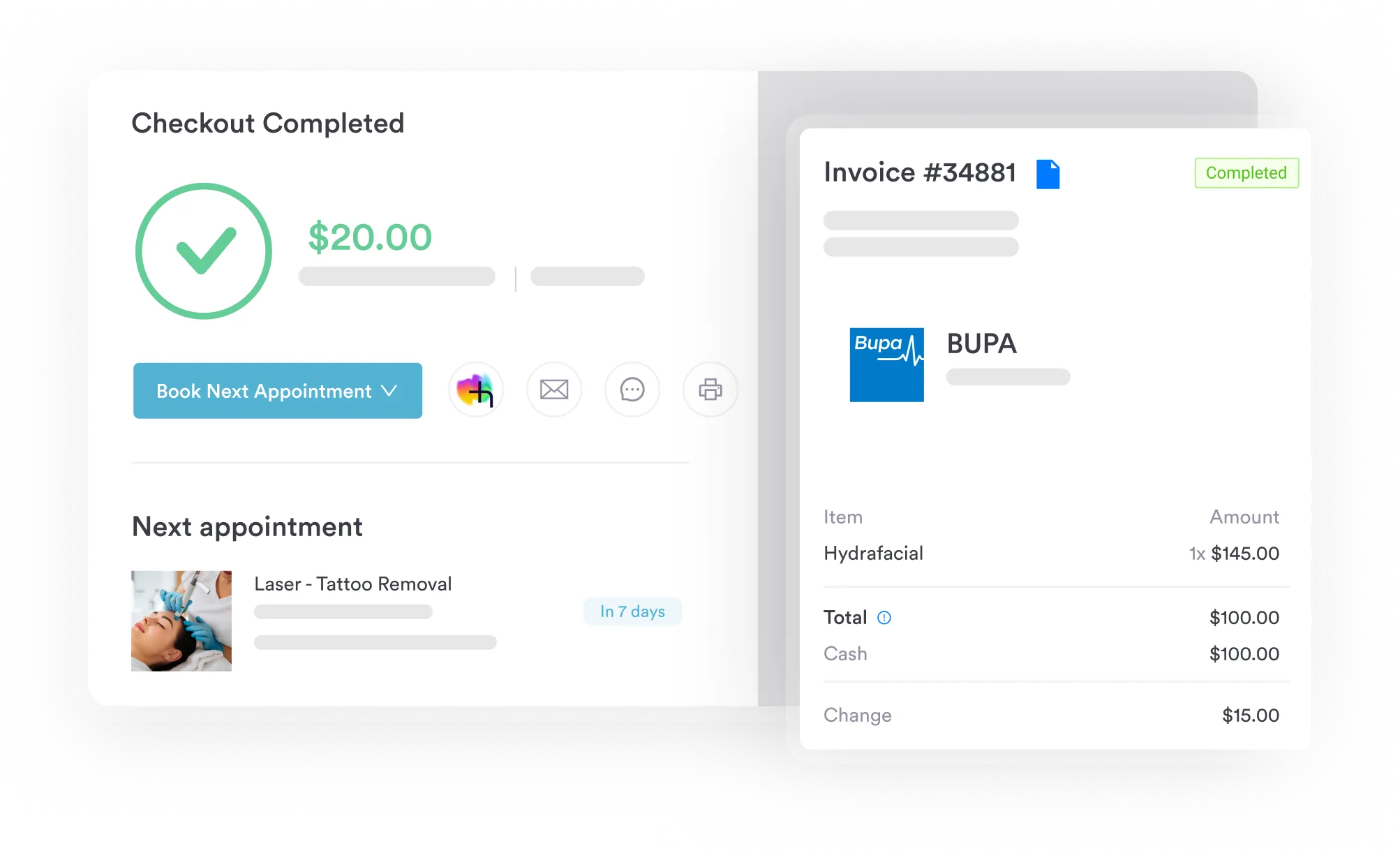
Through the Claim.MD integration, Pabau checks eligibility before the scan and submits CMS-1500 claims electronically. Payer status updates flow back to one dashboard, and ERA files settle payments against the claims they pay. Rejected claims are flagged “Needs action” with the reason shown, so your team fixes them while the appeal window is still open.

Pabau checks each 70554 claim for missing details, stores prior authorizations against the appointment, and tracks every claim through Claim.MD to payment.

Billing 70554 correctly comes down to two facts captured before the scan: that the study is functional, and who will run the tasks. Settle both on the order, and the code, the coverage check, and the modifier follow from them.
The trade-off is front-loaded effort. Building the prior auth, the indication, and the administration record into intake takes time on every study. Appealing a denied fMRI claim after surgery takes far longer, and some never pay.
Strong revenue cycle management keeps prior auth status, claims, and remittances in one view, so a missing authorization surfaces before submission. Book a demo to see how Pabau tracks your fMRI claims from authorization to payment.

Need to understand how claims move from submission to payment? Our Claim.MD clearinghouse guide walks through the end-to-end electronic claim lifecycle, including how remittances reconcile against expected reimbursement.
Struggling with repeated denials across your coding team? Medical billing compliance practices covers audit-readiness, documentation standards, and the internal controls that reduce denial rates across imaging codes.
Want to verify payer eligibility before the fMRI is scheduled? Insurance eligibility verification explains how eligibility checks catch coverage problems and prior-auth requirements before the patient arrives.
Sending a prior auth request for an fMRI? The medical prior authorization form gives you a ready-made request with the clinical fields payers ask for.
Chasing authorizations by phone and fax? Prior authorization software compares tools that track requests and approvals against scheduled studies.
CPT Code 70554 is the AMA code for functional MRI of the brain without physician or psychologist administration. It covers test selection and administration of repetitive body-part movement and visual stimulation tasks, usually run by a technologist. It is used mainly for pre-surgical cortical mapping in patients with epilepsy, brain tumors, or arteriovenous malformations.
The difference is who administers the testing. CPT 70554 covers functional MRI where a technologist or other non-physician staff member runs the tasks. CPT 70555 requires physician or psychologist administration of the entire neurofunctional testing and is reported only when 96020 is performed. Report one code per session, never both.
Medicare reimbursement for CPT 70554 is locality-adjusted and updated annually under the Medicare Physician Fee Schedule. Use the CMS MPFS lookup tool to find the current non-facility and facility rates for your locality. Global, professional-component (modifier 26), and technical-component (modifier TC) rates differ, so confirm which billing arrangement applies before submitting.
Traditional Medicare fee-for-service does not require prior authorization for CPT 70554, but many Medicare Advantage plans and commercial payers do. Requirements vary by plan and state, so verify with each payer before scheduling the study. A missing prior authorization is a frequent cause of functional MRI denials.
Commonly accepted ICD-10-CM codes for CPT 70554 include G40.x for epilepsy and C71.x for malignant brain neoplasms. D33.x covers benign brain tumors, and Q28.2 covers cerebral arteriovenous malformation. Medicare covers presurgical fMRI under National Coverage Determination 220.2, and MAC LCDs add local detail. Check both before billing, as accepted diagnoses vary by MAC.
The most frequent denial reasons for CPT Code 70554 are unsupported ICD-10 diagnosis codes and missing prior authorization. Incomplete documentation of the task paradigm or medical necessity is another common cause. Using a structural MRI code (70551-70553) for a functional study, or the reverse, also triggers denials. A pre-submission checklist covering all seven claim elements prevents most of them.



