HCPCS Code G0163: Skilled nursing observation and assessment
What is HCPCS Code G0163? HCPCS Code G0163 is a deleted Level II code for skille...

Last Updated: Oct 15, 2026
70552 is the CPT code for magnetic resonance (eg, proton) imaging, brain (including brain stem); with contrast material(s). It applies only when the brain MRI is performed with contrast and no pre-contrast sequences are acquired.
A study that starts without contrast and continues with it belongs under 70553. Most commercial payers require prior authorization for 70552, and the radiology report must state that the gadolinium agent was administered.
Let Pabau's smart automation suggest the right codes, reduce claim denials, and keep your practice compliant—effortlessly.
Automate repetitive tasks and focus on what matters most—your patients.
Reduce coding errors and ensure compliance with the latest regulations.
Clean claims, fewer denials, and faster reimbursements.
Powerful insights and reporting to help your practice thrive.
HIPAA compliant SOC 2 certified GDPR-compliant Trusted by 4,000+ clinics worldwide

CPT Code 70552 covers brain MRI with contrast material only, not a combined without-then-with contrast study (that is 70553).
Gadolinium contrast administration must be explicitly documented in the radiology report; missing this detail is the leading cause of medical necessity denials.
Medicare reimbursement for 70552 splits into professional component (modifier 26), technical component (modifier TC), and global billing depending on the practice setting.
Pabau’s claims management software integrates with Claim.MD to submit 70552 claims electronically, track eligibility, and flag denial patterns before they reach a payer.
CPT Code 70552 is the AMA-assigned code with the official descriptor: “Magnetic resonance (eg, proton) imaging, brain (including brain stem); with contrast material(s).”
The code sits in the Diagnostic Radiology section of the CPT code set. Its subsection is Diagnostic Radiology (Diagnostic Imaging) Procedures of the Head and Neck (70010-70559).
The key clinical scope is contrast-only. The study is ordered when the ordering physician needs contrast enhancement to evaluate abnormalities that may not appear on a non-enhanced scan.
Common indications include suspected intracranial tumors, CNS infection, active demyelinating disease such as multiple sclerosis, and post-operative assessment of surgical resection margins. When those margins follow resection of a supratentorial brain tumor other than a meningioma, the craniotomy is billed as 61510.
The three brain MRI codes describe three distinct contrast protocols. Selecting the wrong one is both a compliance risk and a denial trigger. Use this table as a quick reference before submitting any brain MRI claim.
Billing 70552 and 70553 together on the same date is a compliance violation. CMS National Correct Coding Initiative (NCCI) edits bundle these two codes. If both are submitted for the same patient on the same date, the claim will be rejected and may trigger a billing audit. When the combined protocol was performed, bill 70553 on its own.
Head CT follows the same three-tier pattern, with 70460 as the contrast-only study. Confirm the modality the physician ordered before picking a contrast tier.
The radiology report and imaging order must contain specific elements to support a 70552 claim. Missing even one of these is enough for a payer to issue a medical necessity denial or request a records audit.
Verify these elements at the point of scheduling rather than after the scan is complete. Many denials start with contrast documentation that sits in the nursing record and never reaches the final radiology report.
The diagnosis code on the claim must support the medical necessity for contrast-enhanced brain MRI. Payers reference their Local Coverage Determination (LCD) policies, published by Medicare Administrative Contractors (MACs), to determine whether a given ICD-10 code justifies 70552. Using a diagnosis code outside a payer’s LCD-approved list will result in denial regardless of clinical appropriateness.
For acute presentations such as intracranial hemorrhage, verify MAC-specific LCD coverage before submitting 70552. Some MACs limit contrast-only studies to established diagnoses and require the combined protocol for new lesion evaluation. Confirm the diagnosis against the ICD-10-CM code library before the claim goes out.
Modifier selection for CPT Code 70552 depends entirely on the billing setting and who owns the equipment. Getting this wrong in either direction creates compliance exposure.
Common error: Appending modifier 26 when billing globally from a free-standing center reduces reimbursement to the professional-component rate only. Verify the billing setting before selecting a modifier on every 70552 claim.
Audit your 70552 modifier usage quarterly. Pull all 70552 claims from the past 90 days and check whether modifier 26 or TC was applied correctly relative to your facility type. Free-standing imaging centers billing with modifier 26 will collect roughly 65-70% less per claim than the global rate they are entitled to.
Prior authorization for CPT Code 70552 is required by many commercial payers, though requirements vary by plan and change annually. Medicare does not require prior authorization for 70552 under traditional fee-for-service, but Medicare Advantage plans operate under separate rules set by each plan sponsor. Medicaid authorization requirements vary by state.
Emergent and urgent cases: Some conditions make pre-authorization impossible, such as suspected acute CNS infection. Document the urgency in the medical record and notify the payer within the required window, commonly 24-48 hours. Most payers allow retrospective authorization for emergent studies, but missing the notification window often results in denial.
Tracking authorization status across several payers takes a standing workflow rather than a memory. A missed auth number is one of the top five denial reasons for 70552, and verification at booking prevents it.
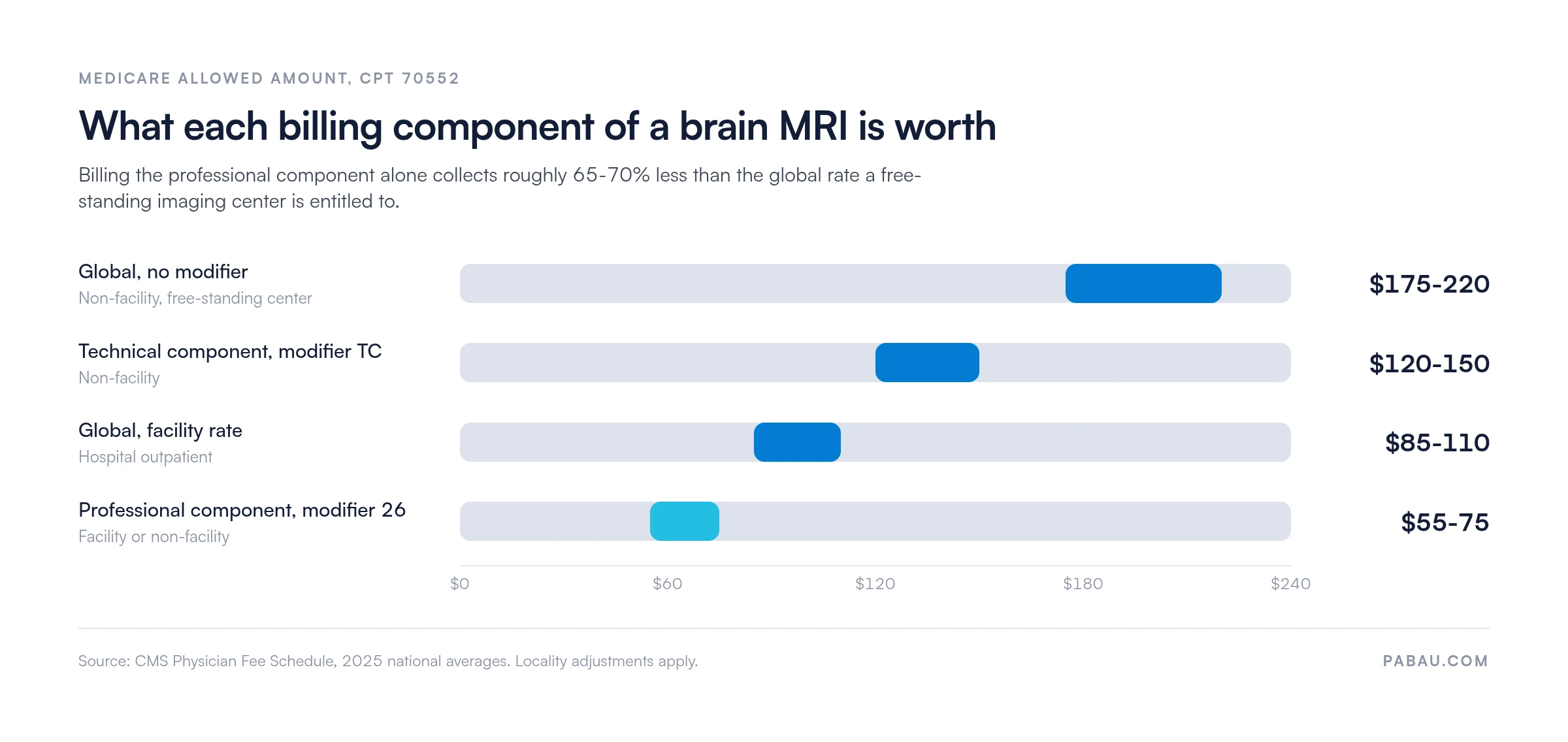
Medicare payment for CPT Code 70552 is published annually in the CMS Physician Fee Schedule. Rates split by professional component (modifier 26), technical component (modifier TC), and the global amount. They also vary between facility and non-facility settings.
The figures below are national averages, so actual payment depends on your geographic locality adjustment. Verify current rates using the CMS fee schedule lookup or the FastRVU 2026 lookup tool.
Rate approximations above are for orientation only. CMS updates PFS rates annually, and locality adjustments can shift payment by 20% or more between high-cost urban markets and rural areas. Always pull the current allowed amount from the CMS fee schedule lookup tool before setting your charge master figures.
Plotted side by side, the four components show how little of the allowed amount the interpretation carries on its own.
Practices that submit 70552 claims electronically get real-time eligibility verification and an ERA, the electronic remittance advice. The ERA maps the payment received against the expected allowed amount, so fee schedule variance is easy to spot and correct.
Denials on CPT Code 70552 cluster around a predictable set of causes. Front-end controls built into the scheduling and authorization workflow prevent each of them.
A structured denial workflow assigns each 70552 denial a reason code, tracks root cause, and reports trends monthly. Practices without a formal denial review repeat the same error across hundreds of claims before anyone spots the pattern.
CPT Code 70552 carries a 0-day global period under the CMS Physician Fee Schedule. In practical terms, this means the code has no post-service package: the radiologist’s professional component (the interpretation) is the entire professional service.
There are no follow-up visits, no management services, and no additional professional billing rights attached to reading a brain MRI with contrast.
This matters in two billing situations that trip up practices regularly.
The 0-day global period also leaves the ordering physician free to bill an evaluation and management service on the same date as 70552. The E/M visit has to be separately documented. The imaging interpretation and the physician visit are distinct services, so both belong on the superbill with their own CPT codes and documentation references.
Check your 70552 claims for split-billing errors at month-end. Run a report of all 70552 claims submitted with modifier 26 and cross-reference against the facility’s TC claims for the same dates and patients. Where only a modifier 26 was billed and no TC claim exists from the facility, you may have left global billing on the table.
Most imaging practices keep the scan order, the authorization number and the claim in three separate systems. That is how an auth number goes missing from a 70552 claim. Pabau, practice management software for healthcare practices, holds all three against one patient record.
Claims go out electronically through Claim.MD, Pabau’s US clearinghouse partner, which validates CPT and ICD-10 codes before transmission. The clearinghouse returns electronic remittance advice that posts payment against the original claim. That closed loop is what cleaner claims management depends on for a high-volume code like 70552.
For 70552 specifically, the workflow covers the three failure points that cost imaging practices the most.
Pabau’s revenue reporting tracks 70552 denial rates by reason code, payer, and modifier applied. That breakdown shows whether a recurring denial is a documentation problem, a modifier problem, or a payer-specific LCD issue.

Pabau’s claims management software integrates with Claim.MD to submit brain MRI claims electronically and verify eligibility in real time. It also flags denial patterns before they reach a payer. See how it works for imaging practices.

Whether a 70552 claim survives comes down to two records. The first is the radiology report proving the gadolinium agent was given. The second is the authorization on file before the scan date. Code the study as 70552 only when no pre-contrast sequences were acquired.
Audit modifier usage against your facility type each quarter. On this code the difference between global and professional-only billing is most of the payment, so a mismatch is expensive long before anyone notices it.
Pabau’s billing tools connect eligibility verification, claim submission and denial tracking in one place, so your team spends less time chasing paperwork. Book a demo to see how Pabau handles radiology billing for imaging practices.

Need a structured approach to claim denials? Denial management in healthcare walks through root-cause analysis and appeal workflows for common CPT billing denials.
Want to understand the clearinghouse submission process? 837 electronic claim file guide explains how HIPAA-standard 837P files carry your CPT codes to payers through the clearinghouse.
Want fewer rejections before they reach a payer? Clean claim submission guide sets out the front-end checks that keep a radiology claim from bouncing back.
Checking your documentation against payer rules? Medical billing compliance covers the records an auditor asks for and how long to keep them.
Tracking revenue from order to payment? What is revenue cycle management explains where imaging revenue leaks between the scan and the remittance.
CPT Code 70552 is the AMA-assigned billing code for magnetic resonance imaging of the brain performed with contrast material only. It covers post-contrast sequences acquired with a gadolinium-based agent. Order it when contrast enhancement is needed to evaluate tumors, CNS infection, demyelinating disease, or post-surgical changes.
70551 is brain MRI without contrast. 70552 is brain MRI with contrast only, a single-phase post-contrast study. 70553 adds pre-contrast sequences before the contrast run. The key distinction is whether pre-contrast sequences were acquired: if they were, the correct code is 70553, not 70552.
Medicare reimbursement for CPT Code 70552 varies by setting and component. The global rate at a non-facility site is approximately $175-$220. The professional component alone (modifier 26) runs about $55-$75, and the facility rate about $85-$110. Verify current rates at the CMS Physician Fee Schedule lookup as rates are updated annually and vary by geographic locality.
Prior authorization for CPT Code 70552 is required by many commercial payers and most Medicare Advantage plans, but not by traditional Medicare fee-for-service. Requirements vary by payer, plan year, and state. Always verify authorization requirements in the payer’s provider portal before scheduling the study.
No. Billing both CPT Code 70552 and 70553 for the same patient on the same date of service violates CMS NCCI edit rules. The codes are bundled, and submitting both will result in an automatic denial and may trigger a billing audit. If a combined protocol was performed, bill 70553 only.
Commonly paired ICD-10 codes include C71.9 (malignant brain neoplasm), G35 (multiple sclerosis) and G40.909 (unspecified epilepsy). Others are G00.9 (bacterial meningitis), I63.9 (cerebral infarction) and Z85.841 (personal history of brain malignancy). The diagnosis code must align with your MAC’s Local Coverage Determination (LCD) to support medical necessity for the contrast-enhanced study.