HCPCS Code E1130: Fixed-arm standard wheelchair billing
HCPCS Code E1130: Descriptor and code details HCPCS Code E1130 is a standard whe...

Last Updated: Oct 7, 2026
70360 is the CPT code for a radiologic examination of the neck, soft tissue. It is a plain-film study of the soft tissue of the neck, with no contrast, fluoroscopy, or cross-sectional imaging, and the code is not view-specific.
Coders most often confuse it with 70370, which covers the pharynx or larynx, including fluoroscopy and/or magnification technique. A swallowing-function study is a separate code again, 74230.
Let Pabau's smart automation suggest the right codes, reduce claim denials, and keep your practice compliant—effortlessly.
Automate repetitive tasks and focus on what matters most—your patients.
Reduce coding errors and ensure compliance with the latest regulations.
Clean claims, fewer denials, and faster reimbursements.
Powerful insights and reporting to help your practice thrive.
HIPAA compliant SOC 2 certified GDPR-compliant Trusted by 4,000+ clinics worldwide

CPT code 70360 covers a plain-film radiograph of the soft tissue of the neck, with no contrast, fluoroscopy, CT, or MRI.
Modifier 26 (professional component) or TC (technical component) is required whenever billing is split between the radiologist and the facility.
Medical necessity must be supported by a paired ICD-10 code, and an unsupported diagnosis is the leading denial reason for this code.
Pabau, the practice management platform we build, handles submission and tracking of claims through Claim.MD from the codes your team enters.
CPT code 70360 is defined by the American Medical Association (AMA) as “Radiologic examination; neck, soft tissue.” It sits in the Head and Neck subsection (70010-70559) of Diagnostic Radiology. In short, the code covers a plain-film study of the soft tissue of the neck without view restriction. It also includes no intravenous contrast, no fluoroscopic guidance, and no cross-sectional imaging.
Knowing where this code stops prevents a common billing mistake. For instance, a team orders a neck CT or MRI, then defaults to 70360 because it is the familiar neck-imaging line on the superbill. Both CT and MRI carry their own CPT codes, so each needs separate support.
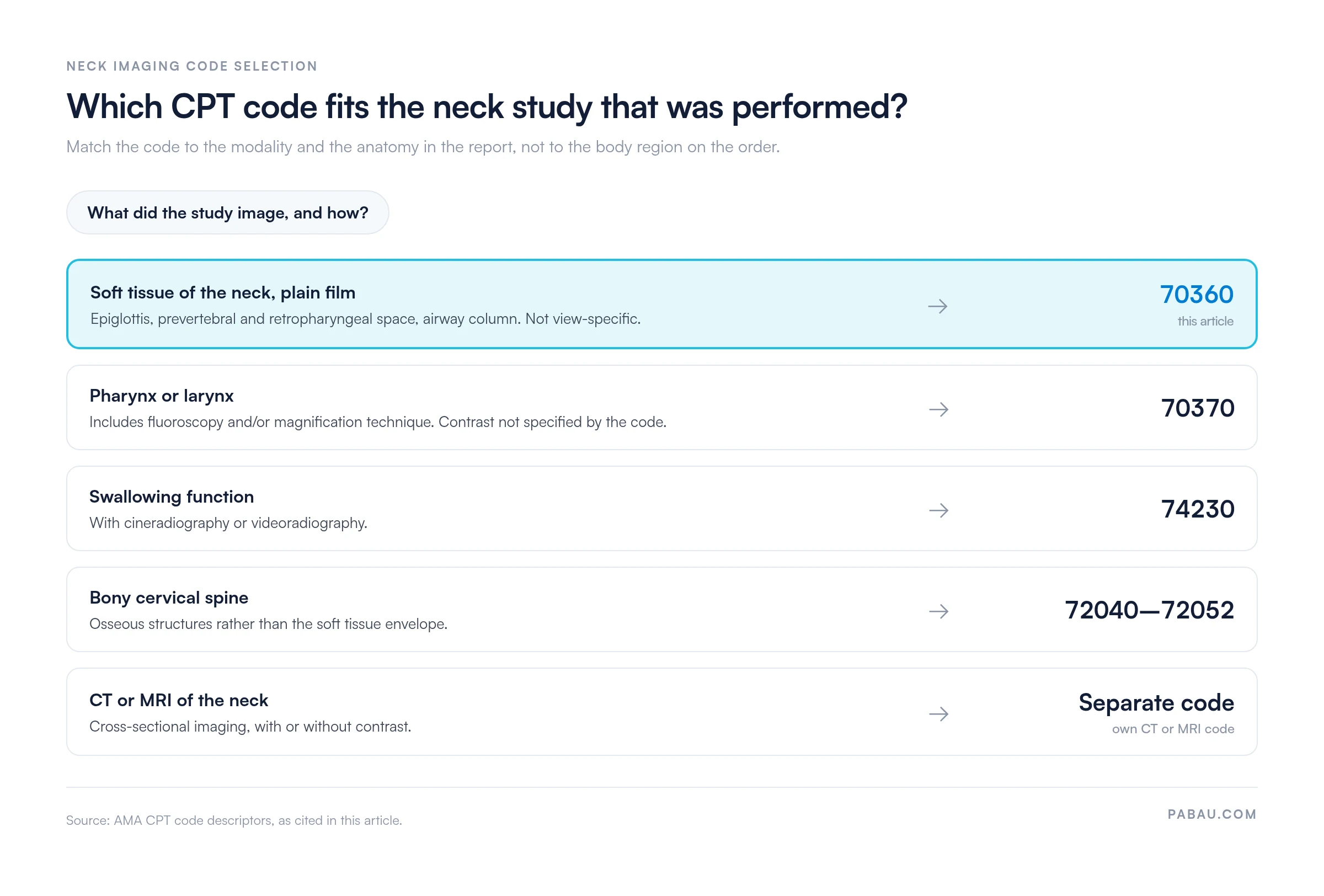
CPT code 70360 fits plain-film evaluation of the soft tissue structures of the neck. The scope includes the epiglottis, prevertebral space, retropharyngeal space, and the air column of the airway. Typically, clinicians order it when foreign body ingestion, epiglottitis, croup, or retropharyngeal swelling is suspected. In practice, it works as a quick, low-cost screen before advanced imaging.
However, a swallowing-function study needs a different code. It is billed with 74230, which covers swallowing function with cineradiography or videoradiography. Likewise, a pharynx or larynx study that uses fluoroscopy and/or magnification technique is 70370 instead. Finally, films of the bony cervical spine belong to the 72040 series.
For example, sending 70360 for a fluoroscopic study causes a type mismatch that payers flag at once. Therefore, the panel below maps each neck study to its code.
CPT 70370 covers a radiologic examination of the pharynx or larynx, including fluoroscopy and/or magnification technique. In contrast, CPT 70360 is a plain film of the neck soft tissue. The two codes describe different imaging events, yet coders often confuse them in neck radiology billing.
CPT 70360 and 70370 cannot be billed for the same encounter without clear documentation that two distinct procedures were performed. Likewise, filing both on the same date for the same body region will trigger a bundling edit from most payers.
Radiology billing needs two layers of paperwork. The first is the ordering provider’s clinical notes, and the second is the radiologist’s formal report. Both must be present before the claim is filed, because payers deny for medical necessity in audits when either one is missing.
Claims management software with a documentation checklist built into the workflow flags a missing report at intake rather than at remittance.
Independent Diagnostic Testing Facilities (IDTFs) in Palmetto GBA’s jurisdiction follow Palmetto GBA Local Coverage Article A58559 (IDTF billing and coding) when billing CPT code 70360. The article also addresses supervision, equipment standards, and personnel qualifications for outpatient diagnostic imaging. Other MACs publish their own IDTF articles, so check the one that covers your jurisdiction.
First, the interpreting physician must meet IDTF enrollment rules. Second, the facility must also keep records of the supervising physician’s credentials available for audit. As a result, failing these rules is a denial category separate from medical-necessity issues.
Flag every CPT code 70360 claim for a two-source documentation check before submission. Confirm that the ordering provider’s clinical indication note and the radiologist’s signed interpretation report are both attached. A missing interpretation is the fastest path to a technical denial that takes 30+ days to appeal.
Payers validate CPT code 70360 claims against the accompanying ICD-10-CM diagnosis code. In fact, an unsupported diagnosis is the single most common denial reason for this code. For reference, the table below lists commonly accepted pairings. Always check them against your MAC’s current Local Coverage Determination (LCD) before billing, because covered diagnoses vary by region.
Finally, use the CrossCoder CPT-to-ICD-10 crosswalk tool to check that your chosen diagnosis code maps to CPT code 70360 before filing. Codes marked “claim-at-risk” above are not always denied, but they need more robust clinical documentation to survive a payer audit.
Modifier selection for CPT code 70360 depends on how the professional and technical components are billed. For example, one entity can bill them globally, or a radiologist and a facility can split them. Getting this wrong therefore generates duplicate-billing edits or underpayment. In addition, building modifier rules into superbill preparation catches the split-billing scenario before the claim leaves the practice.
For hospital-based radiology departments, the facility typically bills TC and the radiologist group bills Modifier 26. In contrast, freestanding radiology practices often bill the global service (no modifier) when the practice owns the equipment and employs the interpreting radiologist. Also, do not append both Modifier 26 and TC to the same claim line, because the pair creates conflicting component edits.
Medicare pays for CPT code 70360 under the Medicare Physician Fee Schedule (MPFS) when a covered ICD-10 diagnosis supports medical necessity. However, payment amounts vary by location through the location adjustment factors built into the MPFS. The work RVU below comes from the CY2026 MPFS. Therefore, check payment amounts with the CMS Physician Fee Schedule lookup tool before using them for budget planning.
Because 70360 is a low-complexity plain film, its total RVU is modest. Practices should use the FastRVU lookup tool to pull the current work, practice expense, and malpractice RVU components. Then apply your locality’s conversion factor for an accurate payment estimate.
Meanwhile, Medicaid payment varies widely by state, and state Medicaid fee schedules differ from the MPFS national rate. For that reason, check your state Medicaid agency’s published fee schedule annually. Moreover, states update rates on their own cycle, which may not align with the federal October 1 ICD-10 and January 1 MPFS update calendars.
IDTFs billing CPT code 70360 in Palmetto GBA’s jurisdiction must also follow the payment rules in Palmetto GBA Local Coverage Article A58559. In addition, IDTFs are paid at the non-facility rate, and the interpreting physician must be enrolled in Medicare and meet the IDTF credential rules.
Traditional Medicare fee-for-service does not require prior authorization for CPT code 70360. However, Medicare Advantage plans and commercial payers set their own prior-authorization rules for outpatient radiology, and policies differ plan by plan and year by year. In fact, assuming Medicare Advantage mirrors traditional Medicare coverage is a common error.
Documenting medical necessity in the ordering note, before the imaging is performed, is the most reliable way to reduce prior-authorization friction with any payer. Maintaining radiology billing compliance records also gives you audit-ready evidence when a payer challenges necessity after the fact.
CPT code 70360 denials cluster around six failure categories. Fortunately, most are avoidable with workflow changes at order entry rather than at the billing stage. In turn, applying denial management workflows reduces rework and shortens days in AR for radiology claims.
In short, filing a clean claim from the outset is faster and less costly than an appeal cycle. After each remittance, match the reason codes against the denial codes reference and the list above. Then address the failure category that generates the most volume first.
Run a monthly audit of every 70360 denial reason code in your ERA data. If more than 10% of denials cite the same reason code, the cause sits in the workflow. Fix that root cause, whether it is a wrong ICD-10 pairing, a missing modifier, or lapsed credentialing, instead of appealing claim by claim.
Many radiology teams assemble a 70360 claim from separate places. For example, the order sits in one system, the signed report in another, and the claim status in a clearinghouse portal.
Instead, Pabau keeps the order note, the radiologist’s report, and the billing record on the same patient file. Your team enters the CPT code, modifier, and diagnosis. Pabau then submits the claim through Claim.MD and tracks its status.
With the report and the claim on one record, staff can confirm the interpretation is signed before filing. They can also follow each 70360 claim until the payer responds, instead of checking a separate portal.

Pabau keeps the order, the signed report, and the claim on one patient record, then submits and tracks claims through Claim.MD.

CPT code 70360 is a straightforward plain-film code, and denials are more likely when modifier rules, ICD-10 pairings, and IDTF rules are treated as afterthoughts. Therefore, the fix starts at the point of order, where the clinical indication gets written down.
Before your next 70360 claim goes out, check three items: the signed interpretation, the split-billing modifier, and a diagnosis your MAC accepts. If one is missing, hold the claim, because a corrected filing costs less than an appeal.
Pabau handles filing and tracking of claims through Claim.MD, so your team can see where each 70360 claim stands. Book a demo to see how it fits a radiology billing workflow.

Need to understand how your clearinghouse processes radiology claims? Medical claims clearinghouse guide explains how electronic claims move from practice to payer and where errors are caught.
Looking for guidance on denial codes that appear on your remittance? Denial codes in medical billing covers the most common CARC reason codes and how to respond to each.
Want to verify eligibility before the patient arrives? Insurance eligibility verification outlines how eligibility checks reduce prior-auth surprises and improve clean-claim rates.
Submitting claims through Claim.MD? Claim.MD clearinghouse guide walks through how the clearinghouse handles submission, tracking, and remittance.
CPT code 70360 covers a plain-film radiograph of the soft tissue of the neck, without contrast or fluoroscopy. It evaluates structures including the epiglottis, prevertebral space, retropharyngeal space, and the cervical airway column. It does not include CT, MRI, or any fluoroscopic study of the neck.
CPT 70360 is a static plain X-ray of the neck soft tissue. CPT 70370 covers the pharynx or larynx, including fluoroscopy and/or magnification technique, and contrast is not part of its descriptor. A swallowing-function study is billed with 74230 instead. Submitting 70360 for a fluoroscopic study will result in a modality-mismatch denial.
Yes, traditional Medicare Part B covers CPT code 70360 when a supported ICD-10-CM diagnosis code establishes medical necessity. Medicare Advantage plans may add prior-authorization requirements that traditional Medicare does not impose. Verify with the specific plan before scheduling.
Commonly accepted ICD-10-CM pairings include J05.0 (croup), J05.10 (epiglottitis), J39.0 (retropharyngeal abscess), R22.1 (neck mass), and T17.200A (foreign body in pharynx). Diagnoses like R13.10 (dysphagia, unspecified) carry higher denial risk without robust clinical documentation. Always verify against your MAC’s current local coverage determination.