CPT code 19281: Breast localization billing and coding guide
CPT code 19281: Official descriptor and procedure overview CPT code 19281 report...

Last Updated: Oct 7, 2026

CPT code 72040 covers a radiologic examination of the cervical spine with 2 or 3 views, not 4 or more.
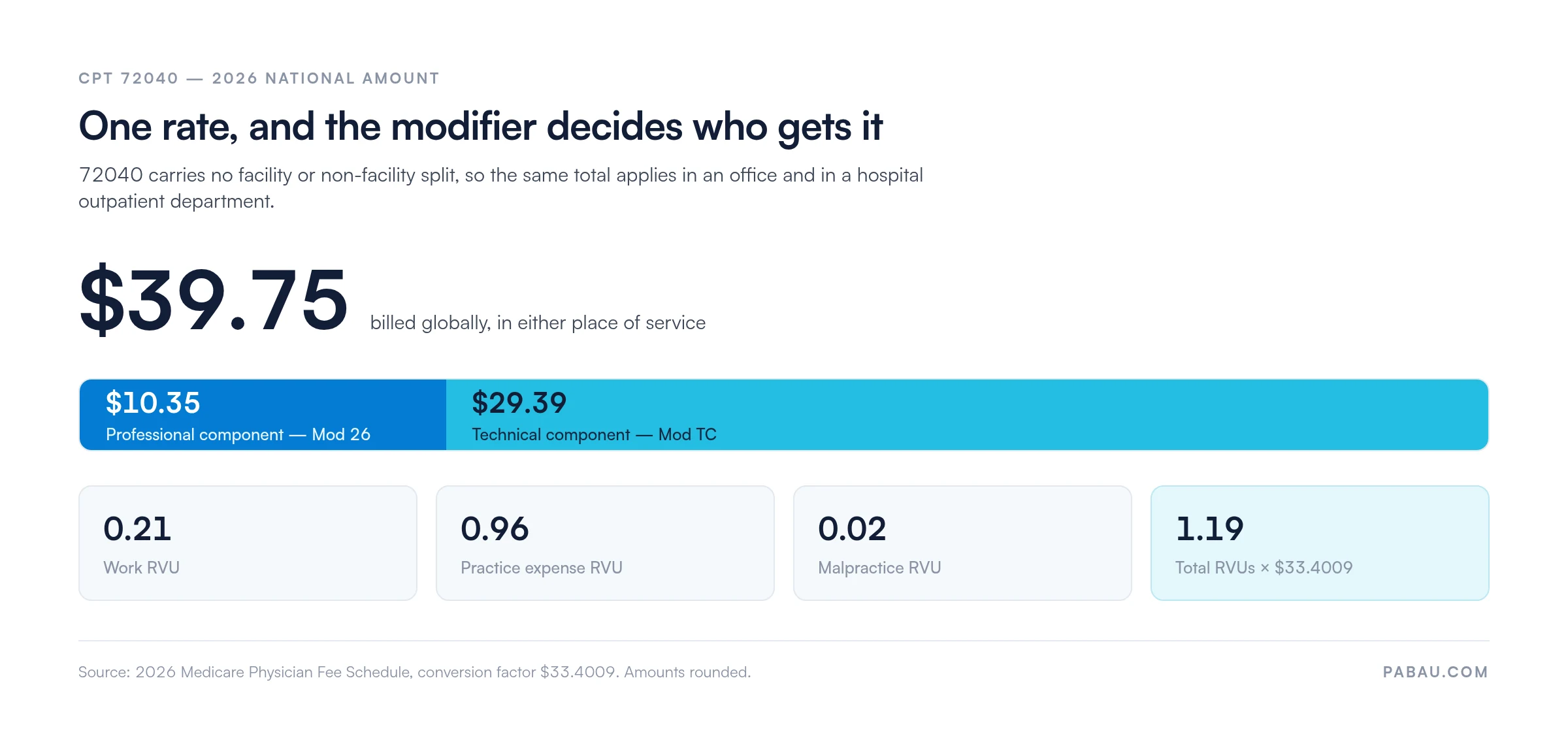
Medicare pays about $39.75 for 72040 in 2026, and the amount is the same in an office and in a facility.
There is no facility and non-facility payment split on this code, so a rate surprise usually points at a modifier.
The technical component (Mod TC) carries about $29.39 of that payment, and the professional component (Mod 26) about $10.35.
72040 cannot be billed on the same day as 72050 or 72052, because NCCI edits bundle the smaller view counts into the larger.
CPT code 72040 is the billable code for a radiologic examination of the cervical spine with 2 or 3 views. Indeed, view count is the only thing that separates it from 72050 and 72052, and that one detail is where most cervical spine claims go wrong.
This guide covers the 2026 Medicare payment for 72040 and the modifiers that divide it. In addition, it covers the NCCI bundling edits, the ICD-10 codes payers accept, and the documentation an auditor will ask for.
CPT code 72040 describes a radiologic examination of the cervical spine with 2 or 3 views. Specifically, per the American Medical Association’s CPT code set, the full descriptor is: Radiologic examination, spine, cervical; 2 or 3 views. The code sits within the Diagnostic Radiology section (70010-79999) and, moreover, applies to plain-film X-ray only, not CT, MRI, or fluoroscopy.
Two or three views are the defining criterion. A single view does not meet the threshold for 72040, while four or more views trigger a different code (72050 or 72052). Consequently, practices that bill 72040 when only one image was captured face both denial risk and audit exposure for overcoding.
Medical necessity is the gating requirement for any payer to reimburse CPT code 72040. Therefore, confirm coverage and any prior-authorization requirement the patient’s plan imposes before the images are taken.
Commonly accepted indications for a 2-3-view cervical spine X-ray include:
Payer policies differ. For instance, Medicare and most commercial insurers accept the indications above, but some managed care plans require documentation that conservative treatment failed before they approve imaging. As a result, orthopedic and physical therapy practices ordering follow-up cervical X-rays should check that the clinical note states the change in status that justifies repeat imaging.
Missing or vague documentation is the leading cause of 72040 denials on post-payment audit. Accordingly, every 72040 claim requires the following elements:
A charge slip that pre-populates the view count and links the procedure code to the diagnosis code reduces transcription errors at the front desk. Even so, the radiology report is the primary audit document. For example, if the report says “AP and lateral views obtained” but the code billed is 72050, the claim is indefensible.
Medicare pays about $39.75 for CPT code 72040 in 2026, and that amount does not change with the place of service. Because the code carries no separate facility and non-facility practice expense value, an office and a hospital outpatient department are paid the same. Specifically, the figure comes from 1.19 total RVUs multiplied by the 2026 conversion factor of $33.4009. What does move, however, is the split between the two components, and the technical side takes roughly three quarters of it.
Geographic adjustment: MAC jurisdictions apply Geographic Practice Cost Indices (GPCIs) that can move the amount 15-25% above or below the national figure. As a result, a practice in Manhattan will be paid more than one in rural Mississippi. Therefore, verify the locality-adjusted number with the CMS MPFS lookup tool for your jurisdiction before you set a fee schedule.
Audit your 72040 payments each quarter against the locality-adjusted CMS amount for your MAC. Because the code pays the same in both settings, a variance rarely comes from the place-of-service field. Instead, it usually means Mod 26 or Mod TC was appended to a claim the practice billed globally. Alternatively, it can also mean the modifier was left off a claim that needed one.
Modifier usage on CPT code 72040 is a top audit trigger. Each modifier changes which share of the $39.75 the payer sends, and, in turn, it signals which part of the service is being billed. Consequently, applying one incorrectly can produce a denial, an overpayment demand, or both.
Modifier 59 caution: CMS introduced the X-modifiers (XE, XS, XP, XU) as more specific alternatives to Modifier 59. In some cases, MACs require an X-modifier in place of 59 when two services on the same date need separating. Therefore, confirm your MAC’s policy before defaulting to Modifier 59 on 72040 claims.
Separate your 72040 professional component (Mod 26) and technical component (Mod TC) claims into distinct charge entry workflows. Otherwise, billing staff who handle both components in a single line-item entry routinely apply the wrong modifier, because the system default assumes a global billing model. As a result, a workflow split prevents this error at the source.
The National Correct Coding Initiative (NCCI) publishes edit pairs that prevent double-billing for services already included in a more comprehensive code. Accordingly, CPT 72040 has established bundling edits with several related spine imaging codes.
NCCI edits are updated quarterly, so a pair that is bundled today may change. Therefore, practices billing high volumes of spine imaging should read each quarterly release on the CMS NCCI edits page. Accordingly, refresh your edit tables before the effective date.
View count is the only factor that separates these three cervical spine codes. As a result, choosing the wrong one from incomplete documentation is among the most frequent coding errors in outpatient radiology.
Critical rule: If a technologist captures an AP, lateral, and odontoid view, 72040 is correct. However, if the ordering physician then requests a flexion view in the same session, bringing the total to four, the claim moves to 72050. In other words, the code reflects the total views captured in one imaging session, not the number originally ordered.
The diagnosis code linked to a 72040 claim has to justify the imaging. Accordingly, payer LCD (Local Coverage Determination) policies list the ICD-10 codes they accept for cervical spine X-rays. The codes below, specifically, are the ones most often paired with 72040.
Cervicalgia is the most frequent pairing on a 72040 claim, and M54.2 carries its own documentation expectations that decide whether the imaging is covered.
Verify ICD-10 code validity annually, because the ICD-10-CM tabular list updates every October 1. Codes retired in prior years, meanwhile, stay in some billing software until the database is refreshed, and a deleted code triggers an automatic denial. Therefore, check active status in the CDC/NCHS ICD-10-CM web tool before each new code year.
Most 72040 denials are preventable at the point of charge entry rather than in the appeal. Accordingly, reviewing the denial codes that recur on radiology claims is a fast way to build a targeted prevention checklist.
Cervical spine imaging is one part of a broader musculoskeletal radiology code family. The table below is a quick reference for the codes most often billed alongside or instead of CPT code 72040.
Radiology and orthopedic teams billing high volumes of 72040 lose time re-keying the same claim data into a separate billing system. Meanwhile, a claim that leaves the practice missing a membership number or an authorization code comes back unpaid, and, ultimately, the rework costs more than the code pays.
Pabau is practice management software that holds the imaging order, the report, and the charge in one patient record. As a result, the biller stops reconciling two systems. In addition, its tools for faster claims management check each claim for the required fields before it is sent, so a missing authorization code is caught inside the practice instead of by the payer.
Submission runs through Claim.MD, our clearinghouse integration, which supports 837P files to thousands of US payers and returns electronic remittance advice automatically. From there, reporting surfaces denial patterns by code, payer, and provider, so a run of 72040 Modifier 26 denials from one MAC shows up before it compounds into a revenue problem.


Pabau checks every claim for the fields payers reject it for, then routes 837P files through the Claim.MD clearinghouse to thousands of US payers. See how radiology billing teams use Pabau to cut rework and get paid sooner.

Three checks settle most 72040 claims before they leave the practice. First, the view count in the radiology report has to match the code billed. Second, the diagnosis code has to justify the imaging. Finally, 72050 or 72052 must not already cover the same session.
The payment is steadier than the coding. Because 72040 pays the same in an office and a facility, a rate surprise almost always traces to a modifier rather than a place-of-service field. Therefore, that makes the Mod 26 and Mod TC split the number worth watching in your monthly remittance review.
Book a demo to see how Pabau keeps imaging orders, reports, and charges in one record so radiology claims go out complete.

Need to understand how clearinghouse submissions work? Our medical claims clearinghouse guide explains how 837P files move from your practice to payers and back.
Want to reduce claim denials before they happen? Our denial management guide covers root-cause analysis and prevention workflows for high-volume radiology billing.
Billing insurance for the first time? Our credentialing guide walks through the provider enrollment steps required before payers will accept your claims.
CPT code 72040 covers a radiologic examination of the cervical spine with 2 or 3 views. Specifically, it is a plain-film X-ray code only and does not apply to CT, MRI, or fluoroscopy of the neck. Therefore, the code requires that the radiology report confirm exactly how many views were obtained.
Medicare pays about $39.75 nationally for CPT code 72040 in 2026, and the amount is the same in an office and in a facility. Indeed, the code has no facility and non-facility payment split. Specifically, that figure is 1.19 total RVUs times the 2026 conversion factor of $33.4009, before geographic adjustment.
No. NCCI bundling edits prevent billing 72040 and 72050 together on the same date of service for the same patient. Instead, if 4 or more views are obtained in a single imaging session, bill only 72050. Otherwise, submitting both codes triggers an automatic denial regardless of Modifier 59.
The primary modifiers are 26, TC, and 59. Specifically, Modifier 26 covers the interpretation and report when a radiologist bills separately, while Modifier TC covers the equipment and technologist costs. Modifier 59, meanwhile, marks a distinct procedural service and needs clear documentation. By contrast, LT and RT modifiers do not apply because the cervical spine is a midline structure.
Required documentation includes a physician order specifying cervical spine imaging and a clinical indication linked to a valid ICD-10 code. In addition, you need a signed radiology report confirming how many views were obtained, plus the place of service. Consequently, missing any of these elements is a common trigger for medical necessity denials.