CPT code 49321: Laparoscopy with biopsy billing guide
What is CPT code 49321? CPT code 49321 is the surgical laparoscopy code for a bi...

Last Updated: Oct 7, 2026
E1130 is the HCPCS Level II code for a standard wheelchair with fixed full-length arms and fixed or swing-away detachable footrests. It sits in the E1130-E1161 standard wheelchair range and has no seat-width or weight-capacity criteria.
Medicare does not pay E1130. The CMS HCPCS file gives it coverage code I and crosswalks it to K0001, so a Medicare claim for this chair is billed as K0001. Medicaid programs and commercial plans that still recognize E1130 set their own coverage and pricing.
Let Pabau's smart automation suggest the right codes, reduce claim denials, and keep your practice compliant—effortlessly.
Automate repetitive tasks and focus on what matters most—your patients.
Reduce coding errors and ensure compliance with the latest regulations.
Clean claims, fewer denials, and faster reimbursements.
Powerful insights and reporting to help your practice thrive.
HIPAA compliant SOC 2 certified GDPR-compliant Trusted by 4,000+ clinics worldwide

HCPCS Code E1130 describes a standard wheelchair with fixed full-length arms and fixed or swing-away detachable footrests, with no seat-width or weight criteria.
Medicare does not pay E1130. CMS assigns it coverage code I and crosswalks it to K0001, the code Medicare claims use instead.
E1130 is absent from the October 2026 CMS DMEPOS fee schedule, so any payment comes from a Medicaid or commercial fee schedule.
Within the E1130-E1161 range, the arm and footrest configuration decides the code, so the delivery ticket must match the descriptor.
HCPCS Code E1130 is a standard wheelchair with fixed full-length arms and fixed or swing-away detachable footrests. That is the full CMS long descriptor. It says nothing about seat width, seat depth or the user’s weight, so none of those measurements decides whether a chair is E1130.
E1130 belongs to the E-series of the CMS HCPCS Level II code set, which covers durable medical equipment (DME). Within that series it opens the E1130-E1161 standard wheelchair range, while the wheelchair bases Medicare pays sit in the K-series. You can look up either family in our index of HCPCS procedure codes.
The table below summarizes the fields CMS publishes for E1130.
Source: CMS alpha-numeric HCPCS file, October 2026 release.
Medicare treats E1130 as an active HCPCS code that it will not pay. Coverage code I in the CMS file means the code is not payable by Medicare. Pricing indicator 00 means Part B sets no separate price for it.
The cross-reference field points to K0001. CMS uses that field to send a code that is not valid for Medicare to a valid current code. E1140, the detachable-arm sibling, carries the same coverage code and the same crosswalk to K0001.
The fee schedule tells the same story. E1130 and E1140 do not appear in the October 2026 CMS DMEPOS fee schedule, while K0001 is listed as a capped rental item. The Manual Wheelchair Bases LCD (L33788) and its policy article (A52497) list K0001 among the covered bases and never mention E1130.
When Medicare is the payer, a standard manual wheelchair goes on the claim as K0001. Policy article A52497 defines K0001 as a chair weighing more than 36 pounds, with a seat height of 19 inches or more. Its weight capacity is 250 pounds or less.
A patient above 250 pounds needs K0006 (heavy duty wheelchair), and a patient above 300 pounds needs K0007 (extra heavy duty wheelchair). E1130 is never the Medicare answer for a larger patient. Our guide to K0001 covers the coverage criteria, the KX, GA, GY and GZ modifiers, and the capped rental rules.
E1130 and K0001 can describe the same physical chair. K0001 is the Medicare-valid code, defined by chair weight, seat height and weight capacity. E1130 is defined only by its arms and footrests, and each sibling in its range changes one of those two features.
The pattern helps when a payer asks why a code was chosen. In this range, the two codes without elevating legrests are the ones Medicare does not pay. Between those two, the arms decide the code. Fixed full-length arms make the chair E1130, while detachable desk or full-length arms make it E1140.
The payer check comes before any of that, so the full decision runs in two stages.
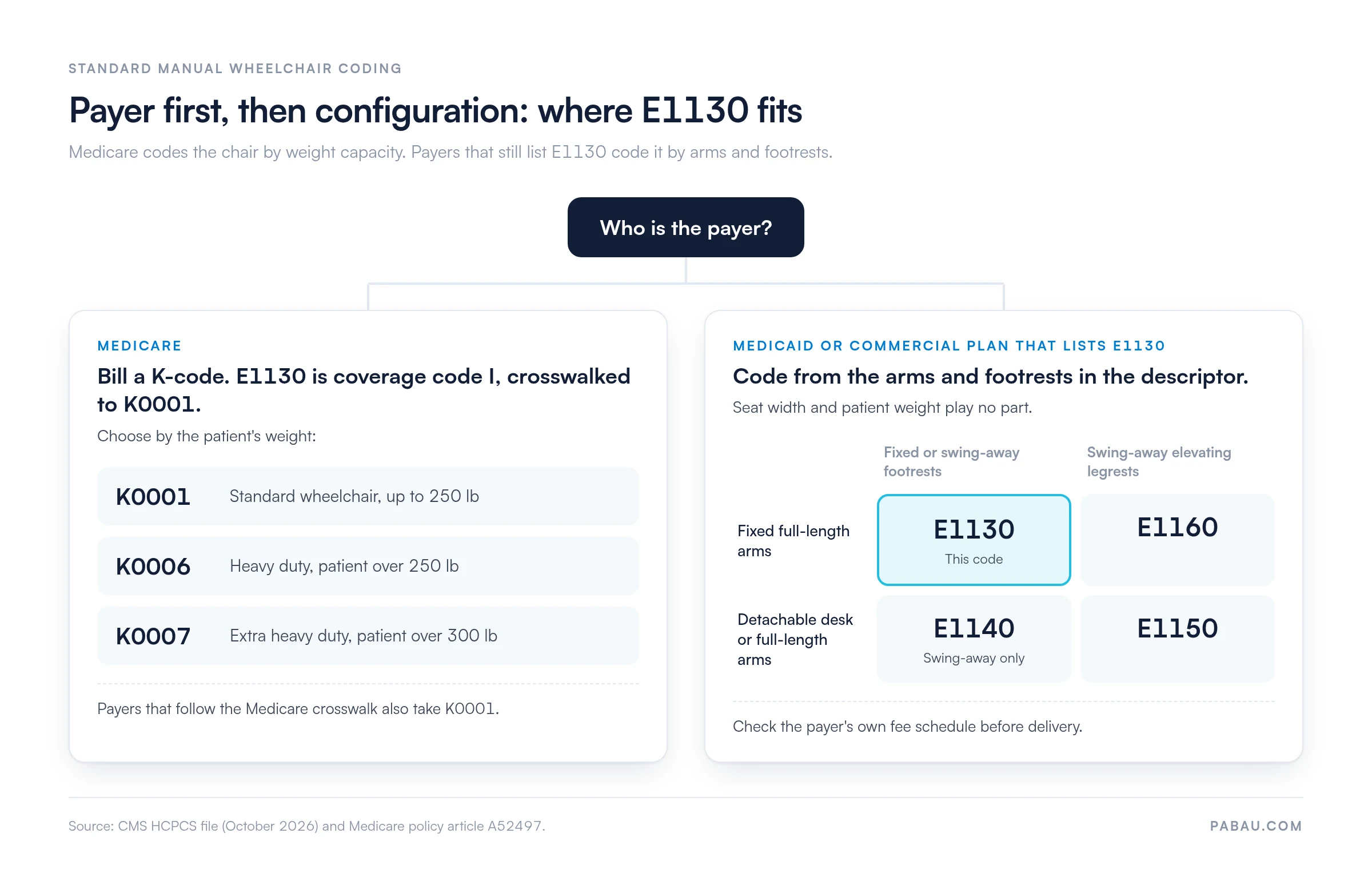
E1130 is billed only to payers that still recognize it, which can include some Medicaid programs and commercial plans. Each of those payers sets its own coverage rules and allowable, so the Medicare policies above do not carry over.
Medicaid programs and commercial plans often publish their own documentation checklists. Where a payer has one, follow it over any general guide, including this one. Where a payer requires approval before delivery, our walkthrough of the prior authorization process covers each step of the request.
Accessories carry their own HCPCS codes, and each one needs its own documented need. Check whether the payer bundles an item into the base chair before billing it separately. Elevating legrests added to a capped rental base such as K0001, for example, are billed as a pair under K0195. The descriptors below come from the CMS HCPCS file.
Before quoting a patient, pull the payer’s fee schedule line for E1130 and every accessory on the order. If the payer lists no allowable for E1130, ask whether it expects K0001 instead. Record the answer on the patient file.
An E1130 claim depends on details spread across the order, the clinical notes, the authorization and the delivery ticket. When those sit in separate folders, a biller rebuilding the claim can copy the wrong arm style or miss an expired authorization.
Pabau, the practice management platform we build, keeps forms, notes and uploaded documents on the patient record. Its claims management feature pulls the patient and service data already on that record into a pre-filled claim. It then submits and tracks the claim with insurers through Claim.MD.
The biller still chooses the code and checks it against the payer’s rules. The supporting paperwork sits in one place, so a payer’s request for records takes minutes to answer.

Pabau keeps orders, notes and documents on the patient record, then submits and tracks claims through Claim.MD, so payer requests are quick to answer.

The first decision on any E1130 claim is the payer. For Medicare, E1130 is the wrong code, and the chair goes on the claim as K0001, K0006 or K0007.
For Medicaid and commercial plans that still list E1130, the arm and footrest configuration carries the code choice. The order and the delivery ticket must describe both. Check the payer’s fee schedule before delivery, because an E1130 allowable is never guaranteed.
Book a demo to see how Pabau keeps the paperwork behind each wheelchair claim on the patient record.

Need to understand the broader HCPCS system? Introduction to medical billing covers how HCPCS codes, orders and payer requirements fit into the wider claim lifecycle.
Billing the same chair to Medicare? HCPCS code K0001 covers the standard wheelchair criteria, modifiers and capped rental rules.
Resubmitting a rejected wheelchair line? Timely filing limits by payer sets out the deadlines for initial claims, corrected claims and appeals.
Want the claim paid on the first pass? What is a clean claim explains what makes a claim error-free and how scrubbing gets you there.
HCPCS Code E1130 is the Level II code for a standard wheelchair with fixed full-length arms and fixed or swing-away detachable footrests. It sits in the E1130-E1161 standard wheelchair range and has no seat-width or weight criteria.
No. The CMS HCPCS file gives E1130 coverage code I, meaning not payable by Medicare, and crosswalks it to K0001. Medicare claims for this chair are billed as K0001, or as K0006 or K0007 for heavier patients.
K0001 is the Medicare-valid standard wheelchair code, defined by chair weight, seat height and a weight capacity of 250 pounds or less. E1130 is defined only by its arms and footrests, and Medicare does not pay it.
No. The E1130 descriptor sets no seat-width or weight-capacity limits. For Medicare, a patient over 250 pounds needs K0006, and a patient over 300 pounds needs K0007.
No. E1130 does not appear in the October 2026 CMS DMEPOS fee schedule. Any allowable for the code comes from a Medicaid program or a commercial payer’s own fee schedule.
That depends on the payer, and many expect RR for rental, NU for a new purchase or UE for a used purchase. The KX, GA, GY and GZ rules in Medicare’s manual wheelchair policy apply to K0001, not E1130.
E1130 has fixed full-length arms, while E1140 has detachable desk or full-length arms. Both have swing-away detachable footrests, and E1130 also allows fixed footrests. Medicare pays neither and crosswalks both to K0001.