

CCSD code G5100: Bypass of duodenum billing guide
CCSD code G5100 bills a bypass that leaves the duodenum in place CCSD code G5100...

Last Updated: Oct 16, 2026
68110 is the CPT code for excision of lesion, conjunctiva; up to 1 cm. It covers complete removal of a conjunctival lesion, such as a papilloma, nevus, cyst or pinguecula, that measures 1 cm or less before excision.
A lesion over 1 cm moves to CPT 68115, and a partial sample is a biopsy billed as 68100. Pterygium has its own codes and never belongs on a 68110 claim.
Let Pabau's smart automation suggest the right codes, reduce claim denials, and keep your practice compliant—effortlessly.
Automate repetitive tasks and focus on what matters most—your patients.
Reduce coding errors and ensure compliance with the latest regulations.
Clean claims, fewer denials, and faster reimbursements.
Powerful insights and reporting to help your practice thrive.
HIPAA compliant SOC 2 certified GDPR-compliant Trusted by 4,000+ clinics worldwide

CPT code 68110 covers complete excision of a conjunctival lesion up to 1 cm. Lesions over 1 cm require CPT 68115 instead.
Documentation must include a pre-excision measurement in centimeters, the anatomical location, and the excision technique to support code selection.
LT and RT laterality modifiers are mandatory on every 68110 claim; missing them is the leading denial trigger.
Pabau’s claims management software checks modifiers and ICD-10 pairings before submission, so fewer ophthalmic claims come back denied.
CPT code 68110 is defined by the American Medical Association (AMA) as: Excision of lesion, conjunctiva; up to 1 cm. Every billing and documentation decision on the claim flows from its three parts: The site, the procedure type, and the size limit.
The anatomical site is the conjunctiva, the thin mucous membrane covering the sclera and lining the inner eyelids. The procedure type is excision, meaning complete removal with intent to cure, not diagnostic sampling. And the size threshold, up to 1 cm, is measured at the lesion’s greatest diameter before the specimen is removed.
Lesion types that qualify for 68110 include:
CPT code 68110 excludes pterygium excision, which has its own code family. It also excludes lesions over 1 cm in greatest diameter, corneal lesions, and scleral procedures. Billing 68110 for a pterygium triggers an ICD-10 mismatch denial. The three questions below settle which code a conjunctival lesion takes.
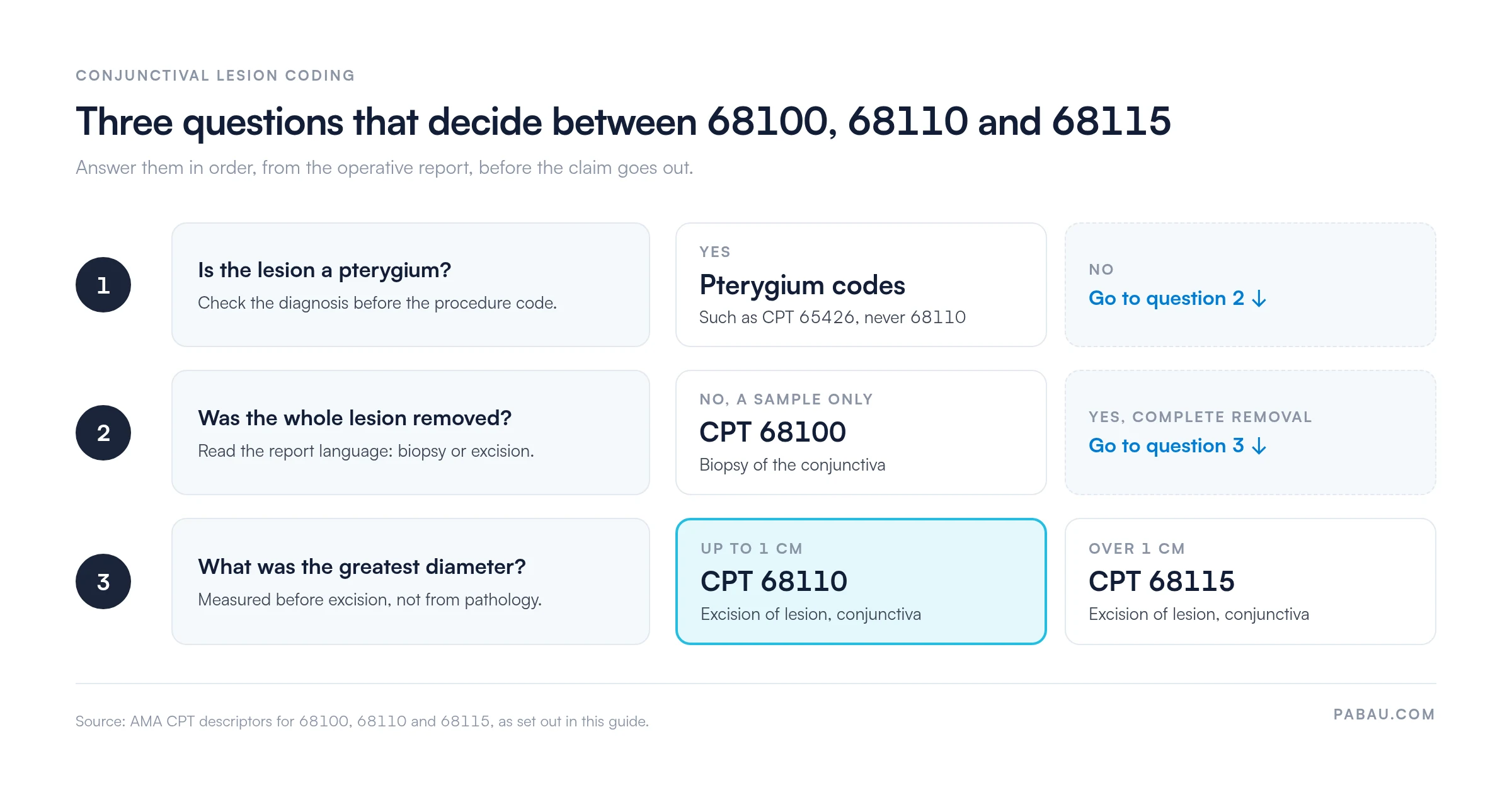
CPT 68115 covers excision of a conjunctival lesion over 1 cm. The two codes share the same procedure type and anatomical site. The only differentiator is the pre-excision measurement. Selecting between them incorrectly, in either direction, creates upcoding or undercoding exposure.
Critical documentation point: The measurement must appear in the operative report before excision, not estimated after the specimen is removed. Pathology specimen size can shrink during fixation and does not substitute for intraoperative measurement when payers audit for code level selection.
CPT 68100 is the biopsy code for the conjunctiva, covering partial removal of tissue for diagnostic purposes. CPT 68110 requires complete removal with therapeutic intent. The operative report language determines which code applies, not the tissue volume removed.
Billing 68100 and 68110 on the same date of service for the same eye requires modifier -59 to indicate a distinct procedural service. NCCI edits bundle these two codes by default. Without -59 and clear documentation that a biopsy and a separate complete excision were performed, the claim for 68100 will be denied.
Auditors reviewing CPT code 68110 claims look for six specific documentation elements. Missing any one of them opens a medical necessity or code-level dispute. Work through this checklist before the claim goes out, in line with medical billing compliance standards for surgical procedures.
Surgeons often record lesion size after excision, taken from the pathology report. Payers may reject this because fixation shrinkage alters specimen dimensions. The intraoperative measurement, captured before excision, is the defensible figure for code selection.
Selecting an ICD-10 code that does not anatomically match the conjunctival excision procedure is the second most common denial trigger after missing laterality modifiers. Review the AAPC Codify CPT lookup and the table below for the correct pairings.
What not to pair with 68110: H11.0x pterygium codes (H11.001-H11.069) must not be used with CPT 68110. Pterygium has dedicated CPT codes outside the 68110 family, such as CPT 65426. Submitting a pterygium ICD-10 code against a 68110 claim signals a procedure-diagnosis mismatch and triggers denial. Use the CrossCoder procedure-to-diagnosis crosswalk to verify ICD-10 alignment before submission.
The laterality modifiers RT and LT are mandatory on every 68110 claim, because the eye is a paired organ. The table below covers them alongside the five other modifiers that come up on conjunctival excisions.
For bilateral procedures, payer rules diverge. Medicare accepts modifier -50 on a single line, but many commercial payers prefer two separate line items, one with RT and one with LT. Verify each payer’s bilateral billing policy before submission. Billing a commercial payer in the Medicare format is a common source of partial payment.
Check your payer’s bilateral surgery indicator (BSI) before billing two eyes on the same DOS. CMS assigns a BSI to every surgical code, and the indicator determines whether -50 or separate RT/LT line items are correct. For CPT 68110, confirm the BSI in the CMS fee schedule file before submitting bilateral claims to Medicare.
Reimbursement for CPT code 68110 under Medicare is determined by the Medicare Physician Fee Schedule (MPFS). The 2026 national rates below reflect the non-facility (office) and facility (ASC or hospital outpatient) payment amounts.
Use the CMS Physician Fee Schedule Look-Up Tool to retrieve locality-adjusted rates for your area. The FastRVU 2026 RVU lookup shows the underlying work, practice expense, and malpractice RVU components.
Geographic adjustment (GAF) means a practice in Manhattan receives a higher payment than one in rural Nebraska for the same 68110 claim. Practices with multiple locations should pull locality-specific rates rather than relying on national averages.
CPT 68110 carries a 10-day global period under CMS minor surgery assignment. This means routine post-operative follow-up visits within 10 days of the procedure are bundled into the surgical fee and cannot be billed separately.
Services that stay separately billable during the 10-day global period include:
Payer variation exists. Some commercial payers assign a 90-day global to minor ophthalmic procedures, or apply global period rules inconsistently. Verify each payer’s global period policy in your contract before billing post-operative services separately. Assuming the CMS 10-day standard applies to all payers is a common source of recoupment.
Denials on CPT code 68110 cluster around six predictable errors. The remittance advice names each one with one of the denial codes payers use, which tells you which fix applies. A structured denial management workflow then recovers the claims that still come back.
An automated pre-submission review for these six error types cuts first-pass denials on conjunctival procedure claims. A clean claim costs less in rework than an appeal. Appeal turnaround from Medicare typically runs 60-120 days.
Place of service directly affects how much the physician is paid for CPT code 68110. The professional fee changes with where the procedure is performed, even though the surgical work is identical.
The non-facility rate pays the physician for supplying the surgical environment, equipment, and staff. In an ASC or hospital outpatient department, the facility takes a separate payment and the physician receives the lower facility fee. A practice weighing in-office surgical capacity for conjunctival excisions has to build this difference into its overhead calculation.
ASC eligibility is also a consideration. CPT 68110 must appear on CMS’s ASC Covered Procedures List for the facility to receive an ASC facility payment. If 68110 is not on the approved list for a specific ASC, the procedure should be performed in the office or hospital outpatient setting instead. Verify ASC eligibility through the CMS ASC payment policy before scheduling.
Run a quarterly audit of your CPT 68110 claims by place of service. Mismatching a facility-rate claim with a non-facility POS code overstates the allowed amount and creates a compliance exposure when payers perform claims data reviews. Your billing system should flag POS mismatches automatically before submission.
In a generic billing tool, a coder checks the laterality modifier, the lesion size and the ICD-10 pairing by eye. One missed RT or LT sends the claim back weeks later, and the appeal clock starts.
Pabau, the practice management platform we build, moves those checks ahead of submission. Its claims management software flags modifier and ICD-10 mismatches on conjunctival excision claims before they leave the practice.
Clean claims then go out through Claim.MD, Pabau’s US clearinghouse integration, which routes to thousands of US payers. It also verifies eligibility before the procedure date, so coverage problems surface while the patient can still reschedule.
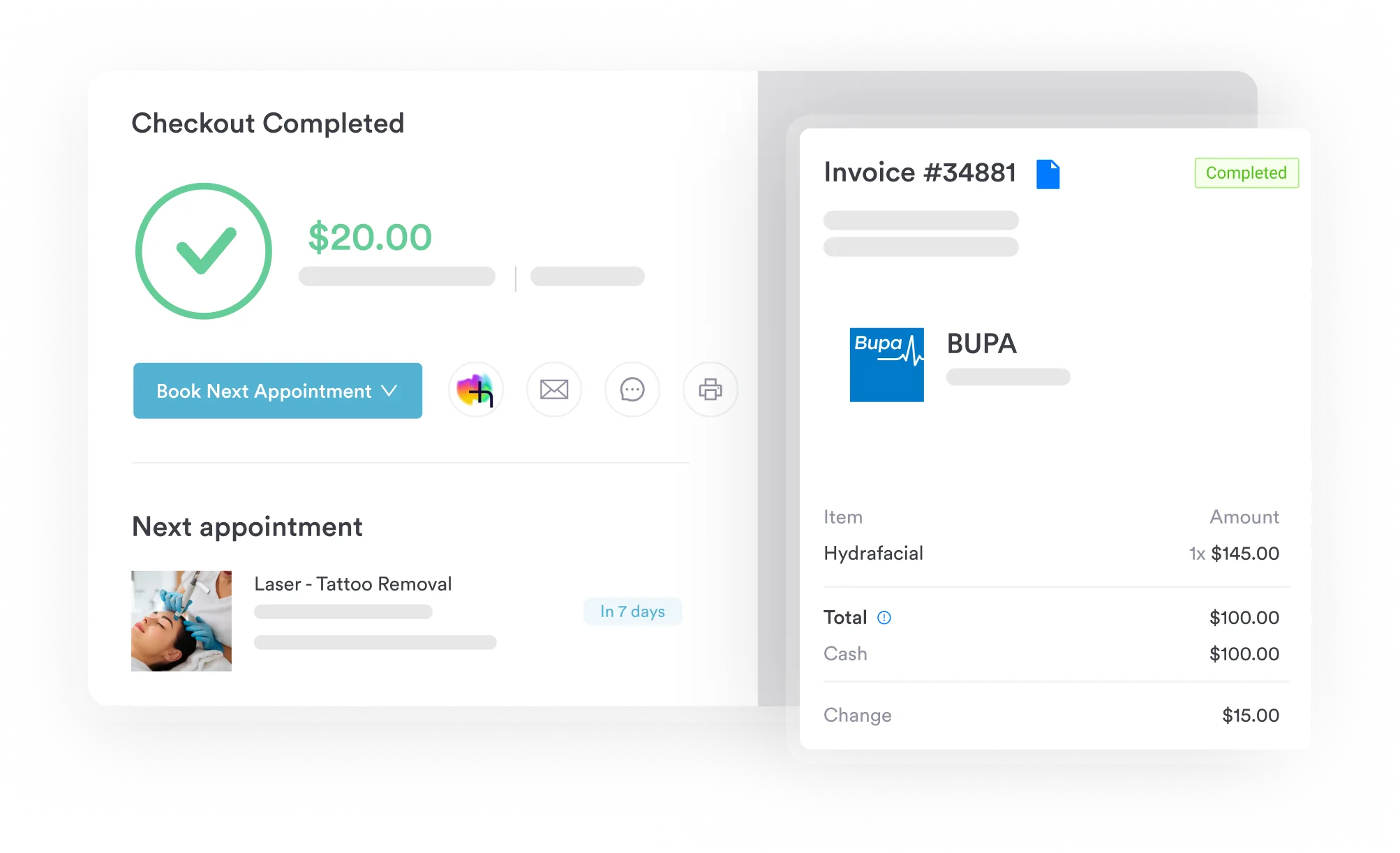

Pabau’s claims management software validates CPT codes, modifiers, and ICD-10 pairings before submission, so your conjunctival excision claims go out clean the first time.

Code 68110 from the operative report, never from memory or the pathology slip. A report that records a pre-excision size, a laterality and a non-pterygium diagnosis gives the payer every reason to pay.
The work sits with the surgeon, and it takes seconds in the OR. Skipping it costs far more, because a Medicare appeal typically runs 60-120 days.
Book a demo to see how Pabau checks modifiers and ICD-10 pairings on your ophthalmic claims before they go out.

Need to understand how clearinghouse submissions work for surgical codes? Medical claims clearinghouse explained covers how claims route from practice to payer and where edits are applied.
Building the encounter form for surgical visits? Superbill documentation best practices walks through the fields that support clean claim submission for surgical procedures.
Looking to verify eligibility before scheduling conjunctival excision procedures? Insurance eligibility verification explains how real-time eligibility checks reduce post-service billing surprises.
Removing a lesion from the eyelid rather than the conjunctiva? CPT code 67840 covers eyelid lesion excision and the documentation it needs.
CPT code 68110 covers complete excision of a conjunctival lesion up to 1 cm in greatest diameter, removed with therapeutic intent. It applies to benign and malignant conjunctival growths including papilloma, nevus, conjunctival cyst, pinguecula, and ocular surface squamous neoplasia. Pterygium and lesions exceeding 1 cm are excluded.
CPT 68110 covers conjunctival lesion excision up to 1 cm; CPT 68115 covers excision over 1 cm. The selecting criterion is the pre-excision greatest diameter measured intraoperatively and documented in the operative report. Post-fixation pathology specimen size does not substitute for the intraoperative measurement for code selection purposes.
RT (right eye) and LT (left eye) laterality modifiers are mandatory on every 68110 claim. Modifier -51 applies to secondary procedures in the same session. Modifier -59 is required when billing 68100 and 68110 on the same date of service. Modifier -78 covers a return to the OR for a complication during the global period. Modifier -79 covers an unrelated procedure by the same physician in that period.
CPT 68110 carries a 10-day global period under CMS minor surgery designation. Routine post-operative follow-up within 10 days is bundled into the surgical fee. New problems, unrelated E/M services (modifier -24), and staged procedures (modifier -58) are separately billable during the global period. Some commercial payers apply longer global periods; verify each payer’s policy before billing post-operative services separately.
The leading denial reasons are missing RT or LT modifiers, pterygium diagnosis codes, and no pre-excision lesion measurement in the operative report. Billing 68115 without a documented size over 1 cm is another frequent trigger. So is billing 68100 with 68110 on the same date without modifier -59.
Yes, but only with modifier -59 appended to CPT 68100 to indicate a distinct procedural service. The operative report must also show that a biopsy and a separate complete excision were both performed. NCCI edits bundle these two codes by default, so claims without the modifier and supporting documentation will deny.



