

CCSD code G5100: Bypass of duodenum billing guide
CCSD code G5100 bills a bypass that leaves the duodenum in place CCSD code G5100...

Last Updated: Oct 16, 2026
66985 is the CPT code for insertion of intraocular lens prosthesis (secondary implant), not associated with concurrent cataract removal. It covers a lens implant placed in a later, separate operation, usually in an eye left without a lens after earlier surgery or trauma.
The cataract decides the claim. If one comes out in the same session, the work belongs under 66984 or 66982 instead. The difference also carries money, because 66985 has 19.72 total RVUs under the 2026 Medicare fee schedule, against 13.85 for 66984. Laterality and the 90-day global period then decide whether the claim pays the first time.
Let Pabau's smart automation suggest the right codes, reduce claim denials, and keep your practice compliant—effortlessly.
Automate repetitive tasks and focus on what matters most—your patients.
Reduce coding errors and ensure compliance with the latest regulations.
Clean claims, fewer denials, and faster reimbursements.
Powerful insights and reporting to help your practice thrive.
HIPAA compliant SOC 2 certified GDPR-compliant Trusted by 4,000+ clinics worldwide

CPT code 66985 covers a secondary IOL placed in an eye with no lens implant, with no cataract removed in the same session.
If the operative note records any cataract extraction, the claim belongs under 66984 or 66982 instead of 66985.
Medicare contractors require LT or RT on cataract and IOL surgery claims, so confirm laterality rules with your MAC and each payer.
The 90-day global period opens the day before surgery, and routine post-op visits inside it are not billed separately.
Pabau’s claims management software pre-fills claims from the record, validates required claim fields before sending, and submits through the Claim.MD clearinghouse.
CPT code 66985 is the code for inserting an intraocular lens (IOL) as a secondary implant. The American Medical Association descriptor reads: Insertion of intraocular lens prosthesis (secondary implant), not associated with concurrent cataract removal.
In plain terms, the surgeon places an IOL in an eye that has no natural lens and no implant, a state called aphakia. No cataract is extracted during the same operation.
That situation usually follows one of three histories. A complicated cataract surgery years earlier ended without an implant, or trauma left the eye without a lens. Less often, a child born without a lens reaches surgical candidacy.
Within the CPT codes set, 66985 sits in the intraocular lens procedures range (66982-66991). Its neighbors there are the cataract and exchange codes it gets confused with, and the quick reference below collects what coders check first.
Secondary IOL implantation is its own surgical episode, separate from any earlier cataract surgery. Knowing the steps helps billing staff confirm that the operative note supports 66985 before the claim goes out.
Above all, the note must state that no cataract was extracted. Any mention of phacoemulsification, extracapsular extraction, or MSICS in the same session moves the claim to 66984 or 66982.
Medicare and most commercial payers expect specific elements in the record before they accept 66985 as medically necessary. Run through this list before the claim is built, because a missing item usually means a denial.
For Medicare patients, check the applicable MAC LCD and its billing-and-coding article, for example Noridian’s Cataract Surgery in Adults (A57195). Confirm you are reading the version in force on the date of service, because a superseded version won’t support an appeal.
The diagnosis has to tell the payer why the eye lacks a working lens. Acquired aphakia, a displaced or broken implant, and lens subluxation are the usual reasons.
Congenital aphakia is excluded from H27.0- and is coded Q12.3 instead. Payers also publish their own covered lists, so check the current policy before billing.
Laterality sits in different places across these codes. H27.11- subluxation and H27.12- anterior dislocation take a 6th character for the eye, such as H27.111 for the right eye. For a lens implant, decide what failed first. T85.22XA covers a displaced IOL, while T85.21XA covers a mechanical breakdown.
66984 covers routine extracapsular cataract removal with an IOL inserted in the same session. By contrast, 66985 covers the IOL insertion alone, with no cataract extraction. These two are the pair coders mix up most often in eye surgery billing.
The usual error is billing 66984 when the note describes a secondary IOL. That claim reports a cataract extraction that never happened, which is a compliance problem in its own right. It also pays less, since 66985 carries more RVUs.
Two questions from the operative note settle which lens code applies, as the diagram below shows.
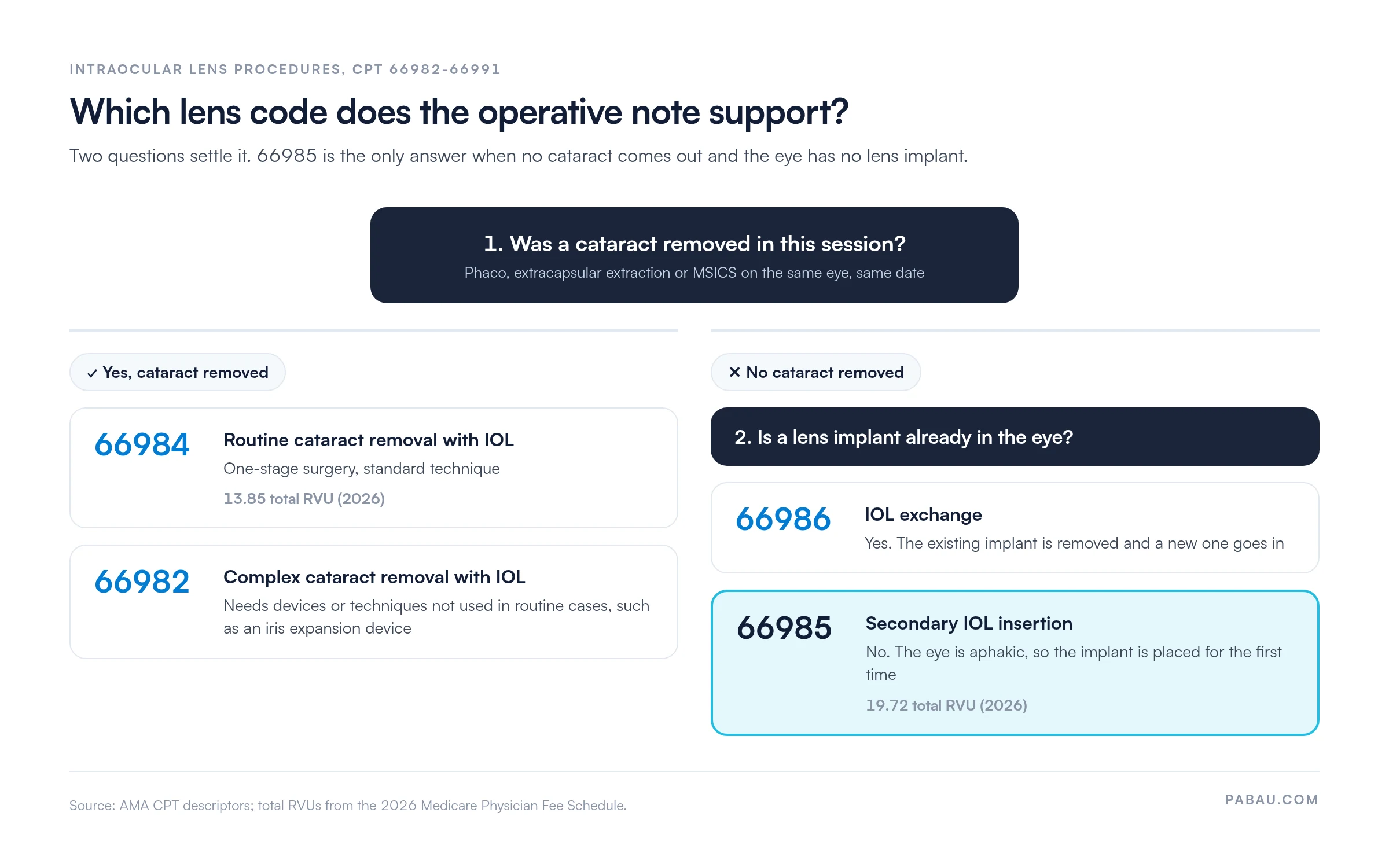
66986 describes removing an existing IOL and inserting a replacement in the same session. 66985, on the other hand, describes a first secondary implant in an eye with no working IOL.
So the test is simple. 66986 needs an implant already in place, while 66985 needs the eye to have none.
Several codes can appear in the same session as 66985. Coders need to separate the ones that may be reported on their own from those bundled under NCCI edits.
The AAPC Codify CPT lookup is a handy reference for edit status. Still, NCCI edits update quarterly, so verify them when you bill.
Every 66985 claim has to show which eye was treated. Medicare contractors require LT or RT on cataract and IOL surgery claims, so verify the rule with your MAC and the payer.
A missing laterality modifier is one of the most common 66985 denials, and one of the easiest to prevent.
Medicare covers 66985 when a covered ICD-10 diagnosis supports the claim and the indications in the applicable MAC LCD are met. Read that LCD alongside its billing-and-coding article, for example Noridian’s Cataract Surgery in Adults (A57195).
Both documents live in the CMS Medicare Coverage Database, which shows the version in force. The wider billing compliance requirements for eye surgery apply on top of the LCD.
Covered indications typically include aphakia after complicated cataract surgery, traumatic lens loss, and lens subluxation that impairs vision. Purely elective or cosmetic lens upgrades are not covered.
NCCI edits also apply to code pairs. For example, 66985 and 66984 on the same eye on the same date will deny.
Prior authorization rules for 66985 vary by payer and region. A claim denied for missing authorization usually can’t simply be rebilled, so check before surgery is scheduled.
The table shows common patterns. Each payer’s own policy is still the one that counts.
When authorization is required, request it at least five business days before surgery. A denial can often be appealed with more clinical documentation, although the timeline leaves little room.
Medicare pays 66985 through the Resource-Based Relative Value Scale (RBRVS). In 2026 the code carries 19.72 total RVUs, including 9.73 work RVUs.
At the 2026 non-APM conversion factor of $33.4009, that works out to roughly $659 nationally. The Geographic Practice Cost Index (GPCI) then moves the figure up or down by locality.
For your own jurisdiction, use the CMS Physician Fee Schedule lookup tool. The FastRVU 2026 RVU lookup also gives location-adjusted figures.
Once the claim is coded, the Claim.MD clearinghouse checks that required claim fields are complete and transmits claims to payers.
In an ambulatory surgery center (ASC), the surgeon bills the professional service under Medicare Part B, and the facility bills its own fee. The lens has its own HCPCS supply codes. V2630 covers an anterior chamber IOL, V2631 an iris-supported IOL, and V2632 for a posterior chamber IOL.
However, the facility bills these separately only where the payer pays supply codes separately. Medicare ASC payment bundles standard IOLs into the facility fee, and supply codes can change each HCPCS year.
CPT code 66985 carries a 90-day global surgical period under Medicare. Routine post-op evaluation and management visits inside that window are bundled into the surgical payment.
Your billing team should track global period dates so no post-op visit is billed without the right modifier. Here is how services in the window break down.
Count the dates carefully. The 090 global covers one day before surgery, the day of surgery, and 90 days after it. In other words, the window opens the day before the procedure.
Most 66985 denials trace back to five patterns, and each one has a direct fix. Building a clean claim the first time prevents most of them.
To cut repeat denials, a structured denial management workflow tracks reason codes by CPT code. It also spots repeat patterns and gives each fix an owner on the billing team.
Run this quick check on every secondary IOL claim before it leaves the practice.
Many practices still build eye surgery claims by hand. Someone reads the operative note, retypes the codes into a claim form, and finds missing fields only when the payer rejects it.
Pabau, the practice management platform we build, includes claims management software that pre-fills the claim from the patient record. The CPT code on the service lands on the charge line, and ICD-10 slots draw from the recorded diagnoses.
Before a claim can go out, Pabau checks that required fields such as membership numbers and authorization codes are complete. US claims then go through the Claim.MD clearinghouse, with eligibility checks and ERA posting built in. Your team keeps the coding judgment and drops the retyping.

Pabau’s claims tools pre-fill claims from the patient record and check required claim fields are complete before sending. CPT code 66985 claims then go through the Claim.MD clearinghouse.

Treat 66985 as a yes-or-no question about the cataract. When the note confirms no extraction and no existing implant, the code is right, and it pays more than 66984. When the note is vague on either point, fix the note before you fix the claim.
After that, it comes down to habit. Put laterality on every line, pick the right H27 or T85 code, and remember that the global window opens the day before surgery. Build those checks into your pre-submission routine, and most 66985 denials never happen.
Pabau supports that routine by pre-filling claims from the record, validating required fields, and submitting through Claim.MD with US eligibility checks and ERA posting. Book a demo to see how it carries your eye surgery claims from note to payment.

Need a deeper dive into clearinghouse billing? Claim.MD clearinghouse overview explains how electronic claim submission and real-time eligibility checks work for surgical codes.
Billing the complex version of cataract surgery? CPT code 66982 covers the devices and techniques that separate complex cases from routine ones.
Coding the lens itself? HCPCS code V2631 explains how iris-supported IOLs are reported as supplies.
Want the full picture of your billing workflow? What is revenue cycle management walks from eligibility checks to payment posting.
Want to understand payer remittances after submission? Electronic remittance advice (ERA) explained shows how 835 files report payment decisions and denial reason codes.
A secondary IOL is a lens implant placed in a later operation, not during cataract removal. The eye is already aphakic when surgery starts, often after complicated cataract surgery or trauma.
CPT 66985 carries 19.72 total RVUs in 2026. At the non-APM conversion factor of $33.4009, that is roughly $659 nationally. Your locality GPCI moves the final amount up or down.
Yes, for the same eye on the same date. NCCI edits treat the two as mutually exclusive, because 66984 already includes an IOL insertion along with the cataract removal.
Acquired aphakia is coded H27.01 for the right eye, H27.02 for the left, or H27.03 for both. A displaced lens implant uses T85.22XA, and congenital aphakia uses Q12.3.
CPT 66985 has a 90-day global period. It starts the day before surgery and ends 90 days after the procedure date. Routine post-op visits inside it are not billed separately.
Yes. Report LT or RT to show which eye was treated, since Medicare contractors require it on IOL surgery claims. Bilateral cases usually go on two lines, though some payers accept modifier 50.



