

HCPCS Code L0472: Hyperextension TLSO billing guide
HCPCS code L0472: Official descriptor and device definition HCPCS code L0472 des...

Last Updated: Nov 5, 2026
65756 is the CPT code for keratoplasty (corneal transplant); endothelial. It covers DSAEK, DMEK and the other endothelial techniques under one descriptor.
Most denials on CPT Code 65756 trace back to five avoidable errors. Two are coding slips: a missing RT or LT modifier and the wrong keratoplasty code. The other three are a missing prior authorization, an operative note without the posterior lamellar approach, and eye bank fees bundled into the surgical fee.
Let Pabau's smart automation suggest the right codes, reduce claim denials, and keep your practice compliant—effortlessly.
Automate repetitive tasks and focus on what matters most—your patients.
Reduce coding errors and ensure compliance with the latest regulations.
Clean claims, fewer denials, and faster reimbursements.
Powerful insights and reporting to help your practice thrive.
HIPAA compliant SOC 2 certified GDPR-compliant Trusted by 4,000+ clinics worldwide

CPT Code 65756 covers endothelial (posterior lamellar) keratoplasty only, and full-thickness transplants use 65730, 65750 or 65755 depending on lens status.
Both DSAEK and DMEK map to 65756, so the operative note must state the posterior lamellar approach and the endothelial technique used.
Every 65756 claim line needs an RT or LT laterality modifier, and a missing one is among the five avoidable denial causes.
Pabau submits 65756 claims electronically through Claim.MD, runs eligibility checks and flags denied claims for rework.
CPT Code 65756 is defined by the American Medical Association with the official descriptor: Keratoplasty (corneal transplant); endothelial. That single word “endothelial” is what separates 65756 from every adjacent code in the keratoplasty family.
The procedure replaces only the corneal endothelium and Descemet membrane, leaving the patient’s anterior stroma and epithelium intact. This selective replacement is what clinically distinguishes endothelial keratoplasty from penetrating keratoplasty and what determines the correct code selection.
Both DSAEK and DMEK are billed under CPT Code 65756. The AMA has not assigned a separate code for DMEK. Industry consensus through the American Academy of Ophthalmology supports mapping both techniques to 65756 in current coding cycles. The operative note must specify which technique was performed, because the documentation standard differs.
Payers do not distinguish between DSAEK and DMEK at the claim level, and both are billed as 65756. The distinction matters for the operative report, which is what auditors review when a claim is flagged.
Four keratoplasty codes sit next to 65756, and picking the wrong one gets the claim downcoded or denied. The choice turns on one question: Did the surgeon replace the full corneal thickness, or only the posterior layer?
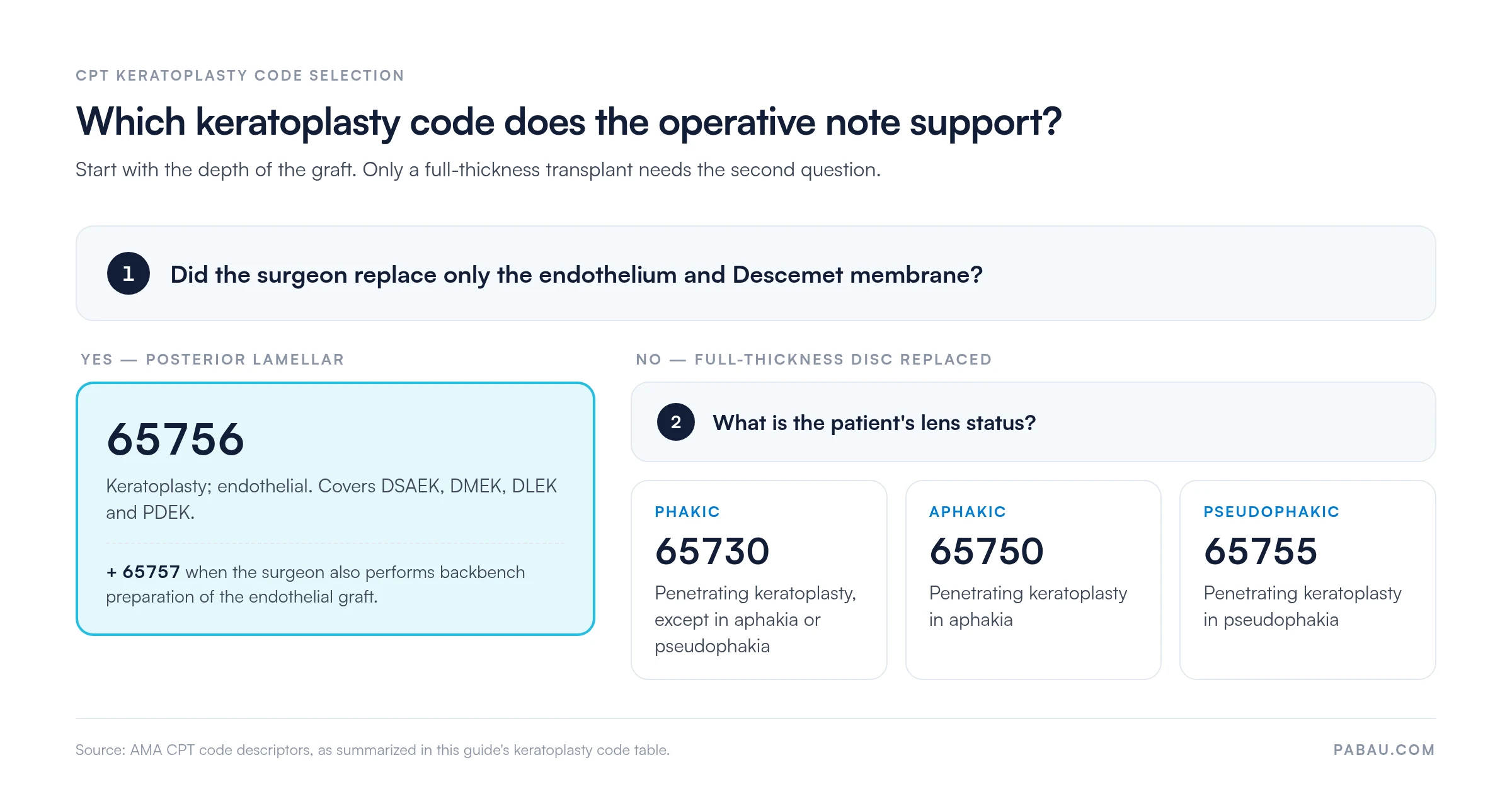
A penetrating keratoplasty billed as an endothelial keratoplasty, or the reverse, is a descriptor mismatch. Payers and RAC auditors flag it on retrospective review, so the table below pairs each code with the documentation that supports it.
For CPT Code 65756, the operative report must affirmatively establish the posterior lamellar approach. A note that says “corneal transplant performed” without specifying the technique gives an auditor no way to distinguish 65756 from 65730 or 65755.
Laterality applies only to the H18.1x bullous keratopathy codes: H18.11 for the right eye, H18.12 for the left and H18.13 for both. H18.51 and T86.841 carry no laterality, so the RT or LT modifier on 65756 identifies the eye. Check the CMS ICD-10-CM code files each fiscal year to confirm effective dates before billing.
Medicare reimbursement for CPT Code 65756 varies by place of service. The professional fee paid to the surgeon differs between an ambulatory surgery center (ASC) and a hospital outpatient department (HOPD). The facility fee structure changes the practice expense RVU component. Use the CMS Physician Fee Schedule lookup tool to retrieve the current-year facility and non-facility rates for your geographic payment locality.
Use FastRVU’s 2026 RVU lookup to calculate the estimated Medicare allowed amount for your locality. Dollar amounts change annually with the conversion factor update; always specify the benefit year when quoting rates to surgeons or practice administrators.
Eye bank tissue acquisition costs are explicitly excluded from the CPT Code 65756 surgical fee. The operating surgeon’s professional fee covers the transplant procedure only. The eye bank’s charges for processing, storage and delivery are billed separately, under V2785 or by invoice. Billing them inside the global surgical fee is an overbundling error that triggers overpayment recoupment.
When the surgeon bills the tissue, the tissue line and the surgical line go on the same CMS-1500 form or 837P transaction. They sit on separate line items with distinct codes, which prevents a cross-claim bundling error.
Prior authorization is required for CPT Code 65756 by most commercial insurers and Medicare Advantage plans, though requirements vary by plan. Medicare fee-for-service does not require prior authorization for keratoplasty, but Medicare Advantage plans frequently do. Failing to obtain authorization before surgery results in a denial that is very difficult to overturn on appeal.
Running insurance eligibility verification at scheduling and again 48 to 72 hours before the procedure date catches plan-level prior auth requirements before the case proceeds.
Modifier selection on CPT Code 65756 claims determines both payment and claim acceptance. Laterality modifiers are non-negotiable. Care-splitting modifiers apply when the surgeon and a co-managing provider share the 90-day postoperative period.
CPT Code 65756 carries a 90-day global surgical period. All routine postoperative care visits are bundled into the surgical fee during this window. The operating surgeon cannot bill separately for postoperative eye exams, medication adjustments, or graft monitoring visits. The exception is a separately reportable service, such as a new problem or an unrelated condition.
When the operating corneal specialist transfers care to a local optometrist or general ophthalmologist, both providers bill 65756 on separate claims. The surgeon appends modifier 54 (surgical care only), and the co-managing provider appends modifier 55 (postoperative management only). The two payments, combined, equal the total allowed amount for 65756. The transfer of care must be documented in writing, signed by both providers, and stored in the medical record.
Five errors recur across CPT Code 65756 denials. Each is preventable with a pre-submission check, and a denial management workflow handles whatever still comes back.
CARC 4 means the procedure code is inconsistent with the modifier used, or a required modifier is missing. On a 65756 claim, check the RT or LT modifier first. The list of medical billing denial codes maps the other CARCs to their root causes.
Run a laterality audit on your last 90 days of 65756 claims. Pull every claim for this code and check that LT or RT appears on every line. Claims missing laterality that were paid without the modifier may still be subject to retrospective audit and recoupment by Medicare Administrative Contractors.
Coverage criteria for CPT Code 65756 vary across payer types. Medicare’s coverage is governed by Local Coverage Determinations issued by each Medicare Administrative Contractor (MAC), not by a single national coverage determination. This means the specific documentation benchmarks vary by geography.
This checklist walks a CPT Code 65756 claim from scheduling through payment posting. Use it on every encounter.
A 65756 case passes through several hands before payment. The scheduler checks coverage, the biller keys the claim, and someone reconciles the remittance. Each handoff is a point where a missing modifier or an unbilled V2785 line can slip through.
Pabau, the practice management platform we build, brings those steps into one system. Its denial-cutting claims management submits claims electronically through Claim.MD. Real-time eligibility checks and electronic remittance also run through the Claim.MD clearinghouse, so coverage is confirmed before the case.
When remittance comes back, Pabau matches each ERA to its claim and flags denied claims for rework. Your billing team can then correct a CARC 4 modifier denial and resubmit while the timely-filing window is still open.

Pabau submits CPT 65756 claims electronically through Claim.MD, checks eligibility before surgery and matches each ERA to its claim. Denied claims are flagged for rework, so your team can correct and resubmit them fast.

Billing CPT Code 65756 well comes down to documentation. Fix the operative note template first, so every DSAEK or DMEK report states the posterior lamellar approach in words an auditor can find. Then make RT or LT and the V2785 line part of the pre-submission check.
That check costs a few minutes per case. A denied or recouped 65756 claim costs far more in rework, appeals and delayed payment, often months after the surgery.
To see how Pabau handles eligibility, claim submission and remittance for ophthalmology surgery, book a demo.

Need to understand how claims reach the payer? Medical claims clearinghouse guide explains how 837P transactions are validated, corrected, and transmitted to insurance payers.
Seeing high denial rates across your surgical caseload? Revenue cycle management overview covers how to track denial patterns and identify systemic coding errors upstream.
Billing other corneal procedures? CPT Code 65435 billing guide covers corneal epithelium removal, its documentation and its modifiers.
CPT Code 65756 covers endothelial keratoplasty, a surgical procedure that replaces only the diseased posterior corneal layer (endothelium and Descemet membrane). The patient’s anterior cornea stays intact. DSAEK, DMEK, DLEK and PDEK all map to this single descriptor. Penetrating keratoplasty (a full-thickness transplant) falls outside 65756. It is billed under 65730 (phakic), 65750 (aphakia) or 65755 (pseudophakia), depending on lens status.
CPT 65756 is for endothelial (posterior lamellar) keratoplasty, where only the corneal endothelium is replaced. CPT 65730 is for penetrating keratoplasty in a phakic patient, where the full corneal disc is excised and replaced. The key distinction is surgical depth: 65756 preserves the patient’s anterior stroma, while 65730 removes the entire corneal thickness. Billing 65730 for a DSAEK or DMEK is a descriptor mismatch that invites audit and recoupment.
It depends on the payer. Medicare fee-for-service does not require prior authorization for CPT 65756, but most Medicare Advantage plans and commercial insurers do. Medicaid requirements vary by state. Submit requests at least 30 days before the procedure with BCVA documentation, specular microscopy cell counts and ICD-10-CM diagnosis codes.
CPT Code 65756 claims are usually denied for one of five reasons. Two are coding errors: a missing RT or LT laterality modifier, or 65730 billed instead of 65756. The other three are a missing prior authorization, an operative note without the posterior lamellar approach, and a bundled eye bank fee. That fee belongs on its own V2785 line. Missing laterality is the easiest to prevent. Check for RT or LT on every 65756 line before the claim is released.
Yes, but the tissue fee goes on a separate claim line, not inside the 65756 surgical fee. Use HCPCS V2785 for most commercial payers, or submit the eye bank’s own invoice where Medicare or Medicaid requires it. Bundling the tissue cost into the global surgical fee is an overbundling error that payers recoup on audit.
CPT Code 65756 carries a 90-day global surgical period. All routine postoperative visits related to the keratoplasty are bundled into the surgical fee during this window. When the operating surgeon transfers care to a co-managing optometrist or ophthalmologist, the surgeon bills 65756 with modifier 54. The co-managing provider bills 65756 with modifier 55, and the two payments together equal the total allowed amount.



