

HCPCS code E0198: Water pressure pad billing guide
HCPCS code E0198 is a water pad for a standard mattress HCPCS code E0198 is the ...

Last Updated: Oct 13, 2026
Billable Code
64708 is the CPT code for neuroplasty, major peripheral nerve, arm or leg; other than specified. It covers open surgical exploration or neurolysis of a major nerve trunk in an extremity.
Coders routinely confuse it with 64721 (carpal tunnel release) and 64722 (other peripheral nerve). The distinction turns on anatomical specificity. Use 64708 only when no more specific code in the 64702-64727 range fits the operative site.
Let Pabau's smart automation suggest the right codes, reduce claim denials, and keep your practice compliant—effortlessly.
Automate repetitive tasks and focus on what matters most—your patients.
Reduce coding errors and ensure compliance with the latest regulations.
Clean claims, fewer denials, and faster reimbursements.
Powerful insights and reporting to help your practice thrive.
HIPAA compliant SOC 2 certified GDPR-compliant Trusted by 4,000+ clinics worldwide

CPT code 64708 describes open neuroplasty of a major peripheral nerve in the arm or leg, excluding carpal tunnel and other specifically coded sites.
The 2026 Medicare national average is about $612 in the office and about $280 in a facility. Rates vary by locality.
Modifier RT or LT is required for laterality. Modifier 50 applies only when both limbs are operated in the same session.
Pabau’s claims management software supports electronic claim submission and denial tracking for peripheral nerve surgery billing.
CPT code 64708 is the procedure code for open neuroplasty of a major peripheral nerve in the arm or leg. It applies where no more anatomically specific code in the neuroplasty section fits. The American Medical Association publishes the full descriptor as: “Neuroplasty, major peripheral nerve, arm or leg; other than specified.”
The code sits within the Surgery/Nervous System chapter, specifically the Neuroplasty and Neurolysis subsection (CPT 64702-64727). Neuroplasty covers two related intraoperative techniques. Exploration means visualizing the nerve directly and assessing its condition. Neurolysis means freeing the nerve from surrounding scar tissue, adhesions, or compressive structures. Both may occur together during the same operative session.
The phrase “other than specified” makes this the catch-all code. It covers open procedures on major peripheral nerves that lack a dedicated code of their own. Correct use requires confirming that no more specific code (such as 64721 for carpal tunnel or 64713 for brachial plexus) better describes the operative site.
Open neuroplasty on a major peripheral nerve is medically necessary when conservative management has failed and the nerve requires direct surgical intervention. According to CMS Local Coverage Determinations governing peripheral nerve procedures, the operative report must connect the clinical indication to a supported ICD-10 diagnosis.
The AMA and AAPC both require the medical necessity documentation to cover three points.
Medicare reimburses CPT code 64708 under the Medicare Physician Fee Schedule (MPFS), with separate rates for facility and non-facility settings. The CMS Physician Fee Schedule lookup tool provides current rates by geographic locality.
Rates above are 2026 national averages. Geographic Practice Cost Indices (GPCIs) adjust payment by locality. Practices in high-cost urban areas such as San Francisco and New York City typically sit 10-20% above the national average. Rural localities usually sit below it. Always verify the exact rate for your MAC jurisdiction using the CMS MPFS lookup before submitting.
Practice management software like Pabau supports faster claims management by tracking reimbursement per payer and flagging underpayments against expected MPFS rates.
Relative Value Units (RVUs) determine the physician payment formula under Medicare. The total RVU for CPT code 64708 multiplied by the conversion factor and the GPCI adjustments yields the final fee. Verify current RVU values using the FastRVU 2026 lookup tool.
The work RVU is identical in both settings because it reflects the surgeon’s time and skill. The practice expense RVU drops sharply in the facility setting. The hospital or ASC absorbs the overhead and bills separately under its own facility fee schedule.
Correct modifier use for CPT code 64708 prevents the two most common denial reasons. Those are missing laterality and incorrect multiple-procedure reduction. The following modifiers apply based on CMS guidance and standard surgical coding rules.
RT and LT are required whenever the procedure is unilateral. Submitting 64708 without a laterality modifier is one of the most common reasons payers return the claim for additional information. Confirm modifier applicability with your MAC’s published modifier indicator for 64708 before billing.
Every claim for CPT code 64708 requires a diagnosis code that establishes medical necessity. Payers cross-reference the ICD-10-CM code against Local Coverage Determinations to determine whether the procedure is a covered service. The following diagnosis codes are among those most frequently linked to 64708 in payer LCD coverage policies.
For broader context on how the neurological ICD-10 chapters are structured, Pabau’s ICD-10-CM code library covers the full range.
Use the most specific ICD-10-CM code available. If the nerve involved is the ulnar nerve in the right upper limb, code G56.21 (right side) rather than G56.20 (unspecified). Laterality specificity in the diagnosis code should mirror the laterality modifier on the CPT line.
The 64702-64727 neuroplasty section contains multiple codes that are frequently confused with CPT code 64708. Selecting the wrong code within this family is upcoding or undercoding depending on direction, with audit and recoupment risk for either. The AAPC Codify CPT lookup provides the full descriptor for each code in this section.
The decision logic is anatomical specificity working downward. First, check whether a named-nerve code applies (64712 for sciatic, 64713 for brachial plexus, 64718 for ulnar at elbow, 64721 for carpal tunnel). If none of those codes matches the operative site, ask whether the nerve is a major peripheral nerve in the arm or leg. If it is, use 64708. If it is a smaller peripheral branch rather than a major nerve trunk, use 64722. The ladder below runs the same test in order.
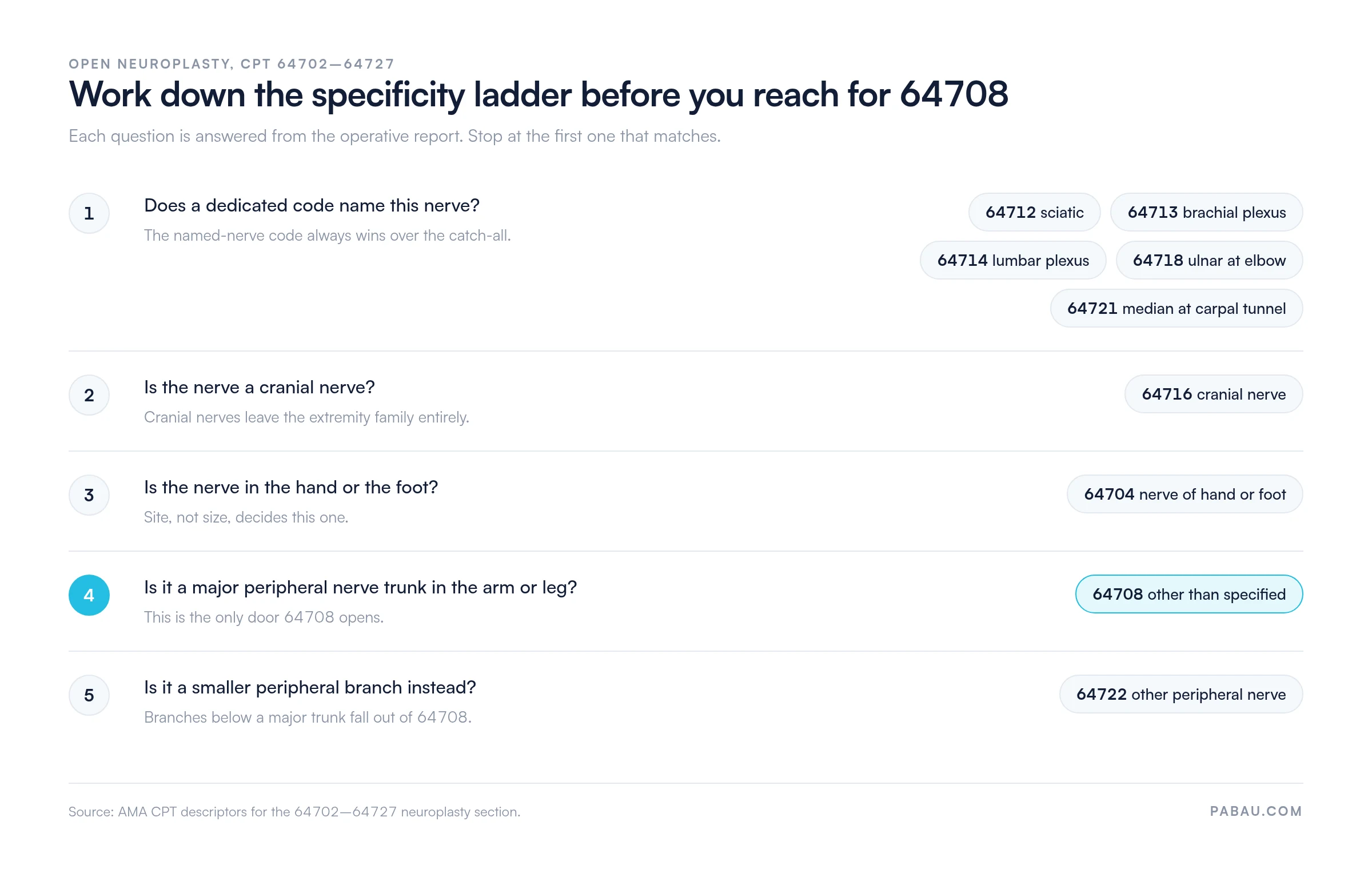
Coders most often confuse 64708 and 64721 because both involve the upper extremity. CPT 64721 covers the median nerve at the carpal tunnel and nothing else. Any other median nerve site proximal to the wrist defaults to 64708, as does any other major nerve in the arm with no named-nerve code.
Before selecting between 64708, 64721, and 64722, look up the specific nerve named in the operative report. If the nerve is named in a dedicated CPT code (sciatic, brachial plexus, ulnar at elbow, carpal tunnel), that code wins. Only reach for 64708 when the named nerve is a major peripheral trunk in an extremity with no dedicated code of its own.
The 64702-64727 range is a US code set, so practices billing UK private medical insurance work from the CCSD schedule instead. Neurolysis with transposition of a peripheral nerve is billed there under CCSD code A6810, which excludes carpal tunnel release. Release of a peripheral nerve without transposition is covered by CCSD code A6700.
Some 64708 cases are repeat surgery, where perineural fibrosis has formed around a nerve an earlier operation already released. On the CCSD schedule, a revision of a previous nerve release is billed as A6900.
Operative notes for 64708 must support every element of the code descriptor. A clean claim starts with a complete operative report, and a payer audit is won or lost on what that report says.
Attaching the operative note at claim level is what turns a complete record into a clean claim. Sending it with the original submission heads off most additional documentation requests.
Four error patterns account for the majority of 64708 claim denials and audit findings. Catching them before submission costs far less than appealing them afterward. Tracking denials by code is what turns a run of rejections into a fixable process problem.
Run a quarterly audit of 64708 claims against your denial rate by payer. Sort the denials by reason code. Laterality errors cluster in one group, documentation insufficiency in another, and bundling issues in a third. Each group needs its own fix, whether that is a modifier checklist, a note template, or a conversation with your surgeons about clinical policy.
Most surgical practices code 64708 in one system and check laterality in a second. The claim’s failure only surfaces when the remittance lands weeks later, by which point nobody remembers which modifier was dropped.
Pabau keeps the charge, its modifiers and the operative note on the same patient record. Claims go out electronically to over 4,000 US payers through our clearinghouse integration, with eligibility verified before the procedure date.
Denials come back with the reason code attached, so your billing team knows within hours whether 64708 was accepted or needs a modifier correction. Documentation requests get answered from the record that produced the claim.

Pabau helps surgical practices submit clean claims for neuroplasty procedures, track denials, and verify patient eligibility before the procedure date. See how it works for your practice.

CPT code 64708 is the catch-all for open neuroplasty of major peripheral nerves in the extremities, and it demands precision on two fronts. First, confirm that no more specific named-nerve code applies. Second, produce an operative note recording the open approach, the nerve treated, and the neurolysis or exploration performed. Missing either element drives denials.
Run the specificity ladder before every 64708 claim, and write the operative note so a reviewer can see the open approach without asking. That discipline costs a few minutes per case and saves the appeal. Book a demo to see how Pabau handles surgical coding and claim submission end to end.

Need guidance on clearinghouse claim submission? Medical claims clearinghouse overview explains how electronic claims flow from practice to payer and where errors are caught.
Submitting 837P files for surgical procedures? 837 file format guide covers the EDI transaction structure behind HIPAA-compliant professional claim submission.
Getting denied on peripheral nerve claims? Denial codes in medical billing maps the most common CARC reason codes to actionable correction steps.
CPT code 64708 describes open neuroplasty of a major peripheral nerve in the arm or leg, other than a specifically named site. It covers surgical exploration and/or neurolysis of a major peripheral nerve trunk in an extremity. Use it only when no more specific code in the 64702-64727 range applies.
The 2026 national average Medicare rate for CPT 64708 is approximately $612 in a non-facility setting and approximately $280 in a facility setting. Rates vary by geographic locality based on GPCIs. Verify your exact rate using the CMS Physician Fee Schedule lookup tool for your MAC jurisdiction.
CPT 64721 is exclusively for open neuroplasty of the median nerve at the carpal tunnel. CPT 64708 applies to any other major peripheral nerve in the arm or leg that lacks a dedicated named-nerve code. If the operative site is the carpal tunnel, use 64721. Any other major extremity nerve defaults to 64708 when no named-nerve code is available.
RT or LT marks laterality and is required whenever the procedure is unilateral. Modifier 50 covers bilateral procedures performed in the same session. Modifier 51 applies when 64708 is the secondary procedure. Modifier 59 distinguishes it as a distinct service at a separate anatomical site.
Yes, CPT 64708 is a covered Medicare service. Coverage depends on a supporting ICD-10-CM diagnosis code and on meeting the payer’s LCD requirements. Coverage requires documentation of failed conservative treatment, electrodiagnostic findings, and an operative report confirming open approach and neurolysis or exploration of the nerve.
Commonly paired ICD-10-CM codes include G56.20 (lesion of ulnar nerve) and G56.30 (lesion of radial nerve). For the lower limb, G57.30 (lesion of lateral popliteal nerve) and G57.50 (tarsal tunnel syndrome) are the usual pairs. Always use the most laterality-specific code available and confirm the diagnosis against your payer’s LCD for neuroplasty coverage.



