ICD-10 Code S42.444P: Medial epicondyle fracture, right humerus
ICD-10 Code S42.444P: full descriptor and code validity ICD-10 Code S42.444P car...

Last Updated: Oct 13, 2026
Billable Code Specific Code
S94.12XA is the billable ICD-10-CM code for injury of medial plantar nerve, left leg, initial encounter.
Coders most often confuse it with S94.11XA, which covers the right leg. The other frequent errors are a wrong 7th character at follow-up visits, and conflating it with the G57 tarsal tunnel syndrome codes. Any of those sends the claim back denied.
Let Pabau's smart automation suggest the right codes, reduce claim denials, and keep your practice compliant—effortlessly.
Automate repetitive tasks and focus on what matters most—your patients.
Reduce coding errors and ensure compliance with the latest regulations.
Clean claims, fewer denials, and faster reimbursements.
Powerful insights and reporting to help your practice thrive.
HIPAA compliant SOC 2 certified GDPR-compliant Trusted by 4,000+ clinics worldwide

S94.12XA is a billable ICD-10-CM code valid for FY2026, covering initial-encounter claims for traumatic left medial plantar nerve injury
The 7th character ‘A’ specifies active treatment; switch to ‘D’ for routine follow-up and ‘S’ for sequela documentation
Tarsal tunnel syndrome (G57.50/G57.52) is a separate entrapment condition coded outside S94 — mixing them is the most frequent miscoding error
Pabau’s claims management software helps practices submit clean S94.12XA claims and track denials before they age
ICD-10 Code S94.12XA is the specific, billable ICD-10-CM diagnosis code for an injury of the medial plantar nerve of the left leg.
It applies at the initial encounter, while active treatment is still in progress. The code is valid for FY2025 and FY2026 with no changes to its descriptor.
The code sits in Chapter 19, covering injury, poisoning and certain other consequences of external causes (S00-T88). Within that chapter it falls under block S90-S99, injuries to the ankle and foot. The category is S94, injury of nerves at ankle and foot level.
The placeholder character X in the 6th position is a structural filler required by ICD-10-CM formatting rules. It carries no clinical meaning. Its only job is to let the 7th-character extension sit in its mandatory final position. Omitting the X or misplacing the 7th character produces an invalid code string that most clearinghouses reject at intake.
The medial plantar nerve is the larger of the two terminal branches of the tibial nerve. It passes through the tarsal tunnel, then runs along the medial plantar surface of the foot.
From there it supplies sensation to the medial three and a half toes. Its motor branches serve the abductor hallucis, the flexor digitorum brevis, and the first two lumbricals. Recording which branch was damaged, and how, is what lets a payer connect the diagnosis to the treatment billed.
Four mechanisms account for most of these injuries, and the note has to name one of them.
Clinical presentation typically includes medial plantar dysesthesia, weakness of toe flexion, and a positive Tinel’s sign over the medial ankle.
The 7th character A in S94.12XA designates initial encounter, meaning the patient is receiving active treatment for the injury. According to the CMS ICD-10-CM coding guidelines, “initial encounter” applies as long as the provider is actively treating the condition. The first calendar visit is not the test.
A patient may present on their fifth appointment and still qualify for the A character. What matters is whether active treatment is still ongoing — wound care, splinting, a nerve block, or surgical repair.
Confusion between A and D is one of the top denial triggers for S94 codes. Set the character from the treatment plan recorded at that visit, not from the visit’s position in a series. A visit-type prompt built into the intake workflow catches most of these before the claim goes out.
The same A and D test applies in the upper limb, where the nerve and body site change but the encounter rule does not. A left arm radial nerve injury at forearm level takes S54.22XD once active treatment ends and routine care begins.
S94 covers injury of nerves at ankle and foot level. Within this category, the S94.1 branch is specific to the medial plantar nerve. The table below sets out the codes a coder picks between. The same laterality pattern runs across Chapter 19, and the rest of the family sits in our ICD-10-CM code index.
S94.11XA covers an identical injury mechanism to S94.12XA but on the right leg. Laterality errors are one of the most common reasons S94 claims are rejected by automated claim-edit systems.
The documentation has to state left or right explicitly. A note that says only “plantar nerve injury” forces the coder to S94.10XA, the unspecified-leg code. Many payers reject that code as insufficiently specific, or downcode the reimbursement.
Check laterality against two sources before choosing between S94.12XA and S94.11XA. Use the provider’s narrative assessment and the physical exam or imaging report.
If imaging is available, the laterality noted there should match the code. Resolve any disagreement between the imaging and the clinical note with a provider query before submission.
Category S94 carries no Excludes1 notes that directly block S94.12XA. The boundary that matters is the one between S94 and G57. S94 covers traumatic nerve injury. G57 covers mononeuropathies of the lower limb, tarsal tunnel syndrome included. The two chapters describe different etiologies and cannot be swapped for each other.
Tarsal tunnel syndrome is a compression neuropathy of the tibial nerve or its branches inside the tarsal tunnel. It is coded G57.50 for an unspecified leg, G57.51 on the right, and G57.52 on the left. Chronic mechanical compression, inflammation, or a structural abnormality causes it.
S94.12XA documents a discrete traumatic event that damaged the nerve. The AAPC ICD-10-CM code lookup places G57 and S94 in separate chapters for that reason.
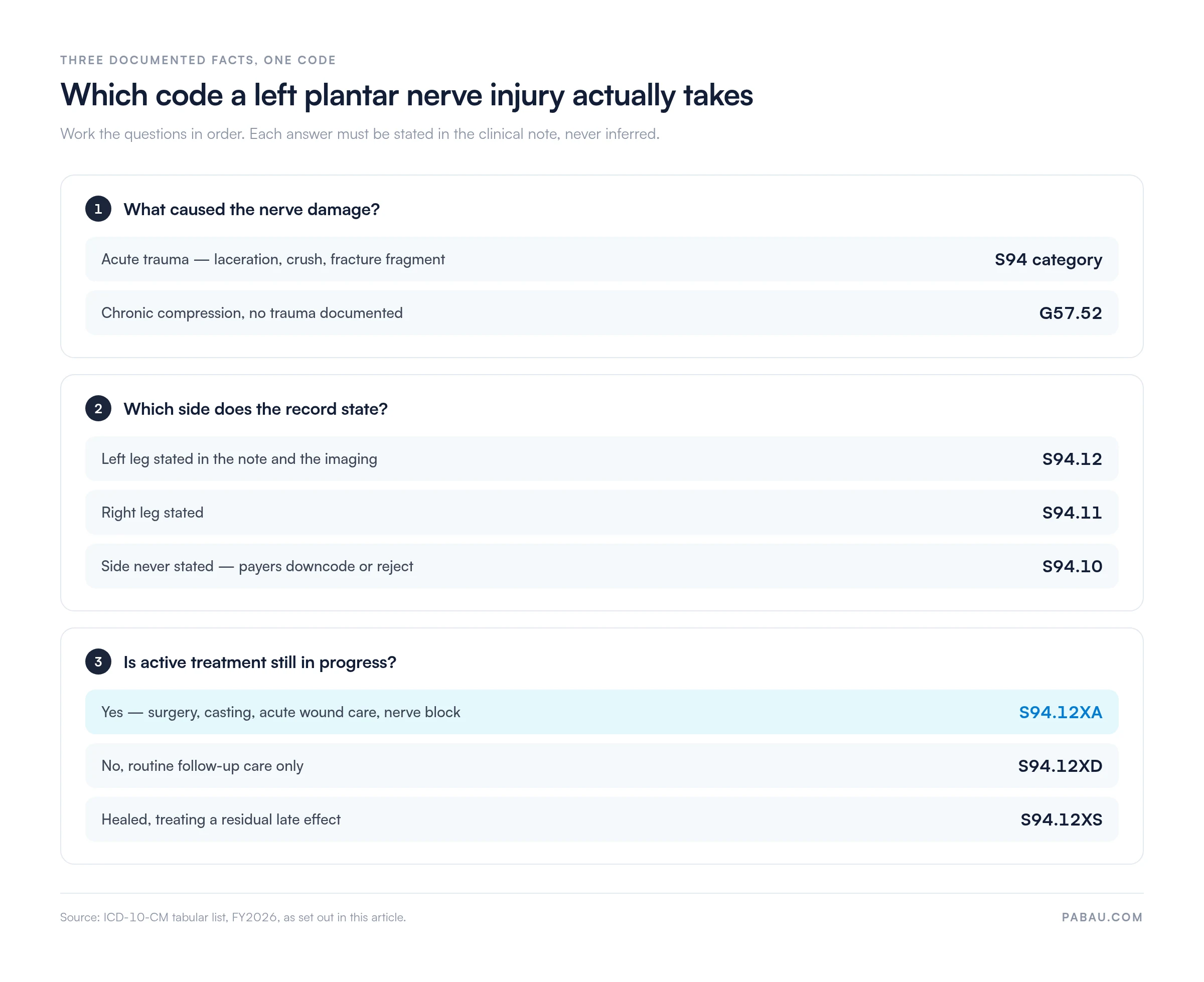
Three documented facts decide which code goes on the claim, and they have to be worked in order. The chart below shows where each answer lands.
Payers auditing S94.12XA claims look for six documentation elements. Missing any one of them can trigger a denial or a request for more information. The CMS Official Guidelines for Coding and Reporting require every code to be supported by the clinical record. On traumatic nerve injury codes, the mechanism and the laterality draw the most scrutiny.
Practices that build these six elements into the encounter note capture them once, at the point of care. That beats reconstructing a record months later when a payer asks for it. Running the claim through a clearinghouse edit before submission catches format errors while they are still cheap to fix.
The procedure codes billed alongside S94.12XA depend on the treatment phase. Evaluation and management codes dominate initial-encounter billing. Surgical nerve repair and electrodiagnostic codes appear once injury severity warrants intervention. According to the AMA CPT coding resources, every pairing has to be supported by medical necessity documentation in the record.
Practice management software like Pabau supports cleaner claims management by flagging CPT-ICD pairing mismatches before the claim is submitted. That matters most on nerve injury codes, where NCCI edits are common.
The CPT numbers above come from publicly available AMA category descriptions. Verify code applicability, RVU values, and NCCI edit pairings against the current AMA CPT codebook for the billing year. Depending on the surgical approach, 64708 may also apply, so confirm the descriptor before billing.
Run S94.12XA through your clearinghouse’s NCS code pairing rules before submitting. Several commercial payers apply NCCI edits that bundle 95905 and 95907 when both are billed the same day by the same provider. If both studies are medically justified, document them separately in the record and attach a modifier 59 or XS where payer policy allows.
S94.12XA denials cluster around a predictable set of coding and documentation errors. Each one has a corrective action, and knowing it is what keeps the rework short. Practices that work these denials systematically recover revenue that would otherwise go uncontested.
Medicare and commercial payers apply medical necessity review to peripheral nerve injury claims under S94.12XA. The review tightens when surgical repair CPT codes are billed alongside it.
Local Coverage Determinations, or LCDs, from CMS contractors may apply to nerve conduction studies 95905 and 95907. Check your MAC’s LCD for peripheral nerve studies before billing electrodiagnostics with S94.12XA.
Prior authorization is driven by the CPT codes paired with S94.12XA, rather than by the diagnosis code. Surgical nerve repair under 64726 typically requires prior authorization from commercial payers. EMG and NCS studies may need medical necessity documentation submitted in advance.
Verify with the payer’s own authorization portal before scheduling any procedure billed with S94.12XA. The CDC/NCHS ICD-10-CM web tool confirms code validity and hierarchy for each fiscal year.
In most practices the coder works from a note written for a clinician to read. Laterality sits in one field, the mechanism of injury in another, and the treatment plan in a third.
Pabau’s digital forms put those three elements in fixed fields on the encounter note, so the coder finds them in one place. Its claims tools then check the CPT and ICD-10 pairing before the claim leaves the practice.

Claims go out electronically, and anything that comes back denied lands in a worklist with its reason code attached. Your team works the denial while the appeal window is still open.

Pabau’s integrated claims management catches laterality errors, 7th-character mismatches, and CPT pairing issues on nerve injury codes before submission. See how it works for your practice.

Confirm the injury is traumatic rather than an entrapment. Then confirm the side is left, and that the 7th character matches the current encounter. Those three facts have to come from the note, which is why S94.12XA is a documentation problem before it is a coding problem.
Fixing it at the point of care costs a prompt on an intake form. Fixing it after a denial costs an appeal, and sometimes the whole claim.
Pabau helps practices submit clean S94.12XA claims and catch coding errors before they reach the clearinghouse. To see how that fits your billing workflow, book a demo with the Pabau team.

Need a clean-claim checklist for nerve injury codes? Clean claim submission standards covers the elements every S94 claim must carry before hitting the clearinghouse.
Billing a facility claim for foot nerve repair? 837 electronic claim file guide explains how HIPAA-standard electronic claims are structured for facility and professional billing.
Handling a denied S94.12XA claim? Denial codes in medical billing explains the CARC and RARC codes that appear when nerve injury claims are rejected.
Need the wider picture on how a claim gets paid? What is medical billing walks through the cycle from encounter to remittance.
Working a backlog of denied claims? Denial management in healthcare sets out a process for triaging and appealing them.
ICD-10 Code S94.12XA is the billable ICD-10-CM diagnosis code for an injury of the medial plantar nerve of the left leg. The 7th character A means active treatment was in progress at the time of the visit. The code sits in Chapter 19 (Injury, S00-T88), block S90-S99, category S94.
Yes. S94.12XA is a valid, billable ICD-10-CM code for FY2026 with a full 7-character string. It is accepted by HIPAA-compliant payers on both CMS-1500 and UB-04 claim forms, provided the clinical documentation supports the diagnosis and encounter type.
S94.12XD (subsequent encounter) applies once active treatment is complete and the patient is receiving routine follow-up care — cast removal, wound check, physical therapy progression. S94.12XA applies as long as active treatment (surgery, acute wound care, nerve block) is ongoing, regardless of how many visits have occurred.
S94.12XA codes a discrete traumatic nerve injury (laceration, crush, fracture complication). Tarsal tunnel syndrome codes G57.50-G57.52 code chronic nerve entrapment or compression without an acute traumatic event. They occupy different ICD-10-CM chapters and cannot be used interchangeably. The etiology documented in the clinical note determines the correct code.
Five errors account for most of them. The 7th character is wrong, the laterality is wrong, or the external cause code is missing. Others conflate S94.12XA with a tarsal tunnel syndrome code, or drop the placeholder X from the code string. Each has a corrective action in the denial table above.
The most commonly paired CPT codes are E&M codes 99213-99215 for office visits and nerve conduction studies 95905 and 95907. Surgical neuroplasty code 64726 covers plantar digital nerve procedures. Verify all pairings against the current AMA CPT codebook and your payer’s NCCI edit table before submitting.