

HCPCS Code Q4175: Billing, coverage, and documentation guide
HCPCS Code Q4175: Code Description and Product Identity HCPCS Code Q4175 is the ...

Last Updated: Nov 20, 2026
64831 is the CPT code for suture of digital nerve, hand or foot; 1 nerve. It reports a direct repair of one proper or common digital nerve in a finger or toe, without a nerve graft.
The code relates to add-on code 64832 and to 64834 (common sensory nerve). Report 64832 once for each additional digital nerve sutured in the same session. Claims turn on the operative report naming the nerve, the digit, and the side.
Let Pabau's smart automation suggest the right codes, reduce claim denials, and keep your practice compliant—effortlessly.
Automate repetitive tasks and focus on what matters most—your patients.
Reduce coding errors and ensure compliance with the latest regulations.
Clean claims, fewer denials, and faster reimbursements.
Powerful insights and reporting to help your practice thrive.
HIPAA compliant SOC 2 certified GDPR-compliant Trusted by 4,000+ clinics worldwide

CPT Code 64831 reports a direct suture of one digital nerve in the hand or foot, without a nerve graft.
Report add-on code 64832 once for each additional digital nerve sutured in the same session.
CPT 64834 is a separate standalone code for a common sensory nerve of the hand or foot, not an add-on to 64831.
The operative report should name the nerve, the digit, and the side, and confirm that no graft was used.
Pabau’s claims management software sends US claims through Claim.MD and posts ERA remittances on the patient record.
CPT Code 64831 is the CPT code for suture of digital nerve, hand or foot; 1 nerve. The descriptor comes from the AMA’s CPT code set, which the CPT Editorial Panel maintains. It sets two boundaries. First, the nerve must be a digital nerve, meaning a proper or common digital nerve supplying a finger or toe.
Second, the base code captures one nerve. Each additional digital nerve sutured in the same session goes on its own line as add-on code 64832.
The code sits within the nervous system surgical section of CPT and applies to both hand and foot procedures. As a result, a coder who works mostly with hand surgeons can use 64831 just as well for a podiatric digital nerve repair.
The included service is a primary direct suture repair of one digital nerve, performed with epineurial technique, at either a hand or foot site. In fact, that is the full scope of the base code. Therefore, any departure from those parameters requires a different or additional code.
Additionally, the most common scope error is leaving off 64832 when the operative report documents laceration of both proper digital nerves of one finger. Both nerves are digital, and both were sutured, so the claim needs a line for each. As a result, submitting only 64831 for a two-nerve repair undervalues the encounter and no longer matches the operative note.
The most denial-prone decision in this family is choosing the base code, then deciding how many add-on lines apply. Also, CPT 64832 and 64834 are the two codes most often confused with 64831. Each code has a distinct nerve or nerve-count scope, and the three questions below settle it.
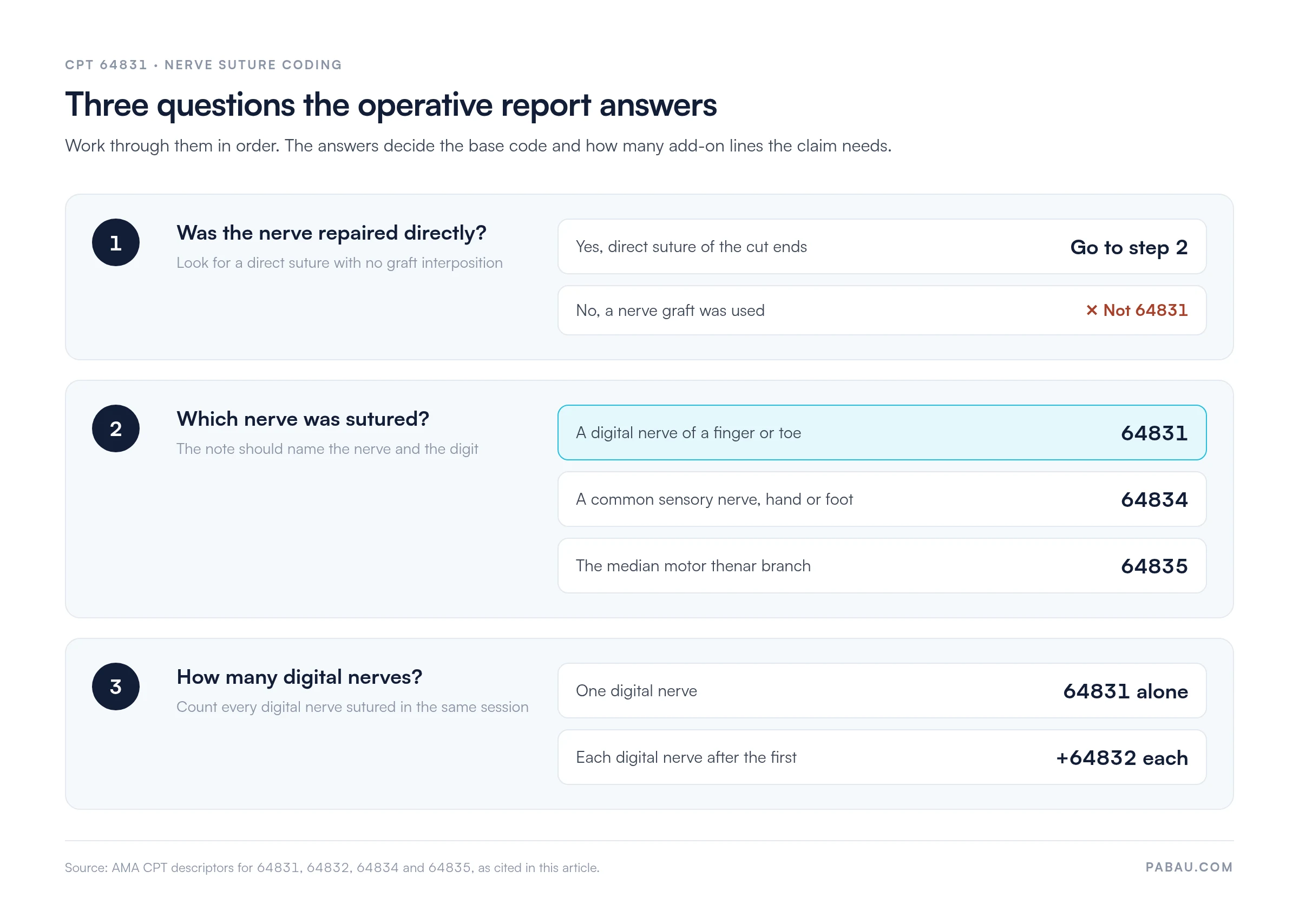
The table lists the official descriptor for each code in the family.
Practical decision rule: First, start with 64831 for the first digital nerve. Then add 64832 once for every additional digital nerve repaired in the same session. Use 64834 instead when the nerve is a common sensory nerve rather than a digital one. However, CPT 64835 covers a specific motor branch and is not interchangeable with 64831.
Before submitting a 64831 claim, count the nerve repairs documented in the operative report. If the surgeon sutured two proper digital nerves of the index finger, you need 64831 plus 64832 on the same claim. Submitting only 64831 for a dual-nerve repair is a common underbilling error that also creates an operative note versus claim mismatch.
Payers audit 64831 claims by pulling the operative report and checking whether the documented procedure maps to the code’s descriptor. Consequently, missing any of the elements below invites a medical necessity or non-covered service denial. Moreover, thorough operative notes are the foundation of building a clean claim. A superbill that captures every procedure element at the point of service cuts post-visit rework.
After incomplete operative notes, modifier selection causes the most 64831 claim failures. The table below summarizes the modifiers that apply and when each is required.
NCCI bundling: The National Correct Coding Initiative (NCCI) bundles certain wound closure codes with 64831 when performed at the same site. In addition, simple layered closure of the skin overlying the nerve repair is part of the global surgical service.
A separate wound closure code alongside 64831 produces a bundling denial unless it carries modifier 59. The note must also show the closure was at a distinct anatomic site. Check the current NCCI table release for the specific edit pairs, because edits update quarterly.
Medical necessity for CPT Code 64831 requires a diagnosis code that logically supports a nerve suture repair. Traumatic laceration is the most common driver, but neuromas and stretch injuries also appear. Therefore, use the most specific ICD-10-CM code available based on the operative report and the treating clinician’s documentation.
For the fingers other than the thumb, S64.49- uses a sixth character for finger and side. In addition, it runs from S64.490A for the right index finger to S64.497A for the left little finger. Meanwhile, the thumb has its own subcategory, S64.3-.
However, a specific ICD-10 code documenting nerve injury does not guarantee coverage. Instead, the payer’s coverage policy and the clinical documentation decide medical necessity. Likewise, never submit an unspecified code when the operative report supports a more specific one. Finally, the finger, the side, and the encounter character (A for initial, D for subsequent, S for sequela) must match the clinical scenario.
Medicare covers CPT Code 64831 when medical necessity is established through supporting diagnosis documentation. The CMS Physician Fee Schedule sets national payment rates, with geographic adjustments applied by Medicare Administrative Contractors (MACs) based on locality. Also, for US practices, Pabau sends claims through Claim.MD and runs insurance eligibility verification before the patient arrives.
RVU values and Medicare payment rates change with each CMS final rule. Thus, always use the AAPC Codify CPT lookup or the CMS fee schedule search to confirm current-year values before quoting reimbursement to a practice or patient.
Prior authorization: Medicare does not require prior authorization for CPT 64831 as a standard rule, but commercial payers and Medicare Advantage plans vary significantly. Therefore, always verify pre-authorization requirements against the specific plan before scheduling elective digital nerve repair. Prior auth requirements also vary by place of service.
CPT Code 64831 carries a 90-day global surgery period under the Medicare Physician Fee Schedule. During those 90 days, postoperative visits related to the digital nerve repair are bundled into the global payment.
For example, a separate evaluation and management (E/M) code for a routine wound check inside that window is denied. However, the exceptions need modifier 24 for an unrelated E/M visit or modifier 79 for an unrelated procedure.
Effective denial management workflows start before the claim is submitted. The table below maps the most common CPT 64831 denial patterns to their root causes and corrections. It also draws on the standard medical billing denial codes.
A digital nerve repair passes through several hands before the claim goes out. First, the surgeon dictates the operative note, a coder reads it, and someone keys the charge. Each handoff is also a chance to drop a modifier or the second nerve’s 64832 line.
Pabau’s claims management software keeps the charge, the operative note, and the claim on one patient record. In addition, US practices submit CMS-1500 and 837P claims through Claim.MD and check eligibility before surgery. Afterward, ERA remittances post back to the same record, and secondary claims go out from it once the primary payer has paid.
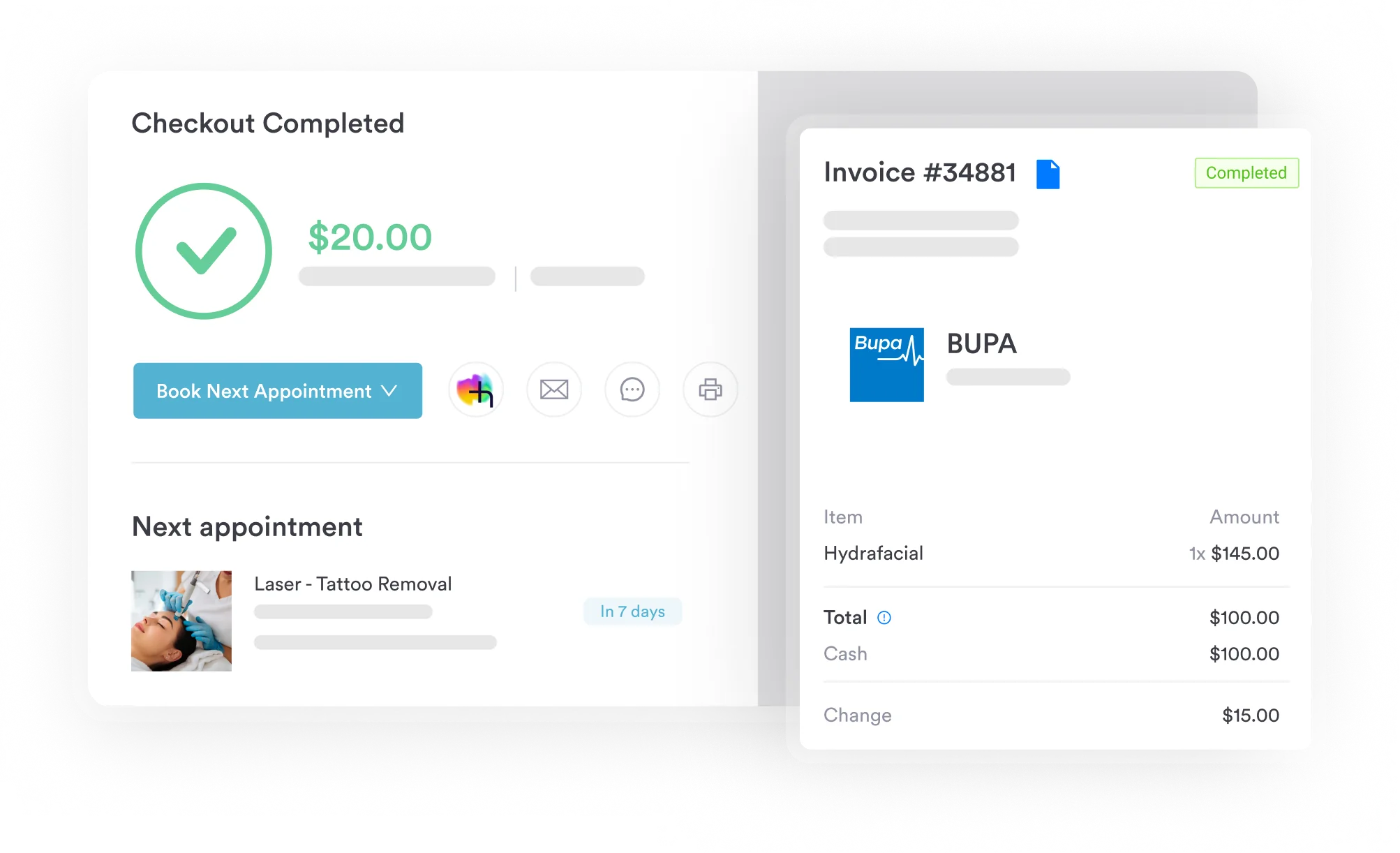
The coder still decides between 64831, 64832, and 64834. However, what changes is the follow-up. A denial and its remittance sit next to the operative note, so the team can correct and resubmit without hunting for paperwork.
Run a quarterly audit of your 64831 claims by pulling the denial rate alongside the modifier usage rate. Suppose more than 15% of claims lack a laterality modifier at first submission. Then your charge entry workflow needs a mandatory laterality field before the claim can advance. A one-time workflow fix typically outperforms ongoing coder training for rule-based errors like missing modifiers.

Pabau keeps the charge, the operative note, and the claim on one patient record. US claims go out through Claim.MD, and ERA remittances post back so your team can correct a denied 64832 line quickly.

CPT Code 64831 pays cleanly when the claim mirrors the operative note. Count the digital nerves first, because that count sets the number of 64832 lines. Then match the finger and side in the diagnosis code.
As a result, a coder who checks those two points before submission avoids most of the denials in this guide. Fixing them at charge entry costs minutes, while an appeal costs weeks of follow-up.
Book a demo to see how Pabau keeps each nerve repair claim, remittance, and operative note on one record.

Need to understand how clearinghouse submission works? Our Claim.MD clearinghouse guide explains how claims route from practice management software to payers and back.
Seeing denial patterns across multiple CPT codes? Revenue cycle management fundamentals covers the full workflow from charge entry through payment posting.
Billing for a surgical practice that handles multiple procedure codes? Best medical billing software for US practices compares platforms by denial rate, clearinghouse integration, and reporting depth.
CPT Code 64831 covers suture of a single digital nerve in the hand or foot using direct epineurial repair technique during one operative session. It does not include nerve grafts, neuroplasty, or repair of non-digital peripheral nerves.
CPT 64832 is the add-on code for each additional digital nerve sutured in the same operative session. Report it once for every digital nerve beyond the first, alongside the primary code 64831.
CPT 64831 is the suture of one digital nerve in the hand or foot. CPT 64832 is the add-on for each additional digital nerve. CPT 64834 is a separate standalone code for a common sensory nerve of the hand or foot.
Traditional Medicare does not require prior authorization for CPT 64831 as a standard rule. Medicare Advantage plans and commercial payers set their own policies, which vary by plan and setting. Verify prior authorization with the specific payer before scheduling elective nerve repair.
CPT 64831 has a 90-day global surgery period. Post-operative visits related to the nerve repair are bundled into the global payment for 90 days after the procedure date. Unrelated E/M services during the global period require modifier 24.
For fingers other than the thumb, S64.49- codes carry the finger and side, such as S64.490A for the right index finger. Thumb injuries use S64.3-, and foot injuries use S94.31XA or S94.32XA. Use the most specific code the documentation supports.





