HCPCS Code G0163: Skilled nursing observation and assessment
What is HCPCS Code G0163? HCPCS Code G0163 is a deleted Level II code for skille...

Last Updated: Oct 15, 2026

CPT code 64493 covers one lumbar or sacral facet joint injection at a single level, with fluoroscopy or CT guidance built into the descriptor.
Add-on codes 64494 and 64495 report the second and third levels, and neither can be billed without 64493 on the same claim.
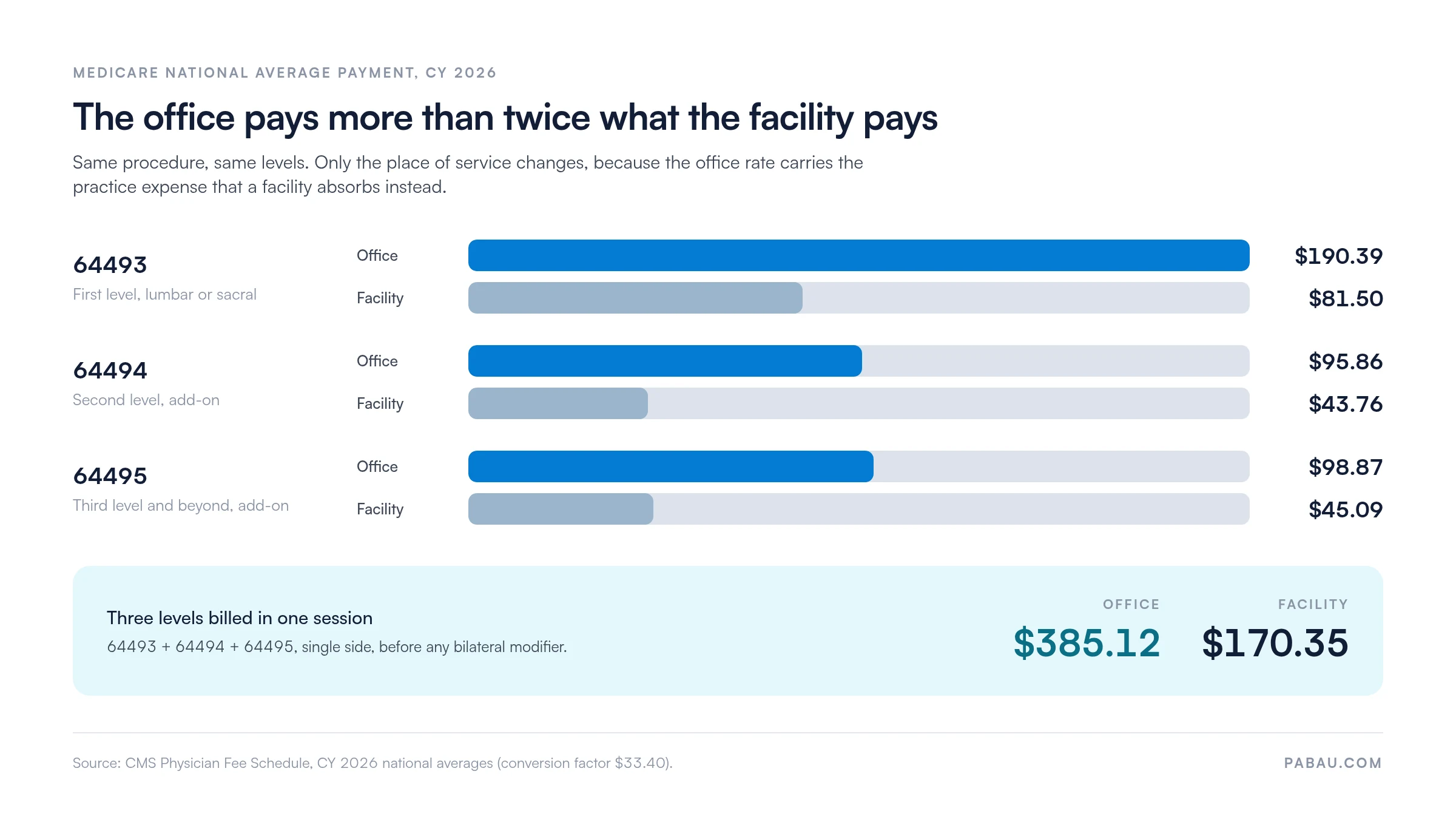
Medicare pays about $190 for 64493 in an office and about $82 in a facility, on CY 2026 national averages.
Modifier 50 is the physician’s bilateral modifier in both settings, while the ASC facility bills two lines with RT and LT.
Practice management software like Pabau tracks each 64493 claim and flags missing image guidance notes before submission.
CPT code 64493 is the billing code for a diagnostic or therapeutic injection into a single lumbar or sacral facet joint. The descriptor builds in fluoroscopy or CT guidance, so image guidance is part of the code rather than an add-on. Miss it in the operative note and the claim gets denied on medical necessity.
This guide covers the descriptor, the 64494 and 64495 add-on codes, and current Medicare rates. It also covers the ICD-10 codes that support medical necessity, the modifier rules, and the errors that drive denials. Every payment figure below comes from the CY 2026 Physician Fee Schedule.
The American Medical Association maintains the CPT code set and publishes the official descriptor for 64493.
Injection(s), diagnostic or therapeutic agent, paravertebral facet (zygapophyseal) joint (or nerves innervating that joint) with image guidance (fluoroscopy or CT), lumbar or sacral; single level.
Three elements have to be present before 64493 applies.
Miss one of the three and 64493 is the wrong code.
64493 is the base code for lumbar and sacral facet joint injections. Two add-on codes extend it when the clinician treats more levels in the same session. Add-on codes cannot be reported on their own, so 64494 and 64495 must always appear on a claim that also carries 64493.
A patient receiving bilateral L3-L4 and L4-L5 injections in one session generates two codes. Report 64493 for the first level and 64494 for the second, with modifier 50 for the bilateral work. Reporting 64494 or 64495 without 64493 on the same claim triggers an automatic rejection at almost every payer.
The 64490 series mirrors 64493 in procedure type but applies to the cervical and thoracic spine. Both series require image guidance and follow the same add-on stacking rule. Picking the wrong series is a common error in interventional pain practices, because the operative note anatomy and the code region have to match.
In the cervical and thoracic series, every level past the second is reported with 64492, not with the lumbar add-on 64495.
Image guidance sits inside the 64493 descriptor, so it is never an optional add-on. Fluoroscopy confirms needle placement during the procedure. CT guidance is used where fluoroscopy is technically insufficient, such as in patients with severe obesity or prior spinal hardware.
CMS Articles A56670 and A58364 confirm the requirement, and a claim with no documented image guidance is denied on medical necessity.
Other musculoskeletal injection codes work the other way. CPT code 20612 for a ganglion cyst carries no guidance in its descriptor, so ultrasound is reported separately with 76942.
Medicare payment for 64493 varies by place of service. The CMS Physician Fee Schedule lookup tool returns the current rate for any locality code. Office (non-facility) rates run higher than facility rates, because the office carries overhead that Medicare pays through the practice expense RVU.
Rates shown are national averages. Geographic Practice Cost Indices adjust payment by locality, so a practice in a high-cost area is paid more. The CY 2026 conversion factor is $33.40, and the CMS lookup tool returns the figure for your own MAC jurisdiction.
The add-on codes pay less than the base code and follow the same split. 64494 pays about $96 in the office and $44 in a facility. 64495 pays about $99 and $45. Stack all three on one side and the place of service is worth more than $200 a session.
The anesthetic and steroid injected are absorbed into that payment rather than billed on a separate line. Separately payable drugs work the other way, and a specialty supply like HCPCS code J1826 carries its own claim line.
Claim submission runs through a clearinghouse. Pabau’s clearinghouse partner Claim.MD reaches thousands of US payers, including the Medicare Administrative Contractors.
Claims management software then tracks acceptance rates for 64493 and surfaces denied claims for appeal, well inside Original Medicare’s 12-month timely filing deadline.
Inadequate medical necessity documentation is the most frequent reason a 64493 claim is recouped after payment. The operative note and the clinical record together have to answer five questions before the claim goes out.
A 64493 claim needs a diagnosis code that establishes facet-mediated or radicular lumbar pain. Specificity decides the outcome. Bare M54.5 was deleted in the 2021 ICD-10-CM update and is no longer billable, so use M54.50, M54.51, or M54.59 instead.
Where a disc disorder with radiculopathy supports the injection, M51.16 is the code that describes it in the lumbar region. Pair the diagnosis with the level documented in the note, not with the level the referral mentioned.
Modifier choice for 64493 depends on who is billing and where the procedure happened. CMS Article A58364 sets the rule, and it turns on site of service rather than on MAC preference. Getting it wrong delays payment and invites manual review.
Modifier 50 is not a MAC preference question. Under CMS Article A58364, the physician reports a bilateral facet injection on one line with modifier 50. That holds in an office and in an ASC. Only the ASC facility claim splits it into two lines, one unit each, with RT and LT. Sending the facility format on a physician claim delays payment.
Prior authorization for 64493 varies by payer and by MAC jurisdiction. Medicare imposes no universal prior authorization requirement for facet joint injections, though several MACs enforce one through their coverage policies.
Commercial payers set their own criteria, and many now require authorization for any lumbar facet injection series beyond the first episode.
CPT 64635 describes destruction of the lumbar or sacral facet joint nerve by a neurolytic agent, better known as radiofrequency ablation. Practices that offer both procedures confuse the two codes often. They differ in purpose, technique, documentation, and payment.
Never bill 64635 when 64493 was the procedure performed. Billing an ablation code for an injection overstates the service, and it is a frequent audit finding in pain practices.
Ablation is not the only next step after a failed injection series. Where imaging shows a lumbar facet synovial cyst and injections stop helping, excision by laminectomy is reported with code 63267.
Denials for 64493 cluster around a short list of errors. Reviewing medical billing denial codes after each denial run shows which of them are systemic and which were one-offs. That tells the practice which step in the billing workflow is costing the most revenue.
Most pain practices run 64493 through three disconnected systems. The physician dictates the operative note in one place. A coder picks the codes in another, and the biller keys the claim into a clearinghouse portal. Each handoff is a chance to lose the image guidance line or the level count.
Practice management software like Pabau holds the note, the codes, and the claim in one record. The coder works from the note the physician signed, so the level count and the guidance modality come straight from the documentation.
Claims go out through Claim.MD, and every acceptance or rejection posts back against the same patient record.
The result is a shorter path from procedure to payment. Denied 64493 lines surface on a dashboard instead of in a month-end report, which leaves time to correct and resubmit inside the filing window.


Pabau connects clinical documentation, CPT code selection, and claim submission in one workflow. Track reimbursement outcomes for CPT code 64493 and spot denial patterns before they compound.

64493 pays well and audits hard. Almost every denial traces back to the operative note rather than to the claim form. If the note names the levels, the agent, and the guidance modality, the coding follows easily. If it does not, no amount of billing skill recovers the claim.
Set the note template first, then the modifier rule, then the authorization check at scheduling. Those three controls cost nothing to put in place and remove most of what a post-payment audit looks for. Book a demo to see how Pabau moves a facet injection from signed note to submitted claim without retyping it.

Need to understand how claims flow from procedure to payment? Revenue cycle management fundamentals covers the full claims lifecycle from coding to remittance.
Struggling with ERA reconciliation after 64493 claims settle? Electronic remittance advice explained walks through how to read 835 files and match payments to claims.
Want to verify payer eligibility before scheduling facet injections? Insurance eligibility verification covers live eligibility checks and how to reduce prior-authorization surprises.
CPT code 64493 covers a diagnostic or therapeutic injection into a lumbar or sacral paravertebral facet joint at a single level. The descriptor requires fluoroscopy or CT image guidance. The American Medical Association maintains the code, and pain management, orthopedic, and interventional radiology practices all use it.
Medicare pays about $190 for CPT code 64493 in an office setting and about $82 in a facility setting. Those are CY 2026 national averages from the CMS Physician Fee Schedule. Actual payment varies by MAC locality, so check the CMS lookup tool for your own area.
CPT 64494 reports the second level of a lumbar or sacral facet injection, and CPT 64495 reports the third level and beyond. Both are add-on codes. They must be billed alongside 64493 on the same claim and cannot be submitted on their own.
Prior authorization requirements vary by MAC and by commercial payer. Medicare imposes no universal requirement, though individual MACs enforce one through their coverage policies. Most large commercial insurers require authorization for lumbar facet injections, so check with the payer before scheduling.
Yes. The physician reports a bilateral facet injection on one line with modifier 50 and one unit of service. That applies in an office and in an ASC, under CMS Article A58364. Only the ASC facility claim splits the service into two lines with RT and LT.
CPT 64490 covers cervical and thoracic paravertebral facet joint injections, and 64493 covers the lumbar and sacral region. Both require image guidance and follow the same add-on stacking structure. Pick the code that matches the anatomical level documented in the operative note.