HCPCS Code G0163: Skilled nursing observation and assessment
What is HCPCS Code G0163? HCPCS Code G0163 is a deleted Level II code for skille...

Last Updated: Oct 15, 2026
20612 is the CPT code for aspiration and/or injection of ganglion cyst(s); any location. One code covers the aspiration-only visit, the injection-only visit, and both performed together.
Coders meet it most often on a wrist or hand cyst, but the descriptor is site-agnostic and applies wherever the cyst sits. Denials usually trace back to documentation that fails to establish medical necessity, or to a bilateral modifier the payer does not accept. Medicare pays 20612 under the Physician Fee Schedule, at a rate that varies by setting and locality.
Let Pabau's smart automation suggest the right codes, reduce claim denials, and keep your practice compliant—effortlessly.
Automate repetitive tasks and focus on what matters most—your patients.
Reduce coding errors and ensure compliance with the latest regulations.
Clean claims, fewer denials, and faster reimbursements.
Powerful insights and reporting to help your practice thrive.
HIPAA compliant SOC 2 certified GDPR-compliant Trusted by 4,000+ clinics worldwide

CPT code 20612 covers ganglion cyst aspiration and/or injection at any site, within the musculoskeletal CPT range 20100-29999.
Medicare reimburses the code under the Physician Fee Schedule, and the non-facility rate is higher than the facility rate.
Modifier 50 and the laterality modifiers LT and RT are the usual choices, but payers differ on which format they accept.
ICD-10-CM codes in the M67.4 subcategory support medical necessity, chosen by anatomical site and laterality.
Practice management software like Pabau captures the code, modifier, and diagnosis at the point of care, so no separate billing lookup is needed.
CPT code 20612 is defined by the American Medical Association as: Aspiration and/or injection of ganglion cyst(s); any location. The code sits in the musculoskeletal system section of the CPT code set, range 20100-29999, within the arthrocentesis, aspiration, and injection subsection. A single code covers both the aspiration-only visit and the combined aspiration-plus-injection visit. No separate CPT code exists for adding a corticosteroid or another injectable at the same encounter.
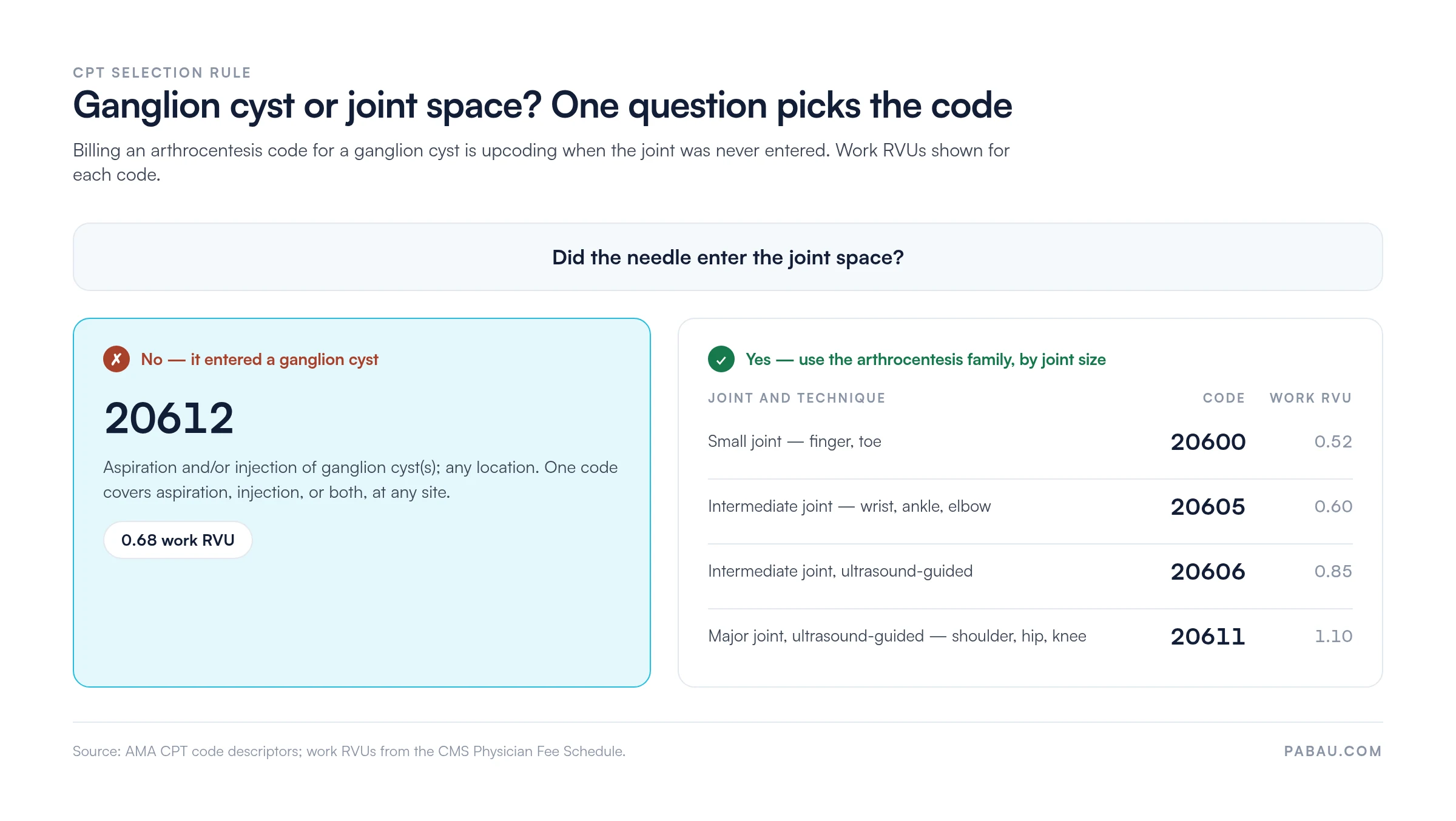
The phrase “any location” is clinically significant. Coders do not need a site-specific code, because 20612 applies whether the cyst is on the wrist, hand, foot, ankle, or elsewhere. That separates it from the arthrocentesis family (CPT 20600-20611), where code selection turns on joint size instead.
A ganglion cyst is a fluid-filled sac arising from a joint capsule or tendon sheath. They are the most common soft-tissue masses of the hand and wrist, and they also appear at the foot, ankle, and knee. Conservative treatment often fails, which makes aspiration or injection the next clinical step.
Documentation has to confirm three things. The procedure was clinically necessary given the patient’s symptoms. Conservative management had been tried, or was not appropriate for this patient. The anatomical site and technique match what the procedure note records.
Medicare reimburses CPT 20612 under the Medicare Physician Fee Schedule (MPFS). Payment differs between facility and non-facility settings, and it varies by locality through the Geographic Practice Cost Index (GPCI). The national averages below reflect the 2026 MPFS. Verify the rate for your own locality with the CMS MPFS look-up tool, because rates change annually.
Those figures come from the RVU totals below multiplied by the 2026 conversion factor. At the non-qualifying rate of $33.4009, CPT 20612 works out to about $67.80 in the office and $36.74 in a facility, before any GPCI adjustment. Private payers often negotiate above the Medicare allowable, while some Medicaid programs pay below it.
RVUs determine how Medicare calculates payment, and the total for CPT 20612 is the sum of three components. Work RVU covers physician time and skill, practice expense RVU covers overhead, and malpractice RVU covers liability. Only the practice expense component differs between the facility and non-facility settings.
RVU values come from the CMS MPFS relative value file and are revised every year. Check the current file before using these figures for practice financial planning.
Every CPT 20612 claim needs a paired ICD-10-CM diagnosis code that establishes medical necessity. The primary codes come from the M67.4 subcategory (Ganglion), extended by further characters that specify the anatomical site and the laterality. Payers deny claims where the diagnosis site does not match the procedure site documented in the chart note.
Some Local Coverage Determinations also recognize M67.48 (ganglion, other site) for less common anatomical locations. Always check ICD-10-CM code validity against the current fiscal year edition, since the code set is updated annually. The CMS ICD-10 codes page publishes the official annual update files.
Modifier selection is where billing errors cluster on this code. The two common scenarios are bilateral procedures and multiple cysts treated at one encounter. Payers handle bilateral billing differently, so confirm the policy before appending a modifier.
CPT 20612 does not include ultrasound guidance in its descriptor. When imaging guides the procedure, bill CPT 76942 (ultrasonic guidance for needle placement) separately. Append modifier 26 for the professional component in a facility setting. Check that ultrasound guidance is separately billable under the patient’s payer contract.
Check your MAC’s LCD before billing modifier 50 for CPT 20612. Novitas and WPS Medicare, for example, state different bilateral billing preferences. Some MACs want two claim lines carrying LT and RT, while others accept a single line with modifier 50. The wrong format triggers an automatic denial, and the corrected claim pushes payment back by weeks.
Documentation, rather than code selection, drives most CPT 20612 denials. Medicare’s coverage article A57079 sets frequency limits on injection services and lists dry needling as non-covered. Those rules are applied by the MAC when it adjudicates the claim, not by a clearinghouse before submission. Four documentation elements are non-negotiable for a clean claim.
Practices submitting electronically gain the most by building these four elements into the documentation template, so the claim leaves correct the first time. When one does come back, the remittance advice names a reason. Mapping those denial codes to the documentation that caused them shows which element is failing.
The National Correct Coding Initiative (NCCI) publishes quarterly edit tables that control which codes can be billed together. For CPT 20612, the bundling conflict triggered most often involves evaluation and management (E/M) codes billed the same day. CMS allows an E/M code alongside a minor procedure only when a significant, separately identifiable service is documented. The pre-procedure assessment for the procedure itself does not qualify.
NCCI edit tables update quarterly. Verify current edit pairs with the AAPC Codify code lookup, which shows the current quarter’s edits alongside the code descriptor and the RVU data.
Miscoding between CPT 20612 and the arthrocentesis family is a recurring audit finding. The codes look procedurally similar, because both put a needle into a musculoskeletal structure to withdraw fluid or deliver medication. Their anatomical targets differ. Ganglion cysts are soft-tissue masses arising from joint capsules or tendon sheaths. The arthrocentesis codes (20600-20611) describe aspiration or injection directly into a joint space.
The clinical rule is short. If the needle enters a joint space, use the arthrocentesis series (20600-20611). If it enters a ganglion cyst, a soft-tissue structure sitting next to the joint, use CPT 20612. A wrist ganglion aspiration is 20612, while a wrist joint aspiration for synovial fluid analysis is 20605. Billing an arthrocentesis code for a ganglion cyst is upcoding when the joint was never entered. The operative note has to make that distinction clear.
Coders in orthopedics, sports medicine, and primary care often weigh CPT 20612 against the trigger point and tendon injection codes. Knowing which one applies prevents both undercoding and upcoding.
Scope of practice decides who may perform and bill the injection. State rules differ on what a non-physician provider may do under supervision. Check the state board’s position and the supervising agreement before the claim goes out.
Practices billing CPT 20612 hit two friction points. The first is the lookup step, finding the right code, modifier, and ICD-10 pairing. The second is submission, getting a clean claim to the payer without manual re-entry. Pabau handles both inside one workflow.
Pabau’s built-in claims management captures the CPT code, the modifier, and the paired ICD-10-CM code when the provider documents the ganglion cyst aspiration. The charge flows into the claim without a second entry in a separate billing system. Claims route to Claim.MD, Pabau’s US clearinghouse partner. Eligibility checks run before the appointment and ERA posting lands after adjudication, so the practice sees what was paid against what was expected.
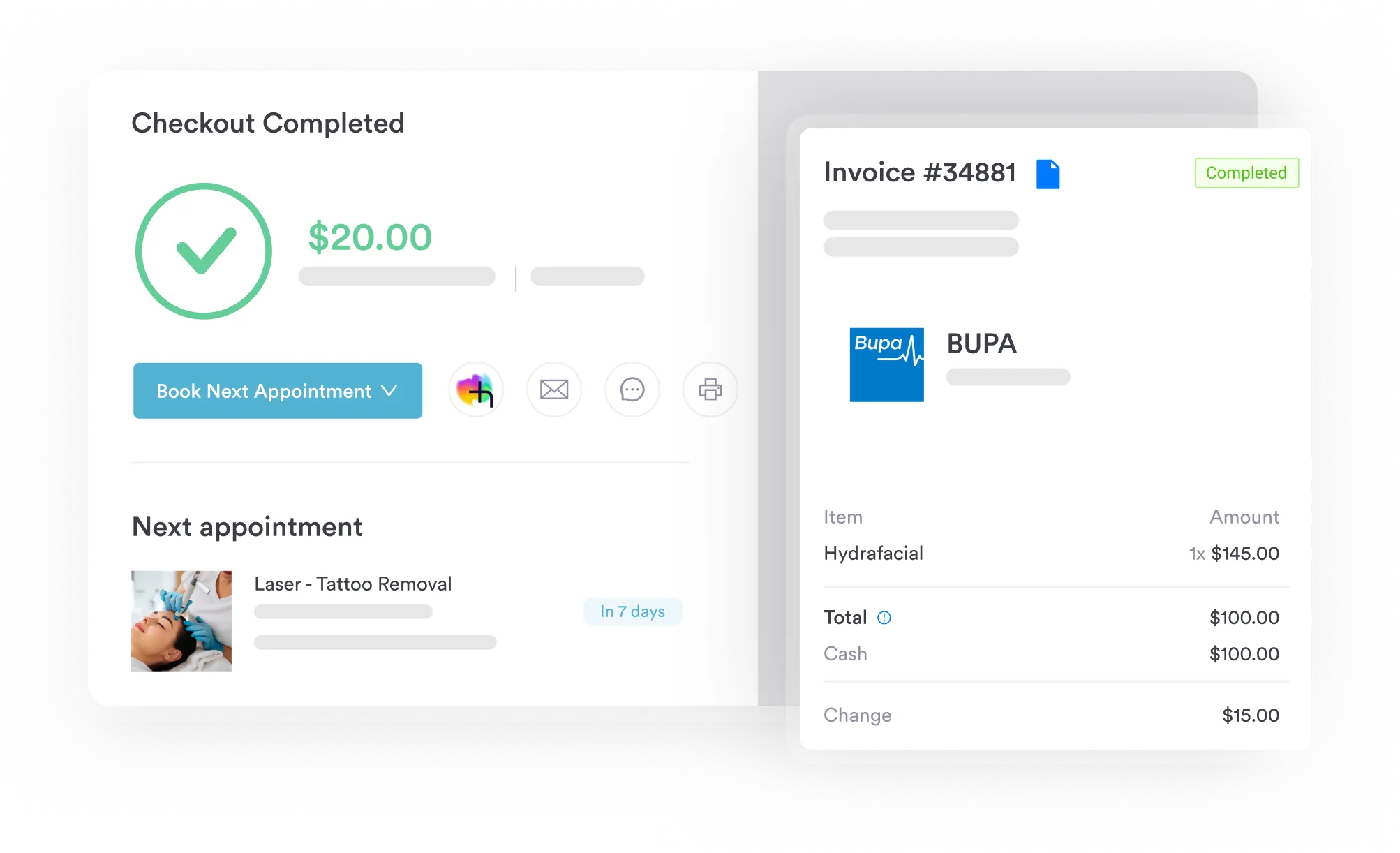
Tracking reimbursement by CPT code shows whether 20612 claims are paying at the expected fee schedule rate. A billing team can take that record into a payer negotiation, or use it to find the documentation pattern behind an underpayment. Centralizing claim data across providers and locations keeps what was documented and what was billed in step.
Run a monthly claim-level report filtered to CPT 20612 and sort it by payer. Compare the paid amount against the expected fee schedule figure for each one. A consistent shortfall from one payer usually points to a contract rate dispute. It can also mean a documentation issue the payer is using to reduce payment. Catching it at 30 days is far easier than chasing it at 90.

Pabau brings clinical documentation and claim submission into one platform. Code, document, and submit CPT 20612 claims without switching tools or re-entering data. See how it works for your practice.

Ganglion cyst aspiration is a small procedure with an outsized denial rate, and most of that is avoidable. Three habits carry the improvement. Record the anatomical site and laterality precisely, and choose the bilateral modifier your payer actually accepts. Separate the E/M note from the procedure note when both are warranted.
The trade-off worth remembering is that 20612 pays modestly, so a resubmission can cost more in staff time than the claim is worth. That makes the first submission the one that counts. Book a demo to see how Pabau captures the code, the modifier, and the diagnosis at the point of care.

Need to understand the full claim lifecycle before submission? Pabau’s Claim.MD clearinghouse guide explains how electronic claim validation works from eligibility check to ERA posting.
Seeing CPT 20612 denials pile up? Denial codes in medical billing maps the most common CARC denial codes to the documentation or modifier issues that triggered them.
Want fewer minor-procedure claims coming back? What a clean claim is sets out what a payer needs to see for a claim to pass on first submission.
CPT Code 20612 covers aspiration and/or injection of a ganglion cyst at any anatomical location. It applies to aspiration only, injection only, or both performed at the same encounter. The code is site-agnostic, so one code applies whether the cyst is on the wrist, hand, foot, or another musculoskeletal site. No additional CPT code is needed to capture the injection agent at the same visit.
Medicare’s 2026 national average is roughly $65-$70 in the non-facility setting and $35-$40 in a facility, before geographic adjustment. The exact amount depends on your GPCI locality. Use the CMS MPFS search tool to look up the payment for your location and confirm the current conversion factor, which CMS revises annually.
Yes, CPT 20612 can be billed bilaterally when the procedure is performed on both sides at the same encounter. Medicare generally accepts modifier 50 on a single claim line and pays 150% of the standard fee. Some MACs and commercial payers prefer two separate lines with modifiers LT and RT instead. Check your payer’s bilateral billing policy before submitting, because the wrong format causes an automatic denial.
CPT 20612 is billed once per cyst per encounter under standard billing rules. When separate cysts are treated at different anatomical sites during one encounter, the code may be reported more than once. Append modifier 59 to the additional unit to indicate a distinct procedural service. Payer policies on multiple units vary, and the note must describe each cyst as a separate lesion at a different site. Verify with your payer before billing multiple units.