CPT code 92521: Speech fluency evaluation billing guide
CPT code 92521: Definition and clinical scope CPT code 92521 is defined by the A...

Last Updated: Oct 5, 2026
One unit of CPT code 64492 covers every cervical or thoracic facet level past the second, however many you inject that day. It is the add-on code for image-guided facet joint injections, into the joint itself or the nerves that supply it.
It never bills alone. It follows 64490 and 64491 on the same claim, and fluoroscopy or CT guidance is already included. Lumbar and sacral levels use 64493 to 64495 instead, so check the region first. The harder question is whether the payer covers a third level at all, and that decides how you schedule.
Let Pabau's smart automation suggest the right codes, reduce claim denials, and keep your practice compliant—effortlessly.
Automate repetitive tasks and focus on what matters most—your patients.
Reduce coding errors and ensure compliance with the latest regulations.
Clean claims, fewer denials, and faster reimbursements.
Powerful insights and reporting to help your practice thrive.
HIPAA compliant SOC 2 certified GDPR-compliant Trusted by 4,000+ clinics worldwide

CPT code 64492 is the add-on for the third and any additional cervical or thoracic facet level, reported after 64490 and 64491.
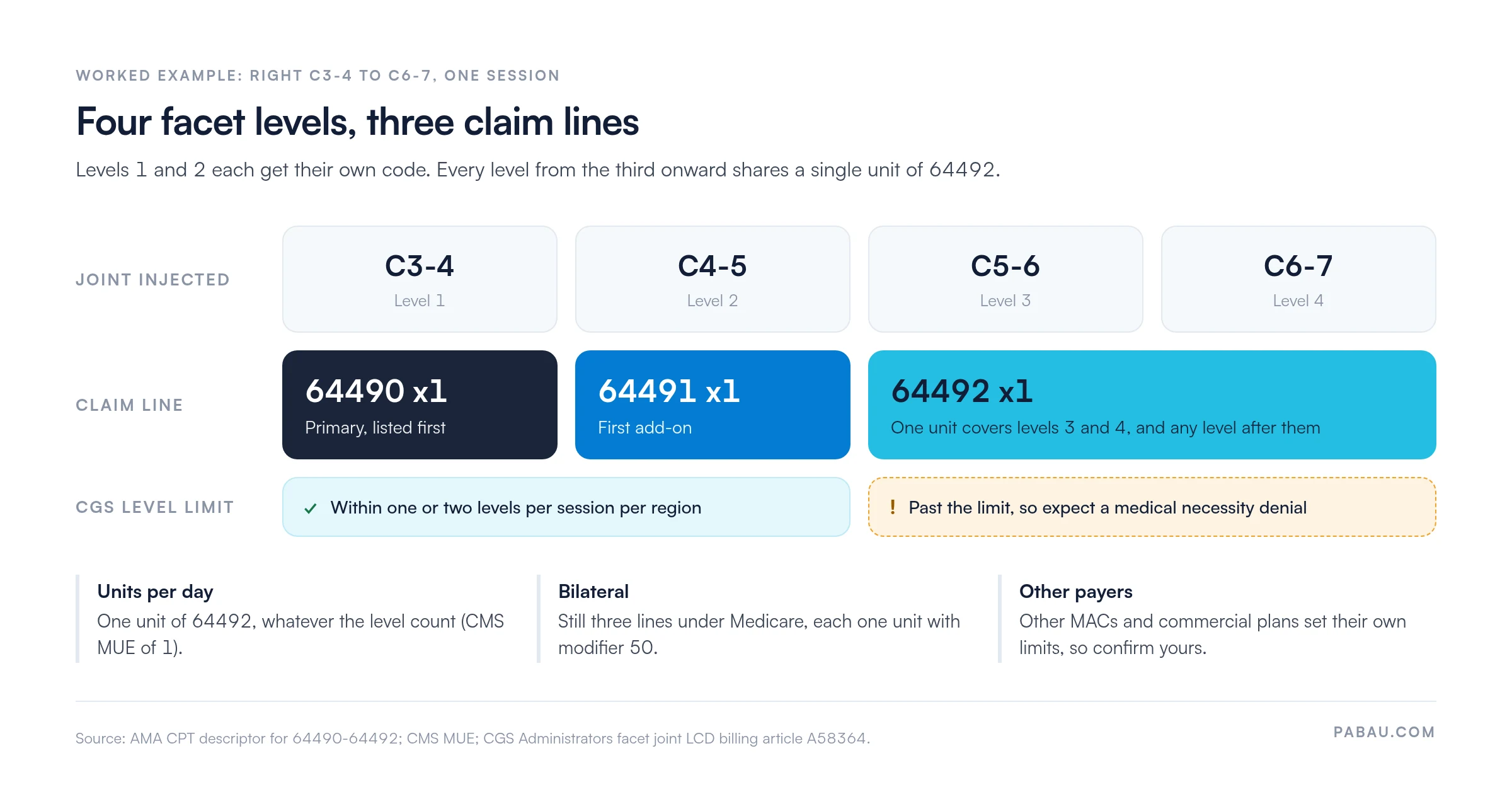
Report it once per day, so a four-level session bills 64490, 64491 and a single unit of 64492.
Lumbar and sacral levels use 64493 to 64495, while the T12-L1 joint stays in the cervical/thoracic series.
The CGS Administrators facet joint LCD billing article (A58364) allows one or two levels per session per region, so a 64492 line rarely pays. Other MACs’ facet LCDs set similar limits, so confirm with your own MAC.
Bilateral work is one unit with modifier 50 under Medicare, and fluoroscopy or CT guidance is never billed separately.
CPT code 64492 is the add-on code for a cervical or thoracic facet joint injection at the third and any additional level. It sits in the same session as 64490 and 64491, never on its own. The American Medical Association (AMA) writes the descriptor in two parts.
Two details in that wording shape every claim. First, “cervical or thoracic” fixes the region. Second, “third and any additional” means one line covers level 3 onward, however many levels follow.
One counting rule trips up new coders. A level is a facet joint, not a nerve. Blocking the two medial branches that supply C5-6 counts as one level.
The three codes work as a ladder. The primary code covers level 1, the first add-on covers level 2, and 64492 covers every level after that.
Worked example. A physician injects the right C3-4, C4-5, C5-6 and C6-7 joints under fluoroscopy. That is four levels in one session.
Notice the third line. Two extra levels still produce one unit, because CPT says not to report 64492 more than once per day. A second unit is a classic medically unlikely edit (MUE) denial. The map below lines up each joint with its claim line and the payer limit.
Name every joint on the claim note or in box 19, even though one 64492 unit covers them. When a payer asks why line 3 exists, the joint list answers the question before anyone pulls the chart.
The region decides the family, and the level number only decides the line. Lumbar and sacral joints have their own parallel series, ending in 64495. The two series look alike, which is why they get swapped.
The thoracolumbar junction catches people out. CPT places the T12-L1 joint in the cervical/thoracic series, so it codes as 64490-64492 even though L1 is lumbar.
Treating both regions on one day is allowed. Each region then starts its own ladder, for example 64490 for the neck and 64493 for the low back. Document the region of every joint so the two ladders stay separate.
The facet codes describe one side. When both sides of a level are injected, Medicare wants one unit with modifier 50. The CGS Administrators facet joint LCD billing article (A58364) counts each unilateral or bilateral intervention at any level as one unit. Modifier 50 then marks the bilateral work.
So a bilateral four-level cervical session still has three lines, each with modifier 50 and one unit. Some commercial payers prefer RT and LT on separate lines instead, so check the plan manual first.
Usually not, and this is where 64492 differs most from its neighbors. Here is the quick version, question by question.
What does the policy allow? Medicare covers facet work under each MAC’s Facet Joint Interventions for Pain Management LCD. In Kentucky and Ohio, the CGS Administrators facet joint LCD billing article (A58364) allows one or two levels per session per spinal region. That applies to unilateral and bilateral work alike.
Other MACs’ facet LCDs set similar level limits, so confirm the cap with your own MAC.
So what happens to 64492? Because 64492 starts at level 3, a CGS claim carrying it exceeds that limit. Expect a medical necessity denial there, and from any MAC with a similar cap.
Does that make the code useless? No. Commercial plans and some Medicare Advantage plans set their own level limits. Check the plan policy and prior authorization rules before you schedule a third level.
Where do I find the rate? Use the CMS Physician Fee Schedule lookup for facility and non-facility amounts in your locality. Rates change every January, so rebuild fee schedules each year.
The diagnosis must match the region. A cervical or thoracic ladder needs a cervical, cervicothoracic or thoracic code, and M47.812 is the most common pairing. These billable codes appear on the 64490-64492 covered list in the CGS Administrators facet joint LCD billing article (A58364). Other MACs publish their own lists, so confirm with yours.
Symptom and injury codes need more care. M54.2 (cervicalgia) and S13.4XXA (sprain of ligaments of cervical spine, initial encounter) are billable, and some commercial payers accept them. They are not on the CGS covered list, so CGS will not pay on them alone. Check your own MAC’s list before relying on them.
Keep lumbar codes off this claim entirely. M47.816 is lumbar spondylosis, and M54.4 is a non-billable parent code. Its children, M54.40-M54.42, describe lumbago with sciatica, which is lumbar too.
An auditor reads the note to confirm each line, not just the total. For 64492, that means the note must prove a third level happened. Build these elements into your template.
Most facet denials are set up long before the claim leaves the office. Follow the claim through its stages and the weak points show up.
The same handful of errors cause most rejections on this code. Pair each one with the denial codes on the remittance so you can fix it quickly.
Run through this list for every multi-level cervical or thoracic claim. It takes a minute and saves weeks of rework.
Facet injections often come before radiofrequency ablation. Medial branch blocks confirm the pain source, and a positive response can support a later neurotomy.
For cervical and thoracic joints, that ablation is 64633 for the first joint and 64634 for each additional joint. The lumbar and sacral pair is 64635 and 64636. Unlike 64492, the 64634 descriptor reads “each additional facet joint”, so check its units per joint.
Billing a block and an ablation at the same level on the same day generally triggers an NCCI edit. Report both only when the record shows a distinct reason for each.
Without connected software, a multi-level facet claim gets built by hand. Someone reads the note, keys three lines and checks the payer rules. Then they log into a separate clearinghouse to send it.
Pabau, the practice management platform we build, starts the claim from the patient invoice, with treatment and insurer details already attached. Its claims software for specialists runs background checks for details insurers need, such as membership numbers and authorization codes. If one is missing, the Send button stays disabled until it is fixed.
In the US, Pabau connects to Claim.MD for eligibility checks, claim status and ERA posting in one place. A missing authorization or an underpaid add-on line shows up there before it turns into a denial letter.

Pabau checks each claim for missing details before it is sent, then submits it through Claim.MD. Your team spends less time reworking multi-level facet claims.

For 64492, region comes first and the unit count comes second. Confirm the joints are cervical, thoracic or T12-L1, then report one unit after 64490 and 64491.
The bigger decision often happens before the procedure. Medicare contractors rarely pay for a third level, so check your MAC’s limit when you schedule. A clear joint-by-joint note then carries the claim through scrubbing and audit.
Book a demo to see how Pabau flags missing claim details before your facet injection claims reach the payer.

Need to understand how clearinghouse submission works? Medical claims clearinghouse guide explains how electronic routing catches errors before the payer sees them.
Submitting multi-level procedures electronically? 837 file format guide walks through the transaction that carries your facet claims.
Auditing your documentation habits? Medical billing compliance covers the record-keeping rules payers check.
Reconciling add-on payments? Electronic remittance advice shows how to read an ERA and spot underpaid lines.
Want more claims paid on first pass? Clean claim guide lists what a claim needs before it goes out.
In the office setting, often yes. The steroid is usually reported with its own HCPCS code, such as J1030 for methylprednisolone acetate 40 mg or J3301 for triamcinolone acetonide 10 mg. In a facility, the facility reports the drug instead.
No. A facet injection targets the joint or its medial branch nerves. A cervical or thoracic epidural targets the epidural space and uses different codes, 62321 for interlaminar and 64479 for transforaminal injections.
ZZZ marks an add-on code with no global period of its own. It takes on the global period of the primary procedure, 64490, so post-procedure visits follow that code’s rules.
Call the payer before the claim goes out. An authorization usually lists the codes and levels approved, so an unapproved 64492 line tends to deny. Some plans allow a retro update within a short window.
Only when the visit is significant and separately identifiable from the decision to inject. Then append modifier 25 to the E/M code. A visit that only confirms the planned injection is part of the procedure.