

CCSD code G5100: Bypass of duodenum billing guide
CCSD code G5100 bills a bypass that leaves the duodenum in place CCSD code G5100...

Last Updated: Oct 16, 2026
Billable Code Specific Code
64430 is the CPT code for injecting an anesthetic agent, a steroid, or both into the pudendal nerve. One unit covers either agent or both on one side, and any image guidance is reported on its own line.
CPT 64450 is sometimes billed in its place, which can cause payment differences and audit flags. That substitution is avoidable, because 64430 is the only code that names the pudendal nerve specifically.
Let Pabau's smart automation suggest the right codes, reduce claim denials, and keep your practice compliant—effortlessly.
Automate repetitive tasks and focus on what matters most—your patients.
Reduce coding errors and ensure compliance with the latest regulations.
Clean claims, fewer denials, and faster reimbursements.
Powerful insights and reporting to help your practice thrive.
HIPAA compliant SOC 2 certified GDPR-compliant Trusted by 4,000+ clinics worldwide

CPT code 64430 covers injection of an anesthetic agent, a steroid, or both into the pudendal nerve, and no other peripheral nerve.
Image guidance is not included in 64430 and is reported separately with CPT 77002 (fluoroscopy) or 76942 (ultrasound).
Billing 64450 for a pudendal nerve injection is a coding error that can change payment and draw audit flags.
Bilateral injections take modifier 50 on one line, and unilateral injections take LT or RT.
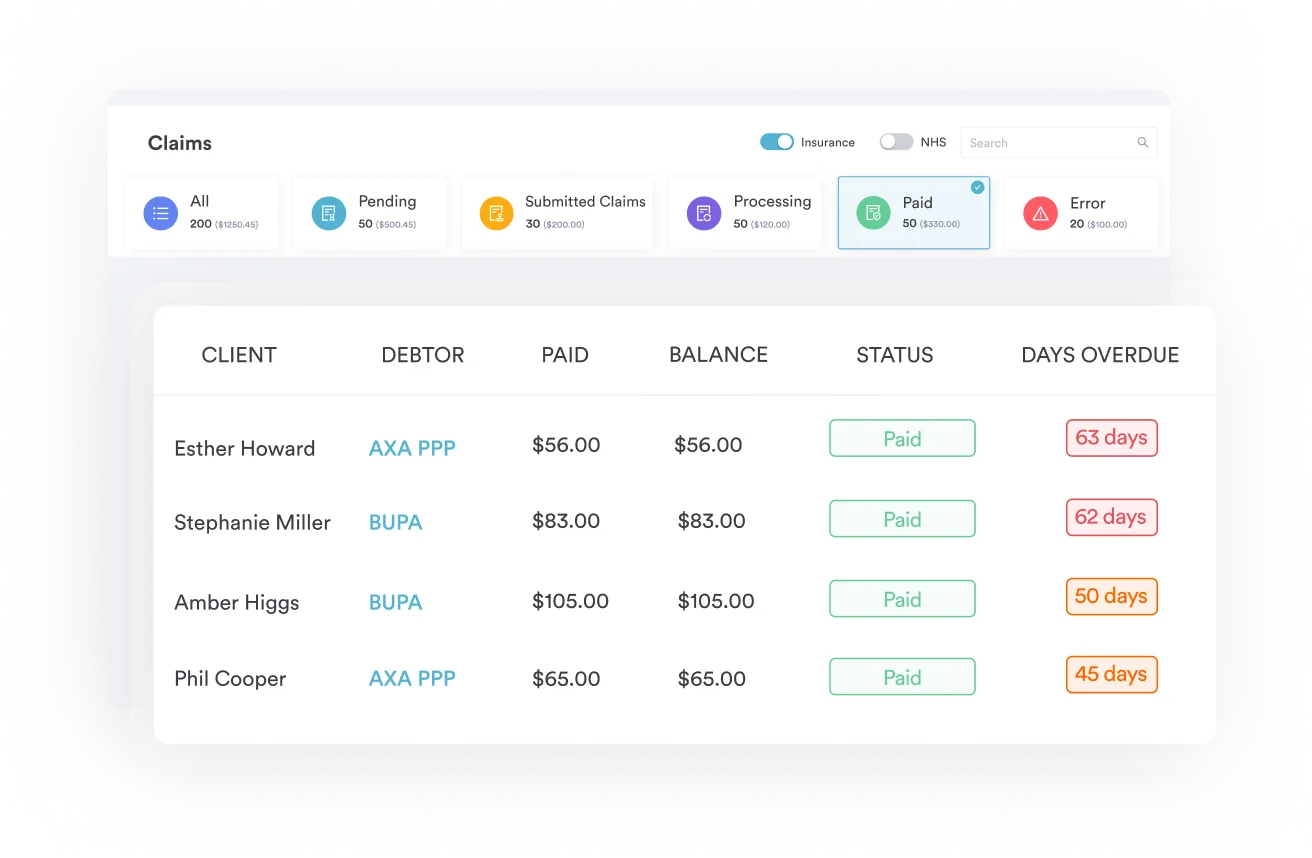
Pabau’s claims management software lets practices track 64430 claim status, denial rates, and resubmissions in one place.
CPT code 64430 is the code for injecting an anesthetic agent, a steroid, or both into the pudendal nerve. The official AMA CPT code set descriptor reads: Injection(s), anesthetic agent(s) and/or steroid; pudendal nerve. Because the descriptor names both agents, no separate line item is needed when both are used in the same session.
The code falls within the 644XX nerve block injection series, under the Surgery section (Nervous System). It carries a global surgery period of 0 days. A same-day E/M visit can still be billed with modifier 25 when it is a significant, separately identifiable service.
For 2026 reimbursement figures, check current rates in the CMS Physician Fee Schedule lookup tool and the FastRVU 2026 RVU lookup. Medicare payment amounts are updated every year, and locality adjustments apply. The table below summarizes the code details that stay fixed while the dollar amounts shift.
Commercial payer rates for CPT code 64430 depend on contract terms and are often set as a percentage of the Medicare allowable. Facility vs. non-facility setting changes the practice expense RVU, and with it the total payment.
The pudendal nerve originates from sacral roots S2 through S4. It leaves the pelvis through the greater sciatic foramen and loops around the ischial spine. It then re-enters through the lesser sciatic foramen to run within Alcock’s canal. It supplies sensation and motor control to the perineum, external genitalia, external anal sphincter, and external urethral sphincter.
This anatomy explains why pudendal nerve pathology produces such varied symptoms, and why precise injection targeting matters for both clinical and billing purposes.
CPT 64430 covers two injection approaches. Landmark-guided injection uses palpation of the ischial spine as the anatomical reference point. Image-guided injection uses fluoroscopy or ultrasound to confirm needle position. Both approaches bill the base code the same way, and image guidance is reported on its own line.
Clinical indications supported in pelvic health and urogynecology settings include:
The descriptor covers anesthetic agent, steroid, or a combination of both in a single session. Injecting both agents does not generate a second billable unit.
Several services are excluded from the base 64430 payment and must be billed separately or not at all.
CPT 64430 covers the pudendal nerve specifically. CPT 64450 covers “other peripheral nerve or branch” injections, the catch-all for nerves that have no dedicated code. The two codes are not interchangeable, and billing 64450 for a pudendal nerve injection is an incorrect code selection.
The confusion arises because 64450 is sometimes seen as a “safer” default when coders are unsure. In practice, billing 64450 for a pudendal injection creates two problems. The claim may be paid at a different rate, and payers auditing for coding accuracy will flag it as a misrepresentation of the service.
The rule is straightforward: If the nerve has its own CPT code, use that code. The pudendal nerve has 64430. Using 64450 for a pudendal injection is the same category of error as using 64450 for a brachial plexus block when 64415 is available.
The 644XX range covers most named peripheral nerve block injections. Knowing the adjacent codes prevents both miscoding and missed billing when a claim involves more than one nerve.
Check the nerve name first. If the 644XX series has a dedicated code for that nerve, use it, and reserve 64450 for nerves with no dedicated CPT code. To test your own error rate, audit your last 30 pudendal nerve claims against the operative notes.
Medicare coverage for pudendal nerve blocks is set locally, through each Medicare Administrative Contractor’s (MAC’s) Local Coverage Determinations (LCDs) and billing articles. Coverage depends on medical necessity documentation. Criteria can vary between Noridian, Novitas, CGS, NGS, and other MACs, so verify the policy for your jurisdiction.
Noridian Article A56034 (Billing and Coding: Nerve Blockade for Treatment of Chronic Pain and Neuropathy) covers Noridian’s JE and JF jurisdictions. It sets the billing and documentation rules there. Noridian is retiring that article on October 31, 2026. Its new LCD, L40265 (Peripheral Nerve Injections and Procedures for Chronic Pain), takes effect on November 1, 2026. Other MACs use their own LCDs and articles. The core criteria that appear across most MAC policies include:
Commercial payers, including BlueCross BlueShield, follow similar medical necessity frameworks. Some impose stricter frequency limits or require a specialist referral before covering nerve block procedures. Pabau, the practice management platform we build, includes claims software for practices that tracks payer-specific coverage rules alongside claim status. Denials tied to one payer’s policy show up before they turn into a revenue problem.
Medicare generally does not require prior authorization (pre-auth) for CPT 64430. Medical necessity documentation is still mandatory and must be available if the claim is audited. Commercial payers are a different matter. Many require pre-auth for nerve block procedures, and pudendal nerve blocks are no exception.
Payers that may require pre-auth for 64430 include managed Medicaid plans, some BCBS affiliates, Cigna, and UnitedHealthcare commercial products. Requirements change with plan year updates. Checking the payer’s authorization portal before scheduling the procedure avoids a denial that cannot be reversed.
Practical steps when pre-auth is required:
A missing pre-auth is a common reason for 64430 denials, and payers rarely overturn these denials on appeal.
Documentation for CPT code 64430 claims does two jobs. It supports medical necessity for coverage, and it protects the claim if it is reviewed. Missing any of the following elements commonly triggers a denial or a repayment demand.
Structured procedure notes that capture these elements at the point of care beat retrospective chart completion. They are the most dependable way to maintain medical billing compliance for nerve block procedures.
Modifiers determine how a payer processes the claim. Applying the wrong modifier, or omitting a required one, turns a clean claim into a denial. The table below covers the modifiers most commonly needed with CPT code 64430.
The ICD-10 code on the claim must clinically support pudendal nerve injection as the treatment. A mismatch between diagnosis and procedure triggers a denial that only a resubmission can fix. The codes below are among those most often paired with CPT code 64430 in pelvic pain and urology practices.
Always verify current ICD-10-CM codes against the CDC/NCHS ICD-10-CM web tool before billing. Code descriptions and cross-reference notes change with annual updates, and an unspecified code accepted last year may need a more granular code this year. Where the record supports only a symptom-level diagnosis, R10.2 is the usual fallback, so check whether your MAC accepts it as the primary code.
Most CPT 64430 denials are preventable. The patterns below come from the claim types that generate the most denial management workflows in pelvic pain and urology practices.
Knowing the common denial codes for nerve block procedures lets practices build targeted appeal workflows. That beats reacting to each denial after it arrives.
A systematic billing workflow for CPT code 64430 removes the manual steps where most errors enter the process. Five coding questions decide every line of the claim, as the builder below shows.
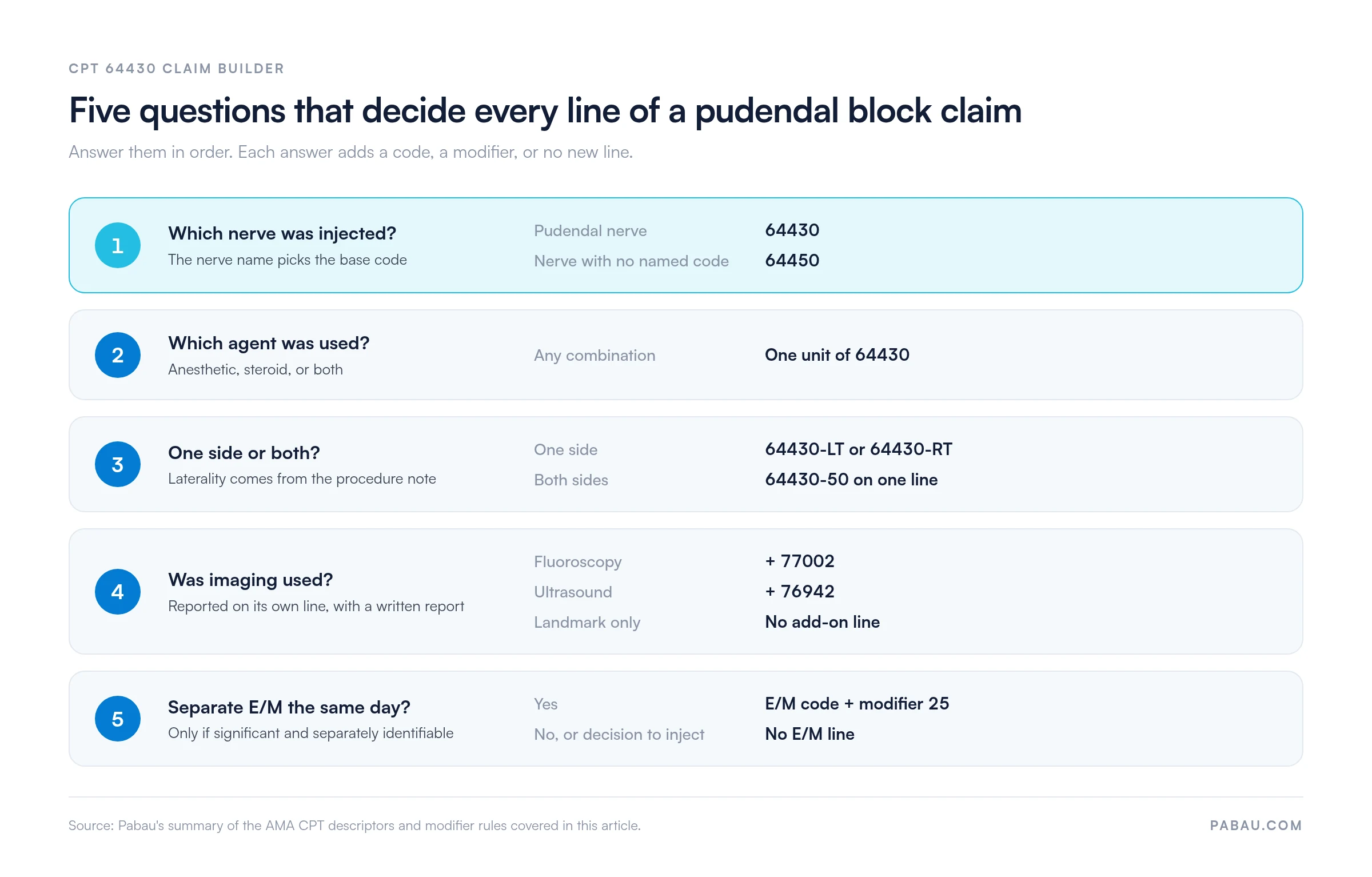
Follow these eight steps before every claim is submitted.
Running this workflow as a pre-submission checklist catches coding and documentation errors before a payer sees them. Our guide to submitting a clean claim covers the elements that trigger the most common claim edits.
Run a quarterly audit of your 64430 claims. Pull every claim billed as 64450 in the same period and cross-reference it against procedure notes that mention the pudendal nerve. A 64450 claim whose operative note names the pudendal nerve is miscoded. Depending on the payer, you can fix it with a corrected claim or an appeal.
In many practices, the coder picks 64430 or 64450 after the visit. They work from a note that may not name the nerve, the side, or the agent. Each missing detail becomes a chart query and a delayed claim.
Pabau links procedure codes to treatment types, so the practitioner records 64430 at the point of care. Structured procedure note templates prompt for laterality, agent, technique, and treatment history while the patient is still in the room.
Claims then go out through the Claim.MD integration, and Pabau’s medical billing workflow tracks status, denials, and resubmissions in one place. Your billing team sees a 64430 denial the day the remittance lands, while the appeal window is still open.

Pabau integrates procedure coding into the clinical workflow, so practitioners associate the right CPT code with each treatment type at the point of care. Track CPT 64430 claim status, denial rates, and resubmission workflows without switching between systems.

Treat the nerve named in the procedure note as the fact that decides every pudendal block claim. When the note says pudendal, the claim says 64430, with laterality and any imaging on their own lines.
The trade-off is a little more structure at the point of care. A note that records side, agent, technique, and treatment history takes a minute longer to write. It is also the record that gets the claim paid and holds up in an audit.
Book a demo to see how Pabau carries a pudendal nerve block from the procedure note to a paid 64430 claim.

Need to understand how claims clearinghouses work for nerve procedures? Medical claims clearinghouse guide explains how electronic claim routing reduces manual submission errors.
Dealing with payer pushback on nerve block claims? Electronic remittance advice (ERA) processing covers how to read 835 files and identify denial reason codes quickly.
Want to understand revenue cycle management for procedural billing? Revenue cycle management guide walks through the end-to-end process from charge capture to payment posting.
Coding a brachial plexus block instead? CPT code 64415 covers the single-injection brachial plexus block and how to report it.
CPT code 64430 is the billing code for injection of an anesthetic agent and/or steroid into the pudendal nerve. It covers landmark-guided and image-guided approaches. Anesthetic-only, steroid-only, and combination injections are all billed under this single code.
CPT 64430 is specific to the pudendal nerve. CPT 64450 is the catch-all for “other peripheral nerve or branch” injections where no dedicated code exists. Using 64450 for a pudendal injection is a coding error, because 64430 is the correct named-nerve code.
Medicare generally does not require prior authorization for CPT 64430, but medical necessity documentation is mandatory. Many commercial payers, including managed Medicaid plans and some BCBS affiliates, do require pre-auth. Verify the specific plan’s requirements before scheduling the procedure.
Yes. Bilateral pudendal nerve injection is billed with modifier 50 appended to 64430. Most payers reimburse bilateral procedures at 150% of the single-side allowable. Do not bill two separate lines using LT and RT unless the payer’s policy specifically requires that format.
No. Image guidance is not included in the base payment for CPT 64430. Fluoroscopic guidance is reported separately with CPT 77002, and ultrasound guidance uses CPT 76942. A written supervision and interpretation report must be documented to support the separate image guidance claim.
The clinical record must include the diagnosis and matching ICD-10 code, the laterality, and the agent injected by name and volume. It also needs the technique used and, for chronic pain, the history of prior conservative treatment. Add a separate radiology report if image guidance was billed.



