HCPCS code A4714: Treated water for peritoneal dialysis billing guide
HCPCS code A4714: Official descriptor, code type, and payment status HCPCS code ...

Last Updated: Oct 15, 2026

CPT Code 64415 covers a single-injection brachial plexus nerve block, and imaging guidance is bundled into it.
CPT 64416 is the correct code when a catheter is placed for continuous infusion.
No separate per-day management code exists for a brachial plexus catheter, because 64416 already covers it.
CMS Billing and Coding Article A57452 sets the coverage criteria, so every claim needs a matching ICD-10-CM code.
Pabau links the procedure code to the diagnosis and checks NCCI edits before the claim is transmitted.
CPT Code 64415 is the procedure code for an injection of anesthetic agent, or steroid, into the brachial plexus, including imaging guidance when performed.
Anesthesiologists, pain management physicians, and surgical teams bill it for single-injection blocks of the shoulder, arm, and hand.
Two errors account for most denials on this code. The first is choosing 64415 when a continuous catheter was placed, which belongs under 64416. The second is billing imaging guidance separately, which an NCCI edit has denied since January 1, 2023. This guide covers the descriptor, billing rules, 2026 Medicare rates, the ICD-10 crosswalk, modifiers, and documentation.
CPT Code 64415 describes an injection into the brachial plexus, with imaging guidance included when it is used. The official AMA CPT code set descriptor reads: Injection(s), anesthetic agent(s) and/or steroid; brachial plexus, including imaging guidance, when performed.
The phrase “including imaging guidance, when performed” took effect on January 1, 2023. Before that date, practices could separately bill CPT 77002 (fluoroscopic guidance) or CPT 76942 (ultrasound guidance) alongside the injection. That is no longer permitted. Imaging guidance is now bundled whether or not it was used.
That same bundling phrase sits in other nerve block descriptors. CPT 64454 for genicular nerve branches carries it too, so 76942 and 77002 are not separately reportable there either. CPT 64455 for plantar digital nerve injections lacks that phrase. Ultrasound guidance is still reported separately there with 76942, though some payers bundle it.
The brachial plexus is a network of nerves running from the cervical spine through the axilla. It supplies motor and sensory function to the shoulder, arm, and hand. A block anesthetizes that network with local anesthetic delivered at one of four approach sites, chosen to match the surgical site.
Clinicians bill 64415 in two main settings. The block is either the primary anesthetic for upper-extremity surgery, or an adjunct to general anesthesia for postoperative pain control. Common indications include shoulder arthroplasty, rotator cuff repair, elbow procedures, forearm and wrist surgery, and acute pain management after trauma.
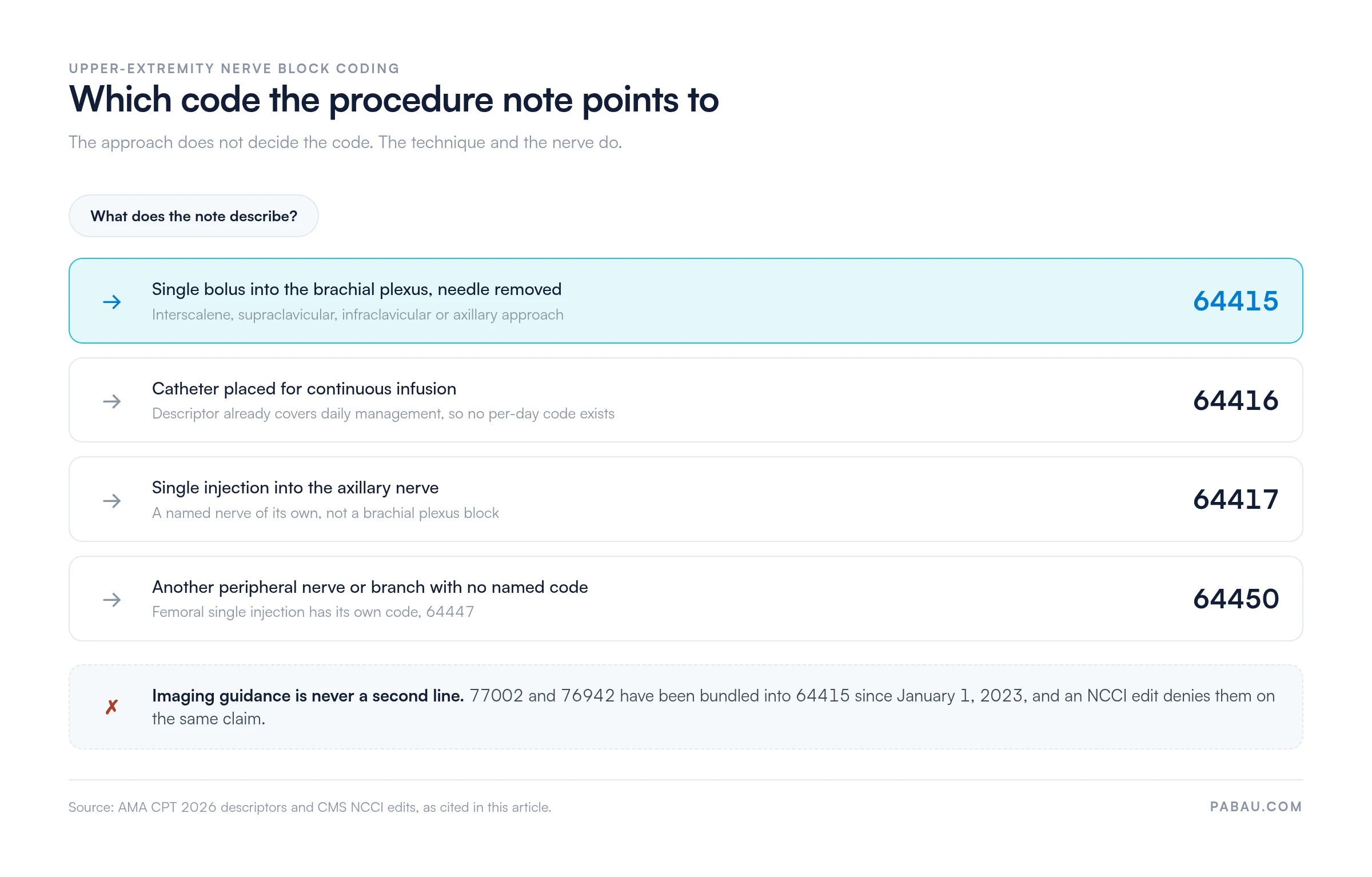
All four approaches bill under the same code, so the approach itself never decides code selection. What decides it is the technique: a single injection, or a catheter left in place for infusion.
CPT 64415 covers a single-injection brachial plexus block. CPT 64416 covers placement of a continuous nerve block catheter for ongoing infusion. Choosing the wrong one of the two causes more denials than any other error in brachial plexus billing.
The map below sets out the whole upper-extremity family, so a coder can match the operative note to one code in a single pass.
Document which technique was used in the operative note before submitting. “Brachial plexus block performed” does not say whether a catheter was left in place. That wording invites a records request, or an outright denial.
CPT Code 64415 follows category-I CPT billing rules. The payer-agnostic rules below apply across Medicare and most commercial plans. Each one has to be satisfied before the claim leaves your practice management system, which is most of what submitting a clean claim involves.
Modifier selection for 64415 depends on laterality, provider type, and payer policy. The table below covers the modifiers payers ask for most often.
Modifier 50 and LT/RT rules vary by payer. Do not assume Medicare rules carry over to commercial plans without checking each plan’s own policy first.
Every CPT Code 64415 claim must link to an ICD-10-CM diagnosis code that establishes medical necessity. Under CMS Billing and Coding Article A57452 (Peripheral Nerve Blocks), the diagnosis on the claim has to match a covered indication. The table below shows the most commonly paired ICD-10-CM codes.
This list covers the common pairings without being exhaustive. Payers verify that the linked diagnosis appears in the patient’s medical record and matches the indication in the operative note. Where the documented condition falls outside this table, the ICD-10-CM codes index gives you the full chapter structure to search.
Before you submit a 64415 claim, confirm the ICD-10-CM code appears in the pre-procedure note or the operative report. A code that exists only in the billing system, with no matching clinical note, is an audit risk. It is also a common reason MAC reviewers request records.
Thorough documentation protects the 64415 claim from audit and denial. The operative or procedure note must address several specific elements to satisfy CMS Billing and Coding Article A57452 and most commercial payer requirements.
Keep these elements in the clinical note itself rather than in a billing comment field. A post-payment reviewer reads the medical record, not the annotations your billing team left on the claim.
Drugs that carry their own billing code work differently from the anesthetic documented here. A J-code identifies the drug rather than one manufacturer’s product, so HCPCS code J1364 covers Hospira’s branded vial and the generic versions from other labelers.
Medicare reimbursement for CPT Code 64415 is set annually through the Medicare Physician Fee Schedule (MPFS). Rates vary by geographic locality, and by facility versus non-facility place of service. The Geographic Practice Cost Index (GPCI) adjustment for your MAC jurisdiction moves them again.
Verify national average 2026 rates with the CMS Physician Fee Schedule lookup tool, or the FastRVU 2026 RVU lookup, for your specific locality. The table below shows the rate structure as a reference framework.
Medicare coverage for CPT Code 64415 is governed by CMS Billing and Coding Article A57452, Peripheral Nerve Blocks. Its applicability varies by MAC jurisdiction. Confirm whether your MAC follows A57452 directly, or publishes a modified local article of its own.
Watch the remittance advice for coverage-related denials once the claim is submitted. Catching them in the first week is what keeps an appeal inside the payer’s timely filing window.
Brachial plexus billing rarely exists in isolation. The codes below are billed alongside 64415, or instead of it, and the distinctions between them decide whether a claim pays.
The AAPC Codify CPT lookup carries bundling edit detail and crosswalk notes for each of these codes. Use it to verify NCCI edit pairs before you submit a claim with several procedure codes on one date.
The same single-injection structure appears in the lower-extremity codes. A sciatic nerve block is reported with 64445, and a femoral block with 64447.
Denials on 64415 claims cluster around four recurring error types. Mapping each one to a specific workflow fix is the fastest way to lift first-pass acceptance rates.
Run a monthly audit of all CPT Code 64415 claims from the prior 90 days, filtered by denial reason code. If NCCI edits account for more than 5% of denials, charge entry is still letting the imaging code through. If medical necessity denials lead instead, the documentation template needs a required ICD-10 field before a coder can submit.
Practices billing CPT Code 64415 need a workflow that connects clinical documentation, code selection, and claim submission without manual re-entry. Practice management software like Pabau captures the procedure code at the point of care. It then links that code to the ICD-10-CM diagnosis recorded in the clinical note.
From there, the claims management software routes the claim electronically through Claim.MD, Pabau’s clearinghouse partner for US practices. Claim.MD validates the code pair against NCCI edits before transmission, so the bundling errors described above are caught before a payer sees them.
For anesthesia and pain management practices with high nerve block volume, the revenue cycle dashboard surfaces denial patterns by code and by provider. Billing teams can then correct a systematic error once, instead of chasing each affected claim.
Pabau covers the cycle from scheduling through remittance posting. That removes the manual re-entry points where coding errors usually enter the workflow.

Pabau connects procedure codes, ICD-10 linkage, and electronic claim submission in one workflow. See how practices billing CPT Code 64415 cut denials with structured documentation and integrated clearinghouse submission.

CPT Code 64415 has clear rules, and its denials come from workflows that never enforce them. Two changes carry most of the value.
Stop imaging guidance from reaching a claim that already carries 64415. Then require the finalized operative note before a coder picks between 64415 and 64416. Both changes ask for a system where the correct path is also the quickest one for the person doing the work.
Pabau connects clinical notes, CPT and ICD-10 capture, and pre-submission NCCI validation in one workflow. Book a demo to see how it handles nerve block billing for anesthesia and pain management practices.

Need a framework for reducing claim denials across your practice? Denial management in healthcare covers how to build a systematic review process that catches errors before submission.
Want to understand how clearinghouse submission works? Medical claims clearinghouse explains how 837P electronic claims flow from practice management systems to payers and back.
Looking for guidance on clean claim requirements? Submitting a clean claim outlines the fields and validation steps that determine whether a claim passes or fails on first submission.
CPT Code 64415 is a Category I procedure code for an injection into the brachial plexus. The descriptor covers anesthetic agents and steroids, and it includes imaging guidance when performed. It applies to single-injection blocks used for surgical anesthesia or postoperative pain control of the shoulder, arm, and hand.
CPT 64415 covers a single-injection brachial plexus block where the needle is removed after the bolus. CPT 64416 covers placement of a continuous nerve block catheter connected to an infusion pump. That catheter delivers local anesthetic over one or more days. Billing 64415 when a catheter was placed is the most common coding error in this code family.
Yes, imaging guidance is bundled into CPT Code 64415, and that bundling took effect on January 1, 2023. CPT 77002 (fluoroscopic guidance) and CPT 76942 (ultrasound guidance) cannot be separately billed alongside 64415. The NCCI edit denies the imaging code when it is billed with 64415 on the same claim.
No, there is no separate per-day code. The CPT 64416 descriptor already covers daily management of the continuous infusion, so the catheter is billed once at placement. CPT 64417 is sometimes cited for this purpose in error. It describes a single injection of the axillary nerve, and billing it for catheter management is an incorrect code selection.
Modifier LT or RT specifies laterality, and modifier 50 covers bilateral procedures, though some payers prefer LT/RT instead. Modifier 59 marks a distinct procedural service that bypasses an NCCI edit. Provider-type modifiers AA and QZ identify an anesthesiologist who personally performed the block, or a CRNA working without medical direction. Modifier rules vary by payer, so verify individual plan requirements before submitting.
Commonly paired ICD-10-CM codes include M75.1 (rotator cuff syndrome), G54.0 (brachial plexus disorders), and G89.18 (other acute postprocedural pain). M79.621 (pain in right upper arm) and G54.2 (cervical root disorders) are also frequent pairings. The diagnosis must appear in the clinical note before the service date. It must also meet the covered indications in CMS Billing and Coding Article A57452.
Sometimes, and the answer turns on the payer plus whether one provider performed both services. CMS has specific rules on billing a nerve block alongside anesthesia base units when the same anesthesiologist or CRNA does both. Some payers allow separate billing with the appropriate modifier. Others fold the nerve block into the anesthesia base payment. Verify the payer’s policy before submitting both codes together.